You're probably here because the idea has been sitting in the back of your mind for a while. You're driving through Hertfordshire, seeing wagons on the M25, the A1(M), or heading into industrial estates around the county, and thinking there might be a more stable path than the job you're in now.
That instinct is often right. HGV driving gives people a practical route into logistics, construction support, retail distribution, utilities, and emergency-service related roles. It's also one of those careers where the path is more structured than many people expect. Once you understand the licence you need, the order of the tests, and the funding routes, it stops feeling vague and starts looking manageable.
A lot of people get stuck at the same point. They search for HGV training in Hertfordshire, then get flooded with course pages, licence names, and mixed messages about price. What they need is a plan.
That's what matters most. Not just finding a course, but knowing which licence fits the job you want, how long each stage usually takes, where delays happen, and whether you can get help with the cost.
Your Journey to a Hertfordshire HGV Career Starts Here
A typical learner doesn't start with a perfect plan. They start with a question. They might be working in warehousing, retail, trades, security, or office work and want something more reliable and hands-on. Sometimes they already know they want artic work. Sometimes they only know they need a change.
In Hertfordshire, that first question usually sounds like this. “What do I need to do to become an HGV driver?” That's the right place to begin, because the route is practical, not mysterious.
Practical rule: Don't choose a training course first. Choose the job outcome first, then match the licence and training route to it.
The strongest applications come from people who think in that order. If you want ambulance or emergency-service related driving, the route may point you toward C1. If you want rigid lorry work, building supplies, municipal work, or local delivery, Category C is often the first serious target. If your aim is long-distance haulage, supermarket trunking, container work, or the broadest range of HGV roles, C+E is usually the licence to build toward.
That difference matters because good HGV training in Hertfordshire isn't just about passing a test. It's about avoiding wasted time and money on the wrong category.
What usually holds people back
Most hesitation comes from three concerns:
Cost: People don't know whether they'll need to pay everything themselves.
Time: They worry the process will drag on without clear dates.
Confidence: They assume HGV driving is only realistic for people with previous large-vehicle experience.
All three can be managed. There are funded routes, there are intensive course formats, and many learners come in with nothing more than solid car-driving habits and the willingness to follow instruction properly.
What works best
The candidates who move quickest usually do three things well:
They pick the correct licence category early
They deal with medical and provisional paperwork straight away
They treat training like a sequence, not a single booking
That approach removes a lot of the uncertainty. Once you know your destination, the rest becomes a checklist.
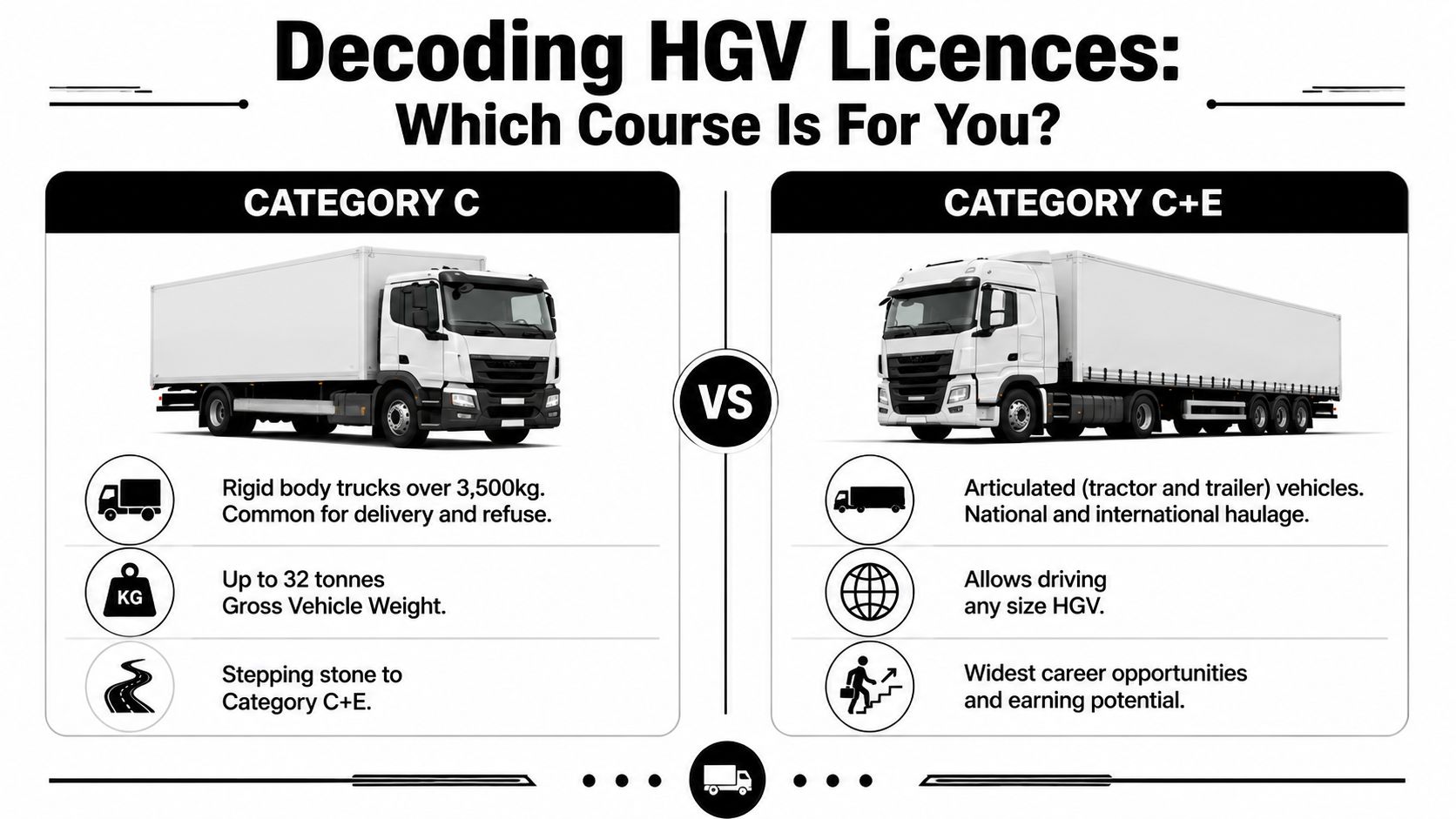
Decoding HGV Licences Which Course Is for You
The licence question trips people up because the names are technical, but the difference is simple. Each category opens a different type of work.
C1 for smaller specialist vehicle roles
C1 covers vehicles above standard car weight and up to the lighter end of the commercial range. In practice, this licence often matters most for people aiming at ambulance service roles, patient transport, and certain specialist van or support-vehicle jobs.
This route suits people who already know they need C1 for a specific employer or profession. It's not usually the first choice for someone who wants broad haulage options. If your goal is mainstream freight work, you'll often outgrow C1 quickly.
Category C for rigid lorries
Category C lets you drive rigid HGVs. These are the vehicles where the cab and body are one unit, not a tractor unit pulling a separate trailer. This category fits a lot of real-world work in Hertfordshire, including local delivery, builders' merchants, refuse, and general distribution.
For many learners, Category C is the first serious entry point because it gives access to proper HGV roles without the added complexity of artic handling. It also gives you a clear progression route if you later decide to move up.
A useful way to think about it is this:
Licence
Best for
Typical fit
C1
Smaller specialist commercial vehicles
Ambulance and support roles
Category C
Rigid lorries
Delivery, refuse, construction supply
C+E
Articulated combinations
Long-distance haulage and widest HGV access
C+E for the widest job range
C+E is the category that allows you to drive articulated combinations and gives you the broadest commercial driving scope. If you already know you want artic work, national haulage, supermarket trunking, or the most flexible long-term licence, this is the category people usually have in mind.
It also carries a training reality that's worth being honest about. It demands stronger spatial awareness, cleaner mirror work, more disciplined road positioning, and better trailer judgement. Learners who do best here usually arrive organised, coachable, and calm.
If your career goal is broad and long-term, C+E usually gives you the most room to move.
Fast-track courses and who they suit
In Hertfordshire, intensive options are common. A local provider advertises Cat C, C1, C+E and C1+E training, with some fast-track options completed in as little as 4 days, while another local school markets C+E training in as little as 6 days according to local fast-track course information for Hertfordshire.
That doesn't mean these courses are easy. It means they are concentrated. They work best for learners who already drive well, take feedback quickly, and can stay mentally switched on for several days in a row. They work less well for people who need a slower build-up or who haven't yet developed strong driving discipline in a car.
If you're still weighing the legal and practical entry points, this guide to HGV licence requirements helps clarify what you need in place before booking the next stage.
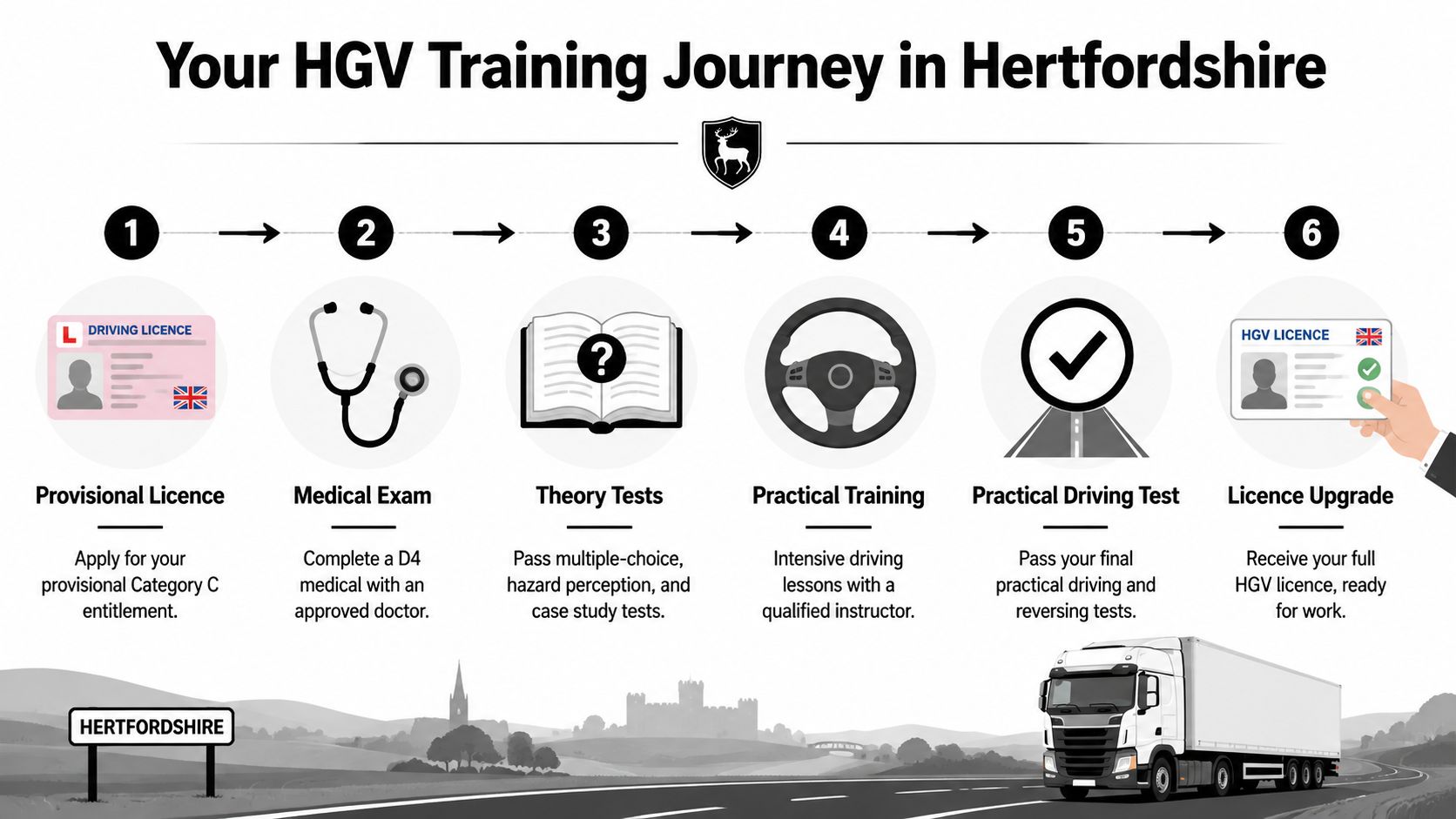
The Complete HGV Training Journey in Hertfordshire
The process is easier once you stop seeing it as one big hurdle. It's a chain. Each link affects the next one.
A lot of delays in HGV training in Hertfordshire happen before anyone gets behind the wheel. The paperwork stage sets the pace.
Start with the medical and provisional
The first job is your D4 medical and your provisional entitlement paperwork. In Hertfordshire, provisional entitlement usually arrives in 7 to 10 business days, and theory retakes can be booked after a 3-day wait if you fail part of the test.
The operational point is more important than the numbers. If your medical paperwork is delayed, the whole sequence shifts. Theory prep often stalls. Practical slots can't be lined up properly. Learners who deal with the D4 and DVLA forms early usually create the cleanest timeline.
Then move into theory preparation
After the provisional is in place, theory becomes the next gate. This stage isn't just box-ticking. It trains you to think like a professional driver rather than a car driver.
Most learners need to prepare for:
Multiple choice theory
Hazard perception
Case-study style CPC content where relevant
Candidates often underestimate this part. That's a mistake. If you rush theory and fail, your practical schedule can become fragmented. It's better to build momentum here than repair delays later.
For training managers and operators, the same sequencing discipline matters at a wider level. If you work in a business context, this overview of how ELDT impacts your fleet is useful for understanding how structured entry-level training affects planning, safety, and compliance thinking.
Practical training is where habits are rebuilt
By the time you reach practical tuition, the focus changes. Instructors are no longer asking whether you know the rules. They're watching whether you can apply them consistently in a large vehicle under pressure.
This stage usually covers:
Vehicle familiarisation so the cab, controls, mirrors, and dimensions stop feeling foreign
Road driving with attention to observation, positioning, speed management, and planning ahead
Manoeuvres such as reversing, and for some categories coupling and uncoupling work
That's why intensive training works for some people and not for others. It compresses learning, but it also demands concentration. One poor habit repeated all day becomes harder to undo the next morning.
Here's a practical way to judge your readiness for a short course:
Good fit for intensive training: You already drive calmly, read the road well, and take correction without overthinking.
Less ideal for intensive training: You panic after mistakes, steer late, or struggle to plan several seconds ahead.
A short visual walk-through can help the process feel more real before you book dates:
The final test stage
The final practical assessment usually separates into the off-road and on-road elements people often refer to as Module 3a and 3b. By that point, the goal isn't flashy driving. It's controlled, legal, predictable driving.
Smooth beats brave. Examiners want safe decisions made early, not dramatic recoveries made late.
That mindset changes results. The best candidates don't try to impress. They show they can be trusted with a commercial vehicle.
Advanced Skills and Specialist HGV Qualifications
Passing your first HGV test gets you into the industry. Specialist tickets shape what kind of industry career you can build afterwards.
Some drivers stay with general haulage and do very well. Others widen their options by adding qualifications that make them useful in more niche settings. That second route often gives you more variety and can move you out of standard trunking or delivery-only work.
ADR for regulated loads
ADR matters if you want to carry hazardous goods. That can include fuel, chemicals, gases, and other regulated loads. It's a more compliance-heavy environment, and it suits drivers who are methodical and comfortable following exact procedures.
The value of ADR isn't only that it's specialist. It's that it opens doors to employers who need a stricter standard of handling, paperwork awareness, and safety behaviour.
HIAB for construction and merchant work
HIAB training focuses on using a lorry-mounted crane. This is especially relevant for builders' merchants, site deliveries, utilities, and jobs where the driver also takes responsibility for unloading materials.
That role can suit people who enjoy more involved work than pure driving. You're not just moving the vehicle. You're helping control the delivery process at the point of drop.
Telehandler and mixed-site work
A telehandler ticket sits slightly outside pure HGV driving, but it can still be a smart addition for people moving into construction-adjacent roles. It shows employers you can handle plant equipment safely and adapt to site environments.
That's often the key difference between a basic licence holder and a driver who gets considered for broader work. The second person isn't just mobile. They're operationally useful.
Career move: If you already know the sector you want, choose specialist training that matches the load, site, or equipment used in that sector.
The key is not to collect tickets at random. Add qualifications that support the work you want to do.
Navigating HGV Training Costs and Funding in 2026
Cost is where many good candidates hesitate. Fair enough. You need to know whether you're looking at a private expense, a funded route, or a work-based option before you commit your time.
The most important point is that funding for HGV training in Hertfordshire isn't one single scheme. It depends on your age, location, work situation, and the route you choose.
The route many learners should check first
In England, HGV driver Skills Bootcamps are free training courses that can last up to 16 weeks. They're open to people aged 19 or older with a full category B car licence, and the scheme covers core entry costs including the provisional licence, the medical exam, and all four Driver CPC tests plus one re-sit per test, according to the official HGV Skills Bootcamps guidance.
That's a major funding route for Hertfordshire learners because it answers the practical question many course pages ignore. Who pays for the early mandatory parts of the process?
If you're eligible, this route can remove the biggest barrier at the start. It also gives career changers a clearer way to test whether the industry fits them without absorbing every upfront cost personally.
Other ways training gets funded
Not everyone will go through a bootcamp. Other routes can still make training achievable.
Apprenticeships: These can be a strong fit if you want to earn while training and join an employer-led route.
Vocational qualifications: Some learners may be able to access partial support depending on where they live and how the training is structured.
Employer sponsorship: Some firms will fund or part-fund training when they need to build their own driver pipeline.
Payment plans: Some coordinators and schools spread the cost over time instead of requiring one lump sum.
If you want a practical overview of these options, including routes that may reduce what you pay directly, this page on funding for HGV training is a useful starting point.
What to ask before paying anything
Before you put down a deposit, ask direct questions:
Question
Why it matters
What exactly is included?
Some quotes cover more of the process than others
Are tests and retests part of the package?
Small exclusions can become expensive later
Is this the right route for my work goal?
Cheap training is poor value if it's the wrong category
Can I access funded training instead?
You don't want to self-fund unnecessarily
The mistake I see most often is learners shopping only by headline price. That can backfire. A cheaper course that leaves out key steps, admin support, or suitable scheduling can end up costing more in delays and retests.
Finding the Right Training Provider in Hertfordshire
A good provider doesn't just sell you a date. They help you move through the process in the right order, with the right vehicle category, and without admin gaps that slow everything down.
That matters even more because funding and route options vary. GOV.UK makes clear that HGV training routes can include Skills Bootcamps, apprenticeships, and vocational qualifications, and that the available option depends on where you live, as explained in the government's HGV training overview. A provider who can explain those routes clearly is doing something useful. A provider who can only quote a course fee is giving you half the picture.
What to look for
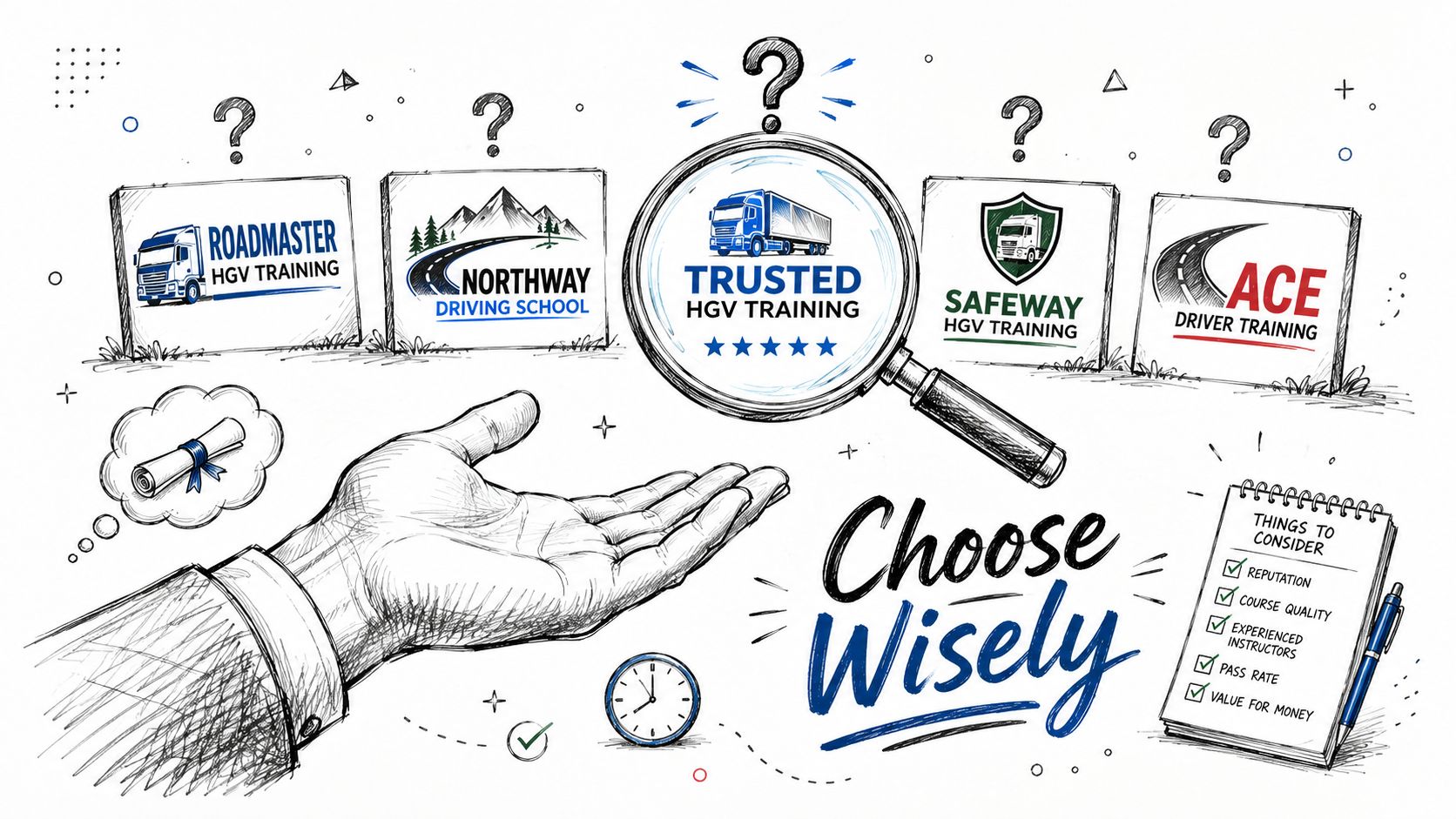
Use a short checklist when comparing HGV training in Hertfordshire:
Clear licence guidance: They should ask what job you want, not just what course you want.
Admin support: Medical booking, paperwork, theory planning, and practical scheduling should feel organised.
Suitable vehicles and instructors: The training vehicle should match the licence you're taking, and the instruction should be DVSA-aligned and test-focused.
Local practical understanding: They should know the roads, manoeuvre standards, and common issues learners face around the training and test area.
Straight answers on funding: If support may be available, they should tell you before pushing self-funded booking.
Why the coordinator model suits many learners
Some people prefer dealing directly with one local school. Others benefit from a coordinator model that manages the stages and books training through a wider network. That can be useful if your priority is getting the documentation, theory, training, and test sequence lined up cleanly.
One option in that category is HGV Learning, which coordinates HGV training bookings, medical and documentation support, theory preparation, and locally arranged practical training through its network. That model can suit learners who want one point of contact rather than piecing each stage together themselves.
For a broader sense of how to assess any training school, even outside the UK market, this review-style example from A-1 Driving School's Atlanta truck school review is useful because it shows the sort of factors people should compare rather than choosing on price alone.
Launching Your HGV Driving Career in Hertfordshire
The day you pass isn't the finish line. It's the handover point from training into work.
In Hertfordshire, new drivers usually look first at roles tied to distribution, retail supply, builders' merchants, utilities support, waste operations, and general haulage. The exact starting point depends on your licence, your confidence level, and whether you've added any specialist tickets that make you more useful to a recruiter.
Some learners move straight into rigid work to build road time and routine. Others already know they want artic roles and apply as soon as the licence is in place. Both routes can work. The better choice is the one that matches your current skill level and lets you build clean experience, not the one that only sounds most impressive.
Why structured pathways matter after the test
A strong training route helps because it doesn't stop at the pass certificate. It points you toward realistic first jobs, helps you understand what employers expect, and stops you applying blindly for roles you're not yet set up to do well.
That's one reason funded pathways have become significant at a national level. The Driver Academy Group's HGV Skills Bootcamp programme launched in December 2021 and had attracted over 30,000 learners, with over 8,000 still in the pipeline at the time reported. The same report noted delivery at 60 locations across England, and that completers can gain a Category C or C+E licence, upgrade from C to C+E, and access specialist qualifications such as ADR, according to Logistics UK reporting on the Skills Bootcamp pipeline.
That matters because it shows a route from entry to employability, not just from enquiry to test day.
If you're serious about changing direction, start with the next concrete action. Check the licence you need. Check whether you qualify for funded support. Get the medical and paperwork moving. That's how a vague plan turns into a working career path.
If you want a clear starting point, HGV Learning can help you map the right licence, understand funding options, and organise the steps from medical paperwork through to practical training and test booking.