You might be reading this on a lunch break, after another long shift, or late in the evening while searching for a career that feels more solid than the one you're in now. Around Croydon, that's a common starting point. People see lorries on the A23, around Purley Way, or heading towards the M25 and wonder if driving one could become a real job, not just an idea they keep putting off.
It can. The confusing part is the process.
Individuals often don't get stuck because they can't learn to drive an HGV. They get stuck because the route to the licence looks full of forms, medicals, theory tests, CPC rules, training days, and test bookings. That's where people lose confidence. They think they're missing something important before they've even started.
You're not missing anything. You just need the steps in the right order, plus a realistic view of how HGV training in Croydon works on the ground.
Why an HGV Licence Opens up a New Career in Croydon
Croydon is a practical place to train for a practical career. You're close to major roads, commercial routes, distribution traffic, construction activity, and the wider South London network. That matters because HGV driving isn't some distant industry. It's built into everyday life here.
For many career changers, the attraction is simple. Driving work is tangible. You train for a clear outcome, gain a licence with recognised value, and move towards roles that keep shops stocked, sites supplied, and services running. If you like the idea of work with a defined purpose, HGV driving often makes more sense than another office role that feels vague or unstable.
Why demand stays strong
One of the clearest reasons demand remains strong is the age profile of the workforce. The average HGV driver age is 55, and less than 1% of the workforce is under 25, according to Motor Transport's report on RHA research. In plain terms, many experienced drivers are getting closer to retirement, and employers need new people coming through.
That matters in Croydon because local training routes aren't only for people already in transport. They're also a route in for complete beginners.
Practical rule: If you're changing careers, you're not “late” to HGV training. Many new starters come from security, retail, warehouse work, construction support, customer service, or delivery roles.
Why the process feels harder than it is
People often assume the hard part is the driving itself. In reality, the stressful bit is usually the admin. Knowing what to book first, when to apply, which licence category fits your goals, and how test timing affects the whole plan makes a bigger difference than most beginners expect.
A good HGV route feels less like a leap and more like a checklist:
Get medically cleared
Apply for the right provisional entitlement
Pass the required theory elements
Train in the right vehicle category
Take the practical test when your slot is ready
That's manageable when it's organised properly.
Croydon learners also have a real advantage. You can train locally, ask local questions, and plan around local roads and test logistics instead of trying to piece together generic national advice that doesn't reflect what happens in South London.
Choosing the Right HGV Licence for Your Goals
Before you book anything, you need to know which licence matches the work you want. Think of HGV licence categories as different sets of keys. Each one opens a different type of vehicle and a different range of jobs.
The main licence categories
Licence
Best for
Typical vehicle type
C1
People who need a smaller commercial vehicle licence
Vehicles between 3.5 and 7.5 tonnes
C1+E
Drivers using a C1 vehicle with a heavier trailer
Small truck and trailer combination
Category C
Most new HGV drivers entering rigid vehicle work
Large rigid trucks
C+E
Drivers aiming for articulated or drawbar work
Articulated HGVs
Which one suits you
C1 is often the most relevant route if you're looking at ambulance service roles, some medical transport work, or smaller specialist delivery vehicles. It's not the route commonly associated with wanting to become a lorry driver, but for the right job it's exactly the right licence.
Category C is the standard choice for many beginners. If you can picture yourself driving a refuse lorry, a tipper, a large box vehicle, a supermarket rigid, or a construction supply truck, this is usually the category people start with.
C+E gives you access to articulated combinations and generally opens the widest range of driving roles. If your long-term plan is full haulage flexibility, this is often the end goal.
A simple way to decide is this. If your target job uses a rigid vehicle, think Category C. If it uses an artic, think C+E. If it's a smaller specialist vehicle, look closely at C1.
What about ADR and HIAB
Some jobs need more than the base HGV licence.
ADR is for drivers carrying hazardous goods.
HIAB is for vehicles with lorry-mounted cranes.
Telehandler-related training may matter if you're working around building sites and plant operations rather than standard road haulage alone.
These don't replace your HGV licence. They sit on top of it and make you suitable for more specialised work.
A career choice with staying power
For someone in Croydon trying to make a sensible career move, this decision matters because the licence you choose affects your earning path, your daily routine, and the kind of employers you can approach. It also feeds into a wider workforce need. As noted earlier, the sector is dealing with an ageing driver base, and that makes well-planned entry routes more important for employers as well as learners.
If you're unsure, don't choose by guesswork. Choose by the type of vehicle you want to drive on an ordinary Tuesday morning.
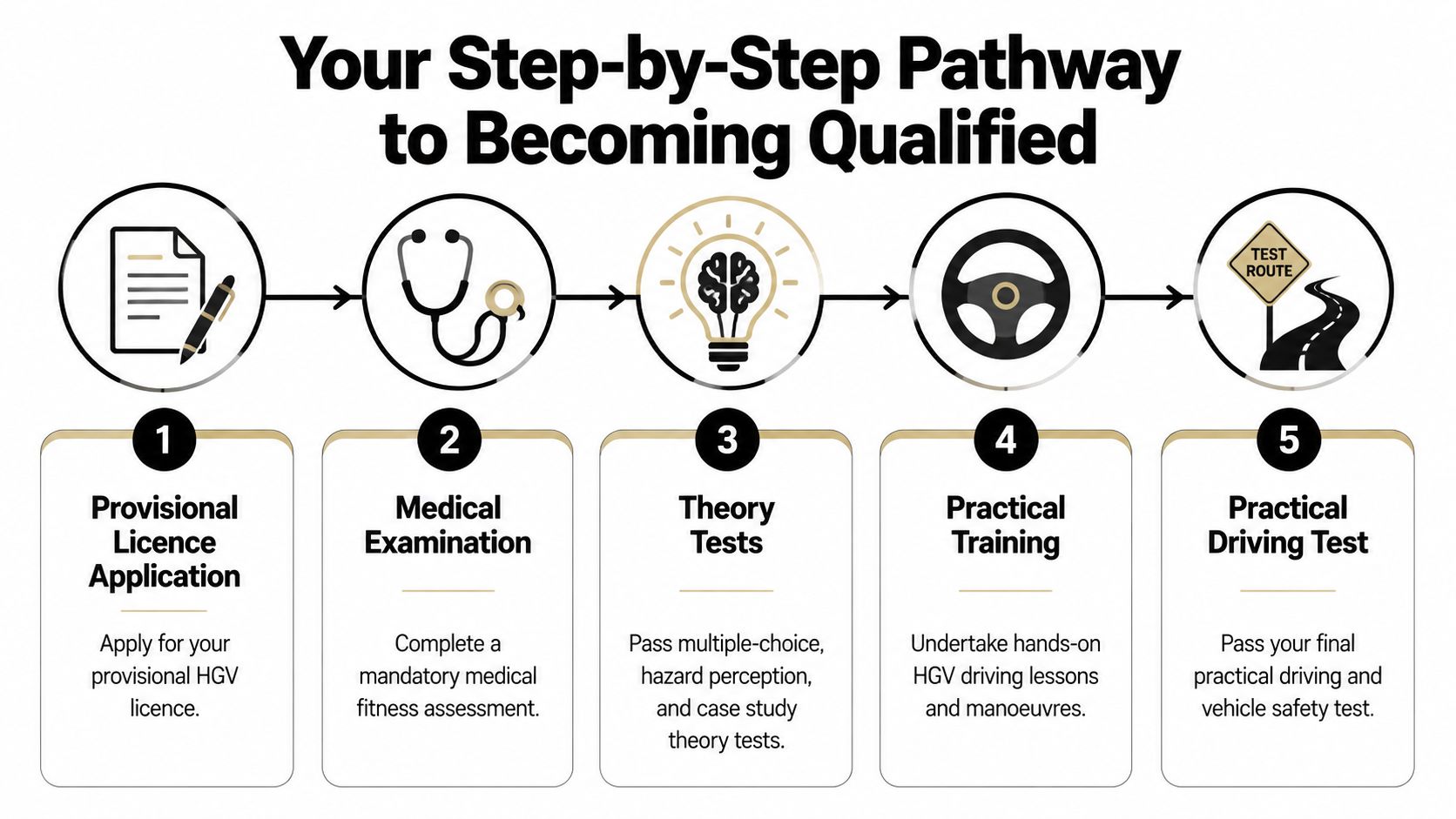
Your Step-by-Step Pathway to Becoming Qualified
The official route is easier to follow when you stop looking at it as one big task. It's a chain. Each link needs to be in place before the next one works.
The key legal point is this. Driver CPC is mandatory for professional HGV drivers in the UK, and the process starts with a car licence, a medical, and provisional HGV entitlement before commercial driving can begin, as set out on the GOV.UK HGV training guidance.
Stage one and two
Start with your licence status and medical
You need a full UK car licence first. Then comes the medical assessment. This checks whether you meet the fitness standards for HGV driving. It's not there to catch you out. It's there because you'll be responsible for a large commercial vehicle on public roads.
Apply for your provisional HGV entitlement
Once the medical side is in hand, you can move on to the provisional application. Many learners first hear about the D2 and D4 forms at this point. That often sounds intimidating, but it's just paperwork that allows you to move into the HGV licensing pathway properly.
Stage three
The theory stage is where many people worry needlessly. They imagine it as one exam. It's better to think of it as a set of checks covering knowledge, awareness, and professional judgement.
That normally includes:
Multiple-choice theory for rules, signs, vehicle knowledge, and safety
Hazard perception to show you can spot developing risks
Case study style CPC theory elements linked to real working situations
Practical demonstration elements linked to professional competence
If you like structure, this is usually the stage where good study habits matter most. A few short sessions each week often work better than trying to cram everything into one weekend.
For a fuller overview of the licence route, the guide on how to become an HGV driver is useful for checking the sequence before you book anything.
A quick visual can help fix the process in your mind:
Stage four and five
Once the admin and theory stages are out of the way, practical training starts to feel like the bit people expected all along. During this stage, you learn vehicle control, road positioning, observation routines, reversing, and safety checks in the vehicle category you've chosen.
Then comes the practical test. That isn't only about smooth driving. Examiners also want to see safe routines, steady judgement, and proper control under normal road conditions.
Most learners do better once they realise the test isn't asking for perfection. It's asking for a safe, consistent standard.
Navigating HGV Training and Testing in the Croydon Area
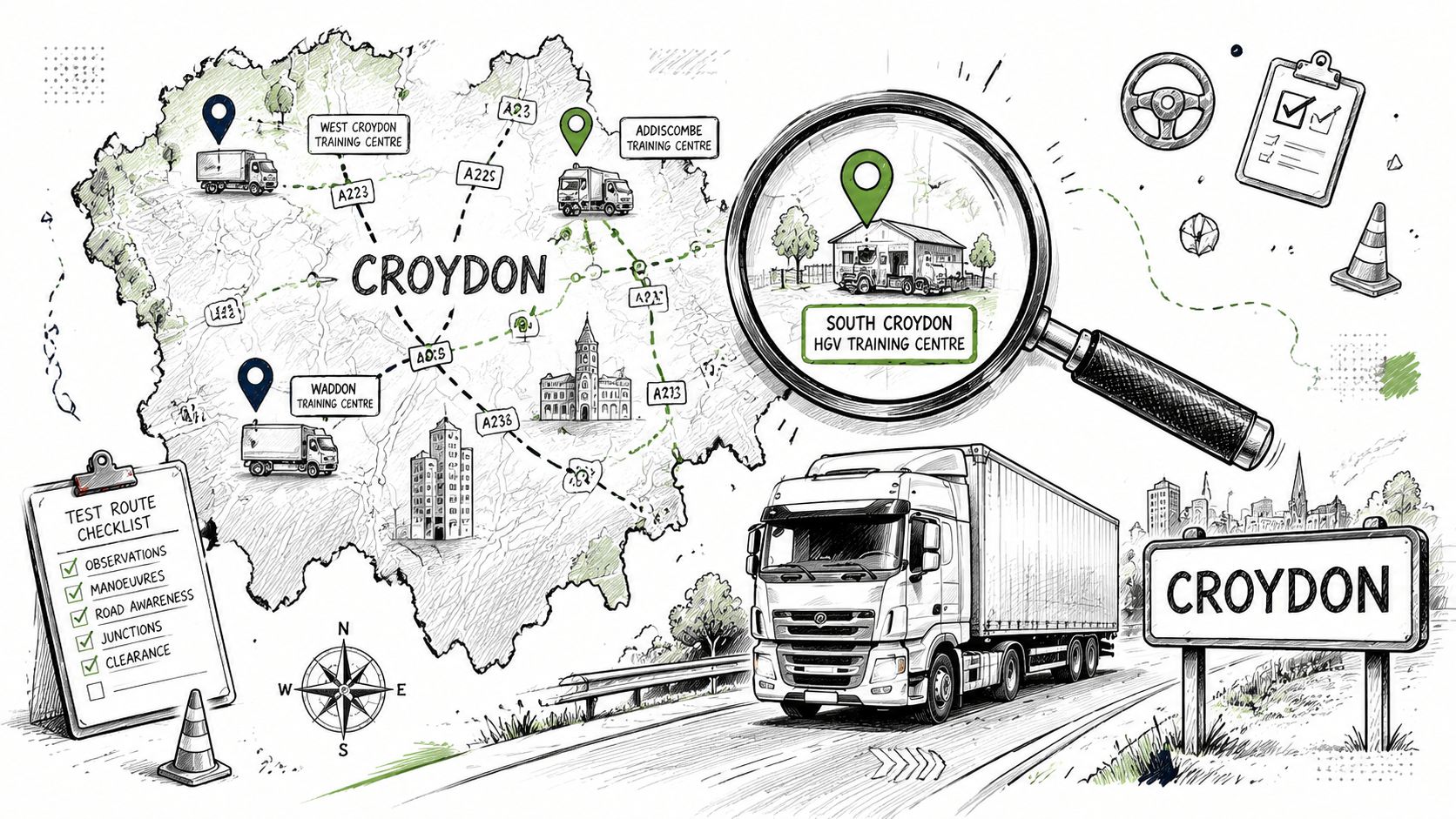
HGV training in Croydon has its own pattern. You'll often train locally, but the practical test may not happen in the same place. That catches people out when they assume everything will be centred around one familiar patch of road.
Some Croydon-based training providers use the Guildford Driving Test Centre for the practical test rather than a closer option. That local-to-Guildford pattern is worth knowing about, since it changes how smart learners prepare and plan their travel time.
Train for transferable skills
If you only learn one route, one set of junctions, and one familiar rhythm of local traffic, you can feel unsettled on test day. That's why strong HGV training in Croydon should focus on transferable standards:
Mirror discipline so observation stays automatic
Speed management so you don't chase the road
Reversing precision for controlled manoeuvres
Coupling and safety awareness where relevant to vehicle type
Lane positioning that works on unfamiliar roads, not just known ones
Local advice: Don't ask, “Will I practise the exact test route?” Ask, “Will I be ready for any suitable test route?”
The test backlog issue people rarely mention
This is the part many marketing pages glide past. Finishing your training doesn't always mean you'll get an immediate practical test date. In and around South London, test scheduling can shape your whole timeline.
Some learners train first and only then discover the available practical slot isn't as close as they expected. That's frustrating if you've arranged time off work, childcare, or temporary transport around an assumed date.
A better approach is to plan with flexibility. Ask direct questions:
Question to ask a training provider
Why it matters
How are practical test dates booked?
You need to know whether dates are secured early or later in the process
What happens if the nearest slot isn't ideal?
This affects your waiting time and training rhythm
Can training be aligned to the available test window?
Good sequencing reduces stress and wasted time
Are alternative test areas ever used?
Some learners prefer options if local demand is tight
If you're moving house, clearing out a room before training starts, or juggling a family move while studying, practical local services can help reduce the pressure. Some readers in Croydon also look for storage for university students in Croydon when they need temporary space during a transition period.
For people comparing local options, the nearby HGV driver training guide can help you think more clearly about training base, travel, and test logistics rather than choosing on price alone.
Understanding HGV Training Costs Timelines and Funding
This is usually the first question people ask themselves, even if they don't say it out loud. Can I afford to do this, and how long will it take before I'm qualified?
The honest answer is that cost depends on the licence path, what's included, and whether you qualify for funding. Timelines depend on paperwork speed, theory readiness, training availability, and test bookings. So if someone gives you a neat one-size-fits-all answer in under a minute, they're probably skipping the awkward details.
What you're usually paying for
When people think about training cost, they often focus only on driving lessons. In reality, the full route may include:
Medical and admin support
Provisional application guidance
Theory preparation materials
Practical training in the vehicle category
Test booking support
Driver CPC-related elements for professional driving
That's why comparing packages can be tricky. One quote may look lower, but it might leave out parts you'll still need to arrange later.
How long the process really feels
Some Croydon learners move through quickly because they already have their documents ready, revise consistently, and can train when dates are available. Others hit delays because one missing form, one postponed medical, or one awkward theory booking shifts everything along.
Government guidance says Skills Bootcamps for HGV driving can be free, can last up to 16 weeks, and were backed by £34 million after funding increased from £17 million, according to the Department for Education's HGV bootcamp guidance. For Croydon residents, that matters because national funding routes often shape what local training access looks like.
Free training doesn't always mean instant training. You still need the paperwork, eligibility checks, and booking sequence lined up properly.
Funding routes worth checking
If you're employed, self-funding may be one route. Some providers also offer staged payment options, which can make the process easier to budget for month by month rather than all at once.
If you're unemployed, changing careers, or on Universal Credit, it's worth looking closely at funded routes before paying privately. The bootcamp pathway can cover the full route for eligible learners, but you need to ask clear questions about eligibility and document requirements.
The funding options for HGV training page is a useful starting point if you want to understand the difference between private payment and supported routes without getting lost in jargon.
A realistic planning mindset
Instead of asking, “How fast can I finish?”, ask better questions:
Have I got my documents ready?
Do I know which licence category I need?
Can I study steadily for theory?
Am I choosing a package that includes the full pathway?
Have I allowed for booking gaps rather than assuming everything will happen back-to-back?
That mindset saves a lot of frustration. HGV training in Croydon is very achievable, but the smoothest journeys usually come from realistic planning, not optimistic guessing.
From Passing Your Test to Finding Your First HGV Job
Passing the test is a milestone, but it isn't the whole story. What matters next is turning that pass into regular work and keeping your qualifications current.
The first thing to keep in view is your Driver CPC. For professional driving, it isn't just a formality. It's part of staying compliant and employable. If you're new to the industry, get into the habit early of treating licence status, CPC requirements, and job readiness as one package, not three separate things.
Where new drivers in Croydon often look
Newly qualified drivers around Croydon often target a mix of employers rather than only one type. That can include:
Logistics firms moving retail, pallet, or general freight
Construction suppliers needing rigid vehicle drivers
Utilities and infrastructure contractors using specialist fleet vehicles
Public service and support roles where C1 may be relevant
Local delivery operations that value route knowledge and reliability
Some drivers stay employed and build experience inside a larger company. Others later move into agency work or self-employed arrangements, depending on the role and the vehicle type. If you ever reach that stage and want to understand the business setup side, this 2026 guide for UK business types is a practical comparison of limited company and sole trader options.
What helps you get hired faster
A licence gets attention. A professional presentation gets callbacks.
Employers usually want to see that you can do the basics well:
What employers look for
What that means for you
Safe attitude
Calm, careful, and compliant from day one
Reliable admin
Documents ready, CPC understood, good communication
Vehicle awareness
Daily checks and road safety taken seriously
Work flexibility
Openness to shifts, routes, or starter roles
Your first job doesn't need to be your forever job. It needs to give you clean experience, good habits, and confidence in the cab.
That's often a significant turning point. Once you've got a licence, some experience, and a steady work record, the job market starts to open up in a more practical way.
How to Book Your Croydon HGV Training and Start Today
If you've read this far, you probably don't need more motivation. You need a clean first step.
That first step is to stop treating the process like one giant decision. You don't need to solve the whole journey tonight. You only need to begin with the right licence choice and the right booking sequence.
A training coordinator can help by handling the moving parts in the right order. That may include arranging the medical stage, helping with provisional paperwork, supplying theory materials, tracking progress, and matching your practical training to available dates. HGV Learning is one example of that model, coordinating documentation, theory support, practical training, and test booking across UK locations.
What to do before you enquire
Have these points ready:
Your current licence status
The category you think you need
Any job goal you already have in mind
Your general availability for training
Whether you want private payment or funded route guidance
That makes the first conversation much more useful.
What a good first contact should feel like
You shouldn't leave the call more confused than when you started. You should come away knowing:
what licence fits your goal
what happens first
what documents you need
what sort of timeline is realistic
how test availability may affect planning
That's the standard to look for. Clear answers. No mystery. No pressure. Just a proper route into HGV training in Croydon.
If you're ready to take the first step, HGV Learning can help you map out the full process, from medical and provisional paperwork through theory, practical training, and test booking. It's a straightforward way to turn early interest into an organised plan.