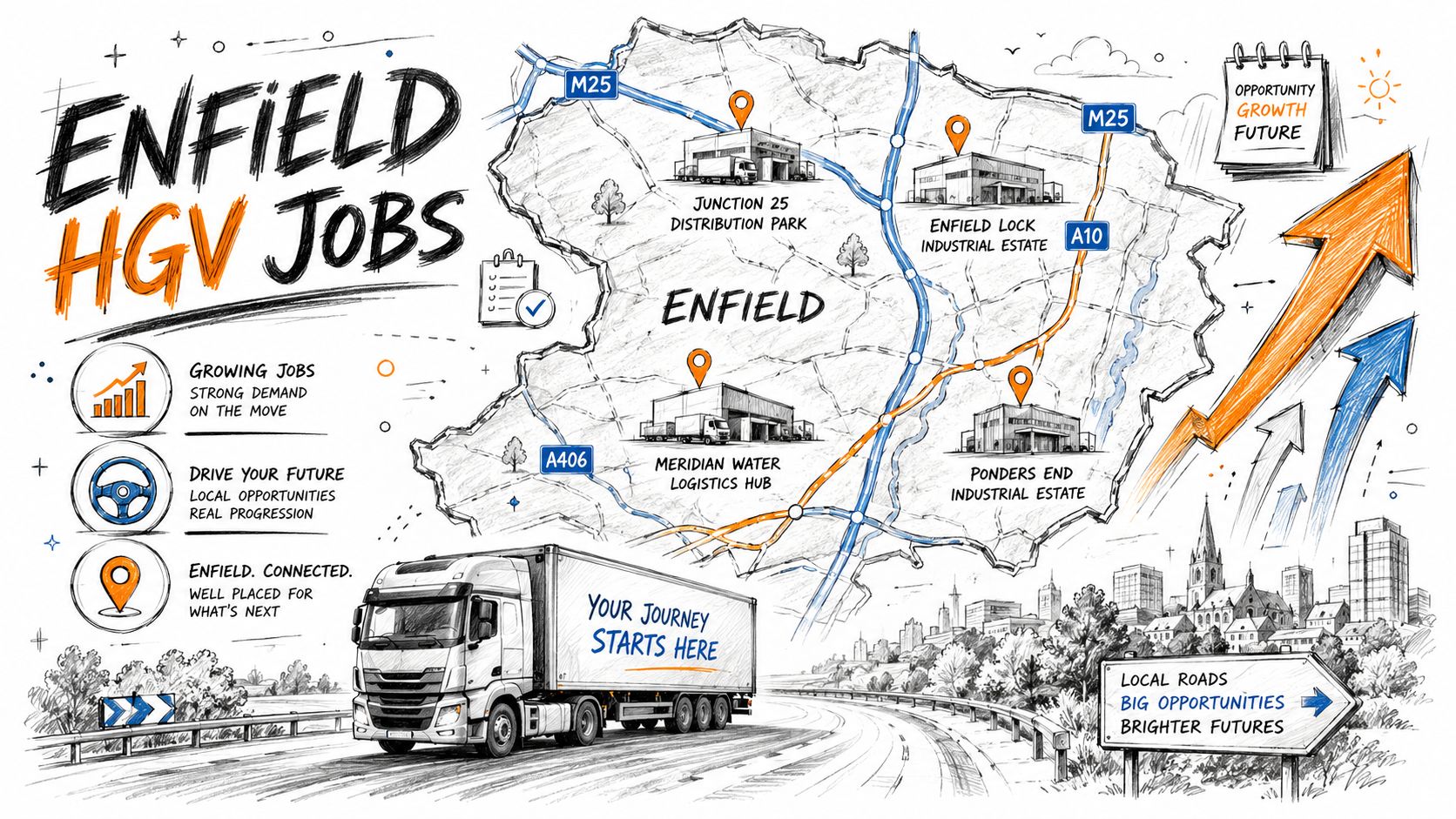
You might be at that point where your current job feels stuck. The hours don't suit you, the pay has stopped moving, or you want work that feels more solid than another office or warehouse role with no clear next step. Around Enfield, you don't have to look far to see what keeps the area moving. Rigid lorries, artics, builders' merchants, refuse wagons, recovery trucks, supermarket deliveries. This is skilled work, and it isn't going away.
That's why HGV driving appeals to so many people locally. It offers a route into a job with a clear licence path, a recognised qualification, and real demand nearby. But the process can look messy when you first search online. You'll see licence categories, CPC modules, medical forms, theory tests and conflicting advice about how long it all takes.
Most of the confusion comes from one problem. General guides explain the national process, but they don't explain how HGV training in Enfield works on the ground. Enfield has its own training and testing rhythm. If you understand that early, you make better decisions, avoid delays, and choose the right licence first time.
Starting Your Journey as an HGV Driver in Enfield
A lot of learners start in the same place. They've got a full car licence, they've driven vans or worked around transport, and they know they want something more structured. Some want local multidrop or municipal work. Others have their eye on motorway work and long-distance freight. Quite a few just want a trade they can build on.
In Enfield, that decision makes practical sense. You're surrounded by the kind of commercial driving that shows you what the job really involves. You can see the difference between a 7.5-tonne vehicle, a rigid lorry and an artic just by watching the roads around the borough and the wider North London freight belt.
The first thing to get clear is this. Passing an HGV test is only one part of becoming employable. You also need to choose the right licence category, plan the paperwork in the right order, and understand where learners usually lose time.
Practical rule: The people who progress fastest aren't always the best drivers at the start. They're the ones who choose the right licence early and keep the process moving.
That matters more in Enfield than many learners realise. Local access is a strength, but it doesn't remove the need to plan. If you're aiming for a job start date, employer onboarding, or a move from van work into larger vehicles, you need a realistic route from first enquiry to test pass.
Who HGV training suits best
HGV training usually fits people who want one of these outcomes:
A career change: Moving out of retail, warehouse, security, facilities, or office work into a more defined skilled role.
Licence progression: Going from car or van driving into C1, Cat C or C+E work.
Sector-specific work: Preparing for construction supply, refuse, recovery, emergency service driving or trunking.
Longer-term progression: Starting with a core licence, then adding specialist tickets later.
If that sounds like you, Enfield is a good place to start. The key is to treat the process like a proper project, not a casual booking.
Why Enfield Is a Smart Choice for HGV Training
A learner in Enfield can sort the paperwork, train on familiar North London roads, reach the DVSA test route without a long cross-city haul, and start applying for nearby driving work in the same part of the capital. That practical overlap is what makes the borough a sensible place to train.
A location built around commercial transport
Enfield sits on a working freight corridor, not on the edge of one. You have the A10, the North Circular, quick access towards the M25, and constant movement between depots, industrial estates, retail distribution points and construction supply yards. For training, that matters because learners need exposure to the kind of road conditions they are likely to face once they pass, including busy roundabouts, lane discipline under pressure, urban restrictions, and mixed traffic between local roads and faster routes.
The borough is also served by the DVSA test centre at Stockingswater Lane, and local providers run C1, Category C and C+E training from the area. In practical terms, it means Enfield works for people aiming at different stages of the licence ladder, whether they want 7.5 tonne work, rigid vehicles, or artic jobs later on.
That local spread helps with timing too. If training, assessment, and test logistics are all built around the same area, there is usually less wasted time than learners get when they book with a provider far from where they live or expect to work.
Training makes more sense when the jobs are nearby
One reason people delay booking is simple. They can see the cost of training, but they cannot always see the route into paid work clearly enough. Enfield is stronger than many areas on that point because the demand is visible on the ground. You do not have to guess where the vehicles are used. You can see builders' merchants, municipal fleets, supermarket logistics, parcel operations and trunking traffic feeding in and out of North London every day.
That changes the decision. Training feels less abstract when the local economy already uses the licence you are working towards.
I also find learners make better category choices in Enfield because the job types are easier to map to real employers nearby. Someone heading for refuse, recovery or merchant work can judge Category C properly. Someone who wants depot-to-depot work can see why C+E may be worth doing first if budget and timing allow.
Why local familiarity saves time
Training near the test area does not guarantee a pass, and it should not be sold that way. A poor driver on familiar roads is still a poor driver. But local familiarity does remove avoidable pressure.
Learners who train around Enfield and the surrounding North London routes usually settle faster into the pace of the area. They get used to the lane choices, the traffic build-up points, the industrial access roads and the general rhythm of commercial driving in this part of London. That leaves more headspace for observation, mirrors, positioning and examiner instructions.
There is a second benefit that people often miss. Enfield makes it easier to plan the whole process from enquiry to employment, because training providers, test access and likely first-job territory sit close together. From a coordinator's point of view, that usually leads to fewer delays, more realistic booking decisions, and a cleaner handover from passing the test to applying for work.
Choosing the Right HGV Licence for Your Career
The most common mistake I see is simple. People ask for “an HGV licence” as if there's only one. There isn't. Your first decision should be based on the vehicles you want to drive and the jobs you want to apply for afterwards.
What the main categories mean in practice
C1 is usually the starting point for people who need to drive larger vehicles that sit above standard van work but below full-size rigid lorries. Think ambulances and some specialist delivery or service vehicles.
Category C is the standard rigid-vehicle licence. If you picture a single-unit lorry used for building materials, refuse, recovery or many urban and regional delivery jobs, that's the territory.
Category C+E is the combination licence for articulated vehicles and drawbar combinations. If your goal is motorway work, trunking, depot-to-depot runs or the broadest range of haulage opportunities, this is usually the route that opens the most doors.
HGV licence categories at a glance
Licence Category
Vehicle Type
Maximum Weight
Common Jobs
C1
Larger light-heavy vehicle
3.5 to 7.5 tonnes
Ambulance driving, specialist service vehicles, some delivery roles
Category C
Rigid lorry
Over 3.5 tonnes
Refuse, recovery, builders' merchants, construction supply, local distribution
Category C+E
Articulated or drawbar combination
Articulated-combination class
Trunking, long-distance freight, motorway haulage, depot work
How to choose without wasting time
Start with the job, not the badge. If you know you want emergency service vehicle work or a role that specifically asks for C1, don't overcomplicate it. If you want broad rigid work around London and the Home Counties, Cat C is usually the sensible fit. If you already know you want artic work, plan for C+E.
Use these decision checks:
Look at actual vacancies: Read local adverts and note which licence categories employers keep asking for.
Match the vehicle to the workday: Urban multidrop and municipal roles feel very different from motorway trunking.
Think beyond the first job: Some learners only focus on getting licensed quickly, then realise they've limited their next move.
Ask what the employer really means: Some firms advertise for “Class 1” or “Class 2” rather than using the DVSA category wording.
The right licence is the one that fits the work you want six months after you pass, not just the quickest course you can book today.
A simple way to decide
If you're still unsure, ask yourself one question. Do you want to drive a rigid vehicle or a combination vehicle?
If the answer is rigid, you're probably looking at C1 or Category C depending on vehicle size and job type. If the answer is articulated or drawbar, you're heading toward C+E.
This choice shapes everything that follows. Training hours, vehicle familiarisation, test preparation and the jobs you can target all depend on it.
Your Step-by-Step Pathway to Qualification
A lot of Enfield learners reach this stage with the same concern. They can see the licence they want, but the process still looks like a pile of forms, tests and waiting time. In practice, it works better when you treat it as a sequence with a booking order. Get that order right, and the whole route becomes easier to control.
Step one and step two
The first part is paperwork, but it affects everything that follows.
Apply for your provisional entitlement. You need the right provisional HGV entitlement before practical training and test planning can be locked in properly. In Enfield, where test demand can shift quickly, there is no benefit in leaving this until the last minute.
Complete the medical. Delays often start here. Appointments get pushed back, forms come back incomplete, or drivers assume they can sort it later. They cannot. If the medical is not done properly, the rest of the training plan stalls.
Step three through step six
Once the provisional and medical are in hand, the route becomes more practical and easier to map out.
Prepare for Module 1. Initial Driver CPC includes theory and hazard perception at this stage. Drivers who have been on the road for years in cars often underestimate it, especially the theory side. HGV questions are more technical, and the pass standard is high enough that casual revision is a bad idea.
Take Module 2 if your route requires it. This is the case studies section of Initial Driver CPC. It tests judgement in work-based situations, not just memory. That matters because employers want drivers who can make sound decisions under pressure, not drivers who only know the wording of the handbook.
Here's a useful visual walkthrough before the practical stages ramp up:
Complete practical driver training. Weak planning becomes evident quickly. A short course can work well if the learner arrives prepared and the training days are booked around realistic test dates. A rushed course with poor familiarisation usually costs more in the long run because retests, extra training days and time off work add up.
Good practical training covers much more than gear changes and vehicle control. It should build mirror use, positioning, hazard reading, roundabout discipline, pace judgement and the habit of planning early on busy roads. Around Enfield, that local road awareness matters. You may train on mixed routes that quickly shift from congested urban sections to faster A-road driving, so drivers need to settle into the vehicle early.
Take Module 3 and Module 4. Module 3 is the practical driving test. Module 4 checks your practical safety knowledge, including topics such as vehicle checks, load security and safe working procedures around the vehicle. I tell learners to treat Module 4 as part of the job, not an add-on. Firms hiring around Enfield and the wider North London area care about drivers who can handle the vehicle safely before the wheels even start turning.
What catches learners out
The usual problems are predictable.
Weak theory preparation: Car experience helps with road sense, but it does not replace HGV-specific revision.
Poor sequencing: Medical, provisional, theory, training and test dates need to line up in the right order.
Leaving Module 4 too late: Safety questions are easier when they are practised alongside the practical course, not bolted on at the end.
Too little vehicle familiarisation: Drivers who settle into the cab early usually progress faster and drive more consistently on test.
Good HGV training builds test-standard driving, but it also builds work-standard habits. That is the part that helps you pass and start earning.
Planning Your Investment Costs Timelines and Booking
A lot of Enfield learners start with the same pressure point. They are not asking whether they can train. They are asking whether they can get qualified in time for a job start, a redundancy plan, or a switch out of van work before the next busy period. That is why cost and timing need planning together from day one.
Price matters, but the calendar usually decides how smoothly this goes.
In Enfield, booking pressure often shapes the whole plan
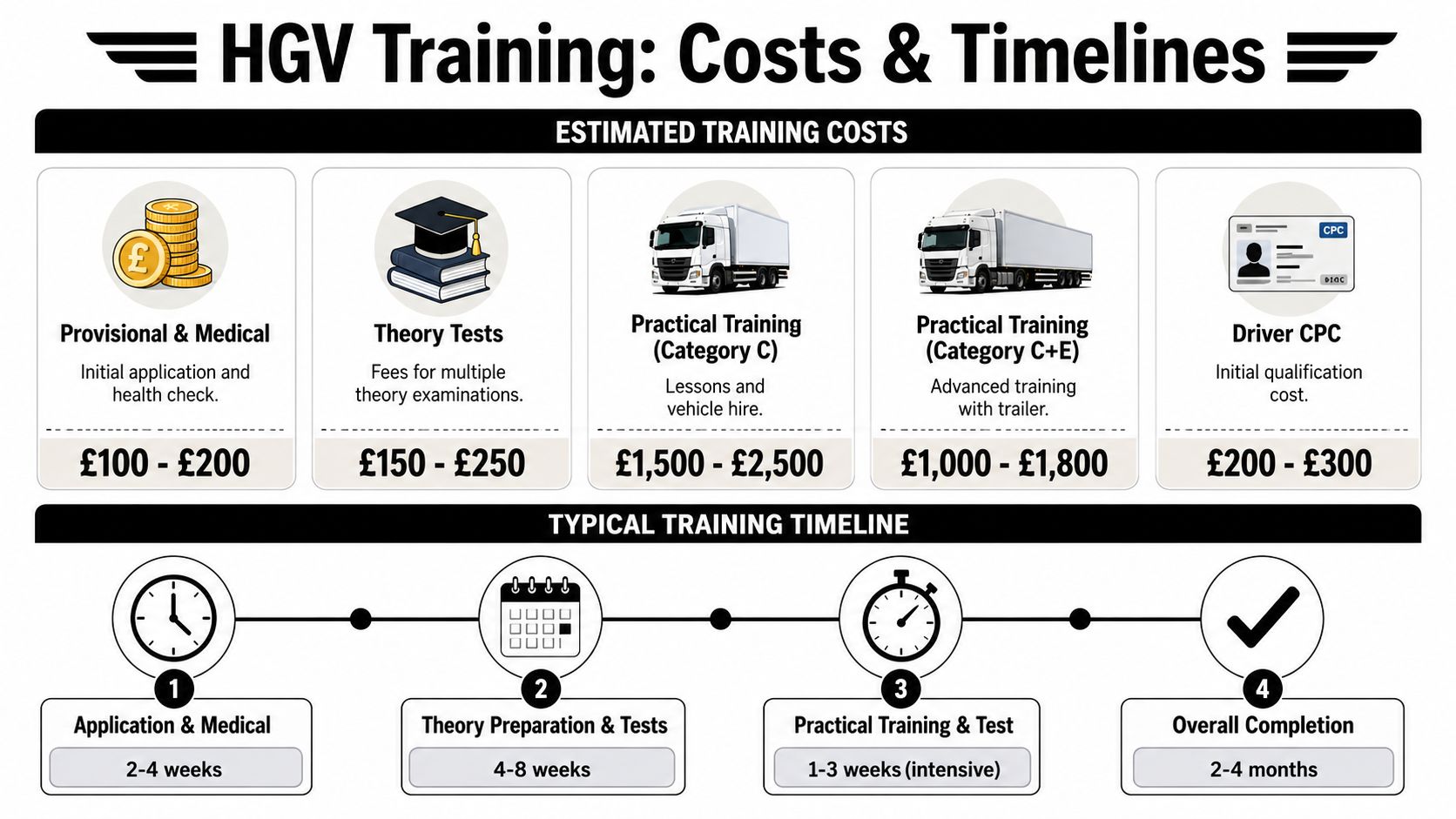
The driving course is only one part of the process. Learners can often expect the training days themselves to be short compared with the waiting time around medical paperwork, licence processing, theory availability, practical test dates and any retest gap if something slips.
That matters more in North London than many people realise. Enfield is a useful local option, but local demand means test availability can tighten quickly. A date that looks close today can move out once paperwork or theory is late. I tell learners to plan backwards from the date they want to be employable, not forwards from the day they first make an enquiry.
What usually affects the total cost
The advertised package price is only useful if you know what sits inside it. In Enfield, two quotes can look similar at first and lead to very different totals once booking support, theory materials, Module 4, retest fees or vehicle hire are added.
The practical trade-off is simple. A cheaper package can work if you are organised, available for bookings, and clear on every extra charge. A higher package price can be better value if the provider is handling the sequence properly and reducing the chance of delays that cost you more later.
The strongest plans leave room for normal delays. The weakest plans assume every form, every slot and every test will land first time.
A sensible booking approach looks like this:
Commit early once you know this is your route: Waiting for the perfect moment usually means losing the better dates.
Keep admin moving every week: Medicals, licence forms and theory bookings cause more hold-ups than the driving itself.
Stay flexible if you can: Learners who can take weekday or short-notice slots are often easier to place around Enfield.
Check who owns the sequence: One person or team should be responsible for tracking what happens next.
Budget for at least one bump in the road: Even strong candidates sometimes need a date change or a retest plan.
Questions worth asking before you book
A coordinator should answer these clearly, without vague sales talk.
Question
Why it matters
What exactly is included in the quoted price?
It shows whether theory help, training days, tests and Module 4 are actually covered.
Who books each stage?
Clear ownership prevents missed dates and crossed wires.
How are Enfield-area test dates handled if the first option is delayed?
Local waiting times can affect your whole schedule.
What are the retest costs and waiting times?
You need the real budget, not only the best-case budget.
Is the package built around my target work date?
Good planning starts with your deadline, not the provider's next free week.
Cheap can cost more
The lowest quote is often the least clear quote. If theory support is weak, if practical booking is left in your hands, or if Module 4 is treated as an extra afterthought, the process drags and the final bill rises.
That is the part many learners in Enfield only see after they have already paid a deposit.
Booking principle: In North London, good timing usually comes from early planning, clear sequencing and realistic backup dates.
Treat the whole process like a managed schedule, not a single course booking. That is how drivers get through training with fewer delays and put themselves in a position to take local job openings when they come up.
Advancing Your Career with Specialist HGV Certifications
Passing your main licence is the start, not the finish. Once you're driving, specialist tickets can move you into more varied work and make you more useful to employers who need more than a standard delivery driver.
The add-ons that change your options
Three of the most practical add-ons are ADR, HIAB and Telehandler.
ADR is for drivers carrying dangerous goods. That can include fuel, chemicals and other regulated loads. It suits drivers who want specialist transport work and are comfortable with tighter compliance requirements.
HIAB is for operating a lorry-mounted crane. It's especially useful in builders' merchants, construction supply and site delivery work around London and the surrounding counties. If you want a driving role where you're also involved in lifting and placing materials, HIAB is often the right next move.
Telehandler training is slightly different because it links more directly to site machinery work. It can still complement an HGV path well if your long-term aim is construction, plant movement or mixed transport and site duties.
When to add specialist training
Not everyone needs extra certificates straight away. In fact, some learners do better by getting settled into their first driving role before specialising.
That said, specialist training makes sense when:
Your target sector asks for it: Construction and hazardous goods employers often want more than a base licence.
You want broader job options: Extra tickets help if you don't want to rely on one type of driving work.
You prefer operational roles: Some drivers like being involved in loading, unloading or site activity rather than pure transport.
One practical option in this space is HGV Learning, which coordinates core licence training alongside specialist programmes such as ADR, HIAB and telescopic handler courses. That's useful if you want one provider to map the next stage rather than sourcing each certification separately.
Think in stages, not all at once
New drivers sometimes try to stack every qualification immediately. Usually that isn't necessary. A better approach is to get the main licence, get some road time, then add the ticket that matches the work you want.
That keeps the training relevant and stops you paying for certifications you won't use.
From Training Completion to Your First Driving Job
You pass the test, get home, and by the next morning the question changes. It is no longer about getting qualified. It is about getting into the right first job quickly, without ending up in work that is a poor fit for your licence or confidence level.
That matters in Enfield because the local market moves fast. Warehousing, retail distribution, building supplies and parcel networks all create regular demand across North London and the M25 side of town. New drivers do best when they treat the first job as a stepping stone. The aim is steady experience, clean compliance habits and a reference that helps with the second role.
Start with licence fit. If you have trained on Category C, target rigid roles first. Council work, builders' merchants, food service and local pallet networks are often a better entry point than chasing artic vacancies too early. If you hold C+E and can reverse well, you can cast the net wider, but employers will still ask sensible questions about tachograph rules, walkaround checks, load security and how you handle time pressure.
A practical first-job search usually comes down to three things:
Apply for roles that match your actual licence and training level: That saves time and avoids weak interviews.
Have your paperwork ready: Licence, CPC card, Digi card, proof of right to work and a basic CV should be in order before you start applying.
Show that you understand the working day, not just the driving: Transport managers want drivers who can check a vehicle properly, report defects clearly and keep to site and delivery procedures.
That last point catches new drivers out. Passing the test proves you can drive safely. It does not automatically prove you can handle delivery notes, defect reporting, start times at 4am, or the pace of multi-drop work around Enfield, Brimsdown, Edmonton and the wider North Circular routes.
If you want a clearer sense of which roles suit a new pass, this guide to lorry driver jobs near you is a useful way to sort realistic options from jobs that expect more experience.
Money matters as soon as you start earning. New drivers often overlook basic admin such as tracking fuel bought personally, overnight costs, parking, or other allowable work expenses. Smart Receipts' guide for truckers is a useful reference if you want to get those records straight from the start.
HGV Learning can also help coordinate the handover from training into job search support. That is useful when you want one plan from medical and theory through to test booking and the first applications, rather than trying to piece it together after you pass.
What Age Can You Start HGV Driver Training? A 2026 UK Guide to Licence Age Requirements
If you're asking what age you can start HGV driver training, the honest answer depends on which licence you're after. A C1 licence, covering vehicles...