You're probably in one of two positions right now. You either want out of a job that's stopped going anywhere, or you've already decided driving is the trade you want and you're trying to sort the actual process from the sales talk.
That's where many find themselves stuck.
A lot of pages about HGV training in Bradford tell you the course is quick, the jobs are there, and the licence opens doors. That part is true. What they often skip is the full path between your first enquiry and your first shift. The paperwork, the waiting, the theory prep, the medical, the test bookings, the CPC, and the fact that the driving itself is only one part of the journey.
This guide is built around the practical reality. It follows the order most candidates go through in Bradford, shows where delays usually happen, and helps you budget for the whole licence rather than just the training days.
Starting Your Journey into HGV Driving in Bradford
Bradford is a sensible place to start an HGV career. It sits in an area where road freight matters, and it's also in England, which matters for training access. Under the official government route, becoming an HGV driver requires a professional qualification such as Driver CPC, and Skills Bootcamps can last up to 16 weeks and are available only in England according to GOV.UK guidance on HGV training routes.
That gives Bradford learners a real advantage. You're looking at a city inside the strongest publicly supported training system for HGV entry in England, while private training routes remain available as well.
Why Bradford works for new drivers
For a new candidate, location matters less because of civic pride and more because of logistics. You need access to training providers, medical appointments, theory preparation, practical tuition, and eventually employers who regularly hire rigid and articulated drivers. Bradford gives you a practical base for that journey.
It also suits different types of learner:
Career changers who need a funded or staged path rather than paying everything at once
Van drivers who want to move into heavier vehicles and formal qualifications
Job seekers who need a route that leads to work, not just a pass certificate
Ambulance or service applicants who may need a commercial vehicle category for specific roles
Practical rule: Don't choose a course on the headline promise alone. Choose the route that fits your time, your budget, and the licence category you actually need for the jobs you want.
What most people underestimate
Most learners think the hard part is driving the truck. In reality, the hard part is usually planning the sequence properly. If you book things in the wrong order, leave the medical late, or underestimate the theory side, the whole process drags.
A good first move is to get familiar with the broader pathway before contacting any provider. A useful starting point is this guide to HGV driver training near me, which helps you understand what local support should include before you commit.
The best candidates don't rush. They line up the paperwork, protect their budget, and build a route from licence to earnings.
Your First Steps Eligibility and Essential Paperwork
Before you start practical HGV training in Bradford, you need the admin side under control. That's the part many people try to skim over, then regret later when a missing form or delayed appointment knocks their schedule off course.
What you need before training starts
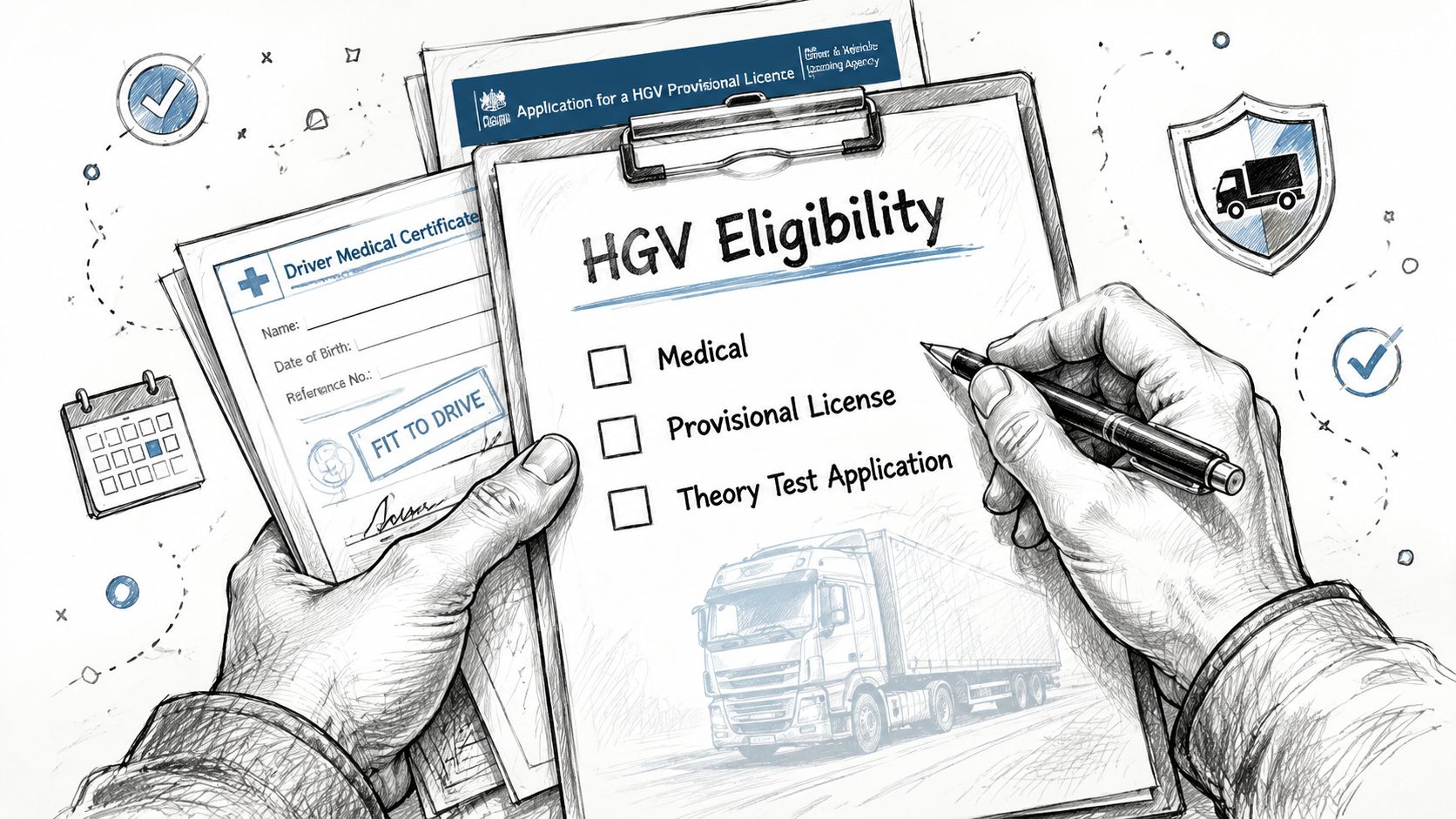
At a basic level, you need to be eligible to begin. In practice, that means having a valid UK car licence and being ready to apply for your HGV provisional entitlement. The two early jobs that matter most are:
Book the medical
Complete the provisional licence application correctly
These steps sound simple. They are simple, but only if you do them in the right order and keep copies of everything.
The medical comes first for most learners
The medical isn't there to catch people out. It's there because professional driving carries responsibility, and the DVLA needs confirmation that you meet the required standard.
When candidates run into delays, it's often because they treat the medical as a small side task. It isn't. If the appointment gets pushed back, your provisional application gets pushed back too. That then affects theory bookings and practical dates.
A sensible approach is to prepare these items before the appointment:
Photo ID and driving licence details so the examiner can match your records properly
Relevant medical information if you have a condition that may need declaring
Glasses or contact lenses if you normally use them for driving
A simple checklist of questions so you don't leave unsure about the next form
Bring a folder from day one. Medical notes, form copies, booking confirmations, theory results, and CPC records get messy fast if you keep them in your phone and nowhere else.
Getting the forms right
The paperwork stage often feels more awkward than the training because there's less feedback. You submit forms, then wait. That's why accuracy matters.
When filling out your provisional application, check every personal detail twice. Small errors create completely avoidable delays. Name mismatches, missed declarations, and incomplete sections are common problems.
For candidates who like to stay organised, digital document habits help a lot. This checklist on Superdocu driver file management is useful because it reflects the wider reality of driver compliance. Even at entry level, keeping clean records makes the whole process easier.
Admin habits that save time later
Here's what works well in practice:
Book early: medical slots and training diaries can fill up, especially when demand rises
Keep copies: scan or photograph every submitted form and every confirmation email
Use one diary: don't split dates across texts, emails, and scraps of paper
Ask what's included: some providers help with bookings and some expect you to manage more yourself
What doesn't work is passive waiting. Good candidates chase missing confirmations, check form progress, and keep the next stage ready.
The first part of HGV training in Bradford isn't glamorous. It is important. If you get this section right, the rest of the pathway becomes much smoother.
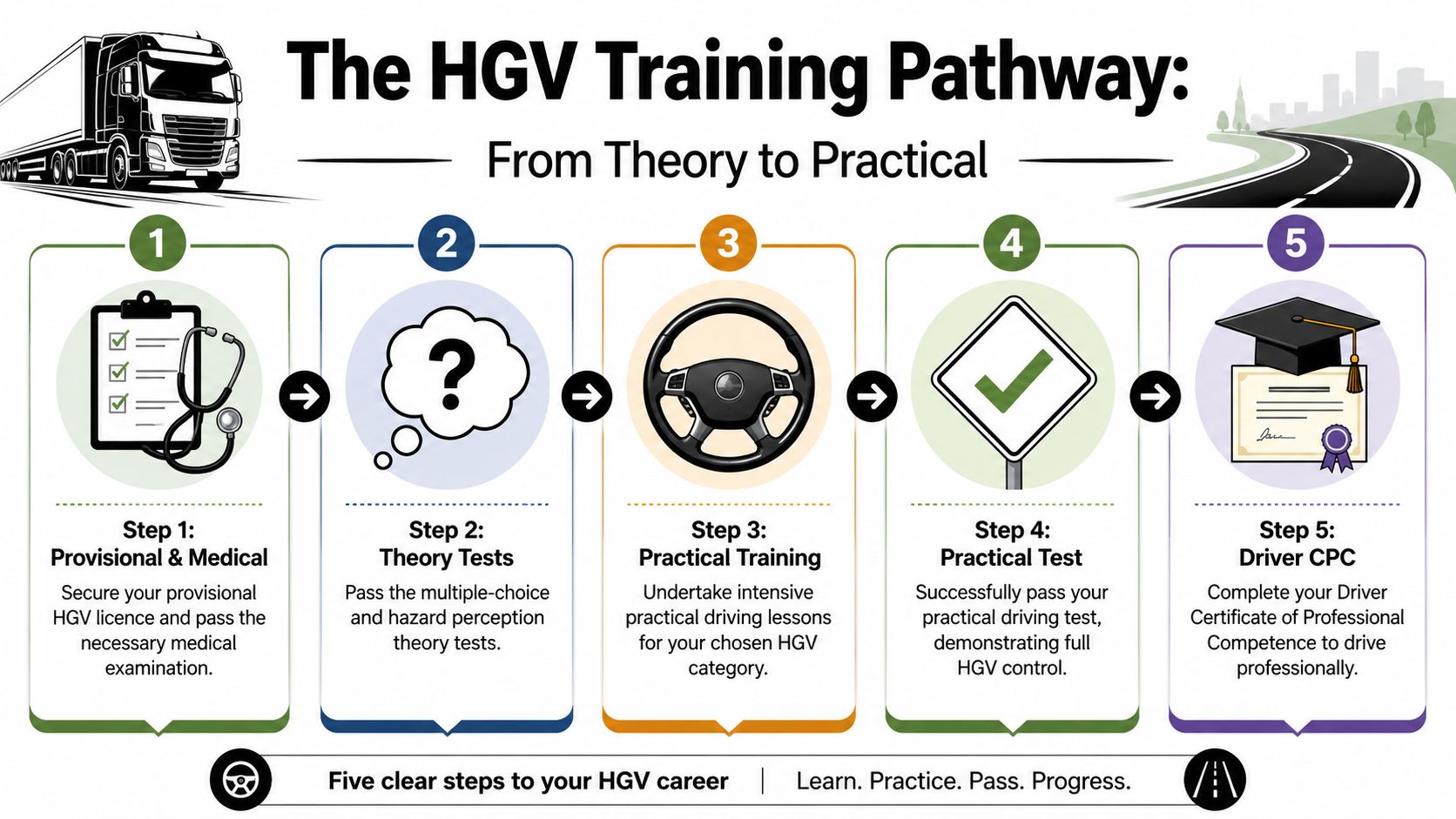
The HGV Training Pathway From Theory to Practical
Most learners imagine the process starts in the cab. It usually starts at a desk, with revision notes, booking confirmations, and a growing list of dates.
In the Bradford area, the usual end to end route for HGV training typically spans 5 to 6 weeks, while the on-road practical part itself lasts about 5 days, according to Metcalfe's Bradford Class 1 training guidance. That gap catches people out. The wheel-turning section is short. The preparation around it takes longer.
A typical learner journey
A common pattern looks like this.
First, the learner gets the medical sorted and the provisional application moving. Then comes theory preparation. Some pass theory quickly because they revise consistently. Others lose time here because they assume car-driving experience will carry them through. It rarely does.
After theory, practical training becomes more focused. During this stage, people often feel the career becoming real. You're no longer “thinking about doing HGV”. You're learning vehicle control, road position, observation, manoeuvres, and test discipline.
A clear overview of the full route helps here, especially if you're comparing providers or licence types. This guide on HGV driver training is useful for seeing how the stages fit together before you start booking dates.
What the theory stage actually involves
The theory phase matters more than many candidates expect. It isn't just a formality before the practical.
You need to prepare properly for:
Multiple-choice theory content covering the knowledge side of professional driving
Hazard perception where timing and judgement matter
CPC-related learning if you're qualifying to drive professionally rather than only obtaining a vehicle entitlement
The learners who struggle most are often the ones who delay revision until a test date is already close. The ones who do better usually study little and often, rather than trying to cram everything into a weekend.
The theory side isn't separate from real driving. If a learner doesn't understand vehicle safety, road risk, and compliance, that usually shows up later in practical training too.
A short visual explainer can help if you're still trying to picture the sequence:
What happens during practical training
Once theory is behind you, practical tuition becomes much more concentrated. Practical training feels fast, because it is. A lot has to happen in a short window.
Expect work on:
Road driving: lane discipline, planning, mirror use, speed control, and dealing with junctions cleanly
Vehicle handling: turns, positioning, and making a large vehicle move smoothly without rushing decisions
Manoeuvres: controlled reversing and other test-relevant exercises
Professional habits: calm checks, safe routine, and responding to instruction without panicking
What works well is full engagement. Candidates improve quickly when they treat each training day as skilled work and show up rested, on time, and ready to listen.
What doesn't work is trying to prove you already know how to drive. HGV instruction is not a bigger version of car tuition. It's a different standard with different consequences.
The CPC point many people leave too late
One of the biggest mistakes is thinking there's just one driving test and that's the whole story. Professional HGV entry involves multiple components, and the CPC side is easy to underestimate if nobody explains it clearly.
That's why organised learners build the process as a chain, not a single event. Medical, provisional, theory, practical, and CPC all have to line up. When they do, the route into work feels straightforward. When they don't, candidates end up with gaps between stages and lose momentum.
Understanding HGV Course Costs and Licence Options
This is the part people ask about first and get the least clear answer on. “How much is HGV training in Bradford?” sounds like a simple question, but it isn't unless you separate the course price from the full licence journey.
Independent guidance says the full HGV qualification process usually takes around 8 to 10 weeks, and Module 3 practical training can cost about £800 to £1,500 depending on geography, with separate costs for tests, medicals, and admin according to RTITB's guide to HGV driver training. That's the key budgeting lesson. Don't price only the driving days.
The three budgeting mistakes candidates make
The first mistake is comparing only the advertised package headline.
The second is forgetting medical, forms, tests, and CPC-related costs can sit outside the practical training quote.
The third is picking the wrong licence category for the job they want.
Cheap on day one can become expensive later if it means extra bookings, repeated tests, or a licence that doesn't match the work you plan to apply for.
Choosing the right licence route
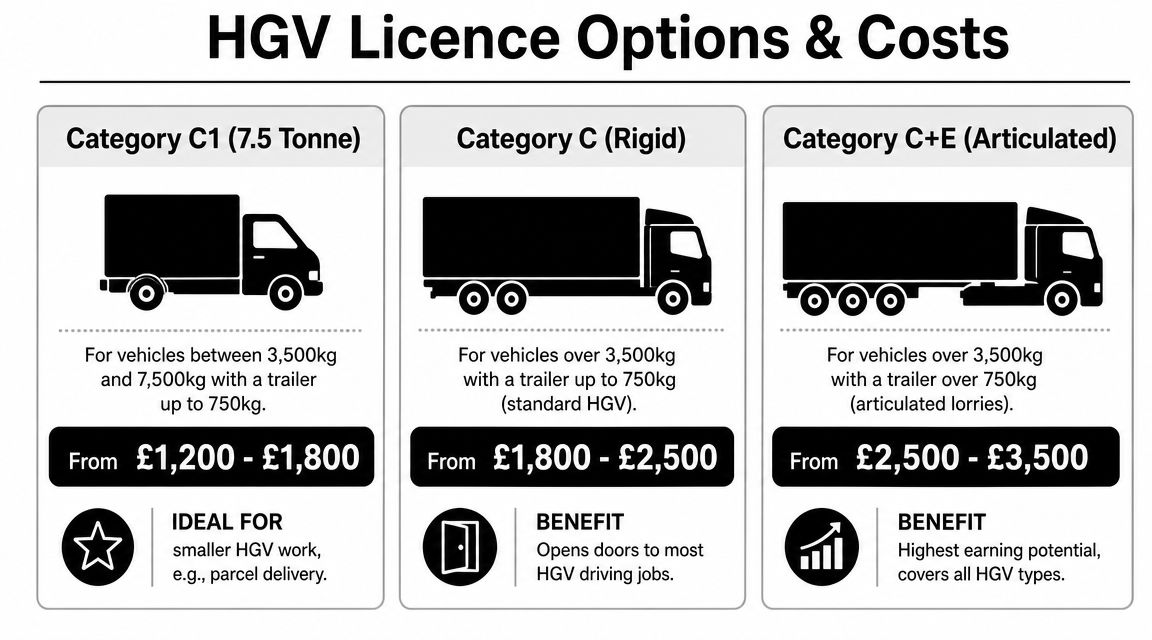
Here's the practical difference between the main paths.
Licence route
Best fit
Main trade-off
C1
Candidates needing smaller commercial vehicle entitlement, including some ambulance-related routes
More limited range of heavy vehicle roles
Category C
New drivers who want rigid vehicle work such as local freight, retail delivery, waste, or construction support
Doesn't cover articulated combinations
C+E
Drivers aiming for the widest range of heavy goods work, including articulated vehicles
Usually a bigger commitment in training complexity and planning
The right decision depends on your intended job, not on what sounds most advanced. Plenty of candidates do well with Category C because it suits local or regional work. Others know from the outset they want the broader flexibility of C+E.
What to ask before accepting a quote
A provider may advertise a package, but you need to know exactly what sits inside it. Ask direct questions.
What's included in the training fee? Check vehicle hire, instructor time, and test booking support
Which items are separate? Medical, theory tests, practical tests, and admin can be billed differently
What happens if dates move? Delays happen. Know how rebooking works
Is there payment flexibility? Some candidates need staged payments rather than one upfront commitment
If funding matters, look at routes beyond private payment as well. This overview of funding for HGV training is useful when you're weighing Skills Bootcamps, employer support, and other practical options.
Cost planning that actually helps
A realistic budget has three layers.
First, the entry layer. This includes medical, provisional process, and theory-related expenses.
Second, the training layer. This is the practical tuition and test preparation.
Third, the completion layer. That includes final test elements, CPC requirements where relevant, and the money you need set aside in case a booking shifts or you need more support.
One practical option in the market is staged payment support. For example, some coordinators, including HGV Learning, offer arranged training pathways with payment plans and support across documentation, theory, and practical booking. That's useful for candidates who can manage the investment monthly but not all at once.
What doesn't help is chasing the lowest quote without asking what's missing. In HGV training in Bradford, the most useful quote is the one that shows the full path, not just the attractive middle section.
Boosting Your Career with Specialist Qualifications
Passing your HGV test is a major step, but it shouldn't be the end of your planning. The drivers who build better long-term careers usually treat the first licence as a platform, not the finish line.
That approach matters because HGV work isn't static. The jobs vary, the sectors vary, and the drivers who can do more than one thing are often easier to place and easier to keep busy.
Why specialist tickets matter
A professional HGV career comes with ongoing compliance. The Driver CPC requirement is 35 hours of periodic training every 5 years according to UK HGV guidance on what to expect from training. That means training doesn't stop once you've qualified. It continues throughout your working life.
That's a good thing if you use it properly.
Instead of seeing periodic training as a box-ticking burden, think of it as the structure around your development. It's often the ideal time to add specialist qualifications that make you more useful to employers and less dependent on one narrow type of driving work.
The add-ons that often make sense
Different tickets suit different sectors.
ADR fits drivers who want access to hazardous goods work and are comfortable with tighter compliance demands.
HIAB suits drivers moving into building materials, utilities, and jobs where lifting at delivery point matters.
Telehandler or similar site-based plant tickets can make sense if your work overlaps with construction compounds, yards, or mixed transport-and-site duties.
Not every driver needs all of them. In fact, collecting qualifications with no plan behind them is usually a waste of money. The better move is to choose one that connects directly to the kind of work you want.
A smarter way to build your career
There are two broad types of newly qualified driver.
The first gets the licence and starts applying everywhere. That can work, but it often leads to random jobs and little direction.
The second chooses a lane. General haulage. Builders' merchants. tanker work. site support. utilities. Then they add the extra qualification that makes sense for that lane.
A specialist ticket works best when it solves a real hiring problem for an employer. That's when it moves from “nice extra” to “reason to call you first”.
This is also where you should think about lifestyle, not just access. ADR may suit one driver's temperament. HIAB may suit another who prefers physical, structured local work. The right next step is the one you'll use.
From Licence to Livelihood Finding Work in Bradford
A fresh pass certificate feels good for about a day. After that, the main question returns. How do you turn the licence into regular paid work?
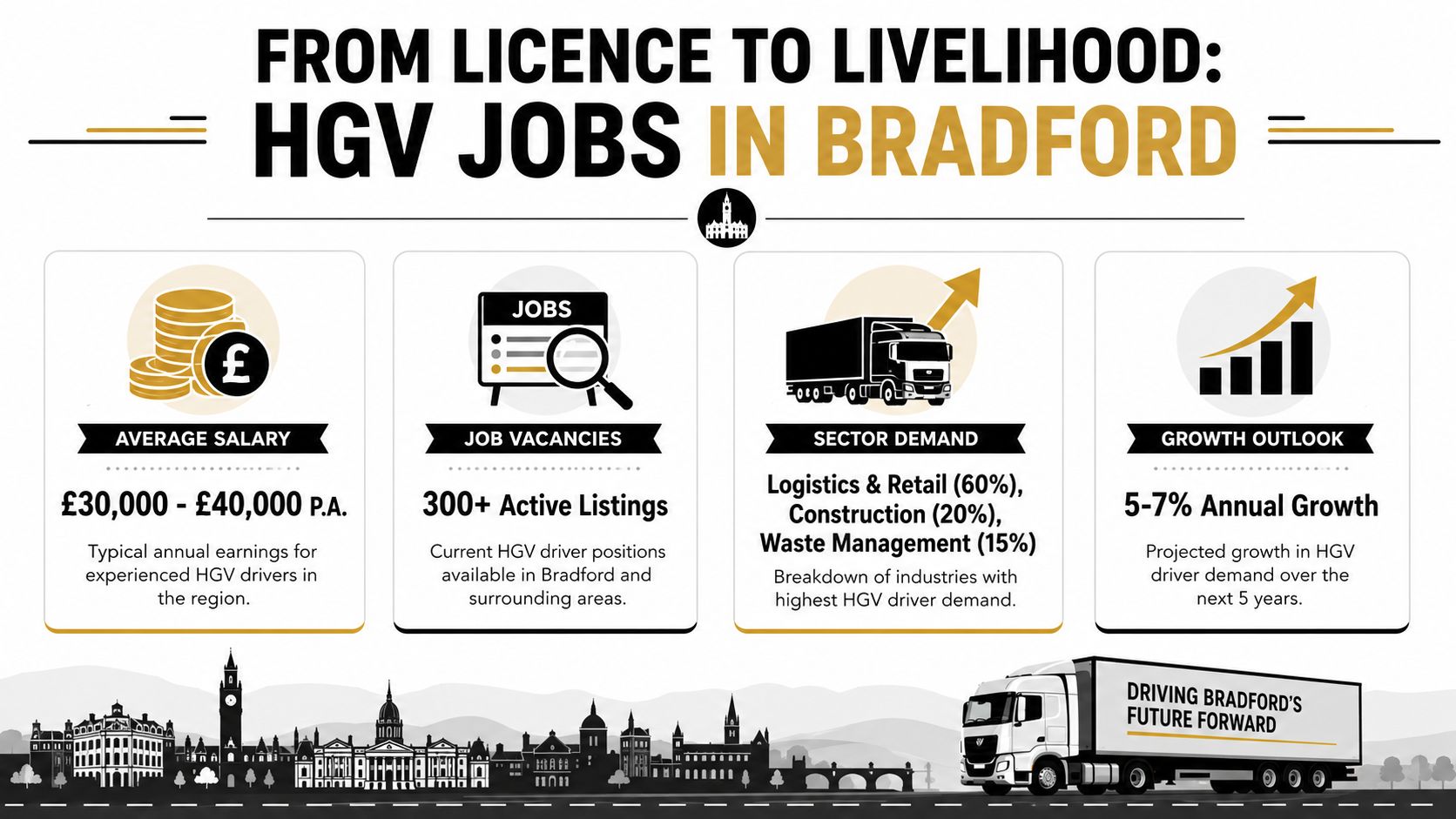
The answer is partly about where you apply, but it's also about how you present yourself. In Bradford, new drivers usually find the best early opportunities by staying realistic, staying organised, and applying to roles that match their licence category and actual readiness.
Department for Education data cited by the RHA shows that 10,220 people started HGV driver bootcamps and 47% gained employment from the training, as noted in the RHA report on lorry drivers and bootcamp outcomes. That matters because it shows structured training can lead to work, not just qualification.
What employers want from newly qualified drivers
Most employers know a new pass won't have years of commercial road experience. That's not usually the issue. The issue is whether the candidate looks employable.
That means:
Clean paperwork: licence details, CPC status, and training records ready to show
A sensible CV: focused on driving, safety, reliability, shift readiness, and relevant work history
Good expectations: willingness to start with the kind of work that builds experience
Professional habits: punctuality, communication, and basic route discipline
A new driver who comes across as organised and coachable often does better than one who talks only about what they eventually want.
Where early opportunities often come from
In practice, Bradford area candidates often look first at general haulage, retail and distribution, builders' merchants, waste, and other fleet-based operations that regularly need qualified drivers. Agency work can also help some new pass drivers get those first commercial shifts, provided they go in with the right expectations.
You'll also make life easier if you learn the tools drivers rely on once they're working. Route planning is a good example. A practical guide to effective truck GPS solutions can help you understand what makes HGV-friendly navigation different from standard car sat-nav use.
How to shorten the gap between passing and earning
The strongest route into work usually combines training support with job readiness. Candidates move faster when they don't disappear after the test.
Use this checklist:
Apply quickly after passing while your training is fresh and your confidence is high
Target matching roles instead of sending the same CV everywhere
Keep your documents ready so you can respond fast when a recruiter calls
Stay open to first-step jobs that give you real commercial experience
Ask for recruitment help if your provider offers CV support or employer introductions
The first job doesn't need to be perfect. It needs to be credible, safe, and useful for building your next move.
The good news is that HGV training in Bradford can be a practical route into paid work when the process is handled properly. The licence matters. The planning matters just as much.
If you're ready to turn interest into a clear plan, HGV Learning can help you organise the route from medical and paperwork through theory, practical training, and the next step into work.
What Age Can You Start HGV Driver Training? A 2026 UK Guide to Licence Age Requirements
If you're asking what age you can start HGV driver training, the honest answer depends on which licence you're after. A C1 licence, covering vehicles...