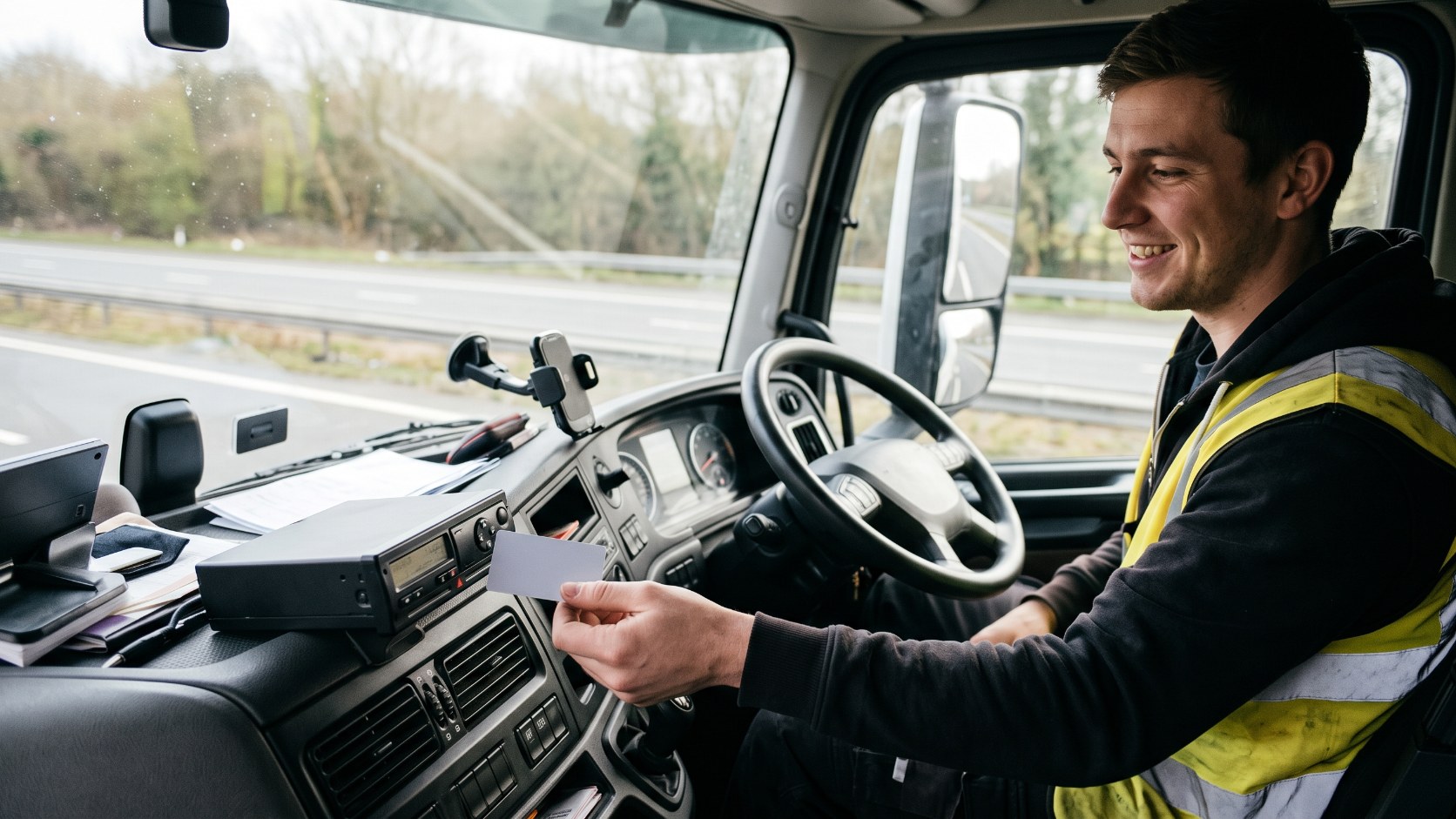
You might be reading this because standard van work feels a bit flat. The driving is fine, but the pay can feel capped, the jobs can blur together, and there isn't always a clear next step.
That's where ADR van driving starts to look interesting.
It's a specialist route for drivers who want more responsibility, more structure, and access to work that isn't the same as ordinary parcel delivery. You're not moving everyday freight. You're handling regulated loads that need training, care, and the right paperwork. That sounds heavy at first, but for many drivers it's what makes the role more appealing. The expectations are clearer, the standards are higher, and the work often sits in sectors that people rely on every day.
For some, ADR van driving is a way to move beyond general multi-drop work. For others, it's a stepping stone into wider transport and logistics careers. It can also suit people who want local or regional routes rather than long-haul HGV work, but still want a more specialised job.
Introduction Why Consider ADR Van Driving
It often starts with an ordinary workday. You finish another round of standard van drops, hand the keys back, and realise the job is steady but hard to build on. If you want driving work with clearer standards, more responsibility, and a better sense of direction, ADR van driving is worth serious attention.
The appeal goes beyond adding a qualification to your CV. ADR training tells an employer you can handle regulated work, follow safety procedures, complete the right checks, and stay calm when the job carries more risk than a routine delivery. For van drivers, that can lead to roles in utilities, engineering support, healthcare supply, construction, facilities maintenance, and time-sensitive service work where access matters as much as driving skill.
That point matters because ADR van jobs sit in a useful middle ground. They are often more specialised than ordinary courier work, but they do not always require you to move into long-distance HGV driving. For some people, that is the right balance. You stay in van-based work, often on local or regional routes, while stepping into sectors that tend to be more structured and more compliance-led.
A simple way to view it is this. Standard van work is often built around volume and speed. ADR van work adds procedure, responsibility, and sector knowledge. The vehicle may be smaller than an HGV, but the role can carry more weight in practical terms because the load, paperwork, and delivery conditions need closer attention.
That also helps answer a common worry. Many new drivers assume ADR only applies to tankers or large lorries. In reality, vans are widely used where deliveries are smaller, access is tighter, or sites need a fast response. Utility contractors, medical suppliers, site-service firms, and last-mile operations linked to regulated goods can all use ADR-qualified van drivers.
If you are still unsure what the role involves day to day, this guide on what an ADR driver does gives useful background before you look at training options.
There is also a lifestyle question to answer. ADR van driving can suit people who like routine, checklists, site rules, and clear responsibility. If you prefer work where expectations are spelled out, that structure is often a benefit rather than a burden. Small operational habits matter too, including practical admin such as managing business vehicle keys, because specialist delivery work tends to run best when the whole process is controlled well.
For many drivers, that is a primary reason to consider this path. It is not only about getting licensed. It is about choosing a type of driving job that may pay better, fit certain lifestyles better, and place you in industries people rely on every day.
What Exactly Are ADR Van Driving Jobs
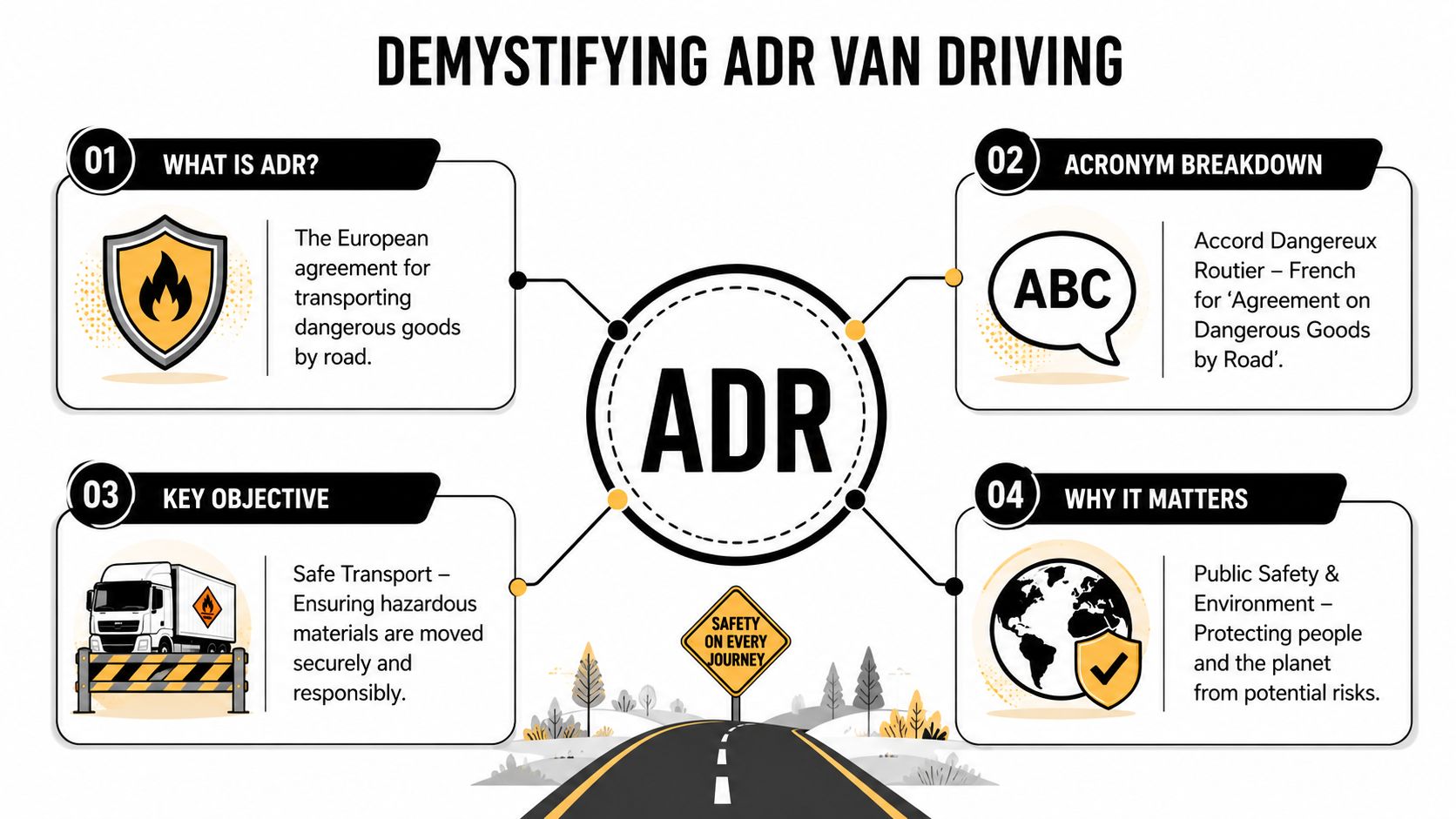
ADR is the system used for transporting dangerous goods by road safely. In simple terms, it's the rulebook for moving loads that could cause harm if they're handled, packed, labelled, or transported badly.
That doesn't mean every ADR load is dramatic or extreme. It means the goods are regulated, and drivers need the right training to move them legally and safely.
What makes these jobs different
An ADR van job isn't the same as normal courier work. The vehicle may still be a van, but the job involves extra checks, stricter handling procedures, and closer attention to paperwork, packaging, and emergency rules.
You're usually expected to know things like:
Load awareness: What category of goods you're carrying and what basic precautions apply.
Vehicle checks: Whether the vehicle equipment, markings, and load condition are correct before you move.
Delivery discipline: How to follow site rules, unloading instructions, and reporting procedures.
Incident response: What to do if there's a leak, damage, or another problem on the route.
If you want a simple explainer before looking at training, this guide on what an ADR driver does gives a helpful overview.
Why vans are used for ADR work
Many new drivers get confused regarding ADR, often thinking only of fuel tankers or large HGV fleets. In real life, van-based ADR work often sits in sectors that need smaller vehicles and tighter route planning.
The operational reality of ADR van driving often involves roles in emergency response, utilities, and last-mile urban logistics, where drivers deal with tighter routes, stricter time windows, and clear handling procedures for goods used in public services, construction, and healthcare, as shown in ADR Network job market insights.
A van can make more sense than a larger lorry when the job involves:
Urban access: Narrow roads, busy town centres, or restricted sites.
Smaller consignments: Regular deliveries of regulated goods rather than bulk loads.
Service-based operations: Support work for field engineers, public services, or maintenance teams.
Think about a utilities contractor needing specialist materials on local routes, or a service team supplying regulated products to several sites in one shift. That's very different from long-distance trunking.
A useful way to think about ADR van driving is this. It combines the route control of van work with the compliance mindset of hazardous goods transport.
There's also a practical side to fleet operations. Businesses running specialist vans need reliable key control and vehicle access procedures, especially where multiple drivers share vehicles. If you work around fleet admin or operational planning, this guide to managing business vehicle keys is useful background.
Your Training Path to Getting ADR Qualified
The process is much easier to handle when you break it into stages. Individuals often struggle because they look at the whole thing at once and assume it's too technical.
It isn't. It's structured.
Start with your licence and job goal
The first question is simple. What sort of ADR work do you want to do?
If you're aiming for van-based roles, your route may differ from someone planning to move into larger Category C or C+E hazardous goods work later on. What matters early is matching the training to the kind of loads and vehicles you're likely to use.
For a clear outline of the route, this page on how to get an ADR licence is a helpful starting point.
Understand the modular structure
One of the best things about ADR training is that it's modular. You don't have to qualify for every type of dangerous goods job on day one.
According to GOV.UK guidance on becoming a dangerous goods driver, drivers can add extra dangerous-goods classes to their ADR card through optional training modules and tests, and the qualification must be refreshed every 5 years to stay valid.
That matters for two reasons. First, it lets you start with a practical scope that matches the jobs you want now. Second, it gives employers a clear way to build your skills over time without guessing what your licence covers.
What you study
ADR training usually combines a core element with specialist modules. The exact combination depends on the loads and the type of carriage involved.
Here's a simple overview.
Class
Type of Goods
Common Examples
Class 2
Gases
Gas cylinders
Class 3
Flammable liquids
Fuels, solvents, some industrial liquids
Class 4
Flammable solids
Certain reactive or combustible materials
Class 5
Oxidising substances and organic peroxides
Products that can intensify fire risk
Class 6
Toxic and infectious substances
Certain chemicals and medical-related materials
Class 8
Corrosives
Acids, cleaning chemicals, industrial agents
Class 9
Miscellaneous dangerous goods
Regulated goods that sit outside the main groups
You may also hear the terms packages and tanks. For most van-based entrants, package work is the more relevant starting point. Tank work is more specialised and often linked to larger-vehicle roles.
Keep this in mind: ADR training doesn't force you to become a tanker driver. It lets you qualify for the type of regulated work you actually want.
What the course is really testing
New learners often assume the test is all about memorising codes. There is some theory, of course, but the deeper aim is simpler. Can you transport regulated goods safely, legally, and calmly?
That means training covers areas such as:
Risk awareness so you understand why the rules exist.
Load handling so you recognise what safe carriage looks like.
Documentation and labels so you can spot obvious issues.
Emergency actions so you know what to do if something goes wrong.
This is why employers value the qualification. It shows more than driving ability. It shows judgement.
Renewal matters
The five-year refresh cycle is easy to overlook when you're only thinking about getting started. Don't overlook it.
A time-limited qualification is helpful for many employers. It gives them a predictable compliance cycle and helps reduce legal and insurance worries in regulated fleets. For drivers, it keeps your qualification current and keeps specialist doors open.
Expected Pay Hours and Career Opportunities
You finish your ADR training, pass the exams, and then the practical question arrives. What does the job look like on a normal Tuesday, and does the pay justify the responsibility?
That is the right question to ask. ADR van driving is a specialist route, but specialist does not always mean the same thing in every company. One employer may offer steady daytime work delivering packaged goods to repeat sites. Another may need early starts, weekend cover, and tighter delivery windows. The job title can look similar while the day-to-day reality feels very different.
What pay usually looks like
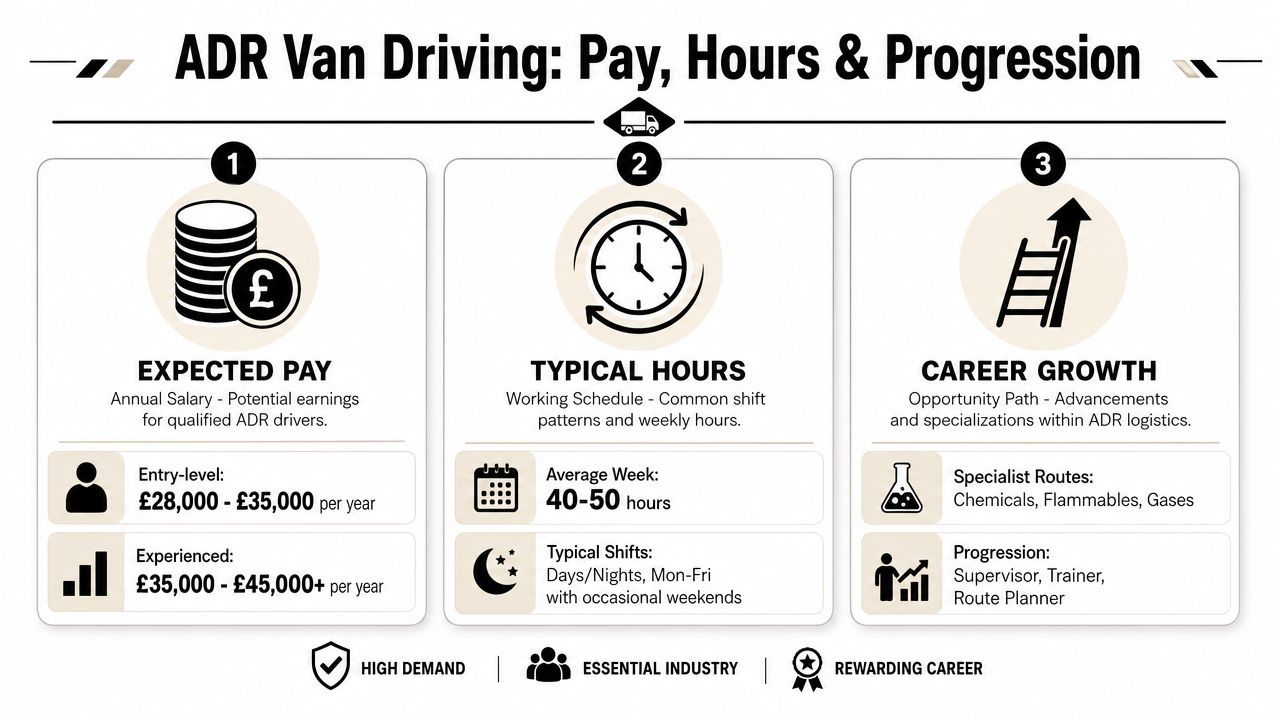
As noted earlier in the article, advertised ADR driver salaries often sit above general van work because the role carries extra legal responsibility, more checks, and a smaller pool of qualified applicants.
The detail matters, though. Many job adverts bundle ADR work together instead of separating van roles from rigid, artic, or tanker work. That can blur the picture. A headline salary may reflect a mix of vehicle types, shift patterns, and overtime assumptions.
Treat the advertised figure as a starting point, not the final answer.
A better way to judge an ADR van role is to break it down like a wage slip:
Base pay: What do you earn before extras?
Shift pattern: Are the hours mainly days, or do they include nights and weekends?
Overtime: Is it occasional relief work or built into your expected income?
Route style: Are you doing local scheduled drops or time-sensitive multi-drop work?
ADR premium: Are you being paid more for the qualification itself, or is it a hiring requirement?
That last point catches a lot of new drivers out. Some firms pay a clear premium for ADR because it helps them fill a hard-to-staff role. Others treat the certificate more like a gate pass. It gets you through the door, but the rate stays close to other specialist van jobs.
Why some roles pay more than others
Pay usually rises when the work becomes harder to cover or more demanding to run safely. That often happens in sectors such as utilities support, fuel-related distribution, engineering supplies, healthcare logistics, and last-mile specialist delivery.
For example, a utility contractor may need a driver who can carry regulated goods to field engineers on fixed service deadlines. A medical or technical supplier may need careful handling, accurate paperwork, and dependable delivery to sites that cannot accept mistakes. Last-mile hazardous goods work can also pay better than ordinary parcel delivery because timing, compliance, and customer procedures are tighter.
This is why two ADR van jobs can sit at very different pay levels. You are not only being paid to drive from A to B. You are being paid to handle risk, follow process, and stay calm when the job is detail-heavy.
A slightly lower salary with predictable daytime hours can be the better long-term choice if it gives you stable income and a routine you can live with.
Hours and working conditions
Many people look at ADR van driving because they want specialist work without committing to long-distance HGV life. That is a fair reason. In many cases, van-based ADR work is more local and more structured.
The trade-off is that the day can feel compressed. You may start early, complete vehicle and load checks, confirm paperwork, follow set routes, deal with site rules, and obtain customer signatures, all before lunch. It is less about motorway mileage and more about control.
A useful comparison is this. Standard courier work often rewards speed and drop volume. ADR van work rewards consistency. Employers want someone who can follow the same safe routine every day, even when the schedule is busy.
Common patterns include:
Day shifts with early starts
Local or regional routes
Multi-drop deliveries to repeat commercial sites
On-call or weekend cover in some utility and service fleets
Physical but manageable loading, depending on the goods carried
If your goal is to sleep at home most nights, work within a defined area, and build specialist experience, that can be a strong fit. If you want maximum hours and long-haul earning patterns, larger-vehicle ADR work may suit you better later on.
Career opportunities after your first ADR van job
Your first role is rarely the end point. It is the first proof that you can work safely in a regulated environment.
That matters to employers.
Once you have real experience, a few paths tend to open up:
Sector specialisation: staying in utilities, healthcare supply, technical distribution, or service support and becoming the driver employers rely on
Higher-responsibility driving work: moving into more complex ADR duties or larger vehicles
Fleet and compliance roles: helping with transport admin, route planning, stock control, or safety procedures
Training and mentoring: supporting new drivers once you have enough experience
The career choice goes beyond a licence question. You are choosing a type of working week and a type of income. Some drivers use ADR van work as a stable long-term niche. Others use it as a stepping stone into rigid or artic hazardous goods roles.
Both are valid.
The smart approach is to judge each vacancy on three things at the same time. Pay, schedule, and industry. When those line up, ADR van driving can offer a solid mix of specialist status, practical earning potential, and a lifestyle that suits drivers who want skilled work without giving up local routes.
How to Find ADR Van Driving Jobs and Succeed
Finding the right role takes a more targeted approach than a basic job-board search. ADR is a specialist field, and van-based positions are often hidden inside wider transport, service, or utilities hiring.
That's why many newly qualified drivers miss good opportunities. They search too broadly, or they describe their skills too vaguely.
Search where the niche roles are
Large job boards are useful, but they don't tell the full story. Jobsite ADR vacancies recently showed only 58 live ADR driver jobs, which suggests a smaller but persistent vacancy pool on niche listings. That's a good reminder that targeted searching matters.
Try searching with combinations such as:
ADR van driver
Dangerous goods driver
ADR multi-drop
ADR delivery driver
Utilities driver ADR
Medical supplies ADR driver
Also look directly at employers in sectors that use smaller vehicles for specialist deliveries. Utilities, maintenance support, public services, healthcare supply, and technical distribution can all be relevant.
Build a CV that shows control and reliability
A weak CV for ADR work reads like a generic delivery-driver CV with one extra certificate added. A strong CV makes safety and consistency obvious.
Make sure you highlight:
Your ADR qualification clearly: Put it near the top, not buried in the final section.
Relevant driving history: Mention route work, timed deliveries, site access, or regulated environments.
Compliance habits: Daily checks, paperwork accuracy, defect reporting, and incident-free conduct all matter.
Customer handling: Many ADR van roles still involve direct site contact, handover procedures, and calm communication.
If you've worked in construction support, medical logistics, facilities supply, or service delivery, say so. Context helps.
Employers hiring for ADR van work are often looking for a safe pair of hands as much as a licence holder.
Prepare for interview questions properly
Interviews for these jobs often test attitude as much as experience. The employer wants to know whether you take rules seriously without becoming flustered.
Be ready to answer questions like:
What would you do if packaging looked damaged before departure?
How do you manage delivery pressure without cutting corners?
What checks do you carry out before starting your route?
How would you handle a customer asking you to ignore a site rule?
Good answers are calm, practical, and safety-first. Don't try to sound clever. Sound dependable.
Your first months on the job
The first role is about building trust. Turn up prepared, follow process, ask sensible questions, and don't pretend to know something you haven't yet learned.
That approach helps more than bravado ever will.
Start Your ADR Career with HGV Learning
If ADR van driving sounds like the right move, the main thing is to start with a training route that's organised from the beginning. Most delays happen when learners try to piece everything together alone, from paperwork and medical steps to theory support and test booking.
That's where a structured provider makes a real difference.
HGV Learning supports drivers through the full process, from the early admin to training coordination and practical progression. That includes help with documentation, medical scheduling, theory preparation, progress tracking, and arranging local training and test dates. For learners who want a straightforward route into regulated driving work, that kind of end-to-end support can remove a lot of friction.
There's also a practical benefit after qualification. Starting a specialist career is easier when your training provider understands the kind of employers that hire ADR drivers and the standards those employers expect. That matters whether you're aiming for van work first or planning a longer-term move into larger hazardous goods vehicles.
ADR van driving won't suit everyone. But if you want more than basic delivery work, and you like the idea of specialist responsibility, compliance, and clear progression, it's a strong option.
If you're ready to move into specialist driving, speak to HGV Learning. They can help you understand the right ADR path, organise the training process, and get you closer to your first regulated driving role.