A lot of people who search for HGV training in Cannock are in the same position. They're working shifts, juggling bills, and trying to work out whether a driving career is a realistic move or just another idea that gets parked because the process looks too complicated.
The good news is that it's a practical route. Cannock is already an established place for HGV training, with access to major transport links and a genuine logistics training footprint that goes beyond basic test prep, including the presence of Freightliner's Training Academy in the town. That matters because where you train shapes how ready you feel when you start work.
Starting Your HGV Career in Cannock
If you're looking at HGV training in Cannock, you're probably asking two questions before anything else. Can I afford it, and what job does it lead to? Those are the right questions.
Cannock makes sense as a starting point because it sits in an area that works for commercial driver training. You need roads that let you build confidence in traffic, roundabouts, industrial routes and faster roads without feeling thrown in at the deep end. You also want a town that's connected to real transport activity, not just one driving yard and a website.
That local, practical side matters more than people think. A town with a working transport footprint tends to produce training that feels job-focused rather than test-focused. You're not just learning how to pass. You're learning how to handle a vehicle, manage pressure, and turn up work-ready.
What the journey usually looks like
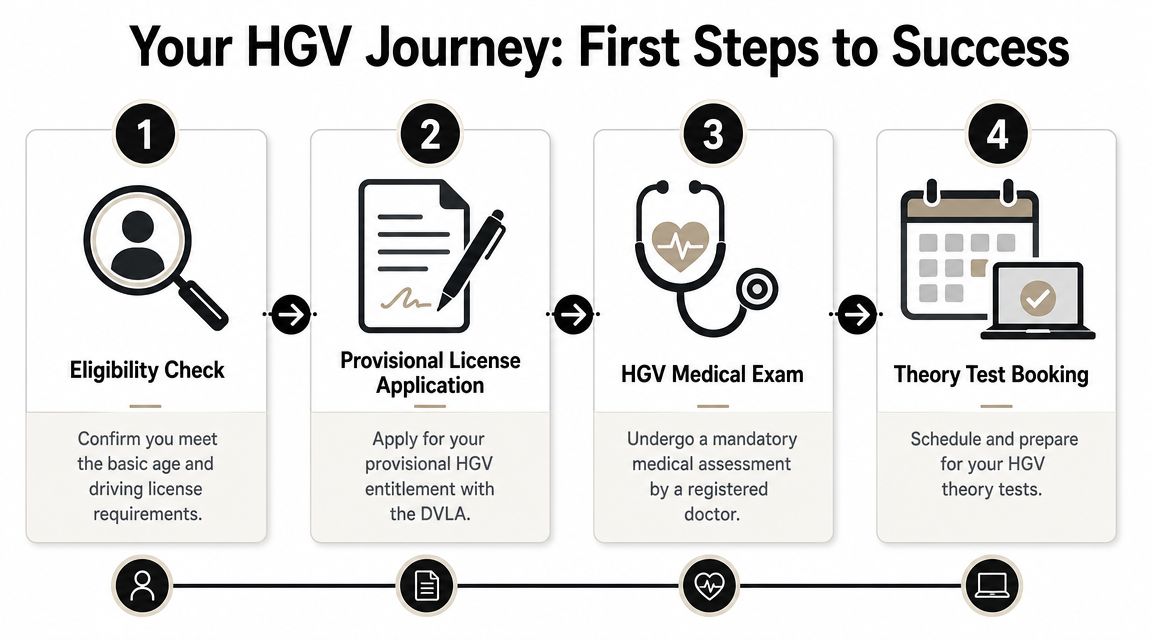
Most new drivers move through the same broad path:
Check eligibility so you know which licence route fits your age, current licence and work goal.
Book the medical early because that's the step that tends to hold everything else up.
Get the theory done properly so your practical training isn't delayed by avoidable retests.
Choose the right licence category based on the work you prefer.
Plan beyond the pass by thinking about CPC, add-on tickets and your first employer.
Practical rule: Don't choose a licence first and only then think about the job. Start with the work you want, then pick the shortest sensible route into it.
If you're also sorting the wider practical side of changing jobs, local services help. Small things like spare keys, lockouts or vehicle access can throw a week off course, so Top Motor Keys for Cannock drivers is a useful local resource to keep in mind.
For anyone comparing providers and locations, a good place to start is this guide to HGV driver training near you. It helps you look at training options in a more organised way than just searching by postcode and price.
Your First Steps Eligibility Medicals and Paperwork
You decide you want to start HGV training in Cannock, you look at course dates, and then the first delay hits. It is usually not the driving. It is the admin.
I see the same pattern with new candidates every week. The ones who get on the road quicker are not always the ones in the biggest rush. They are the ones who sort the right category, book the medical early, and send clean paperwork the first time. That matters even more if you are budgeting carefully or trying to move from one job into another without losing income.
Start by checking what licence path actually fits your goal
Before you spend money, check your age, your current car licence, and the kind of work you want at the end of this.
For many new drivers, the choice is between C1, Cat C, and C+E. C1 suits lighter commercial work such as some ambulance and delivery roles. Cat C is the usual Class 2 route for rigid vehicles. C+E opens the door to artic work and usually the wider job market, but it still needs to match the kind of driving you want to do and the budget you have available.
If you passed your car test before January 1997, look closely at your licence. Some drivers already have C1 entitlement under grandfather rights. That can save time and change the route you need to pay for, so it is worth checking before you book anything.
Licence
Vehicle type
Common use
C1
3,500 kg to 7,500 kg
Ambulance, some delivery roles
Cat C
Rigid vehicle over 7,500 kg
Class 2 work
C+E
Articulated combination
Class 1 work
The practical question is simple. Do not pick the biggest licence just because it sounds better. Pick the one that gets you into paid work fast enough, then build on it if needed.
Book the medical before you plan the rest
A lot of candidates want to start with revision or practical lessons. In real life, the medical is often the step that decides your timeline.
The D4 medical checks eyesight, blood pressure, hearing, and your medical history. If you want a clear picture of what the appointment involves, this guide to the HGV medical and D4 process explains what you will usually need to prepare.
I tell candidates to book it early for one reason. It stops expensive downtime later. There is no point paying for theory materials, arranging time off work, or pencilling in training dates if your provisional application cannot move because the medical has not been done.
Get the paperwork right first time
The forms themselves are not difficult. The problem is that small mistakes cost time.
You will usually deal with:
D2, the application for provisional lorry entitlement.
D4, the medical form completed by the doctor.
Check every detail before anything goes in the post. Name, address, date of birth, licence number, signatures, and declarations all need to line up. If one part is missing or hard to read, the application can stall while you wait for forms to come back or for DVLA updates.
The hold-ups I see most often are basic ones:
Missing signatures on the D2 or D4
Old address details that do not match the licence
Medical appointments booked too late
Forms filled in quickly between shifts, with errors
No copies kept for reference if something has to be chased
That last point matters. Keep photos or scans of everything you send.
Be honest about timing and money
This early stage feels slow, especially if you are eager to change jobs. It is still part of the job change.
The trade-off is speed versus wasted spend. If money is tight, avoid booking parts of the process in the wrong order. A rushed start can mean paying for time off, revision tools, or training slots before your paperwork is ready. A planned start gives you a better chance of lining costs up with your pay cycle and moving into work without a long gap.
That is why I advise candidates in Cannock to treat the admin phase as the foundation of the whole plan, not as a box to tick. If you are asking, "How can I afford this?" the answer often starts here. Fewer delays usually means fewer repeat costs and a faster path to earning.
A practical checklist that keeps things moving
Handle this stage in a set order:
Check your current licence and any existing entitlement
Decide which category matches the work you want
Book the medical as early as possible
Complete the D2 and D4 carefully
Keep copies of every form and document
Leave room in your diary for appointments, post, and DVLA processing
Candidates who stay organised here usually have a much easier run later. It is not the exciting part of HGV training, but it is the part that often decides how quickly you get from first enquiry to first driving job.
Preparing for Success The HGV Theory Test
The theory stage is where candidates either build momentum or lose it.
People who treat theory as a box-ticking exercise often end up learning in fragments. They memorise bits of the Highway Code, do a few random mock questions, then wonder why their scores swing up and down. The stronger approach is structured practice that shows what you know, what you keep getting wrong, and whether you're ready for test conditions.
What you're preparing for
The theory side of the HGV route is broader than most new drivers expect. It usually means preparing for:
Multiple choice questions, where knowledge gaps show up fast.
Hazard perception, which is less about speed and more about reading developing risk.
CPC case studies, which test judgement in job-based scenarios rather than simple recall.
That mix matters. A candidate can feel confident on facts but still struggle when a question asks what should happen next in a practical situation. Professional driving requires both.
Why random revision usually fails
Reading alone has its place, but it's weak as a full strategy. A book can explain rules, signs and safe practice. It can't show your weak spots clearly unless you test yourself properly and review patterns.
That's why a structured online system usually works better than passive revision. Progress tracking, topic-level scoring and realistic mocks give you something more useful than confidence. They give you evidence.
For candidates who want a clearer revision path, theory training for HGV tests shows how that structured preparation works in practice.
A practical study method
The best theory candidates usually keep things simple. They don't revise everything every day. They divide the work and build consistency.
A sensible pattern looks like this:
Focus area
What to do
Knowledge
Work through question banks by topic, not at random
Hazard perception
Practise spotting early developing hazards, not just obvious events
Case studies
Read carefully and answer as a professional driver, not as a car driver
One habit makes a big difference: review the questions you got wrong before starting a new mock test. Otherwise you only practise starting again, not improving.
What good preparation feels like
It doesn't feel dramatic. It feels organised.
You should be able to say which topics are weakest, which clips you tend to misread, and whether your mistakes come from rushing, guessing or misunderstanding. That level of clarity is what turns theory from a hurdle into the foundation for safer practical training.
Candidates who arrive at practical lessons with solid theory behind them usually take instruction better. They already understand signs, road position, driver responsibilities and the logic behind decisions. That makes the move into real vehicle training much smoother.
Practical HGV Training In and Around Cannock
You've passed the theory, sorted the paperwork, and booked the course. Then you arrive for day one, look up at the cab, and realise this is the point where the plan either starts to feel possible or starts to feel expensive.
That matters more than people admit. Practical training is the part you are paying for by the day, so the goal is not to look impressive in the first hour. The goal is to build enough control, quickly and properly, that you pass without dragging the course out and adding cost.
Cannock is a practical place to learn because the local roads give you the sort of work you will meet once you are employed. You need busy roundabouts, town traffic, industrial estates, tighter approaches, dual carriageways and sections where observation matters more than speed. A candidate who trains around Cannock usually gets a useful mix of low-speed control and proper road planning, rather than spending the whole course on easy roads that flatter you.
What the first drive is really like
The first lesson is rarely smooth. New candidates tend to drift their attention into one mirror for too long, turn in too early, or carry too much speed into a roundabout because the vehicle still feels unfamiliar.
That is normal.
A good instructor strips the job back to a few habits you can repeat every time. Get the mirror routine right. Keep the vehicle in the correct lane early. Set the speed before the hazard, not in the middle of it. If those three things improve, the rest usually follows.
The mistake I see most often is a car driver trying to tidy things up late. In a lorry, late corrections are what create messy junctions, harsh braking and poor positioning. Early planning saves you.
Picking the licence that fits the job you want
The training route should match the work you want at the end of it, because that affects both cost and job options.
C1
C1 suits candidates moving into roles with smaller commercial vehicles, including some medical and specialist delivery work. It can be the right route if your target job does not need a full-sized rigid or artic licence.
Cat C
Cat C is the standard route into rigid lorry work, often called Class 2. For many new drivers in Cannock, this is the most direct way into paid work because it opens access to a wide range of local and regional delivery jobs.
C+E
C+E covers articulated and drawbar combinations. It gives you access to a broader section of the freight market and often improves earning potential, but the training standard is higher because trailer tracking, road position and forward planning all need to be cleaner. If your budget is tight, there is a real decision to make here. Go straight to C+E if you can fund it and want the wider job pool, or start with Cat C if you need to get working sooner and build from there.
What practical training is meant to build
Good HGV training is habit training. The vehicle only starts to feel manageable when your routine becomes consistent.
A proper course usually focuses on:
Mirror discipline, so checks happen before every change of speed, direction and position
Approach planning, so junctions and roundabouts are set up early and calmly
Speed control, so you arrive in the right gear and at the right pace
Road position, especially on left turns, lane changes and tighter urban sections
Reversing and manoeuvres, where patience and setup matter more than confidence
Candidates usually lose marks before the turn, not during it. The setup is where the drive is won or lost.
That is why repetitive practice matters. It is not glamorous, but it keeps you from paying for extra training days because of the same avoidable faults.
Training for the test and for the first job
Test standard matters, but employability matters too. A candidate can scrape through a test with rough habits and still struggle in the first assessment drive with an employer.
The better approach is to train for both. Keep the drive safe, legal and smooth. Use the mirrors in a way that makes sense. Take information in early. Show that you can be trusted with the vehicle, the public and the schedule.
This short video gives a useful feel for the practical side of HGV driving and training:
Candidates who do best in Cannock usually treat each lesson like paid preparation for a real shift. They ask sensible questions, accept correction quickly, and work on the faults that would cost them a pass or a job offer. That mindset saves time, saves money, and gives you a better start once the licence is in your hand.
Specialist Skills for a Higher-Paying Career
Passing Cat C or C+E is a major step. It is not the finished product.
A lot of new drivers think the licence itself is the career move. In practice, the licence gets you into the market. The stronger earnings and steadier options usually come when you add the right skills on top.
Why the extra tickets matter
Employers don't only ask whether you passed. They look at how quickly you can become useful. A driver with the right add-ons can often fit into more than one kind of role, and that changes your options.
RTITB notes that drivers must complete 35 hours of CPC periodic training every 5 years, and it also points out that ancillary qualifications such as ADR and HIAB are part of what employers increasingly want in ready-to-work candidates, as outlined in this simple guide to HGV driver training.
That creates a simple truth. The market rewards drivers who stay compliant and keep adding capability.
Which add-ons make the biggest difference
Different tickets suit different sectors. The smart move is to pick the one that matches the work you want nearby.
ADR helps if you want roles involving hazardous goods. It can widen your options in specialist transport.
HIAB matters for builders' merchants, construction supply and site delivery work where drivers need to operate a lorry-mounted crane.
Telehandler training is useful if you want a broader foothold around construction and site logistics.
These aren't vanity extras. They change the kind of conversations you can have with employers.
A better career strategy
Some drivers pass the main test and stop there. That can work, but it often leaves them competing for the same entry-level roles as everyone else. A better strategy is to build a stack of qualifications that matches a real job type.
Think of it this way:
Goal
Useful stack
General freight
Cat C or C+E, CPC kept current
Construction delivery
Cat C or C+E, HIAB, CPC
Specialist loads
Cat C or C+E, ADR, CPC
A licence gets you considered. A licence plus the right specialist ticket gets you shortlisted for work that needs less hand-holding.
That's why upskilling is worth taking seriously. It improves flexibility, helps with job security and gives you more control over the direction of your career.
Costs Funding and Finding Your First HGV Job
This is the point where many people either move forward or stop. Not because they lack the ability, but because they assume the money side will be too difficult.
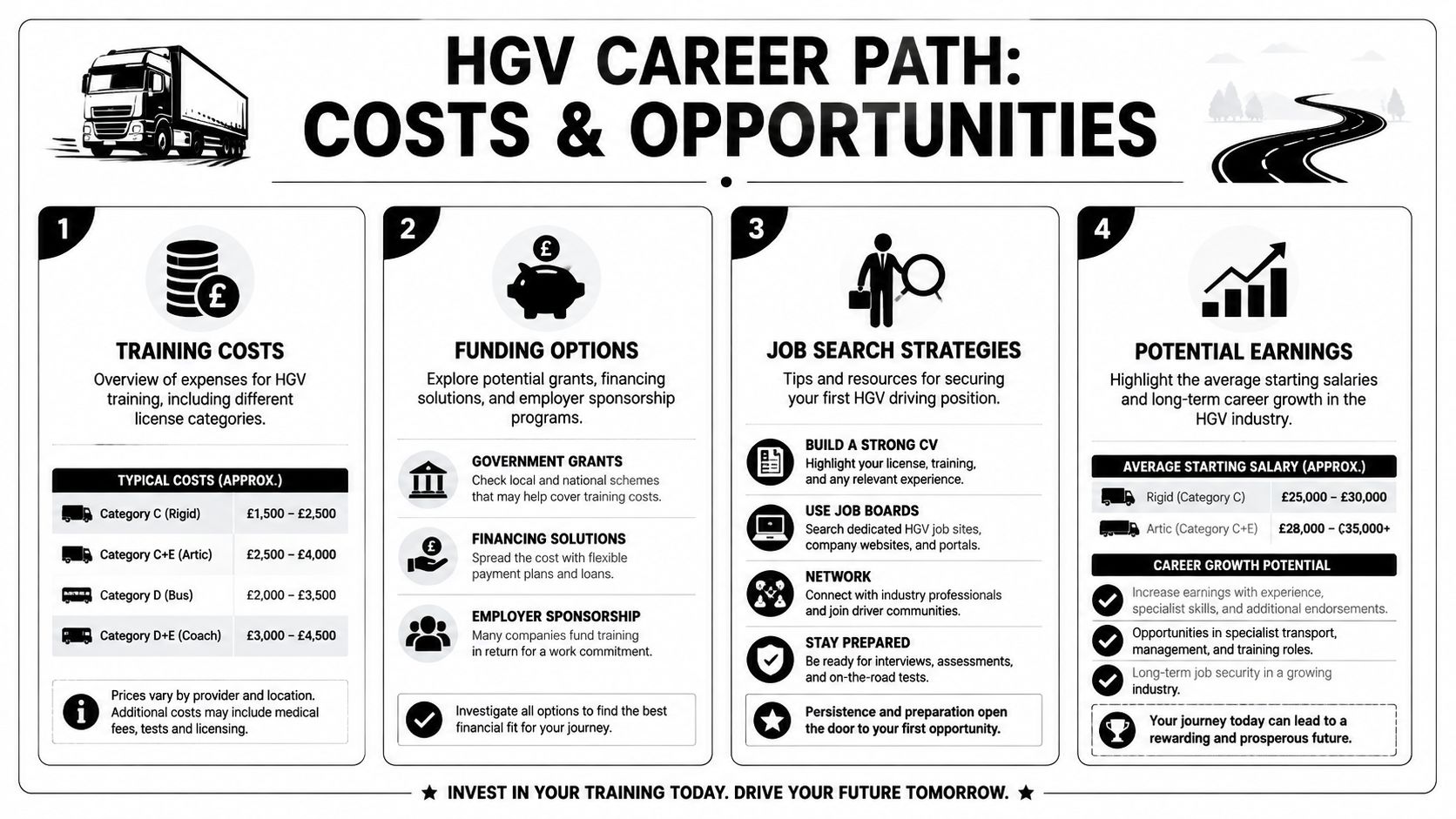
That assumption isn't always right. The better way to look at HGV training in Cannock is as a route with several funding paths, not one large bill that has to be paid all at once.
Start with funding before you compare packages
A lot of candidates make the mistake of comparing course prices first. That's understandable, but it isn't the best first step. Check what support you might qualify for before you decide what you can and can't afford.
Government guidance says HGV Skills Bootcamps are free for eligible learners, can run for up to 16 weeks, and are open to adults aged 19+ who are employed, self-employed, recently unemployed or returning to work. The same guidance also points people towards local FE providers to check whether medicals and licences can be funded, as explained in the government's guide to training to become an HGV driver.
That matters because it answers the question many local pages don't. How do I pay for this without a large upfront hit?
The funding routes worth checking
The most useful options usually fall into a few groups:
Skills Bootcamps if you meet the eligibility rules and want a government-backed route.
Employer-funded training if you're already in transport, warehousing, utilities or a related sector.
Adult education or local support where regional provision may help with parts of the process.
Payment plans if funding isn't available but cash flow is the actual issue.
For people managing a household budget while changing career, the wider financial picture matters as much as the course itself. Anyone balancing bills and repayments may find this guide on switching to trades with a mortgage useful because the decision-making pressures are often similar.
What happens after you pass
The pass certificate is a milestone. It is not the whole outcome.
The strongest training pathways connect licence gain to employability. That means help with choosing the right route, understanding which sectors fit your licence, and getting pointed towards roles where a newly qualified driver has a realistic chance.
One practical option in this space is HGV Learning, which coordinates the process from documentation and medical scheduling through theory preparation, local practical training, and then recruitment guidance and job-matching support. That joined-up approach makes sense because most career changers don't just need a course. They need a route into work.
How to improve your first-job chances
A new pass can still look strong if you present it properly. Employers want signs that you're serious, prepared and safe.
Choose the right licence route so your training matches the roles you apply for.
Keep CPC requirements in view because employers notice drivers who understand compliance.
Add one relevant specialist ticket if it fits your target sector.
Apply with a clear story about your shift history, reliability and reasons for moving into driving.
The first job often goes to the candidate who looks easiest to put on the rota safely, not the one who talks biggest.
That's the direct link between funding and employment. When you choose the right training path, the money isn't just buying lessons. It's buying a shorter route from career change to paid work.
If you're ready to turn the idea into a plan, HGV Learning can help you organise the process from medical and theory through to practical training and the first steps into work.
Related Articles
23/10/2026
Driver CPC Card Renewal: How to Avoid a Lapsed DQC (2026 UK Guide)
If your Driver CPC card is sitting in your wallet with a date on it you haven't looked at properly in years, you're not alone....