You might be reading this after another shift that no longer feels worth it. Or after scrolling job boards in Coventry and thinking, “I need something steadier than this.” That's usually when people start searching for HGV training in Coventry. They want a job with a clear route in, proper qualifications, and a realistic chance of earning well once they're passed.
The confusing part is that most training pages jump straight to the driving course. They don't explain the whole journey. They don't tell you what happens before you ever get behind the wheel, how long the admin can take, or what you need to budget for beyond the headline fee.
That's where people often get caught out.
If you're starting from scratch, the process is manageable. You just need it in the right order. Once you understand the sequence, the costs, and what local employers are really asking for, the path becomes much clearer.
Why an HGV Career in Coventry Makes Sense
A lot of career changes start in a very ordinary way. Someone in Coventry is working in warehouse operations, retail, delivery, building trades, or shift work, and they want something more stable. They're not looking for a vague “new opportunity”. They want a job that leads somewhere.
Coventry gives you a practical reason to take HGV driving seriously. The city sits in a major Midlands logistics corridor, so transport, warehousing, regional distribution, and trunking work are part of the local economy. That matters because the training isn't detached from real jobs. It connects directly to the kind of work employers around Coventry and the wider West Midlands already need people to do.
A Coventry-specific training page highlights local routes including C1, Category C, C+E, theory test support, and careers help, and it points to the kind of licence progression many new drivers look at when planning a long-term move into logistics. In the same local market, a live Coventry HGV Class 1 advert listed a permanent full-time role at £42,891.08 per year, with the employer requiring a C+E licence, Driver CPC, and digital tachograph card on this Coventry HGV training and jobs page.
That's the key point. Local employers aren't asking for “someone who can drive a big vehicle”. They're asking for someone who holds the right licence and the right compliance documents.
Practical rule: If a Coventry job advert lists C+E, Driver CPC, and a tachograph card, your training plan needs to aim at employment, not just passing a test.
If you're weighing up whether the switch is worth it, it also helps to compare the wider earning picture for the role in this guide to average HGV driver salary in the UK. That gives you useful context, but Coventry stands out because the work is close to large freight routes, depots, and regional distribution networks.
For many people, that changes the decision. HGV driving stops feeling like a big leap and starts looking like a structured route into a recognised trade.
Choosing Your HGV Licence Path
The licence letters confuse almost everyone at first. That's normal. Most learners don't struggle with driving. They struggle with knowing which licence matches the job they want.
In Coventry, you'll usually hear about C1, Category C, and Category C+E. Those aren't just technical labels. They open different types of work.
What each licence is for
C1 is commonly linked to smaller large vehicles, such as 7.5-tonne style work. People often look at this route for delivery roles, some service fleets, and certain emergency service pathways.
Category C is the usual entry point for rigid lorries. If you picture a large box lorry or tipper where the cab and body are one fixed unit, that's the sort of vehicle Category C is associated with.
Category C+E takes you into articulated combinations and drawbar-style combinations. These are the larger vehicles many people think of when they imagine motorway freight work. It's also the licence that often appears in better-paid Class 1 job adverts in and around Coventry.
Parcel work, service fleets, some ambulance-related pathways
Category C
Rigid lorry
Large rigid vehicle
General haulage, builders' merchants, local distribution, refuse and utility work
C+E
Articulated or larger combination vehicle
Heavier combination work
Class 1 trunking, depot-to-depot runs, supermarket and regional logistics work
How to choose without wasting money
The best starting question isn't “What's the easiest licence to get?” It's “What job do I want this licence to qualify me for?”
Use this quick filter:
If you want a fast route into smaller commercial vehicle work, look closely at C1.
If you want to enter goods transport with rigid vehicles first, Category C is often the practical route.
If you're aiming for Class 1 roles and wider long-distance options, you'll usually be looking at C+E.
The wrong licence can still leave you unemployable for the role you actually want.
That's why a decent training conversation should begin with your end goal. If you want Coventry trunking or Class 1 work, there's no point being sold a pathway that doesn't match those job adverts. On the other hand, if your plan is ambulance service work or lighter fleet driving, you may not need to jump straight to the largest category.
Pick the licence by job outcome, not by what sounds impressive.
Your Step-by-Step Qualification Roadmap
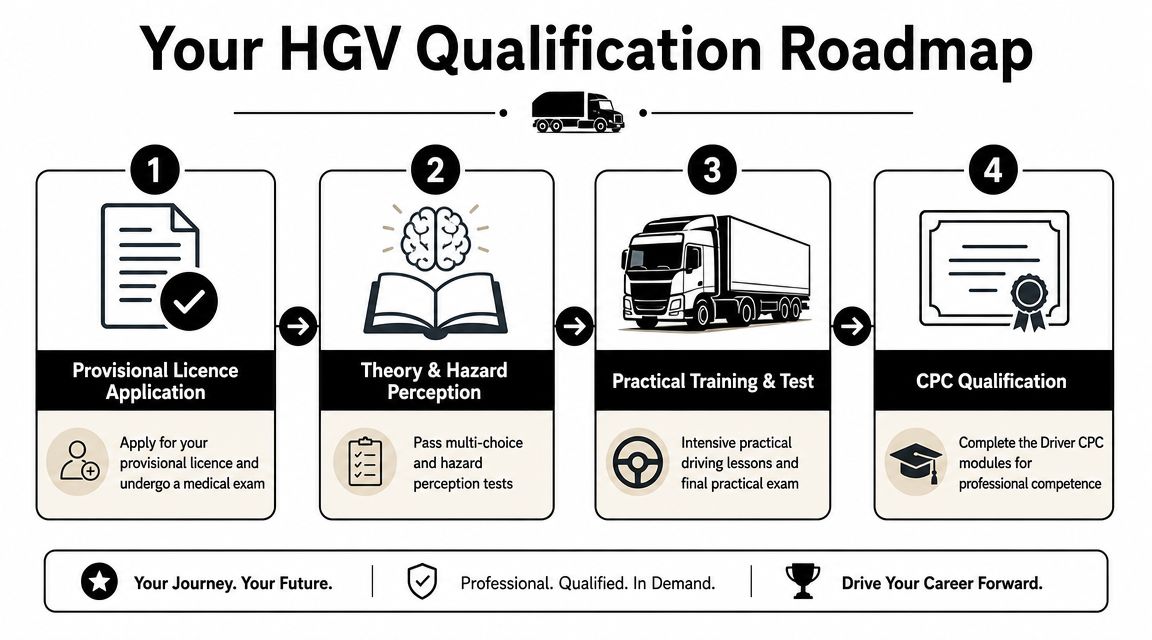
A lot of Coventry learners start with the same assumption. They picture themselves booking a few days of driving lessons, passing a test, and then applying for jobs. The actual process is longer than that, and it runs in a set order. If one stage is late, the next stage waits.
The easiest way to understand it is to treat it like a chain. Your medical and licence paperwork come first. Theory sits behind that. Practical training comes after the licence stage is in place. Driver CPC is the part that turns a driving pass into legal eligibility for paid work.
Step one starts with forms and your medical
Your first job is the D2 and D4 stage. The D4 is completed through a medical assessment. The D2 is the application for provisional entitlement on the right HGV category.
This part feels like paperwork, so some learners treat it as a side task. In practice, it sets the pace for everything else. A Coventry training provider explains on its HGV driver training page that provisional entitlement must be in place before the later training and test stages can properly move ahead. The same page also notes that practical Category C training is often delivered as a short, concentrated course to DVSA test standard.
That point matters. The driving course may only take a few days. The full qualification journey does not.
Step two is theory and hazard perception
Once your provisional entitlement is sorted, you can focus fully on theory. That usually means the multiple-choice test and hazard perception, plus any CPC theory elements your route requires.
Often, learners lose time without noticing. They book the medical, send the forms, then mentally wait for the driving part. A better approach is to use that waiting period for revision. It works much like preparing materials before a job starts on site. If the groundwork is done early, the later stage runs more smoothly.
Watch this for a useful overview of the process in action.
Step three is practical training and test
This is the stage commonly referred to as “HGV training.” You train in your chosen licence category and build the standard needed for test day. That includes observation, planning, road position, speed control, vehicle handling, and reversing or other off-road exercises where required.
For Coventry learners, the main thing to remember is timing. A short practical course does not mean the whole licence process is short. It only means the tuition block is concentrated. If your paperwork or theory is still outstanding, that short course can end up sitting in the middle of delays rather than finishing the journey quickly.
A sensible order looks like this:
Book the medical early so the first admin stage is under way.
Send off the D2 and D4 promptly to avoid holding up your provisional entitlement.
Study for theory while you wait, rather than leaving revision until later.
Book practical training at the right point, once the earlier stages are confirmed.
Step four is Driver CPC
Passing the driving test and being ready for paid work are not always the same thing. For many new drivers, Driver CPC is the part that completes the picture. It is what allows you to work legally as a professional driver for hire or reward.
That is why the timeline matters so much. Learners often compare providers only on the price or length of the practical course, but your real plan should cover the full route from medical to work-ready status. If you want the stages set out clearly in one place, this guide to getting an HGV licence is a useful reference.
Judge your timeline by the full sequence, not just the days spent behind the wheel.
That one change in mindset helps you plan your booking dates, your budget, and your route into a first driving job far more accurately.
Budgeting for Your HGV Licence in Coventry
A lot of Coventry learners start with one simple question. What will I spend? The confusing part is that the first number you see is often only one slice of the full journey.
A training quote usually highlights the practical course because that is the visible part, much like pricing a house move by the van alone and leaving out boxes, fuel, and insurance. To budget properly, you need the full route cost from first form to being ready to take paid work.
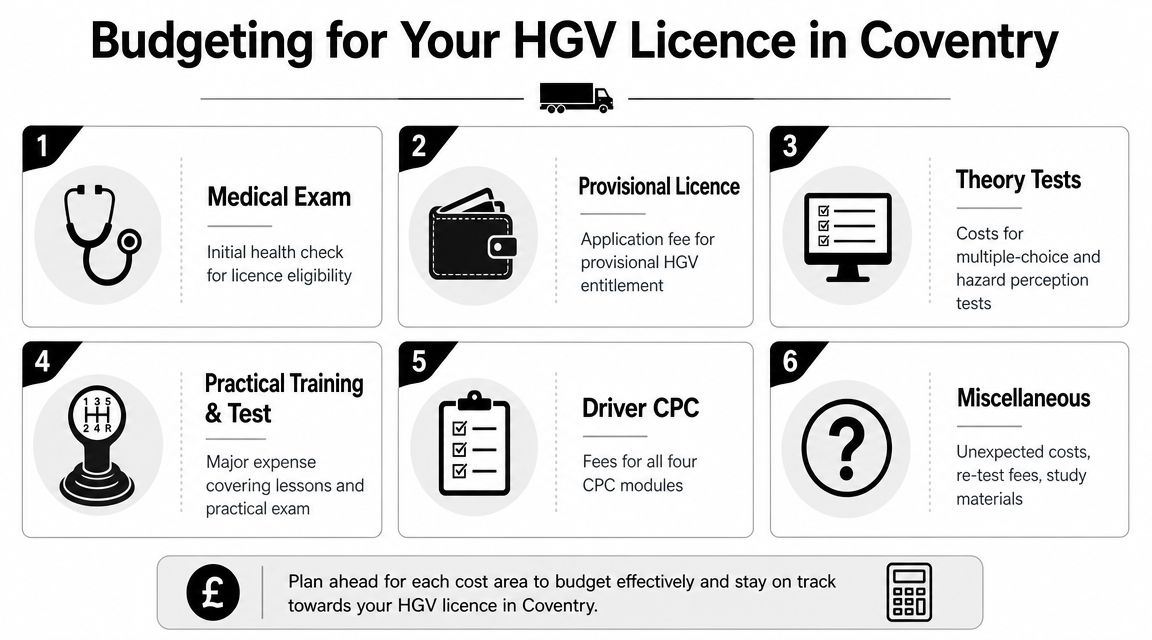
This summary graphic shows the main areas to account for:
The headline fee is only part of the picture
One Coventry training page states that HGV training can cost from £1,900 to £4,999, but it also explains that packages vary and may include or exclude items such as the medical, theory support or testing, and CPC elements. It also notes that bespoke packages can leave out parts a learner doesn't need, which is why a blended figure can be misleading.
That is normal in this market. One learner may need the full process from scratch. Another may already have theory passed, provisional entitlement in place, or CPC completed. The right question is not whether one provider looks cheaper at first glance. The right question is what that quote covers, and what you would still need to pay elsewhere.
Split your budget into stages
Breaking the cost into stages makes comparisons much clearer:
Medical stage The doctor's examination needed before your licence process can move ahead.
Licence application stage Your provisional paperwork and any admin tied to that step.
Theory and hazard perception Revision materials, test booking, and possible rebook fees.
Practical training and test The on-road tuition, vehicle use, and test appointment. This is usually the biggest single cost.
Driver CPC elements The part that turns a passed test into work-ready status for many new drivers.
Possible extras Travel to the training site, time off work, repeat tests, and any add-ons not listed in the first quote.
This staged view helps you compare like with like. Without it, you can end up comparing a partial package from one provider with a more complete package from another and assuming the cheaper one offers better value.
Questions worth asking before you book
Use a short checklist and get clear answers in writing if you can:
What is included in this price? Ask whether it covers only tuition or also the medical, theory, tests, and CPC.
What would I pay if I need a retest? That can change your total spend more than learners expect.
Is this package built for my current stage? If you have already completed theory or another requirement, you may not need a full package.
How is payment structured? A lower quote can still be hard to manage if most of it is due upfront.
A useful budget is not “How much is the course?” It is “What will I spend from first form to first job-ready qualification?”
That one question keeps you focused on the full sequence, not just the days in the cab.
Some learners also need a payment plan rather than a single lump sum. HGV Learning, for example, states that it offers in-house payment plans over 10–12 months as part of its broader training pathway. For someone in Coventry changing careers while still covering rent, bills, and travel, that can make the process more manageable.
There may also be funded routes available in England through Skills Bootcamps, depending on local availability and eligibility. As noted earlier, those schemes can reduce or remove training costs for some new drivers, so they are worth checking before you commit your own money.
The practical course is the centre of the process, but it is not the whole budget. Once you price the journey in order, stage by stage, the all-in cost becomes much easier to understand and much easier to plan for.
Finding the Best Local Training Partner
Two training providers can look similar on the surface. Same licence category. Similar-looking trucks. Similar course wording. But the quality of instruction, route preparation, and local test knowledge can make a real difference to your result.
That's especially important if you're aiming for C+E work around Coventry.
One local training source for the Coventry and Garrets Green test-centre catchment lists a DVSA pass rate of 41.4% for Category C+E, while the provider reports a 55.3% pass rate. That's a gap of 13.9 percentage points on this Category C+E training page. You don't need to overcomplicate that figure. It tells you that coaching quality matters.
What to check before booking
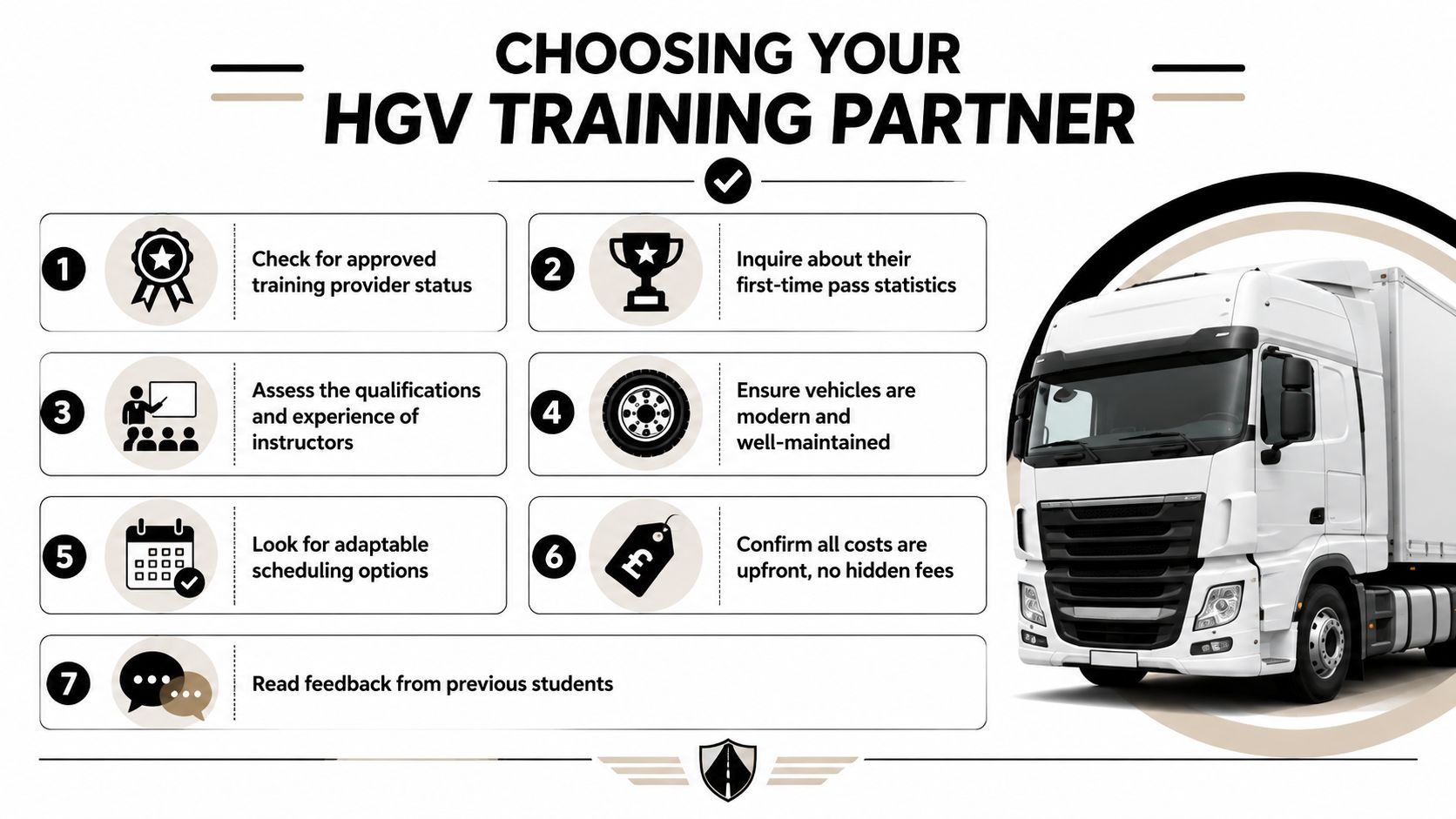
Use a simple checklist when comparing local providers:
Pass rate context Don't just ask, “What's your pass rate?” Ask which category it relates to and which test area it covers.
Local route knowledge A trainer who knows the local catchment can prepare you for the standards and habits that matter on test.
Vehicle condition Training in a well-maintained vehicle helps you focus on the drive, not on wrestling with poor equipment.
Clarity on package content You should know exactly what is and isn't included before paying.
Signs of a provider that suits beginners
Some providers are technically competent but not beginner-friendly. That's a problem if you're coming from a car-driving background and need calm, structured guidance.
Look for these signs:
They explain the sequence clearly instead of just selling lessons.
They answer practical questions directly about medicals, theory, and test booking.
They talk in job outcomes rather than only licence jargon.
They assess your starting point realistically so you don't pay for the wrong path.
If a provider can't explain your route in plain English before you book, they probably won't make the training feel any clearer once you start.
Why coordination matters as much as instruction
A strong training partner doesn't only teach reversing, roadcraft, or coupling routines. They also help keep the process organised. That includes timing, paperwork, and making sure you aren't left waiting because one earlier stage was missed.
For some learners, a coordinator model works well because it joins the admin stages to local practical training. That can suit people who want one point of contact rather than chasing separate bookings themselves.
The best local partner for HGV training in Coventry is the one that gives you a realistic plan, transparent pricing, and proper preparation for the category you need. Fancy branding matters less than organised support and test-ready instruction.
Advancing Your Career with Specialist Training
A lot of new drivers in Coventry reach the same point after passing. They have the licence, they have the first job in sight, and then they realise the licence is only the foundation. The next choices shape what your week looks like, what loads you can handle, and how much variety you have in the roles you apply for.
Specialist training works like adding tools to a toolbox. Your HGV licence lets you enter the trade. Extra qualifications let you take on more specific work.
Two common examples are ADR and HIAB. ADR is for carrying hazardous goods. HIAB is for operating a lorry-mounted crane. If you picture the difference between a general builder and one with extra plant tickets, it is a similar idea. Both can work, but the one with the added qualification can take on a wider range of jobs.
These extra tickets are not the first thing every new driver needs. They make more sense once you know the type of work you want.
For example, a driver starting with general haulage around Coventry, the M6 corridor, or local depot work may be better off getting some road time first. A driver aiming for builders' merchants, utilities work, or regulated deliveries may benefit from planning ADR or HIAB earlier, because those roles often ask for them from the start.
Driver CPC stays in the picture throughout your career as well. As noted earlier, if you want to drive professionally, CPC requirements need to be kept up to date. That is separate from adding specialist tickets, but both affect the jobs you can take.
A sensible order usually looks like this:
Get your core licence and become employable for entry-level HGV work.
Build experience with daily checks, route planning, reversing, paperwork, and depot routines.
Add specialist training that matches the jobs you want to move into.
Keep your CPC requirements current so your licence remains usable for paid driving work.
This matters for budgeting too. The practical course fee gets you only part of the way to your longer-term earning plan. If you already know you want crane work or hazardous goods work, it helps to treat those future qualifications as part of your full training timeline and costs, not as an unexpected extra later.
Once you start working, communication becomes part of the job as much as driving. You will deal with depot instructions, delivery updates, handovers, and route changes. If you want a feel for the kind of systems operators use, this guide can help you find communication apps for logistics teams.
The strongest career plan is usually the simplest one. Get qualified. Get settled in the right first role. Then add the specialist training that fits the work you want more of.
Your Future on the Road Starts Here
A lot of people delay this step because the process looks bigger than it is. Once it's broken down properly, it's straightforward. You sort the medical and forms. You get your provisional entitlement moving. You prepare for theory. You complete practical training. You make sure your professional qualification requirements are in place. Then you start applying for the kind of work your licence allows you to do.
That's why clear planning matters so much with HGV training in Coventry. The practical course is only one part of the journey. The key difference comes from understanding the full timeline and the actual budget before you commit.
This is also the stage where your wider work habits start to matter. Once you're in the industry, communication, job coordination, and depot handovers become part of daily life. If you want a feel for the kind of tools operators use, this guide can help you find communication apps for logistics teams.
A training pathway should leave you job-ready, not just test-ready.
If you want support from the first enquiry through to training and then into work, ask direct questions. Who handles the paperwork? Who books the stages? What support is there if you need to spread the cost? Is there help with finding work once you've passed? Those questions will tell you very quickly whether you're looking at a simple driving course or a complete route into a new job.
If you want a clear next step, speak to HGV Learning. They coordinate the full process, including medical and documentation support, theory preparation, locally arranged practical training, and post-qualification recruitment guidance, so you can move from first enquiry to job-ready with a more organised plan.