You might be looking at job boards late at night, typing in HGV Cat C jobs and wondering whether this is a sensible move or a leap into the unknown. That's a common place to start. Many people come to Cat C after warehouse work, delivery work, construction, retail, the forces, or an office job they've grown tired of.
What usually helps is seeing the whole route clearly. Not just how to get a licence, but how to turn that licence into paid work, how to avoid weak applications, and how to make yourself look like a safe bet to a transport manager.
What a HGV Category C Job Really Involves
A Category C job usually starts before the engine does. You arrive at the yard in the dark, check the vehicle, confirm the load, review the route, and sort the paperwork before the first mile counts. By the time the truck is rolling, part of the work is already done.
A Category C, often called Class 2, means driving a rigid vehicle rather than an artic. These jobs sit at the centre of day-to-day UK transport. You'll see them in distribution, construction, utilities, municipal work, removals, and specialist delivery, where the vehicle needs decent carrying capacity but the route still calls for the flexibility of a rigid.
Drivers coming in from car, van, or warehouse roles often expect long uninterrupted spells behind the wheel. Some shifts are like that, but many are not. A Cat C role usually combines driving with daily vehicle checks, route discipline, load awareness, paperwork, customer handovers, and defect reporting. In some jobs, the vehicle is the easy part. The pressure comes from timed drops, awkward access, manual handling, or getting the paperwork right first time.
Route planning and discipline so delivery windows are met without rushing
Load and paperwork checks to avoid wrong drops, damaged goods, or rejected deliveries
Customer contact at depots, sites, yards, stores, or residential addresses
End-of-shift admin such as defect reporting, delivery records, and debriefs
This is why transport managers hire for more than licence entitlement. They want a driver who turns up on time, protects the vehicle, follows site rules, keeps calm under pressure, and gives customers confidence that the job is under control.
A good Cat C driver is calm, methodical, and consistent. Safe driving gets you through the gate. Professional habits keep you in work.
Where Cat C work usually fits
If you are scanning vacancies, Cat C often appears in roles like these:
Type of work
What it often involves
Distribution
Multi-drop store or depot deliveries, cage work, pallet networks
Construction
Builders' merchants, site drops, plant, aggregates, or materials
Utilities
Equipment transport, support vehicles, planned service runs
Public services
Refuse, highways, council fleet, or other procedure-led roles
Each type of work has trade-offs. Distribution can offer steady demand and a clear routine, but shifts can be tight and physically busy. Construction work may involve fewer drops, but site access, uneven ground, and load security need strong awareness. Public service fleet roles often have defined procedures and regular patterns, though entry standards can be stricter.
That is what makes Cat C a solid starting point for many new HGV drivers. It gives employers a way to assess your standards in a rigid vehicle first, and it gives you a route into paid work where reliability, safety, and attitude matter just as much as passing the test.
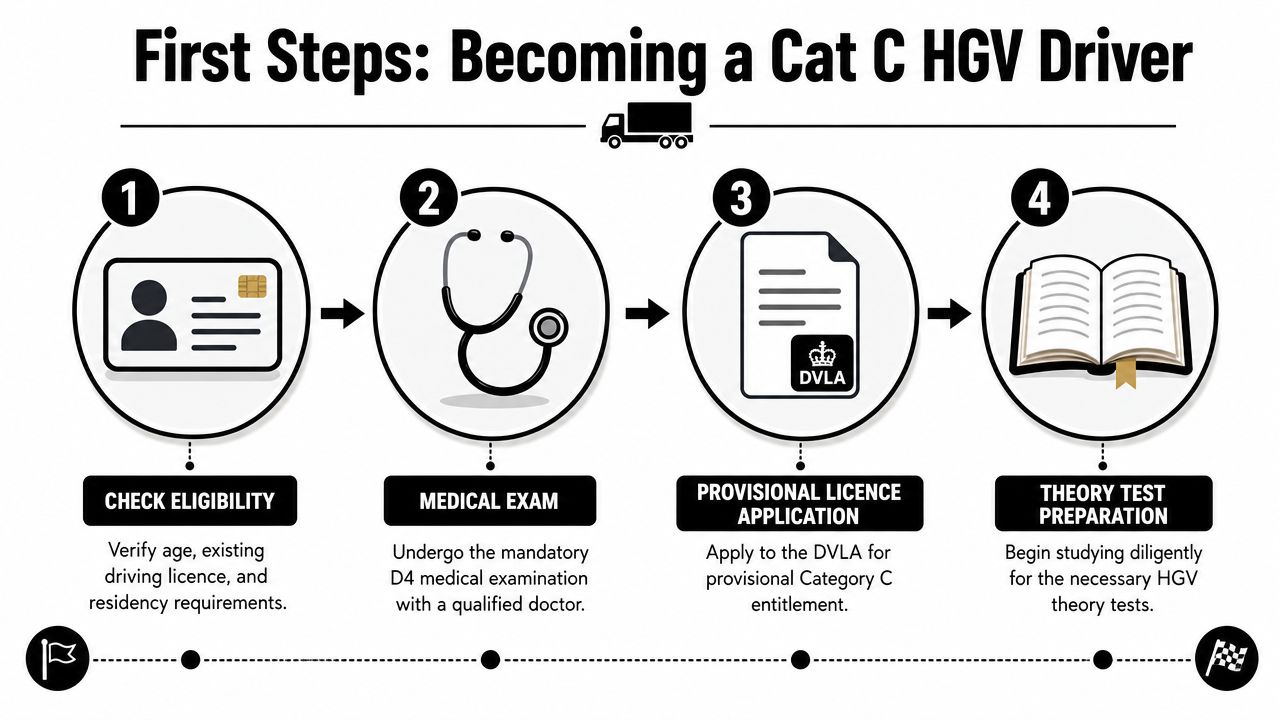
Your First Steps to Becoming a Cat C Driver
Before you book training, get the basics right. The early stage is mostly paperwork and eligibility, and small mistakes here can slow everything down.
Start with legal eligibility
You need to confirm that you meet the basic requirements before anything else. The first check is simple. You must be over 18 and hold a full car licence before moving into the Cat C route.
Then comes the medical side. Commercial driving carries more responsibility than ordinary car use, so the DVLA process asks for evidence that you're medically fit to drive this type of vehicle safely.
Get the D4 medical sorted
The D4 is your medical examination form. A qualified doctor completes it after checking the health issues relevant to vocational driving. Treat this as an early priority, not a last-minute errand. If the medical is delayed, the whole process is delayed.
The second form is the D2. That's the application for your provisional HGV entitlement. In simple terms, the D4 proves medical fitness and the D2 tells DVLA what entitlement you're applying for.
A practical guide to the licence route is available in HGV Learning's overview of what a Cat C HGV licence is.
Keep the sequence clean
Most avoidable delays happen because people rush the forms or assume the training provider will sort every detail automatically. Keep your process tidy:
Check your licence details and make sure your personal information is current.
Book the medical early so the D4 doesn't become the bottleneck.
Complete the D2 carefully and double-check every field before sending it.
Wait for provisional entitlement before locking in the practical side.
After that, your focus shifts to theory preparation. This is a good point to watch the process in action:
What works and what doesn't
What works is treating the admin stage like part of the job. Cat C driving is a compliance-based trade, so being organised from day one helps.
What doesn't work is assuming the hard part starts only when you get into the cab. For a lot of candidates, the first test is whether they can follow a regulated process properly.
Mastering the HGV Training and Qualification Pathway
A candidate can look ready on paper, book training quickly, and still stall halfway through because they do not understand how the qualification stages fit together. The Cat C route is structured for a reason. Employers want drivers who can follow a regulated process, pass the right tests in the right order, and arrive job-ready rather than half-qualified.
There are several ways into the trade, including specialist training, employer-led routes, and apprenticeships, as noted earlier. What matters in practice is choosing a path you can finish cleanly, with the right support around theory, practical training, and CPC. The people who progress fastest usually are not the ones who rush. They are the ones who keep the sequence straight and treat each stage like part of the job.
The four parts you need to understand
Professional Cat C work depends on passing all four Driver CPC modules. They are connected, and weak preparation in one stage often shows up again later in training.
Module 1 covers theory and hazard perception.
Module 2 tests case-study judgement in realistic work scenarios.
Module 3 is the practical driving test.
Module 4 checks whether you can demonstrate daily safety and compliance tasks properly.
Theory and case studies test professional judgement. You need to read a situation, spot the risk, and choose the safe, legal response without hesitation. That is the standard employers care about too.
On the practical side, examiners are checking far more than whether you can move a vehicle from A to B. They watch observation, lane discipline, mirror use, speed control, planning, road position, and how you respond to instructions under pressure. A learner with tidy habits and a calm head is usually easier to put right than someone who tries to force progress with overconfidence.
Practical rule: Build repeatable habits. Mirror checks, measured speed, clear positioning, and steady decision-making pass more tests than flashy driving ever will.
How to prepare without wasting time or money
Poor revision usually looks the same. Candidates bounce between apps, memorise isolated answers, and turn up for lessons without a routine. Then they wonder why progress feels uneven.
A better method is to train in layers. Get the theory secure first. Use case studies to improve decision-making. Use practical lessons to build habits you can repeat under pressure. Leave enough time for Module 4 so you can explain safety steps clearly rather than reciting them badly.
Stage
Best approach
Theory revision
Use one consistent question source and review weak topics properly
Case studies
Learn the logic behind the answer, especially legal and safety decisions
Practical lessons
Repeat checks, mirror routine, road position, and manoeuvres until they become automatic
Module 4
Practise giving clear, ordered explanations of safety procedures
One practical option in the market is HGV Learning, which coordinates documentation, theory preparation, and locally arranged practical training. That joined-up approach suits candidates who want one provider handling the main steps instead of piecing the route together themselves.
Employers are also getting better at shifting from credentials to capabilities. Passing matters, but so does how you trained. A driver who can explain defects properly, follow site rules, and stay composed on assessment day is easier to hire than someone who only knows how to say they passed.
Add extra tickets at the right time
New drivers often ask about ADR, HIAB, Moffett, or Class 1 progression before they have finished the core Cat C route. That order is generally incorrect.
Get the Cat C licence and CPC completed first. Then look at specialist add-ons based on the type of work you want. If your target is general haulage, builders merchants, pallets, municipal work, or food service, a clean Cat C pass with solid habits is enough to open the first door. More tickets help later, once you know which jobs are worth chasing.
Building Your Professional Driving Toolkit
Passing your test gets you into the market. It doesn't make you competitive by itself.
That distinction matters because most applicants describe themselves too narrowly. They write “newly qualified Cat C driver” and stop there. A transport office reads that as licence achieved, but ability unknown. You need to show how you'll perform on an actual shift.
Compliance gets checked first
Current UK Cat C adverts commonly ask for a full UK Category C licence, no more than 6 penalty points, a valid Driver CPC, and enough English and numeracy to manage documentation and delivery accuracy, based on live patterns visible in Indeed Cat C driver listings.
That tells you how hiring works. The first filter is compliance, not personality. If your application doesn't make your licence status, CPC currency, and paperwork ability obvious, it can be rejected before a manager even considers your attitude or road sense.
What a stronger CV looks like
A useful Cat C CV highlights the work around the wheel, not just the wheel itself. Include evidence of:
Daily vehicle responsibility such as checks, defect reporting, or safety awareness
Time-critical work where lateness had real consequences
Customer-facing reliability in delivery, site, or service roles
Manual-handling experience if the role includes multi-drop or physical unloading
Numeracy and paperwork where accuracy mattered
If you've worked in warehousing, removals, van delivery, plant hire, retail distribution, or site work, you probably already have transferable evidence. The mistake is failing to translate it into transport language.
Your CV should read like a logistics professional's CV. Not a general CV with “Cat C licence” added near the top.
Why extra tickets matter
Once you've got your first role in sight, specialist training starts to move the needle. ADR can open hazardous-goods work. HIAB can help with builders' merchants, construction supply, and site delivery. Those aren't beginner essentials, but they can widen your options once your core qualification is in place.
There's a bigger hiring shift behind this too. Employers increasingly look beyond certificates alone and focus on usable skills. If you want a broader view of that thinking, this piece on shifting from credentials to capabilities is worth reading. It matches what transport teams already do in practice. They ask, “Can this person handle the route, the paperwork, the yard, the customer, and the pace?”
How to Find and Win the Best HGV Cat C Jobs
The hardest part for many new drivers isn't passing. It's finding the first employer willing to back a fresh pass.
That's because adverts are often vague. A vacancy may say Class 2 Driver without telling you whether newly qualified drivers are welcome, whether warehouse duties are part of the shift, or whether the job is mostly local drops or something broader. Live market patterns on CV-Library HGV driver listings show exactly that problem.
Read the advert like a transport planner
When you open a vacancy, don't just look at the title and pay band. Read for clues.
Good signs for a newer driver often include:
Mentions of training or induction
References to driver/warehouse or yard support
Local or regional delivery patterns
Language about reliability, service, and flexibility rather than years of experience
Roles that combine driving with warehouse or yard work can be a strong entry point. Some candidates avoid them because they want “pure driving”. That can be a mistake. Combined roles let you build credibility fast, learn site routines, and become known to a transport manager before moving into more dedicated driving runs.
Where to search properly
Use a mix of channels rather than one job board. Search major boards, specialist HGV recruiters, local fleet operators, builders' merchants, municipal contractors, and utility suppliers.
If you want a practical starting point for local searches, HGV Learning has a useful guide on finding lorry driver jobs near me.
It also helps to think like the company advertising. A clear, trustworthy vacancy page can make a real difference to response quality. Even outside transport, firms that invest in straightforward recruitment pages tend to present roles better. You can see the logic in examples like Northpoint Web design for Utah businesses, where the underlying lesson is clarity. Better structure attracts better-fit applicants.
Interview and driving assessment habits that matter
Employers usually want evidence that you'll be safe, punctual and easy to manage. Expect questions around:
Interview topic
What they want to hear
Start times
That you understand early starts and will turn up reliably
Defects and checks
That you take vehicle safety seriously
Paperwork
That you can complete records accurately
Route pressure
That you stay calm and don't panic when delays happen
Customer contact
That you can represent the company properly
For any practical assessment, the strongest candidates do simple things well. They listen carefully. They don't argue. They use mirrors consistently, manage space early, and keep their pace sensible.
Don't try to impress an assessor with speed. Impress them by looking controlled from start to finish.
Understanding Pay Shifts and Your Career Path
You pass your test, get your first offer, and the hourly rate looks decent. Then critical questions begin. How many hours will you work in practice, how often will the shift run over, and what sort of life does that job give you from Monday to Friday?
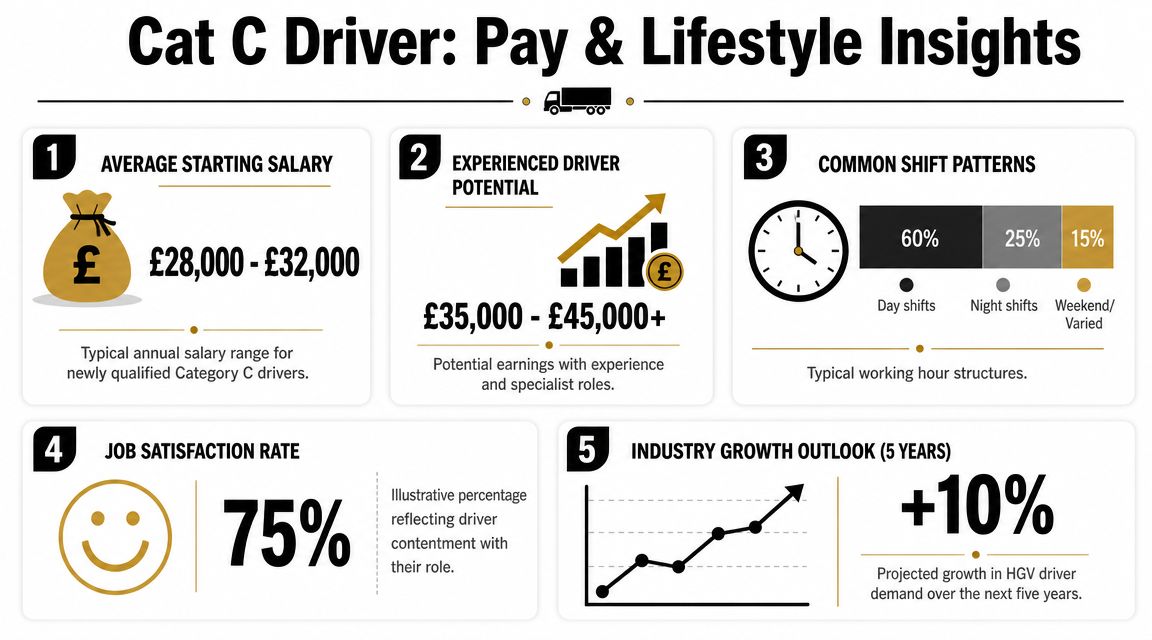
Newly qualified Cat C drivers typically start around £16 to £20 an hour, with higher earnings available as drivers gain experience or move into C+E work. Rates in London and the South East often come in above the wider UK average. For the full picture, see our average HGV driver salary guide. That gives you a useful starting point, but no salary guide can tell you whether a specific job is well paid for the hours, pressure, and physical effort involved.
Headline pay versus real earnings
A posted rate only tells part of the story.
I have seen new drivers accept a role because the top-line number looked strong, then realise the week includes unpaid waiting, regular overruns, or heavy handball that makes the money feel very different by month two. A slightly lower hourly rate on a well-run contract can leave you better off overall if the start times are consistent, overtime is paid properly, and the work is organised well.
Before accepting any Cat C role, ask:
Is the pay hourly, salaried, or day rate
When does overtime start, and at what rate
Are breaks paid or unpaid
How often do shifts overrun
Are nights, weekends, or bank holidays part of the standard pattern
Are you PAYE or working through an agency arrangement
Do you cover any regular costs yourself, such as parking or travel to a remote depot
Those answers matter because two jobs advertised at a similar annual figure can produce very different take-home pay and very different stress levels.
The lifestyle side
Shift pattern is where many new drivers make a poor first choice. They focus on being home every night and miss what the day involves.
A local rigid job might sound ideal, but local does not always mean easy. Multi-drop can mean tight delivery windows, reversing into awkward yards, repeated manual handling, and constant customer contact. On the other hand, a cleaner trunk-style rigid role may involve less physical work and fewer drops, but it can still mean anti-social start times and long periods on the road.
The right job depends on what you can sustain week after week. Early starts suit some drivers. Physical store delivery suits others. Some want routine and a predictable run sheet. Others are happier with variety if the company plans the work properly.
Why many drivers begin with Cat C
Cat C is where a lot of solid driving careers start because it gives you real commercial experience without jumping straight into artic work. You learn time discipline, defect reporting, load awareness, customer standards, and how to keep your head when the day stops going to plan.
That experience has value. Employers looking at C+E candidates often prefer drivers who already understand the basics of transport work in a live operation, not just the licence category itself. A steady year or two in the right Cat C role can put you in a much stronger position for higher-paid work later.
A sensible career plan
The best long-term results usually come from a simple plan:
Get qualified and choose your first role for experience, not just rate
Build six to twelve months of reliable work with clean paperwork and safe habits
Learn the sector properly, including customer expectations, loading routines, and depot standards
Add extra qualifications or tickets only when they match the work you want
Step up to C+E when you have enough grounding to make that upgrade pay off
That approach is less exciting than chasing the biggest advert in week one, but it is how many drivers build a stable career.
If you want help turning the full process into a clear plan, HGV Learning supports candidates from medicals and licence paperwork through theory, practical training, and recruitment guidance, so you can move from first enquiry to first job with fewer gaps in the process.
What Age Can You Start HGV Driver Training? A 2026 UK Guide to Licence Age Requirements
If you're asking what age you can start HGV driver training, the honest answer depends on which licence you're after. A C1 licence, covering vehicles...