You're probably at the stage where you've had enough of jobs that go nowhere. You want decent training, a licence that means something, and a line of work that feels solid. In Grimsby, that usually means you've noticed just how much freight moves through the area, from the docks to food distribution, construction supply, and day-to-day haulage out on the A180 and beyond.
That's where HGV training in Grimsby starts to make sense. Not as a vague idea, but as a practical route into regulated professional driving.
You don't need more hype. You need straight answers. How long does it take. What paperwork slows things down. What does the full journey really cost once you include more than the headline course fee. And once you pass, what kind of work can you get around Grimsby and North East Lincolnshire?
Your Roadmap to a New HGV Career in Grimsby
A lot of new drivers come into this looking for two things. Stability and a clear path. They don't want another course that leaves them half-finished. They want to know the route from first enquiry to sitting in a cab earning properly.
That route is more structured than many people expect. You're not just learning to handle a larger vehicle. You're entering a professional system with legal checks, test stages, and ongoing compliance. That's one reason proper HGV training in Grimsby matters. Good training doesn't just help you pass. It prepares you for the reality of the job, where planning, paperwork, safety, and timekeeping all count.
What a working driver actually needs
Passing the driving test is only part of the picture. Local employers want drivers who understand the day-to-day side of transport. That includes load awareness, walk-round checks, dealing with delays, and basic operational discipline.
If you're new to logistics, it also helps to understand how transport businesses run behind the scenes. A simple guide to route planning and proof of delivery gives useful context on the systems many operators rely on after the vehicle leaves the yard.
For a broader view of the licence path itself, the HGV driver training guide is a useful starting point.
Practical rule: Choose training that reflects the job, not just the test. A driver who can reverse neatly but can't manage paperwork, checks, or customer-facing responsibility will struggle in work.
What works and what wastes time
The people who progress fastest usually do three things well:
They start paperwork early. Delays often happen before training begins.
They treat theory seriously. Weak theory prep slows everything after it.
They budget for the whole route. A cheap headline price can turn expensive if key parts are missing.
What doesn't work is waiting until the last minute, booking training before the licence process is moving, or assuming every local job wants the same licence type. In Grimsby, the better decision is often the one that matches the work you want at the end.
First Gear Getting Your Paperwork in Order
The first stage feels boring compared with getting behind the wheel, but it decides how smoothly everything else goes. If your paperwork is right, training can move quickly. If it isn't, you end up chasing forms and losing momentum.
For most learners, the process begins with a D4 medical and a provisional HGV licence application. That's the gateway to the rest of your training.
Start with the medical
The D4 medical confirms you're fit to drive professionally. In practice, that means arranging an appointment with a GP or a provider that carries out driver medicals. The doctor checks the standards relevant to vocational driving and completes the D4 form.
This step matters for a reason. HGV driving isn't casual motoring. You're responsible for a large vehicle, long working periods, and road safety in real traffic.
A lot of learners put this off because it sounds complicated. It usually isn't. The hard part is often just booking it promptly and making sure the form is completed correctly.
Apply for provisional entitlement properly
Once the medical side is in hand, you move to the licence application. The forms need to be complete, consistent, and sent off without avoidable mistakes. If a detail is wrong, the delay can ripple through your entire plan.
Use this simple checklist:
Check your car licence first. Make sure your existing driving licence is valid and your details are current.
Book the D4 early. Don't wait until you've chosen training dates.
Read every form line by line. Small mistakes cause bigger hold-ups than expected.
Keep copies of what you send. If anything needs chasing, you'll know exactly what was submitted.
A motivated candidate can often move from provisional application to full qualification in 8 to 10 weeks, with the intensive practical part taking about five days.
Don't spend money in the wrong order
One of the most common mistakes is paying for the practical side too early. The better sequence is simple. Get the medical done. Get the provisional application moving. Then line up theory preparation and practical dates with confidence.
That order keeps your budget under control and avoids the frustration of having a training booking you can't use yet.
In Grimsby, local learners often want speed. That's fine, but speed comes from being organised, not from rushing at random. A clean paperwork start makes the rest of the route feel much more straightforward.
Mastering the Theory and CPC Requirements
A lot of Grimsby trainees hit the same wall. They get the medical sorted, send the licence application off, then assume the next step is just waiting for cab time. A week later they realise theory slots, CPC prep, and revision time all affect how quickly they can start earning.
This part decides whether your plan stays on schedule and on budget.
The three theory elements
Before practical training is finished, you are usually dealing with three separate knowledge tests. Each one checks a different part of the job.
Module 1a tests multiple-choice theory. That includes road law, signs, vehicle safety, load awareness, drivers' hours, and general operating rules.
Module 1b is hazard perception. The mark comes from spotting a risk as it develops, not when it becomes obvious.
Module 2 is the CPC case study test. It asks what a professional driver should do in real working situations.
Module 2 catches out plenty of otherwise capable candidates. The issue is not usually intelligence. It is mindset. People revise isolated facts, but the test rewards decisions you would make on an actual shift, with safety, legality, time pressure, and customer demands all in the background.
That matters in Grimsby because local entry-level work often involves early starts, port traffic, food distribution, or multi-drop pressure. Employers want drivers who can make sensible decisions before they ever hand over the keys.
Why CPC needs planning early
Driver CPC is part of getting on the road legally for paid driving work. It also affects how employable you are once you pass. If you need a clear explanation of the qualification itself, this guide on what Driver CPC training involves sets it out clearly.
The practical point is simple. Build CPC into your training plan from the start.
If you leave it until after theory or after practical training is booked, your timeline can stretch and your costs can creep up. That often means more travel, more time off work, and more chance of losing the training dates you wanted. For candidates around Grimsby who are trying to switch careers quickly, those delays matter just as much as the course fee.
Drivers must complete 35 hours of approved periodic training every five years, with each block lasting at least 7 hours, to maintain the Driver Qualification Card, as noted in this Driver CPC training reference.
How to prepare like a working driver
Cramming can get someone through a school exam. It is a poor way to prepare for HGV theory.
The strongest candidates I see in Grimsby keep it steady and practical. They do short revision sessions most days, use mock tests to find weak spots, and treat hazard perception as pattern recognition rather than guesswork.
A prep routine that works usually looks like this:
Revise in short sessions. Twenty to thirty minutes a day is more useful than one long session at the weekend.
Review wrong answers properly. Find out why the right answer is right, especially on compliance and safety topics.
Practise hazard clips with discipline. Click too late and you miss the score. Click wildly and you risk losing marks.
Answer CPC questions as a paid driver would. Choose the lawful, safe, workable option, even if it feels slower.
Road safety is the reason these standards are there. Research cited in the Huddersfield paper highlights the serious consequences of poor HGV operation, including thousands of collisions and casualties in Department for Transport data from the period discussed. The point for a new driver is straightforward. Theory and CPC are not box-ticking exercises. They are part of learning how to stay legal, stay employable, and make sound decisions under pressure.
Practical Training Behind the Wheel in Grimsby
The first time you climb into a Category C or C+E vehicle, the cab feels bigger than anticipated. The view is different. The mirrors need discipline. Your timing changes. Good training turns that first uneasy hour into something controlled and repeatable.
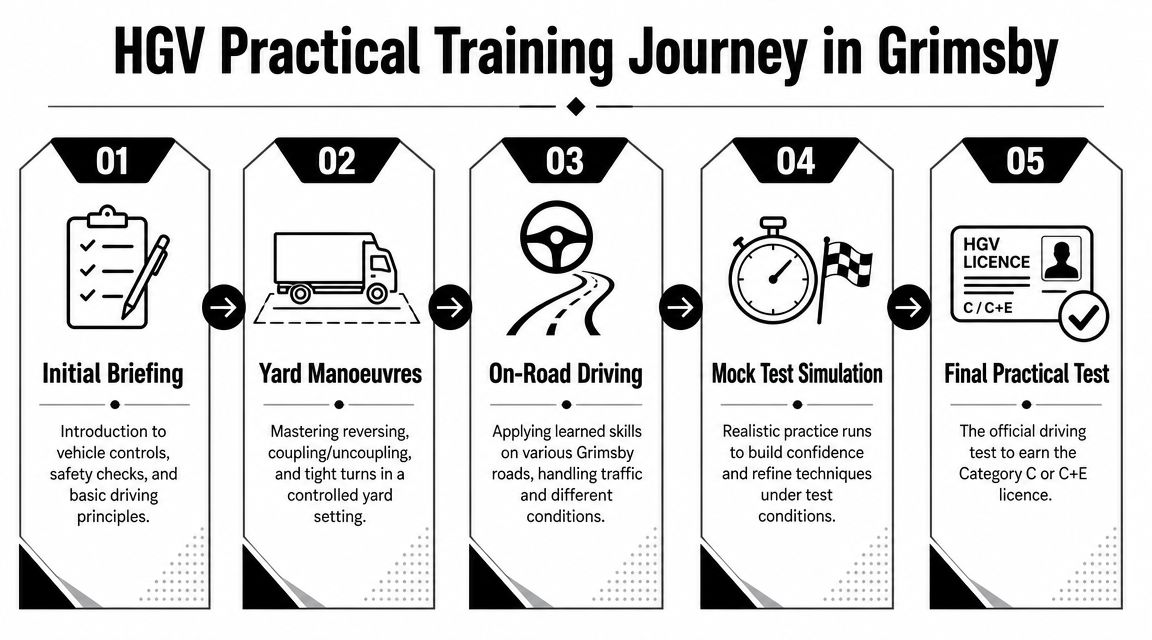
In Grimsby, the strongest practical courses don't try to impress you with speed alone. They build method. You learn the vehicle, then the yard work, then the road work, then test discipline.
A simple view of the training path looks like this:
What the first training days feel like
Most practical weeks start with familiarisation. You get used to the cab layout, mirrors, controls, seat position, and the flow of a proper walk-round check. New drivers often want to move straight into driving, but the early basics matter because they shape every decision afterwards.
Then comes yard work. Nerves first show up here.
You'll practise controlled manoeuvres, positioning, observation, and reversing. If you're going for C+E, coupling and uncoupling also become part of the routine. These skills aren't glamorous, but they're the bits that expose sloppy habits quickest.
The best practical trainees don't rush the reverse. They slow down, reset their mirrors, and make deliberate corrections early.
On-road training around Grimsby and Lincolnshire
Once the basic control is there, road driving starts to join up. At this stage, the vehicle begins to make sense in live traffic.
Training usually covers:
Roundabouts and lane discipline. Large vehicles punish late decisions.
Approach speed. New drivers often arrive too fast or brake too late.
Mirror routine. If your mirror use isn't consistent, the examiner will notice.
Road positioning. You need to claim the space the vehicle needs without drifting or hesitating.
Around Grimsby and the wider Lincolnshire road network, that means learning to handle mixed conditions. You may move between urban sections, busier connecting roads, industrial areas, and more open stretches where anticipation matters as much as steering.
Some candidates improve fastest once they've seen a realistic demonstration of the standard expected. This can help settle nerves before or during training:
What examiners are really looking for
The DVSA practical test isn't about flashy driving. Examiners want a driver who is safe, composed, observant, and consistent. They look for planning, smooth control, and proper response to what's happening around the vehicle.
That means a few things in real terms:
Use the mirrors before the vehicle moves.
Keep the vehicle settled. Harsh braking and rushed steering suggest weak anticipation.
Follow instructions calmly. One wrong turn isn't the issue. Unsafe reactions are.
Respect space. Kerbs, tight turns, and road positioning all matter.
A useful training week builds confidence without creating false confidence. That's the difference. You don't need to feel fearless. You need to feel prepared.
Your Complete Guide to HGV Training Costs and Funding
A lot of Grimsby learners reach this point with the same question. "Can I afford to do this, and will the job at the end pay it back?" That is the right question to ask before you book anything.
Course prices on adverts rarely show the full spend. In practice, your budget depends on whether you go for Cat C or C+E, whether your package includes CPC elements and test fees, how test-ready you are, and whether you need to spread the cost.
The figures you will see first
Industry guidance from RTITB's guide to HGV driver training says a new HGV driver can often complete initial training in about 5 days, with the practical Module 3 element commonly costing around £800 to £1,500, and the overall route to qualification often estimated at about £1,500 before ongoing periodic training.
Use that as a benchmark, not a promise.
Around Grimsby, I tell people to treat any headline quote as the starting point for questions. A lower price can still work out well if it includes the right elements. A cheap-looking package that strips out tests, medicals, CPC, or retest charges often ends up costing more.
Build your budget properly
An all-in budget usually needs to account for more than the training cab and test day.
Cost Component
Estimated Cost Range
Practical Module 3 training element
£800 to £1,500
Total route to qualification
Around £1,500
Average training and test costs in some cases
About £1,200
Earlier RTITB guidance also notes that some drivers may be fully licensed in as little as 8 weeks, and that average training and test costs can come in at about £1,200 in some cases. Your own route depends on licence category, package structure, availability of test dates, and whether you pass each stage first time.
The missing costs are usually the ones that catch people out:
Medical appointment and form completion
Theory study materials
Theory and hazard perception test bookings
Initial CPC elements
Practical test fees
Retest charges
Finance interest or admin charges
Ask for an itemised quote in writing. If a provider cannot show clearly what is included, treat that as a warning sign.
Budgeting tip: Compare providers on total cost to licence, not on the first number they put in an advert.
Funding routes and staged payments
Grimsby learners do have options if paying upfront is difficult. England offers funded routes in some areas, including Skills Bootcamps, which can reduce or remove part of the training cost depending on eligibility and local availability.
If you are weighing up self-funding against employer support or instalments, this guide to funding for HGV training is a useful place to compare the main routes.
One provider used by learners in this space is HGV Learning, which coordinates documentation, theory, practical training, and payment options including in-house plans over 10 to 12 months, according to the publisher information supplied for this article.
That sort of payment plan can help with cash flow, but check the full amount repayable before you sign. Spreading the cost may make training possible now, though the final bill can be higher if charges apply.
What matters most for Grimsby drivers
Cost only makes sense in relation to job prospects. In Grimsby and the wider Humber patch, there is regular demand linked to port traffic, food distribution, warehousing, tanker work, container movement, and general haulage across Lincolnshire and into South Yorkshire. That demand is why many learners here choose C+E if their budget allows it. It costs more at the start, but it often gives access to a wider spread of vacancies.
Cat C can still be the right choice. It suits some local delivery, rigid work, and entry routes well. The trade-off is simple. Lower training cost now can mean fewer job options and slower wage growth later.
Questions to ask before you pay anything
Keep it straightforward:
What exactly does this quote include?
Are theory tests, CPC, and practical test fees included?
What will I pay if I need a retest?
What happens if a DVSA date changes?
How much will finance add to the total?
Do you train me for the licence I want, or the one that suits your diary?
That last point matters more than people think. A provider should build the plan around the work you want in Grimsby, not just the easiest package to sell.
Boosting Your Earnings With Specialist Licences
Passing Cat C or C+E gets you into the trade. Specialist tickets shape what kind of career you build after that.
In the Grimsby and Humber area, the smartest next step often depends on the work around you. A general haulage role suits some drivers well. Others can widen their options by adding qualifications that fit local industry.
Which specialist routes make sense locally
ADR can open doors where hazardous goods move through fuel, chemical, or specialist distribution work. It isn't for everyone, but it gives you access to jobs that need more than a standard licence.
HIAB matters where lifting and delivery combine. Builders' merchants, construction supply, and site delivery roles often value a driver who can do more than arrive at the gate and wait for someone else to unload.
Telescopic handler training sits slightly differently because it links driving with plant and site work. For some people, that crossover makes them more useful to construction, utilities, and yard-based employers.
The trade-off most learners miss
A lot of new drivers assume the highest licence category alone does all the work. It doesn't. Some employers care just as much about reliability, CPC status, flexibility, and whether you can handle a specialist task without drama.
That's why a narrower but more targeted skill set can sometimes produce better opportunities than a broad plan with no clear direction.
A licence gets you through the door. A specialist qualification can decide which doors open first.
Build in stages, not all at once
The practical way to do this is simple:
Get the main licence sorted first. Don't overload your first training phase.
Watch local vacancy patterns. The right add-on depends on actual work nearby.
Add specialisms with purpose. Choose the qualification that connects to the sector you want.
That approach keeps your spending sensible and gives you a cleaner story when you speak to employers. You're not just qualified. You're useful in a specific part of the market.
Finding Your First HGV Driving Job in Grimsby
The licence must now lead to work. That's the point of the whole process.
Many online guides stop at the pass certificate, but local job reality matters more than generic encouragement. It’s also true that most generic guides don't connect training to local employer demand in areas such as port logistics, food distribution, and construction, and a real-world guide needs to address where graduates can work and what those employers value.
Where new drivers usually find openings
In and around Grimsby, new licence holders often look at a few obvious sectors first.
Port-related logistics brings container, freight, and supporting transport movement linked to the Humber.
Food production and distribution is a natural fit in this area because supply chains need dependable transport.
Construction and builders' supply can suit drivers with HIAB or those willing to add it later.
General haulage and multi-drop work often gives newer drivers the chance to build time and routine.
The point isn't that every company hires in the same way. It's that your licence choice should line up with the type of operator you want to work for.
What employers notice quickly
A new pass can still be a strong candidate if they present properly. Employers usually look beyond the licence card.
They tend to value:
A tidy, honest CV
A current CPC position
Good attitude to vehicle checks and paperwork
Reliability and shift flexibility
Professional communication
If you're reviewing an offer, it also helps to understand the paperwork on the employer side. A plain-English guide to essential employment contracts for businesses gives useful background on how terms are typically formalised.
Don't apply as if the licence alone sells you. Apply as someone ready to join a transport operation and make life easier for the planner, the transport manager, and the customer.
How to improve your chances after passing
The strongest first moves are usually practical, not clever.
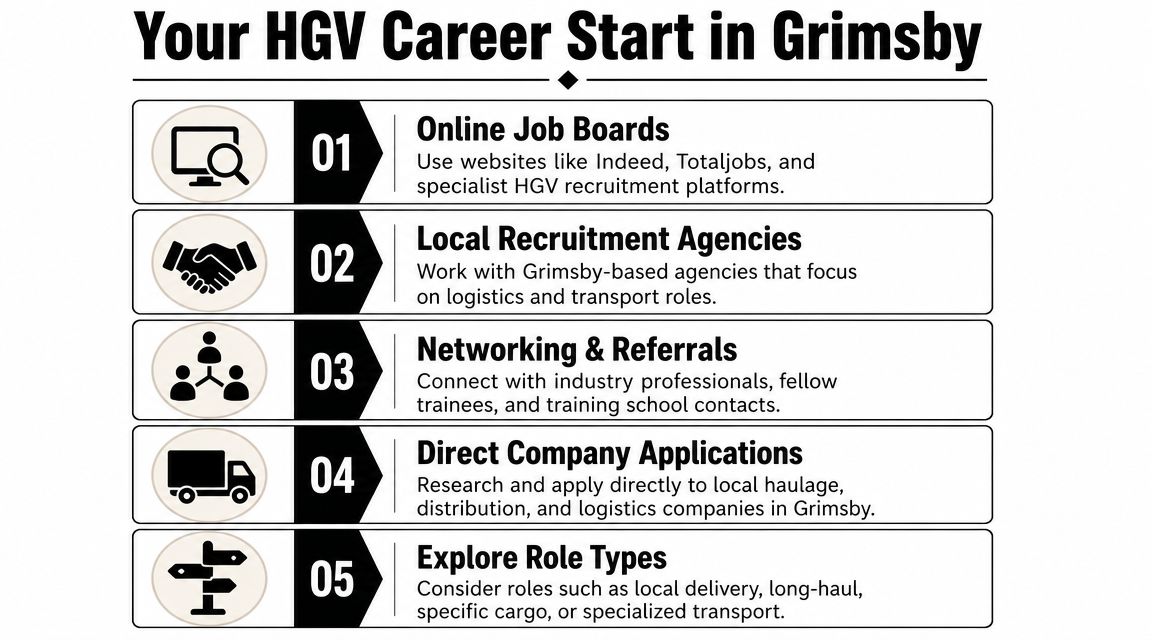
Register with local recruitment agencies that handle logistics roles.
Apply direct to transport firms, merchants, and distribution businesses.
Tell your training contacts you're available. Referrals still matter.
Be open on role type. Local work, nights, rigid work, and support roles can all build valuable experience.
This is also where job-matching support can help if your training coordinator offers it. Some learners need more than a licence. They need help translating it into a first interview and then into a first proper shift.
If you're ready to turn interest into a real plan, HGV Learning can help you arrange the steps from medical and paperwork through theory, practical training, and support into work. It's a straightforward route for Grimsby learners who want clarity on licences, funding, and the jobs that fit at the end.
Related Articles
16/10/2026
What Age Can You Start HGV Driver Training? A 2026 UK Guide to Licence Age Requirements
If you're asking what age you can start HGV driver training, the honest answer depends on which licence you're after. A C1 licence, covering vehicles...