Thinking about a career as a lorry driver in Northern Ireland? It’s a smart move. You are looking at a stable, in-demand profession, and the Category C licence is your ticket in. This is the qualification that lets you get behind the wheel of rigid lorries over 3,500kg. It is the foundation for a real career in logistics, construction, or delivery services right here in NI.
What Is a Category C Licence and Why Do You Need One?
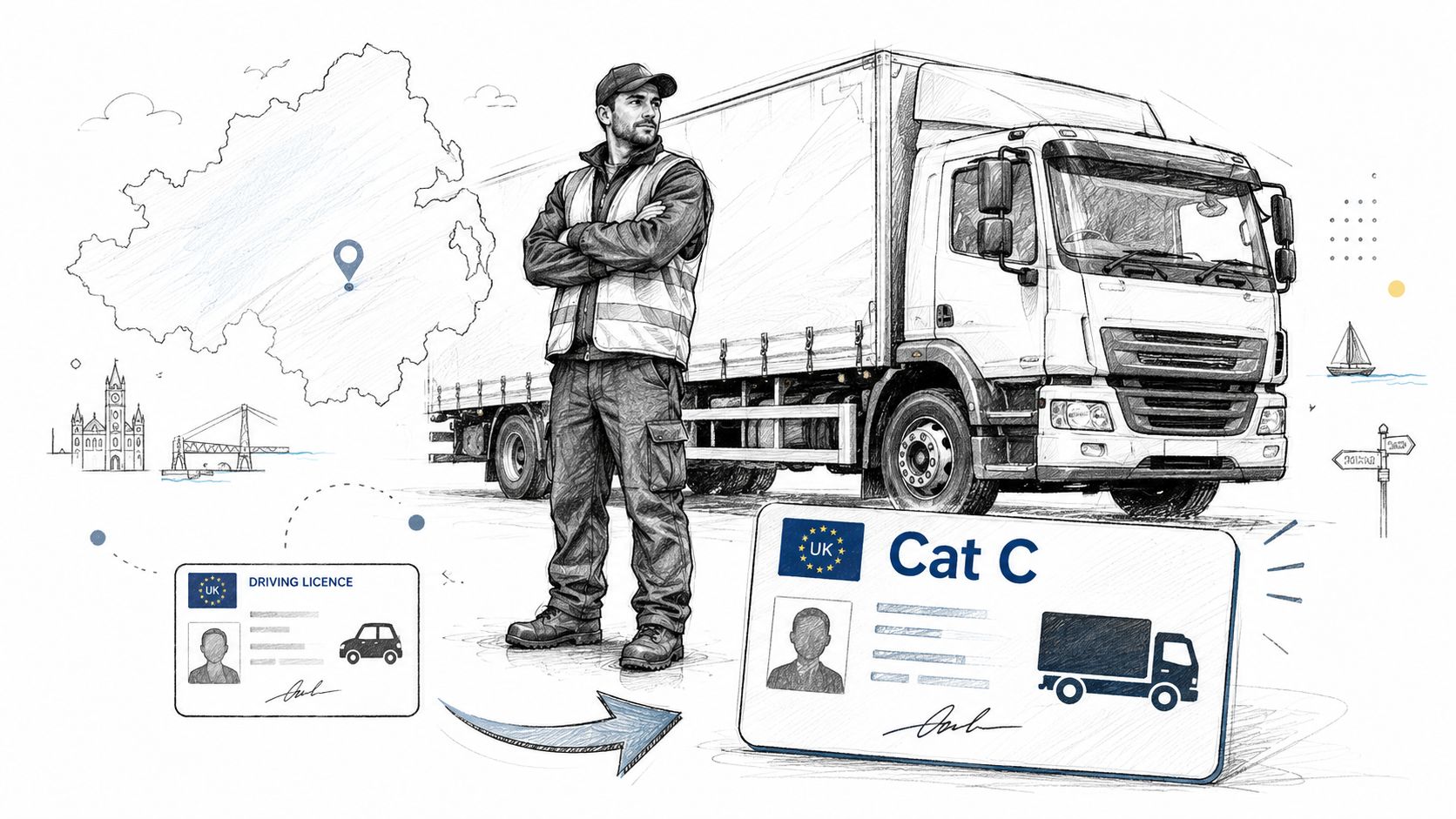
So, what exactly is a Category C licence? Officially, it is the credential that lets you drive any rigid heavy goods vehicle (HGV) with a weight over 3,500kg. But if you're scrolling through job sites in Northern Ireland, you will probably see it called a 'Class 2' licence. They are the same thing. This is the first serious step you will take, moving up from a standard car licence to operating the big commercial vehicles.
Getting this qualification opens up a whole new range of vehicles you can drive. We are talking about everything from the local delivery lorries you see every day to construction tipper trucks and large removal vans. It is the bedrock of your HGV journey. In fact, you cannot even think about training for a Category C+E licence (the one you need for articulated lorries, or 'artics') until you have passed your Category C test.
Your Career Progression Path
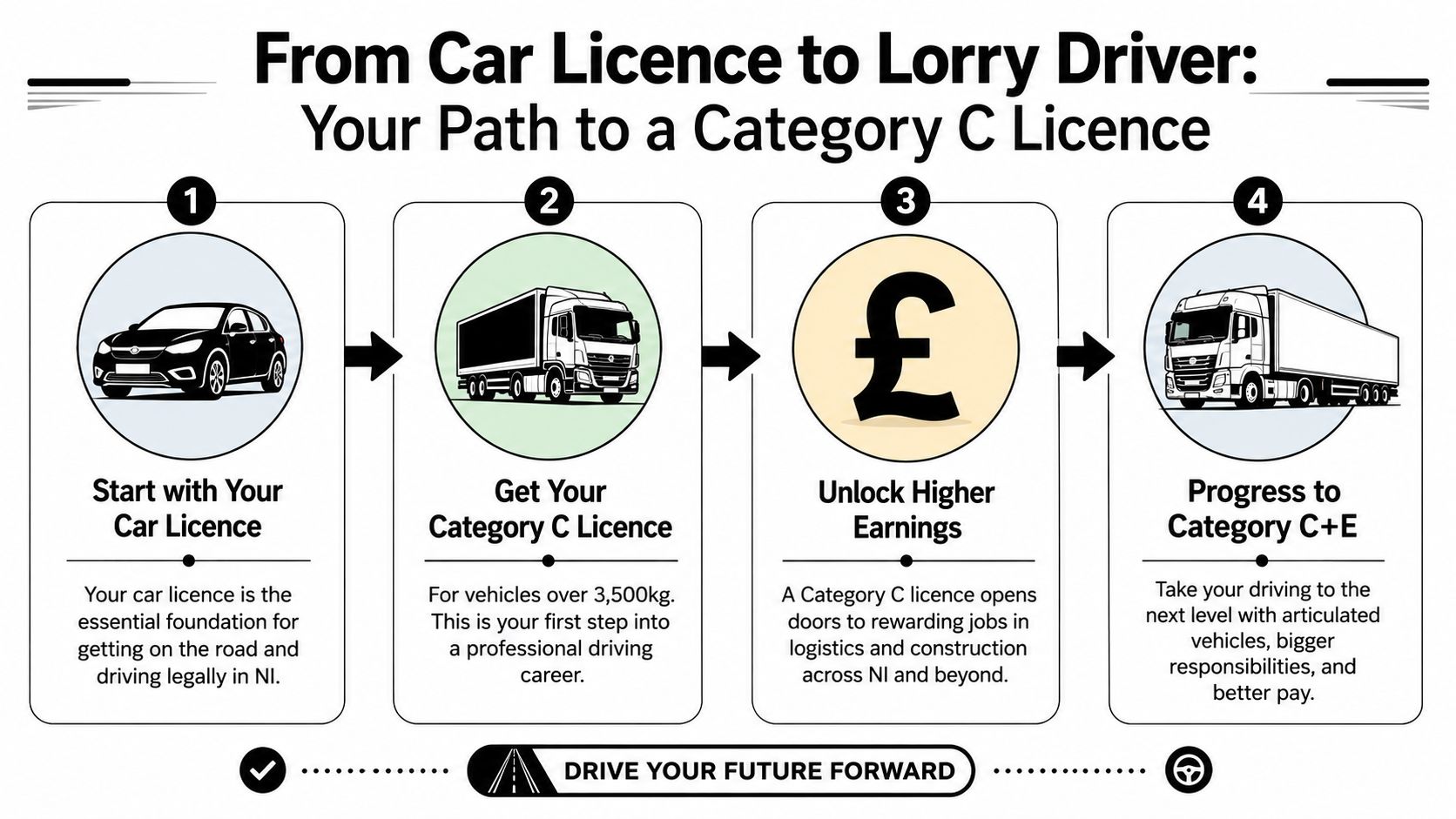
The journey from car driver to professional lorry operator is a well-trodden one. It follows a clear and logical path, as you can see in the infographic below. It lays out the typical career steps for an aspiring HGV driver in Northern Ireland.
As you can see, getting your Category C licence is the main event. It is the milestone that really opens up the door to professional driving roles and better pay.
Understanding the Terminology
While the legal definition of Category C is the same across the UK, you will find many employers in Northern Ireland still use the older terms. It pays to know what they mean. In Northern Ireland, your Category C lets you drive rigid goods vehicles over 3,500kg and pull a small trailer up to 750kg.
Official GOV.UK data shows this lines up with the old HGV Class 2/3 classification. Meanwhile, the Category C+E licence corresponds to the old HGV Class 1. Knowing these legacy terms is a huge help when you are on the hunt for driving jobs.
Getting your Category C licence isn’t just about passing a test; it is an investment in a skilled trade. It proves you are committed to professional standards and safety, making you a much more attractive candidate to employers in a very busy industry.
For a more detailed look at the specifics, have a read of our guide on what is a Cat C licence and what it allows you to drive.
Your Medical and Provisional Licence: Getting the Paperwork Right
Before you can even think about getting behind the wheel of a lorry, there is some essential paperwork to sort out. This is the foundation of your journey. You will need to prove you meet the required medical standards and then apply for your provisional Category C licence with the Driver & Vehicle Agency (DVA).
Getting this first stage right is crucial. Any mistakes now can cause frustrating delays, so it is worth taking the time to understand the process.
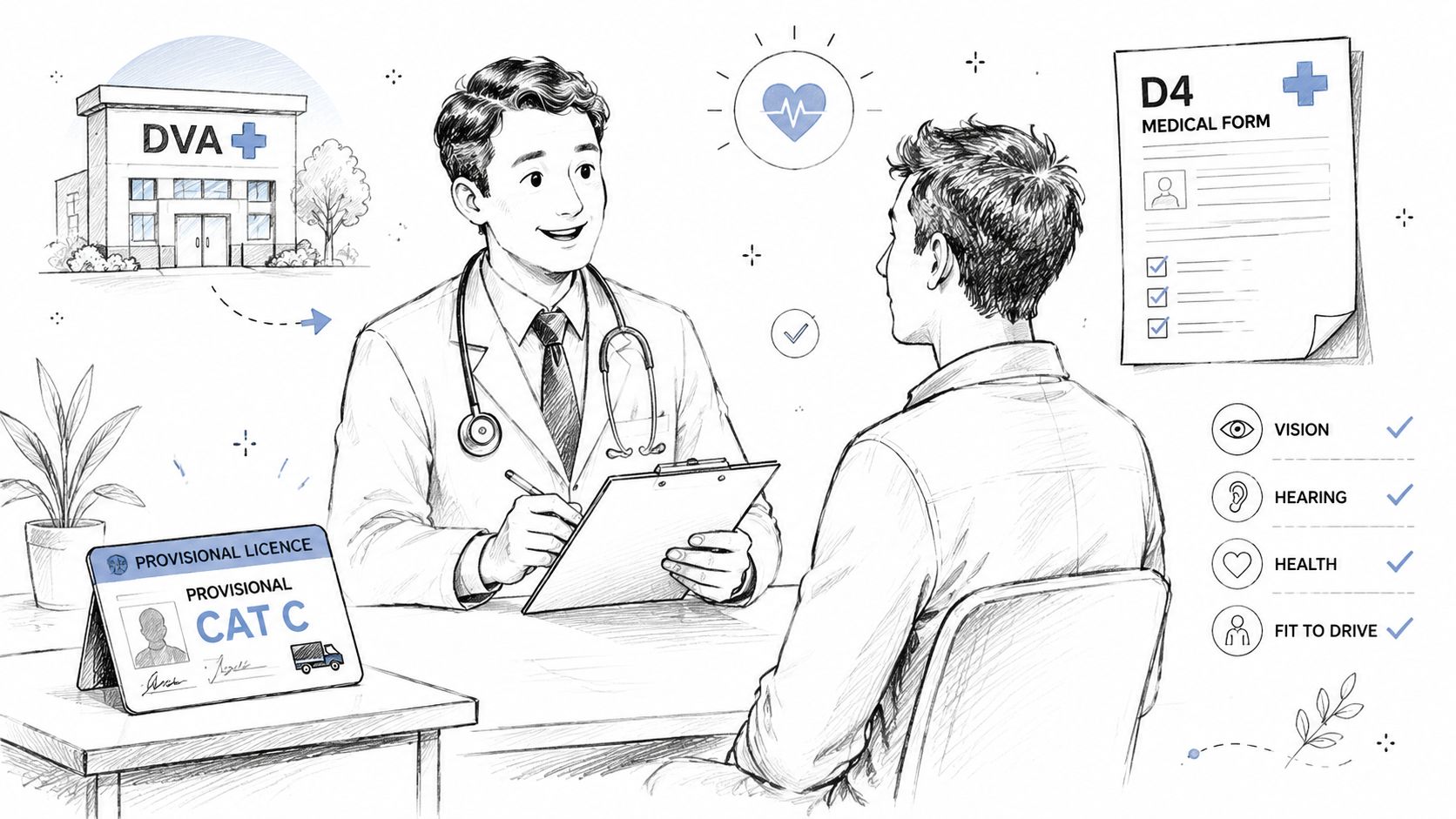
It all starts with a lorry driver medical. This is not your standard GP check-up; it is a specific assessment designed to ensure you are medically fit to operate a large goods vehicle. The DVA has strict eyesight and health requirements, and this examination, documented on a D4 medical report form, is a non-negotiable part of the process.
Tackling the Application Forms
After your doctor signs off on your D4 medical form, the next piece of the puzzle is the D2 application form. This is the form you will use to officially ask the DVA to add the provisional Category C entitlement to your driving licence.
Accuracy here is absolutely vital. We see people get their applications sent back all the time for simple, avoidable errors.
Forgetting to sign a section
Not putting down the correct GP details
Having information on the D2 form that does not match the D4
These small slip-ups can set your timeline back by weeks. A good training provider will often help you arrange your medical and will always cast an expert eye over your forms before they go anywhere.
The bottom line is this: a perfect application is the quickest way to get you into a truck for training. Slow down, double-check every single detail, and ask for help if you are unsure. It is far better to get it right the first time.
With both the D2 and D4 forms filled out correctly, you will post them off to the DVA in Coleraine. Once they have processed everything, you will get your driving licence back with the new provisional entitlement added. That is your green light to start booking theory tests.
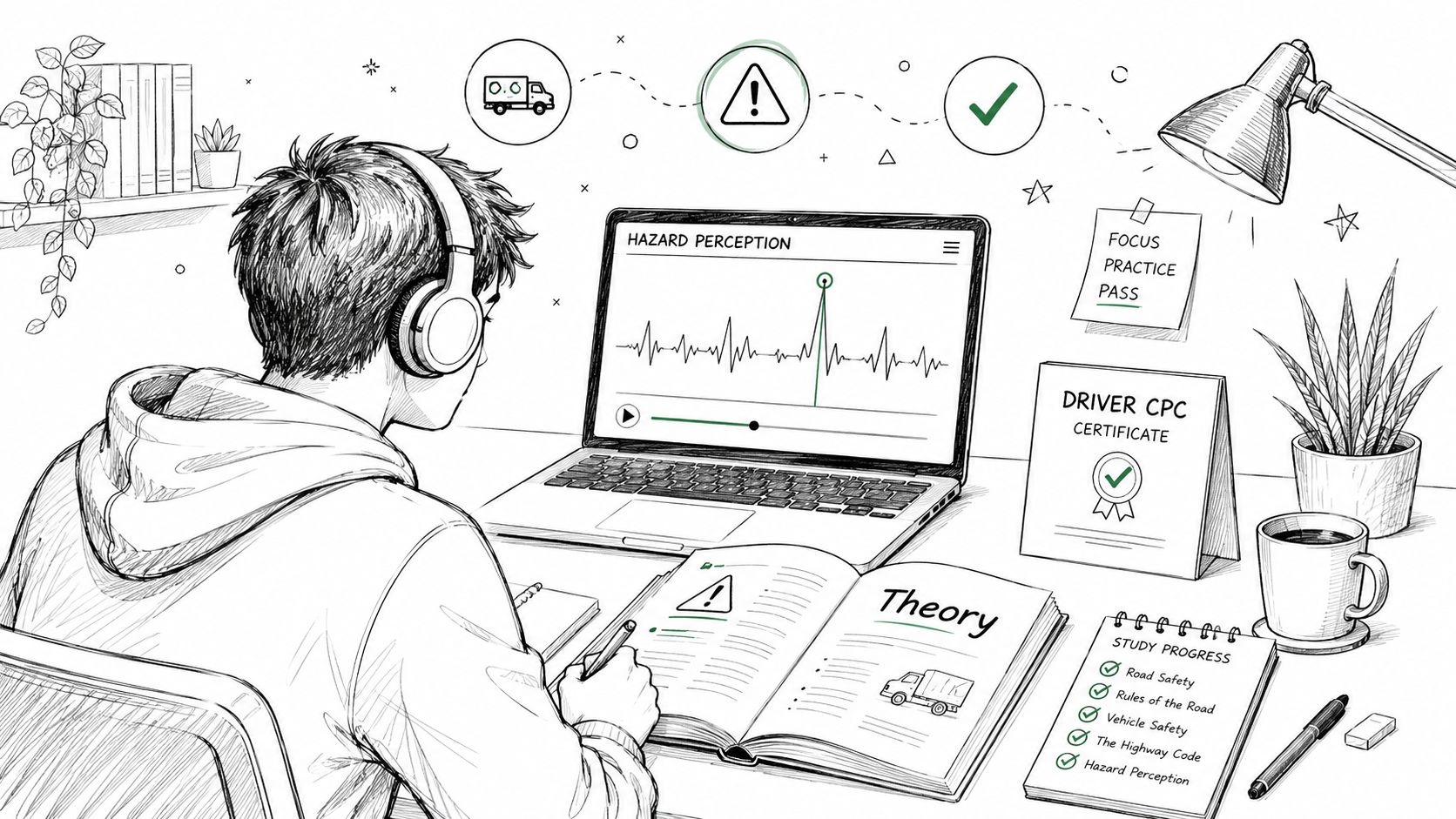
Once your provisional licence arrives, it is time to tackle the theory side of things. This is not just one quick test; it is a series of assessments designed to make sure you have the professional knowledge needed to handle a rigid lorry safely on Northern Ireland's roads.
First up are the main Driver and Vehicle Agency (DVA) theory tests. You will sit both parts back-to-back in a single session at your local test centre.
Part 1a: Multiple-Choice Questions: You will face 100 questions with a 115-minute time limit. This covers a massive range of topics, from basic road signs and vehicle safety checks to the complex rules on drivers' hours. You will need to score at least 85 out of 100 to pass.
Part 1b: Hazard Perception: Straight after the multiple-choice, you will move on to this video-based test. It consists of 19 clips featuring developing hazards. Your job is to click as soon as you spot one. The quicker you react, the higher your score, with a pass mark of 67 out of 100.
My best advice? Get your hands on some good theory preparation software. The ones that let you do unlimited mock tests are brilliant because you can really drill down into the areas where you are struggling and watch your scores improve.
Demystifying the Driver CPC
Passing those initial theory tests is a huge step, but to drive for a living, you also need your initial Driver Certificate of Professional Competence (CPC). This is a mandatory qualification that proves you are ready for the professional side of the job.
Think of the Driver CPC as the "professional" part of your qualification. It is not just about controlling the lorry; it is about understanding the job. This includes everything from load safety to customer service and handling emergencies.
The initial CPC qualification is broken down into two more modules:
Module 2: Case Studies: This is another computer-based test, but instead of quick-fire questions, you will work through seven real-world case studies. Each scenario is followed by a set of questions designed to test how you would apply your knowledge in a practical situation.
Module 4: Practical Demonstration: This is often called the 'show me, tell me' test. You will meet an examiner at the lorry and walk them around it, demonstrating your practical knowledge. You will have to explain how to check key safety components like tyres and brakes, talk about securing loads, and show what you would do if you spotted a defect.
Once you have successfully passed all four modules (1a, 1b, 2, and 4) you are officially qualified to start your career as a professional lorry driver. If you want to dive deeper into the specifics, you can check out our guide on CPC training for more information.
From Practical Training to Passing Your Driving Test
Alright, this is where the theory meets the tarmac. You have cleared the theory and CPC hurdles, so now the focus shifts entirely to hands-on, practical training and the final test: the Module 3 driving exam. This is the part of getting your Category C licence in Northern Ireland that everyone looks forward to.
Your practical lessons will start with the absolute basics. The very first session is all about getting properly acquainted with the lorry. You will be guided through the crucial ‘walk-around’ safety checks, learning how to inspect everything from the tyres and lights to fluid levels and braking systems before the engine is even switched on. This is not just a box-ticking exercise for the test; it is a fundamental habit you will carry with you every single day as a professional driver.
From there, you will start getting a real feel for the vehicle's size and weight on proper Northern Ireland roads. This is where you learn how to judge gaps in traffic, navigate tight junctions, and handle roundabouts with confidence. Your instructor will hammer home the importance of constant mirror checks and correct road positioning: two of the most vital skills for driving a large vehicle safely.
What the DVA Examiner Looks For
The DVA practical test is designed to make sure you can handle a rigid lorry safely and professionally in all sorts of road and traffic situations. It is not just about getting from A to B; it is about proving you have consistent, all-round competence behind the wheel.
The test itself covers a few key areas:
The Reversing Manoeuvre: You will be asked to complete a specific reversing exercise into a marked bay. The secret here is all about slow, controlled movements and constant observation.
On-Road Driving: This forms the main part of the test. The examiner will watch your general driving closely, assessing how you approach hazards, your use of speed, and how you interact with other road users.
'Show Me, Tell Me' Questions: During the drive, the examiner will ask you two vehicle safety questions. For instance, "Show me how you would check the directional indicators are working," or "Tell me how you would check the brake lights are working on this vehicle."
A top tip we always give our students is to talk through what you are doing. If you are checking a blind-spot mirror before moving off, say it out loud. This shows the examiner your thought process and proves you are a proactive, thinking driver.
The licensing system in Northern Ireland puts a huge emphasis on road safety, which is why the training is so thorough. As a Category C candidate, showing a safety-first attitude is absolutely essential. You can learn more about how this approach shapes the industry by checking out the TRL's report on driver licensing.
Understanding Your Investment and Career Potential
Let us talk about the big question on everyone's mind: the cost. Getting your Category C licence in Northern Ireland is a serious step towards a new career, and it is smart to look at it as an investment. You need to know what you are putting in and, more importantly, what you can get out of it.
The overall cost is made up of a few key things: the official DVA test fees, your driver medical, and, of course, the hands-on practical training. While the initial number might seem like a lot, you have to stack it up against the salary you can command once you are a qualified HGV driver.
Comparing Costs to Earning Potential
Looking at figures from across the UK gives us a good ballpark figure. One industry source estimates the cost for an entry-level Category C licence at around £1,999, with the mandatory Driver CPC qualification adding about £350 on top. While these are national averages, they give you a realistic idea of the investment. You can explore more details on NI-specific training options on hgvtraining.co.uk.
Now, let us weigh that against what you could be earning. A newly qualified driver can expect a solid starting salary, and it is not uncommon for experienced drivers to earn well over £40,000 a year. The return on your investment becomes clear very quickly.
To put this into perspective, here is a rough breakdown of what you might spend versus what you could earn in your first year.
Estimated Costs vs Potential First-Year Earnings
Cost Component
Average Estimated Cost
Potential First-Year Earnings
Medical Examination
£50 – £100
Provisional Licence
Included in car licence
Theory Test & Hazard Perception
£64
Practical Driver Training (Cat C)
£1,500 – £2,000
Practical Test (Part 3a & 3b)
£155
Driver CPC (Part 2 & 4)
£350 – £450
Total Estimated Investment
~£2,119 – £2,769
£28,000 – £35,000+
As you can see, the upfront cost is a fraction of what you can earn in your very first year on the road.
This is not just about a licence; it is about launching a career. A Category C ticket immediately opens doors to a huge range of jobs right here in Northern Ireland.
Local and Regional Deliveries: Think supermarkets, parcel networks, and local suppliers.
Construction: Driving tipper trucks or delivering materials to building sites.
Public Services and Utilities: Working for companies maintaining our infrastructure, which often means stable, long-term work.
The moment you pass, you have a professional skill that is always in demand. This is not just another line on your CV; it is your key to a career with real progression and solid earning power.
We understand that paying for it all at once can be tough. That is why many training providers offer flexible payment plans, letting you spread the cost over a few months. Some even provide job-finding support, helping you connect with local employers and get into a paid driving seat as quickly as possible.
Common Questions About Getting Your Lorry Licence
Starting the journey to get your Category C licence can feel like navigating a maze of forms, tests, and regulations. It is only natural to have questions. Here, we tackle some of the most common queries we hear from aspiring lorry drivers across Northern Ireland, giving you the clear, straightforward answers you need.
How Long Does It Really Take to Get a Category C Licence in NI?
This is probably the number one question we get, and the honest answer is: it varies. The timeline is often dictated by DVA processing times and test availability, which can be unpredictable.
That said, if you are dedicated and follow a structured training plan, it is realistic to go from your initial medical assessment to passing your practical test in about 8 to 12 weeks. Working with a good training provider is key here: they can help coordinate your bookings, which cuts down on dead time and keeps the momentum going.
Do I Need the Driver CPC If I Will Not Be Driving for a Living?
The Driver CPC is a must if you plan to drive a lorry as your main paid job. It is the professional standard. However, there are a few specific exemptions for non-commercial use, such as driving for the emergency services or transporting your own personal materials where you are not being paid for the driving itself.
The rule of thumb is simple: if you are driving for hire or reward, you need a Driver CPC. It is a non-negotiable part of being a professional commercial driver.
What Happens If I Fail One of the DVA Tests?
Failing a test can be disheartening, but it is certainly not the end of the road. Plenty of excellent drivers did not pass every single test on the first go. If it is a theory test, you can simply rebook after a short waiting period.
If you fail the practical test, this is where a good instructor proves their worth. They will sit down with you, analyse your performance, and pinpoint exactly where things went wrong. The next step is to book a few more hours of training focused specifically on those weaker areas, building your skills and confidence back up before you re-sit the test. Think of it as an opportunity to become an even safer, more competent driver.
At HGV Learning, we are here to guide you through every stage of getting your Category C licence in Northern Ireland. Contact us today to find out how our structured training programmes can get you on the road to your new career.