You're sitting in the cab, lined up near the bay, and it suddenly feels as if every simple driving habit has stopped working. Forward planning still matters, but the steering now seems backwards, the trailer reacts late and then too much, and every small error looks bigger in the mirrors than it did in your head.
That feeling is normal. Reversing a trailer is one of the first jobs that exposes the difference between driving a vehicle and controlling a combination. It's also why this manoeuvre matters so much on the UK HGV path. The DVSA large goods vehicle test includes controlled reversing work, because a professional driver has to place a vehicle accurately at very low speed in the spaces where damage and near misses happen most often in real work.
A lot of new drivers go looking for one magic trick. There isn't one. What works is understanding the shape of the unit and trailer, reading the mirrors properly, and knowing when to stop and reset before a small bend turns into a bad angle. That's how you pass the test. It's also how you keep control in a crowded yard on a wet Tuesday morning when no one gives you extra room.
Your First Reversing Challenge
The first proper reverse usually starts the same way. You pull up, the bay looks narrower than it did from outside the cab, and your brain says the whole thing is too awkward to recover if it goes wrong. Most learners aren't scared of moving backwards. They're scared of losing the trailer early and not knowing how to get it back.
That's especially common if you've come from car driving or light towing. A trailer doesn't forgive late thinking. It asks for calm, not force. The driver who rushes the wheel usually makes the trailer swing harder. The driver who keeps the speed down and reads the mirrors usually gets it sorted, even if the first line-in isn't perfect.
I've seen plenty of learners improve the moment they stop treating reversing like a one-shot performance. It isn't. It's a series of tiny decisions. Set up straight. Let the trailer begin to move. Watch which mirror opens up. Correct early. Straighten again. Repeat. Once that clicks, the bay stops feeling like a trap.
Most bad reverses don't begin with one huge mistake. They begin with one small mistake that the driver tries to rescue too late.
If you've practised with caravans or leisure trailers, some of the habits transfer well. A practical outside read on that lighter end of towing is these tips for backing up an RV, especially for understanding patience and observation before speed. For drivers moving towards professional work, proper coaching matters more because the standard is tighter and the environment is less forgiving. That's where structured training and the wider benefits of undertaking HGV driving lessons become obvious very quickly.
What usually changes the mindset
A learner starts out trying not to make mistakes. A professional starts out trying to stay in control.
That sounds minor, but it changes everything. If you're control-focused, you accept pull-forwards, you keep the unit tidy, and you don't chase the trailer with frantic wheel movement. You work the problem. You don't fight it.
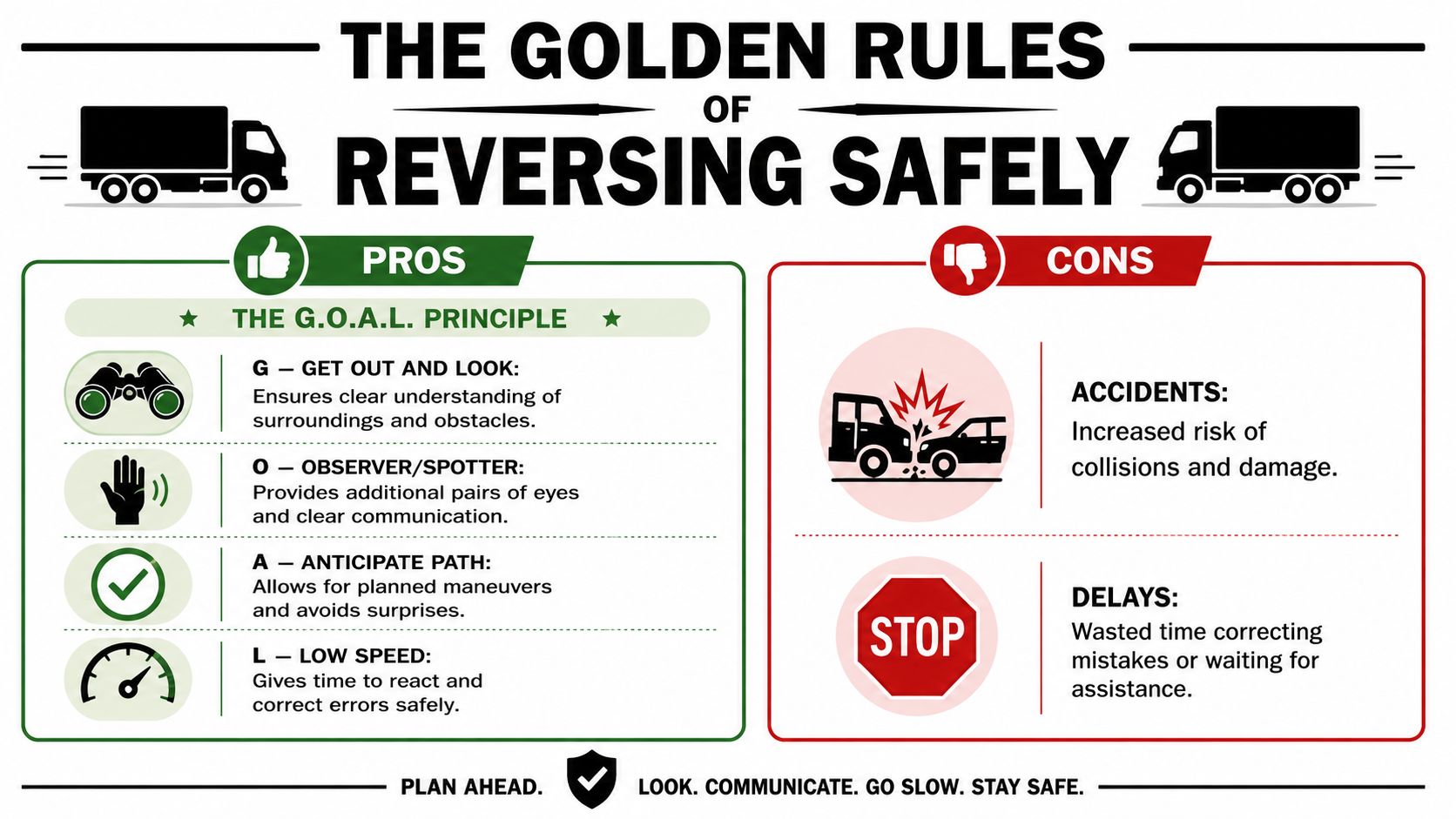
The Golden Rules of Reversing Safely
Before the vehicle moves, the job starts on foot. Professional drivers use G.O.A.L., meaning Get Out And Look, because no mirror gives you the full picture in every yard, depot, site entrance, or loading area.
In busy working environments, that habit isn't optional. UK road-safety guidance consistently treats work-related reversing as a serious risk, especially in depots, yards and construction areas, where banksmen or spotters and proper site controls may be required because mirrors alone are not enough. That's reflected in practical advice on safe trailer reversing in high-conflict work areas.
Start with the ground, not the steering wheel
Drivers often focus on the bay and forget the approach. The approach decides whether the reverse will be simple or messy.
Check these points before selecting reverse:
Space behind and beside: Look for bollards, low barriers, kerbs, parked vehicles, pedestrians and blind-side hazards.
Ground condition: Slopes, potholes, mud, standing water and uneven surfaces can upset a slow reverse more than people expect.
Exit room for a reset: Leave yourself enough space to pull forward and start again if the angle goes off.
Overhead clearance: Branches, canopies and building projections matter, especially with taller bodies and mixed site layouts.
Position for an easy first move
A poor set-up creates work you don't need. A good set-up makes the trailer begin in a controlled way.
The basic rule is simple. Start as straight as possible before backing. If you begin twisted, the trailer is already trying to walk away from you. If you begin straight, you can choose when and how the angle develops.
Use this simple sequence:
Stop and square the rig up Put the unit and trailer in line before the reverse starts wherever the site allows.
Choose one reference side Know which side matters most for clearance and keep checking it without ignoring the other mirror.
Create the angle gently Don't wind on lock and hope. Start the bend with a small input and wait for the trailer to answer.
Practical rule: Good reversing starts with good positioning. If the set-up is poor, fix the set-up before you try to fix the reverse.
Slow is what gives you options
At very low speed, you have time to see, think and correct. That's why experienced trainers keep coming back to the same control variables. The job is governed by slow speed, small steering inputs, and effective use of mirrors or a spotter. If your site role includes supervision or fleet processes, broader operational thinking in a fleet safety management guide NZ is also worth reading because reversing safety is always part of a bigger system, not just an individual manoeuvre.
What doesn't work is trying to save time by rolling faster. Faster removes thinking time. It makes the trailer's movement look sudden, encourages over-correction, and usually leads to a pull-forward anyway.
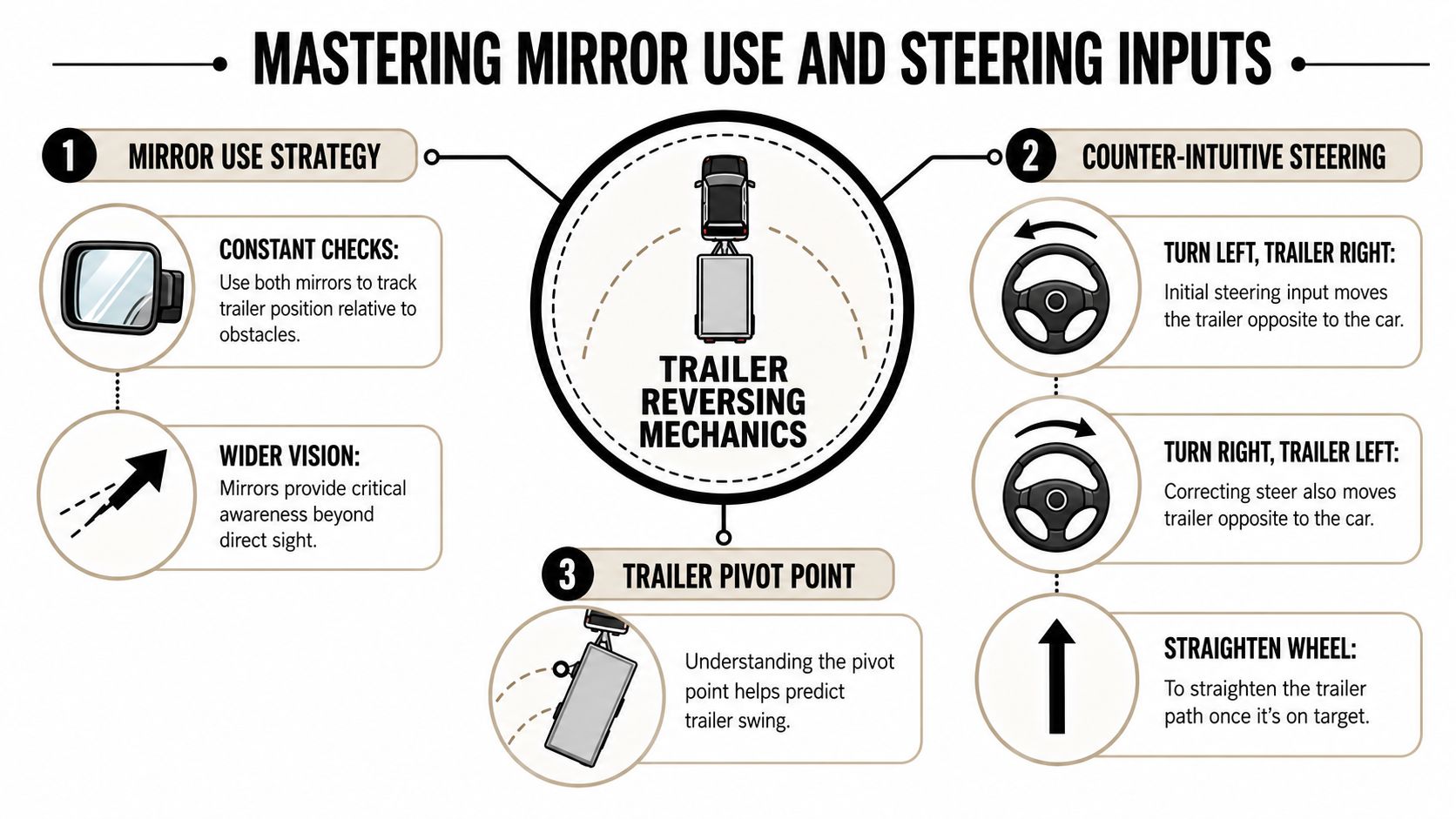
Mastering Mirror Use and Steering Inputs
This is the part learners tend to overcomplicate. The trailer doesn't need a dramatic command. It needs a clear one.
The DVSA reversing standard for large goods vehicles is built around controlled manoeuvres such as reversing into a bay. The driver has to show precision at very low speed, using mirrors continuously and making small steering corrections, because trailer steering response is the reverse of forward driving. That principle is outlined in this guidance on how to back up a trailer for controlled manoeuvres.
What your mirrors are actually telling you
New drivers often look in the mirrors without reading them. They see the trailer, but they don't interpret the angle.
Your mirrors tell you three things:
Direction of drift: Which way the trailer tail is moving.
Rate of change: Whether the bend is developing slowly or building too quickly.
Clearance: How much room you have on each side as the trailer tracks back.
If one side suddenly shows much more trailer than before, the angle is increasing. If one side starts to disappear, the trailer is folding away from that mirror. The right response is usually small and early, not large and late.
The opposite steering principle
The key rule is this. When reversing, the trailer moves toward the side you steer away from in the cab.
That catches learners out because it feels wrong at first. But once you stop trying to steer the front of the unit and start guiding the trailer through the pivot, the movement makes sense.
A useful working thought is: steer to start the trailer, then steer back to catch it.
Here's a clean way to practise it:
Begin with the rig straight Let the trailer roll back cleanly before adding any steering.
Use one small input Turn the wheel a little, then pause and watch the trailer answer in the mirrors.
Read the response Don't add more lock just because you're impatient. Wait for movement.
Correct back early Once the trailer starts taking the line you want, unwind the steering so the angle doesn't keep building.
Straighten and follow After the trailer is on line, bring the unit behind it rather than continuing to bend the combination.
Think about the pivot point
The pivot point matters more than the front wheels. The front wheels only decide how the unit moves. The pivot decides how that movement transfers into the trailer.
If you understand that, you stop staring at the bay entrance and start predicting the trailer's path. Good reversing is predictive. You don't wait for the trailer to go wrong. You catch the beginning of wrong.
Here's a simple comparison:
What the driver does
What usually happens
Large steering input
Trailer angle builds quickly and needs a bigger correction
Small steering input
Trailer begins to move without running away
Late correction
Unit chases the trailer and the bend tightens
Early correction
Trailer settles onto line and stays manageable
A short demonstration helps when this feels too abstract:
Mirror rhythm that works in real life
Don't stare at one mirror until you forget the other side exists. Use a rhythm.
A practical routine looks like this:
Primary mirror first: Check the side where the key line or tighter hazard sits.
Secondary mirror next: Confirm the opposite side stays safe.
Brief forward awareness: Keep track of unit swing and cab position.
Repeat without rushing: The checks should be constant, but not panicked.
If the mirrors start giving you bad news faster than you can process it, the vehicle is moving too quickly or the angle is already too deep.
That's why small corrections beat dramatic ones every time. The best reverse often looks uneventful from outside. That's the point.
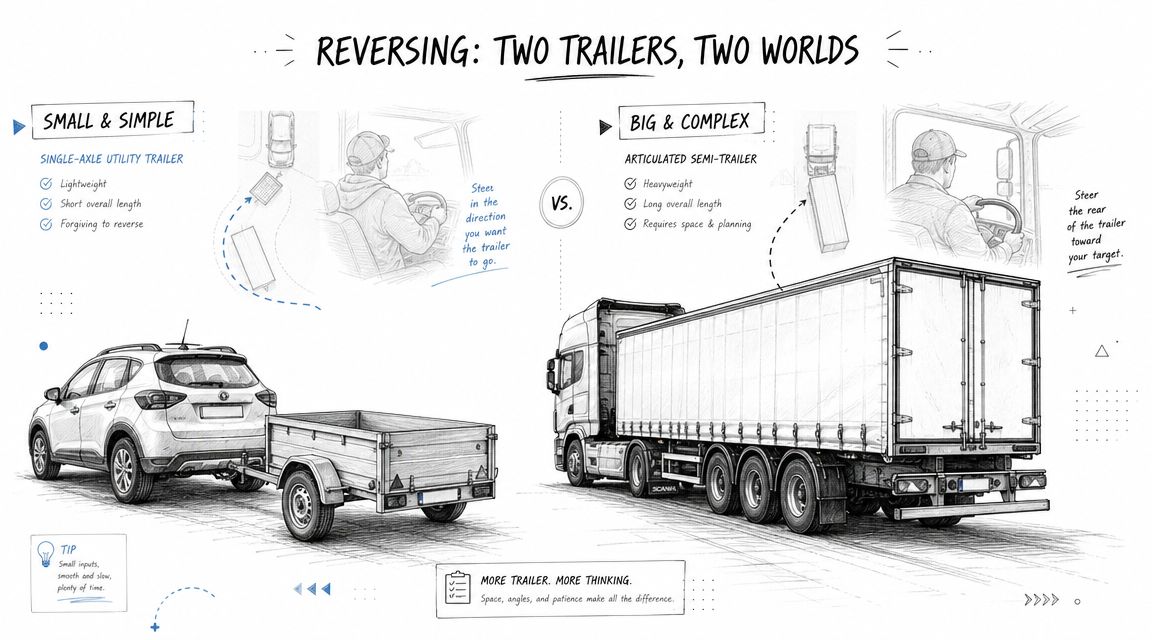
Adapting Your Technique for Different Trailers
Not every trailer teaches the same lesson. The core principles stay the same, but the response speed, pivot behaviour and margin for error change with the outfit.
One fact never changes. Trailer physics amplifies errors. Once the tractor and trailer angle increases, the offset can grow quickly and may lead to a jackknife. That's why training keeps returning to slow speed, small steering inputs, and mirrors or spotters, with early corrections rather than heavy late ones, as explained in this guide to trailer reversing control and jackknife risk.
Small trailers and light combinations
Small trailers react quickly. That sounds helpful, but it catches people out because the response arrives before the driver has settled.
With a small trailer:
Tiny inputs matter more
Over-correction happens fast
A straight set-up is even more valuable
The common mistake is turning the wheel as if the trailer needs persuading. It doesn't. A small trailer usually needs less steering and more patience. If you keep feeding in more lock, it will swing sharply and force a reset.
Drawbar and wagon-and-drag outfits
A drawbar set-up gives you a different problem. There are two pivot points, not one. That means the movement can feel slower at first, then more complex as both parts of the combination begin to influence each other.
The driver has to watch the whole shape of the outfit, not just the rear trailer. If the front section starts creating a poor angle, the back section follows it into trouble.
A useful way to think about a drawbar reverse is this:
Vehicle type
Main challenge
Best mindset
Small trailer
Twitchy response
Less steering, more waiting
Drawbar
Two pivots to manage
Keep the whole combination tidy
Artic
Angle can build into jackknife
Early corrections and regular resets
Articulated lorries
The articulated lorry usually feels slower to answer than a small trailer. That slower response can tempt a learner to add too much steering. Then the trailer bites harder than expected a moment later.
With an artic, the big risk is allowing the angle between unit and trailer to build unnoticed. Once it gets too deep, the correction becomes larger, the cab loses room, and the reverse starts turning into a jackknife recovery rather than a proper manoeuvre.
What helps with an artic:
Build the angle gradually
Watch both mirrors continuously
Unwind the wheel before the trailer looks dramatic
Pull forward before the shape gets ugly
For drivers working towards C+E control, this broader articulated lorry driving guide is useful because reversing only makes sense when you also understand trailer cut-in, swing, and general articulation behaviour.
The best artic reversers aren't brave with steering. They're disciplined with shape.
What changes and what doesn't
Different trailers need different amounts of input, but the foundations remain fixed.
What always works:
A straight start
Low speed
Mirror-led decisions
Early corrections
A calm pull-forward when needed
What usually fails:
Trying to force the trailer into line
Waiting too long to unwind the steering
Treating every trailer as if it reacts the same way
That's why a good driver adapts. The skill isn't memorising one hand movement. The skill is reading the outfit you have.
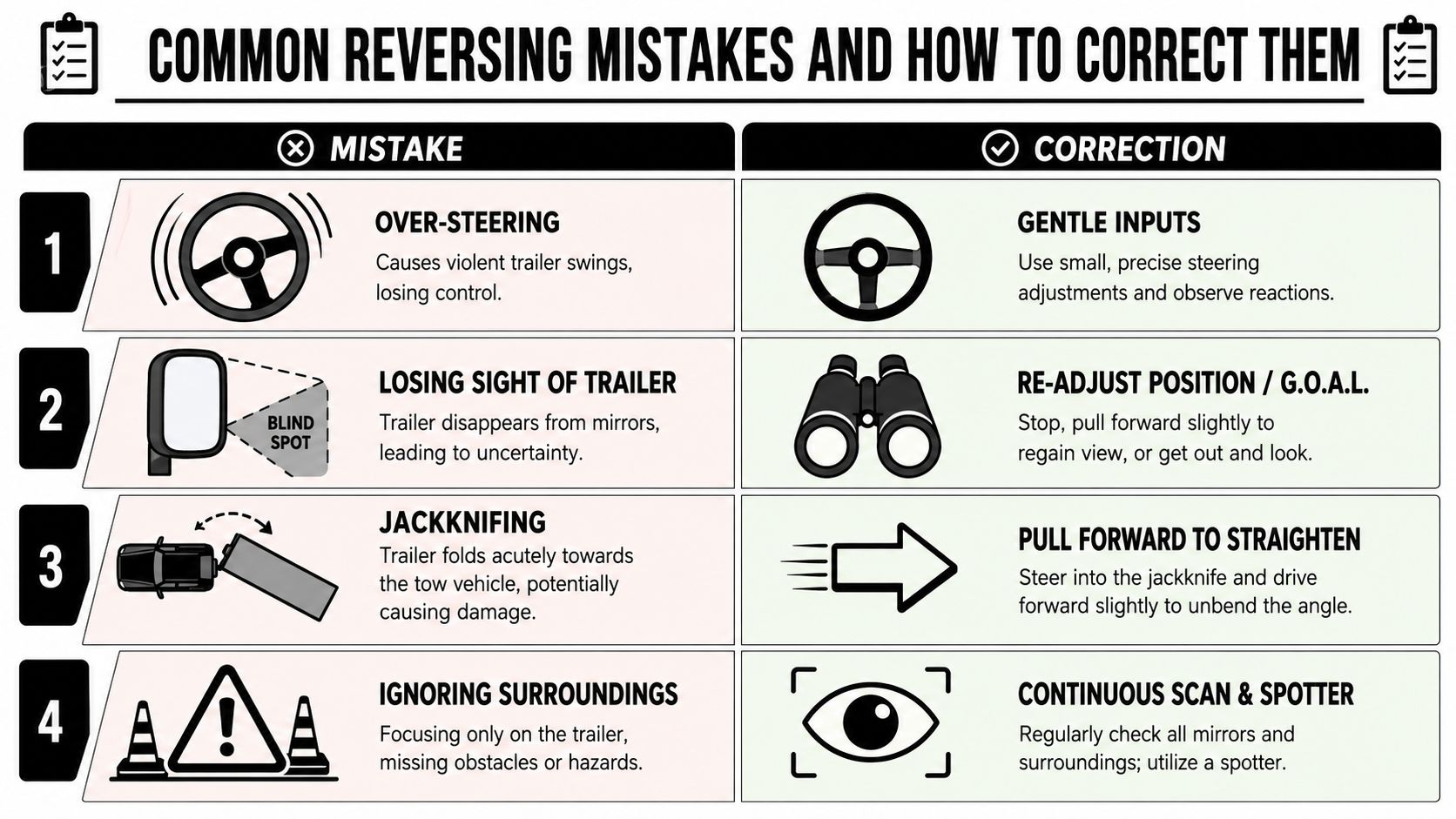
Common Reversing Mistakes and How to Correct Them
Most reversing errors are ordinary. They're not signs that a driver can't do it. They're signs that the driver has let one of the basics slip for a moment.
Official learner guidance is sensible here. Start in a large empty car park, reverse slowly, and practise until you can hold a straight reverse for about 20 metres and complete 90-degree turns in both directions, as set out in this practical advice on reversing with a trailer. That kind of repetition builds control before pressure gets added.
Four mistakes that keep turning up
Over-steering
The driver sees a slight drift, adds too much lock, then has to rescue the rescue. The fix is to reduce input and wait for the trailer to respond before adding more.
Losing the trailer in the mirrors
This usually means the angle has become too severe or the set-up was poor. Stop. If needed, pull forward slightly to regain a useful view. If the area is uncertain, get out and look.
Letting the bend deepen too long
Drivers often hope the trailer will sort itself out. It won't. Once the shape starts tightening, unwind early or pull forward and reset.
Watching only the trailer tail
That creates missed hazards near the unit, front corner swing, or obstacles on the blind side. Keep scanning the whole scene, not just the rear-most point.
The professional correction that saves most bad reverses
Pulling forward is not failure. It's judgement.
If the trailer is drifting badly, the angle is poor, or the bay approach has gone messy, a short pull-forward can restore the straightness you lost. Experienced drivers do this without drama. What wastes time is continuing a bad reverse because pride got involved.
Stop early, reset early, and the manoeuvre stays cheap in time and stress.
A lot of test problems come from candidates trying to salvage a poor line instead of cleaning it up. That's one reason common HGV test failure reasons often come back to observation, control, and decision-making rather than lack of bravery.
Simple practice drills that pay off
Use a quiet, open space and keep it basic:
Straight-line reverse Hold the trailer straight for about 20 metres.
Left and right ninety-degree entries Practise both directions, because one side will usually feel less natural.
Deliberate reset drill Start a bend, stop, pull forward, and re-enter. Learn that recovery is part of the skill.
The driver who practises clean resets usually improves faster than the one who only practises perfect attempts.
From the Test Bay to the Loading Bay
The test bay asks for control under observation. The loading bay asks for the same control with more distractions, tighter space and more consequences. The principle doesn't change. The standard gets less forgiving.
On test day, the examiner wants to see a driver who stays composed, uses observation properly and places the vehicle accurately without snatching at the wheel. In daily work, that same calm matters even more because reversing often happens around staff, fixed obstacles, time pressure and poor visibility. A driver may have cameras, sensors or trailer-angle aids, but those tools don't replace judgement. Modern fleets increasingly use reversing cameras and trailer angle aids, yet those systems still depend on the driver planning the manoeuvre, keeping speed low, and using pull-forward corrections when needed, especially with longer combinations and tighter urban access, as discussed in this overview of modern reversing aids and their limits.
What carries over into real work
The biggest difference between training ground reversing and workplace reversing is conflict. In actual scenarios, someone may walk behind the vehicle, another lorry may cut across the yard, and the marked space may not be generous.
That's why employers need proper reversing areas, site rules and trained spotters where risk is high. Drivers still have to do their part:
Plan the approach before committing
Stop if sightlines break down
Use a banksman properly if one is provided
Treat cameras as aids, not proof that the area is clear
If your work includes loading bays and trailer restraint points, it also helps to understand wider loading dock safety practices because the reverse is only one part of safe arrival, positioning and unloading.
A clean reverse is satisfying, but professionalism shows up most clearly when the reverse isn't clean at first. The driver who pauses, reassesses, and puts the vehicle where it needs to be without drama is the one operators trust.
If you're learning how to reverse a trailer for a C1, Category C or C+E test, or you want structured practice that matches real working conditions, HGV Learning can help you arrange the training path, theory support and practical instruction needed to build safe, test-ready reversing habits.
What Age Can You Start HGV Driver Training? A 2026 UK Guide to Licence Age Requirements
If you're asking what age you can start HGV driver training, the honest answer depends on which licence you're after. A C1 licence, covering vehicles...