Be ready for a realistic all-in cost of about £1,900 to £4,200 for a Cat C qualification in the UK. That's a much better starting point than a training advert alone, because the final bill can also include your medical, study materials, CPC elements, practical tests, and the main driving course.
If you're looking into a new driving career, that wide range can feel frustrating. You want one clear price, but you quickly find a mix of package prices, test fees, optional extras, and small print.
That confusion is common. Some quotes focus on the practical course only, while the actual route to qualification includes several separate stages. Costs vary a lot between providers because each element, training, medical, theory test, and practical test, is often priced separately rather than bundled into one figure, which is exactly why two learners can pay very different totals for what looks like the same goal. For a full breakdown of what’s typically included, see our Cat C Licence Cost UK guide.
Understanding the Real Cost of Cat C Training
Many learners start in the same place. They search for Cat C driver training cost, see one headline figure, and assume that's the whole job done. Then they discover theory tests, CPC parts, medicals, and retest charges that weren't obvious at first glance.
That doesn't mean anyone is trying to mislead you. It usually means different providers package things differently. One school may quote tuition only. Another may bundle the test. A third may include more support before you ever get behind the wheel.
Why the headline price often feels too low
A Cat C quote can look simple, but the route itself isn't a single purchase. It's a chain of steps, and each step has its own purpose.
For most new drivers, the costs fall into three groups:
Pre-course costs. These are the items you need before practical training can move ahead, such as the medical and early test stages.
Core training costs. This is the practical course itself, which is usually the biggest part of the spend.
Qualification costs. These are the final test and CPC elements that turn training into a usable vocational licence.
Practical rule: If a provider gives you one figure, ask them to list every item included and every item excluded. That simple question prevents most budgeting surprises.
What you're really budgeting for
The useful way to think about Cat C driver training cost is not “What's the cheapest course?” but “What's my full route from application to qualified driver?”
That shift matters. A lower upfront quote can still lead to a higher final bill if it leaves out test fees, CPC stages, or the extra hours you may need if the course is too short for your experience level.
If you're still getting familiar with the licence itself, this guide to what a Cat C licence is helps put the training route into context.
A good budget should leave you feeling calm, not caught out. Once you know each cost element, you can compare quotes properly and decide what suits your timeline, learning style, and cash flow.
What a Complete Cat C Training Package Includes
A learner gets a quote for Cat C training, feels relieved, then notices the small print. The medical is extra. Module 4 is extra. The test vehicle hire is extra. The cheapest figure on the page no longer looks cheap.
That is why it helps to treat a training package like a shopping list, not a single label on the shelf. Once you can see each item clearly, comparing providers becomes much easier and your budget becomes far more accurate.
The official fees that should be easy to spot
Some charges are set nationally, so they should not vary much from one provider to another. The official GOV.UK lorry and bus driver fee page lists the part 1 multiple-choice theory test at £26, the hazard perception test at £11, the part 2 case studies test at £23, the part 3a off-road exercises test at £40, the part 3b on-road driving test at £115 on weekdays or £141 on evenings, weekends and bank holidays, and the part 4 practical demonstration at £55 on weekdays or £63 at higher-rate times. The same page shows that the provisional HGV application is free.
These figures act like the fixed ingredients in a recipe. Training schools can package them differently, but the official test fees themselves are public. If a quote looks unusually low, check whether these charges are included or still waiting further down the road.
What is usually inside a full package
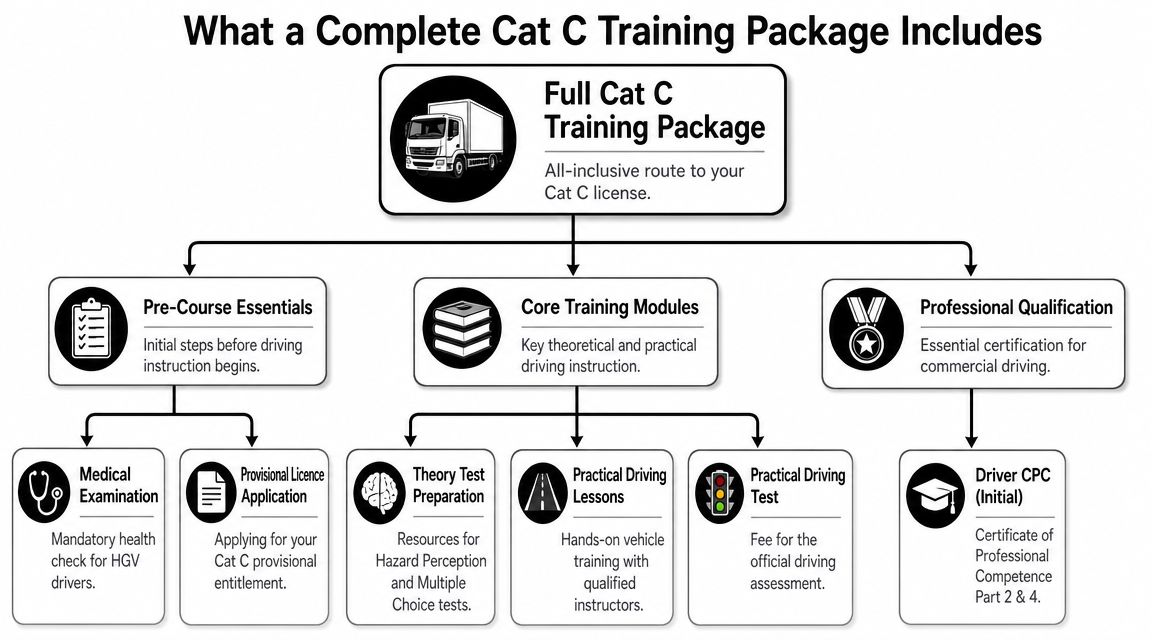
A full Cat C package often includes several separate parts that happen in sequence:
Medical examination. You need a driver medical before your provisional entitlement can be processed. Some schools arrange this for you, while others leave you to book and pay for it separately.
Application support. The provisional application is free, but some providers help you complete the paperwork correctly and track what happens next.
Theory study materials. This may include online revision access, practice questions, hazard perception preparation, or tutor support.
Theory and CPC part 2 bookings. Some packages include the booking service and test fees. Others include only guidance.
Practical training in a Category C vehicle. This is usually the largest single part of the package and often includes vehicle hire for training days.
Practical test bookings. Off-road and on-road tests are separate stages, and the quote should show clearly whether both are included.
Driver CPC part 4 preparation and test. If you plan to drive professionally, this part matters because passing the licence test alone does not complete the full job-ready route.
A clear quote should separate those items line by line. If it bundles everything into one figure, ask for a breakdown anyway.
Where quotes often become hard to compare
The confusing part is not usually the official fees. It is the training content around them.
One provider may include theory support, practical test bookings, vehicle use for the test, and CPC Module 4 preparation. Another may advertise a lower price that covers only the driving lessons. On paper, both are selling Cat C training. In practice, they are selling different portions of the route.
Many new drivers often get caught out. They compare a partial package with a fuller one and assume the lower figure represents better value.
The practical course is usually the largest line in the budget
For many learners, the biggest share of the spend is the practical training block itself, because you are paying for instructor time, vehicle use, fuel, scheduling, and often test-day vehicle hire. That part tends to shape the final price more than any other single element.
So when you review a quote, ask two direct questions. How many hours or days of practical training are included? Does the price include the vehicle for both training and test day?
Those two answers tell you far more than a headline number on its own.
Budgeting tip: Ask every provider for the same breakdown: medical, theory support, theory test fees, practical training hours, test fees, vehicle hire for test day, CPC part 4, and retest charges. That turns vague quotes into a practical budgeting tool.
Key Factors That Influence Your Training Price
The price changes because the training route isn't built in exactly the same way for every learner. The practical part may be structured as a longer course, a shorter intensive course, or a package with different levels of support.
Course length changes the value, not just the price
A shorter course can look attractive because the upfront figure is lower. But lower isn't always cheaper in the end.
A published UK pricing page shows that 5 to 6 day Class 2 packages are around £2,030 to £2,330, while shorter 2 to 3 day intensive formats can seem cheaper upfront but may increase the risk of needing a retest or extra training. The same source gives a regional example of a 2-day, 16-hour course at £1,040 plus VAT, plus a £115 test fee, with retests charged separately at 4 hours training plus VAT plus the test fee (National Driving Centre prices).
That doesn't mean a short course is wrong. It means it suits some learners better than others. If you learn quickly, have strong road awareness, and cope well under pressure, an intensive route may work. If you need more repetition, a longer block may protect your budget better.
What often changes the final bill
The most common price drivers are practical and easy to miss:
How many training days you need. More time in the vehicle usually means a higher quote, but it may reduce the chance of paying again later.
Whether tests are included. Some schools build the practical test into the package. Others list it separately.
Retest policy. If you don't pass first time, extra tuition and another test booking can raise the total.
Booking slot choice. Higher-rate practical test times cost more than weekday slots.
Support level. Some providers offer more help with paperwork, bookings, and theory progress than others.
The cheapest-looking course can become the most expensive one if it leaves you underprepared for test day.
A quick explainer may help if you're comparing course formats and wondering what drives price differences in practice.
Don't judge quotes on one line alone
When learners compare Cat C driver training cost, they often focus on the first number they see. A better approach is to compare package design.
Ask each provider the same questions. How many hours are included? Is the practical test in the quote? Are CPC elements included? What happens if you need more training? Those answers usually tell you more than the headline price.
Estimating Your Total Cat C Licence Cost by Region
Regional pricing is one of the hardest parts of budgeting because many providers publish national-style ranges, while actual quotes depend on local availability, instructor time, and how the course is packaged.
As a rough guide, total costs across UK providers commonly span a wide range once you add together the medical, study materials, CPC training and testing, and the main practical course and tests, which is exactly why it pays to get an itemised quote rather than compare a single headline figure.
A simple regional budgeting table
The table below is best used as a planning tool, not a promise of what every school in every town will charge. It reflects the verified all-in UK range rather than claiming precise local averages.
Region
Estimated All-in Cost Low
Estimated All-in Cost High
South East
£1,900
£4,200
London
£1,900
£4,200
Midlands
£1,900
£4,200
North of England
£1,900
£4,200
Wales
£1,900
£4,200
Scotland
£1,900
£4,200
South West
£1,900
£4,200
East of England
£1,900
£4,200
Northern Ireland
£1,900
£4,200
How to use the table properly
This works best if you treat the low figure as your starting scenario and the high figure as your caution range.
Use the lower end if:
You already have a clear schedule and can take weekday test slots where available.
You need fewer extra resources because you're confident with study and admin.
Your package is tightly bundled and doesn't split too many items into add-ons.
Use the higher end if:
Your medical quote is at the upper end.
Your package includes more support and add-ons.
You may need extra training time or a retest.
You prefer premium booking times for practical stages.
If your budget is tight, build your plan around the all-in figure, not the training-only advert. That's the number that protects you from stalling halfway through.
If you're comparing options in your area, looking at HGV driver training near you can help you gather local quotes in a more structured way.
How to Fund Your HGV Driving Career
A four-figure training bill can feel heavy at first glance. The good news is that most learners don't have to think about funding in only one way.
Some pay from savings. Some spread the cost. Some get support through an employer or a public scheme. The right route depends less on theory and more on your circumstances, your urgency, and how much risk you're comfortable taking on.
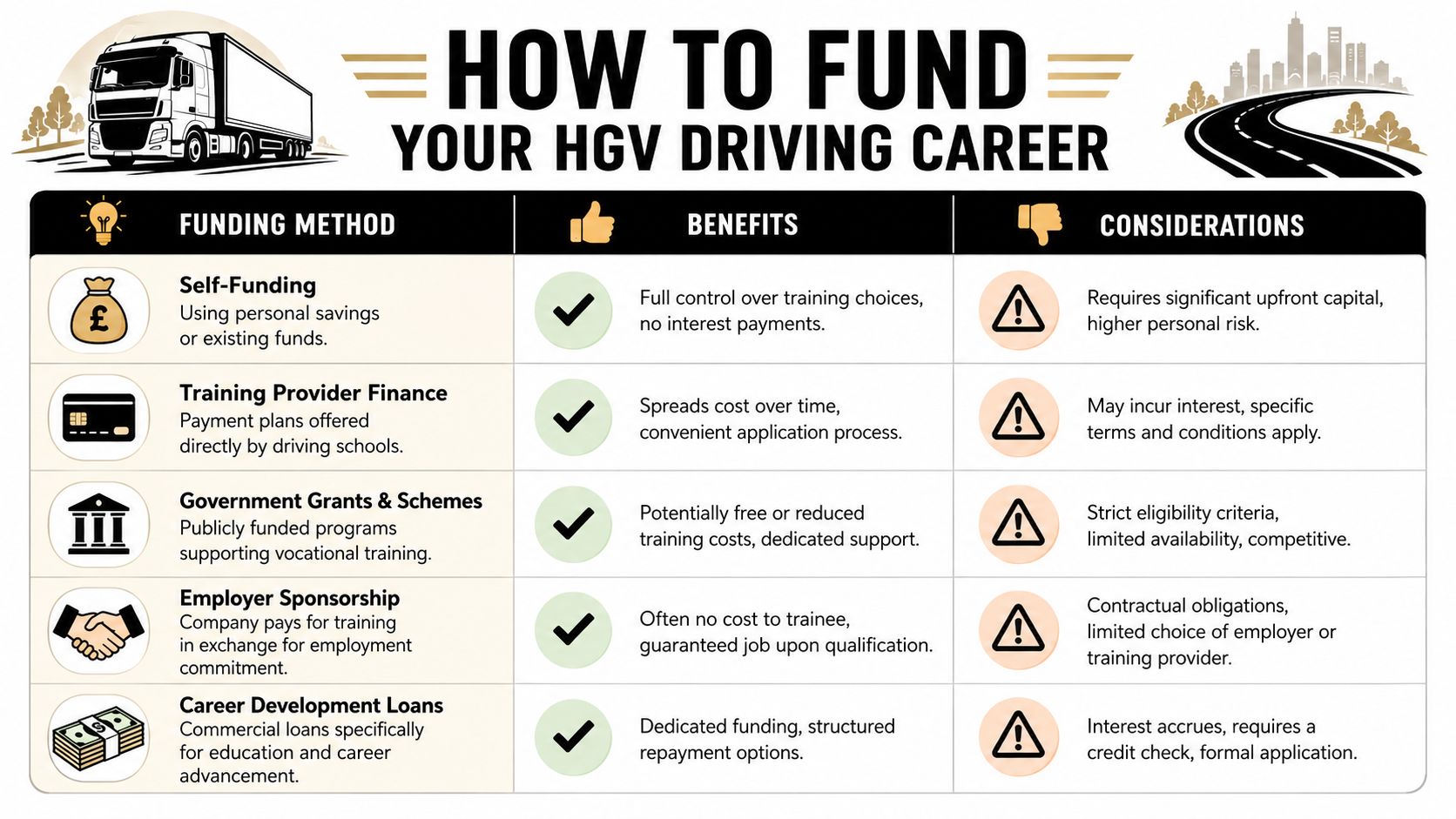
The main funding routes
Each funding option has trade-offs. It helps to think in terms of control, speed, and monthly pressure.
Self-funding. This gives you the most control over where and when you train. It also means the full cost lands on you upfront.
Training provider payment plans. These can spread the cost into manageable chunks, though terms vary and you should read them carefully.
Employer sponsorship. Some firms support new drivers, often with a commitment to work for them afterwards.
Government-backed opportunities. Availability changes, and eligibility rules can be strict, but they're worth checking.
Career development borrowing. This can enable quicker access to training, but it introduces repayments and approval criteria.
Why spreading the cost can make sense
For many career changers, the practical problem isn't whether Cat C training is worthwhile. It's whether they can manage the timing of the payments.
A staged payment approach can help because it lets you protect your household budget while still moving forward. Some providers offer in-house payment options, and funding for HGV training is worth reviewing if you want to see the kinds of routes learners commonly explore. HGV Learning also offers in-house payment plans over 10 to 12 months, according to the company information provided.
A sensible funding choice is the one you can maintain without stress if your training timeline shifts or a retest becomes necessary.
Questions to ask before you commit
Before you agree to any funding method, check the practical details:
What's included in the financed amount. Make sure it covers the parts you need, not just the driving lessons.
What happens if you need extra training. Ask whether additional hours can be added later and how they're charged.
When repayments start. Timing matters if you're changing jobs or reducing work hours during training.
Whether there are conditions attached. Employer-funded routes may limit your choices after qualification.
Funding should support your training, not create fresh uncertainty. If the terms are hard to understand, pause and ask for them in writing.
Your Timeline From Application to Qualification
Cost matters, but timing matters too. Many learners aren't just asking what Cat C driver training costs. They're also trying to work out how soon they can qualify and start applying for work.
Some parts move quickly. Others depend on bookings, availability, and how prepared you are when test dates arrive.
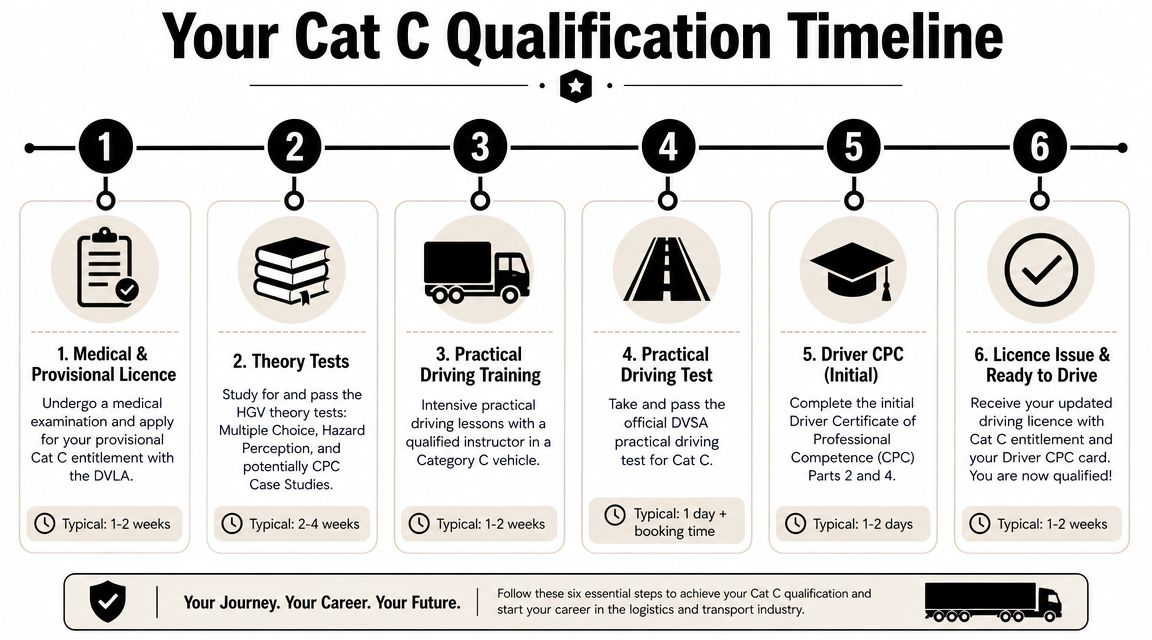
A practical timeline to expect
The infographic above gives a useful planning sequence. In plain terms, your route often looks like this:
Medical and provisional application. You complete the medical and send off the paperwork for provisional entitlement.
Theory stage. You study for the multiple-choice, hazard perception, and, where relevant, CPC case studies.
Practical training. You complete your in-vehicle instruction in a Category C vehicle.
Practical testing. You take the off-road and on-road test stages.
Driver CPC completion. You complete the final practical demonstration if required for professional driving.
Licence issue. Your updated entitlement and CPC card are processed.
Where delays usually happen
The training itself is only one part of the timeline. Delays often come from admin, test availability, or trying to fit training around work and family commitments.
You can make the route smoother by doing a few things early:
Book the medical promptly so your provisional step doesn't drift.
Start theory revision straight away instead of waiting for practical dates.
Keep documents organised so forms and confirmations don't get lost.
Ask for a full booking sequence from your provider if they coordinate dates for you.
Fast qualification usually comes from good sequencing, not from rushing. Learners who organise the early stages well often avoid the stop-start pattern that drags the process out.
A realistic plan helps you budget better too. If your timeline stretches, your payment plan, work schedule, and retest contingency all become more important.
Common Questions and Starting Your Journey
A lot of new drivers reach this stage with the same worry. The headline quote looked manageable at first, but now the main question is what the full bill could look like if something does not go to plan.
That is a sensible concern.
Cat C training usually pays off best when you treat it like a budget with moving parts, not a single fixed price. The course fee is only one part of the picture. Retests, extra tuition, time away from work, and CPC requirements can all change what you spend. If you understand those parts before you book, you are far less likely to get caught by surprise.
What happens if I fail a test
A failed test does not mean starting from zero, but it often does mean extra cost. In most cases, you will pay for another test booking, and your provider may recommend more training before the retest.
That is why retest terms matter so much.
The first quote you receive might only cover the initial attempt. If the package is very short, you may save money on day one but spend more later because there was not enough time to build confidence. A better way to compare providers is to ask for two figures: the initial package price and the likely cost of a retest package if you needed one. That turns a vague quote into a more useful budgeting tool.
Is retraining for a retest included
Sometimes it is included. Sometimes it is charged separately. Providers set this up in very different ways, so do not assume anything is built in.
Ask for these points in writing:
Whether the retest fee is included
Whether any extra training hours are included
What a typical retest package would cost in full
How quickly a retest can usually be arranged
Written answers help you compare like with like. They also give you something clear to refer back to later if there is any confusion.
Should I choose the cheapest package
Choose the package that fits your starting point.
A driver with recent experience in large vehicles may need less time than someone coming from a standard car licence with no commercial driving background. The cheapest option can work well if it includes enough training for your level. It becomes expensive if it leaves you underprepared and paying again.
Training works a lot like buying the right size boots for a long walk. Too much is wasteful, but too little causes problems before you reach the finish. The aim is not to buy the lowest number on the page. The aim is to pay for enough instruction to pass with confidence.
What should I do before asking for quotes
Get clear on your own situation first. That makes the answers you receive far more useful.
For example, do you need Driver CPC for paid work, or are you taking the licence for personal use? Do you need weekend availability because of your job? Do you want the provider to organise bookings and admin, or are you happy to handle some of that yourself? Those details affect both price and scheduling.
Then ask every provider for the same breakdown. A good quote should show what is included, what is excluded, and what would trigger extra charges. If one training company gives a single total and another lists each element separately, the second quote is usually easier to budget from because you can see where your money is going.
The cost that causes trouble is often not the highest quote. It is the unclear one.
If you want a clear quote with the costs set out properly, contact HGV Learning. A detailed breakdown of the route, the included elements, and the likely extras can help you budget with confidence and choose the training path that fits your situation.
Want to see how the numbers break down for your own budget? Try our repayment calculator.