A typical novice HIAB course in Scotland usually sits between £600 and £900. Prices look confusing at first, but they make more sense once you see how course length, operator experience, attachments and certification fees change the total.
You've probably already seen the problem. One provider page shows a few hundred pounds, another looks closer to a full licence add-on, and neither makes it clear what's included. That's why HIAB training prices in Scotland can feel harder to compare than they should.
The confusion isn't imagined. HIAB training prices vary a lot from one provider to another depending on course length and experience, which is exactly why many drivers and employers struggle to judge what a fair quote looks like without asking around first.
What matters isn't just the headline fee. You need to know whether the quote covers the training days, practical assessment, written test, registration, card or certificate charges, VAT, and whether you're booking a novice course, a refresher, or attachment-specific training. That's where people either save money or end up paying twice.
Your Guide to HIAB Training Prices in Scotland
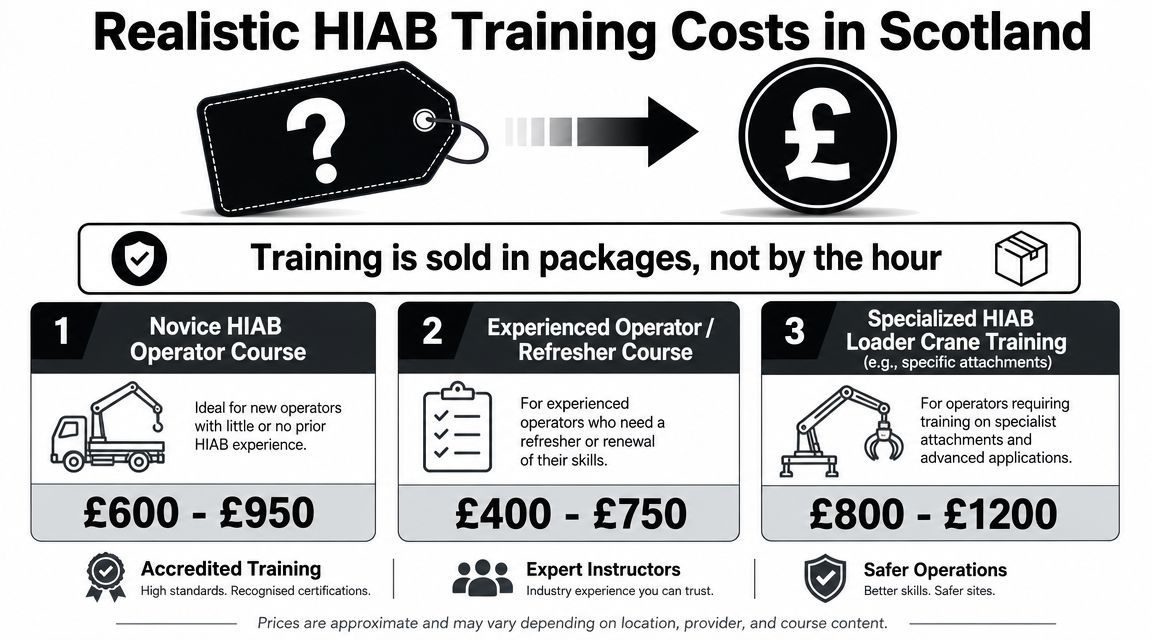
If you're comparing providers, the first thing to know is that HIAB courses are usually sold as fixed training packages, not as open-ended hourly lessons. That's good news for buyers because it makes the market easier to benchmark.
In practice, most quotes fall into a recognisable ladder. A provider may offer a short refresher for an experienced operator, then a longer basic course for a novice, then a more expensive package if extra attachments or more complex lifting tasks are involved. The price rises because the provider is giving you more instructor time, more assessment coverage, and more paperwork.
Why the market looks messy online
Part of the problem is that some websites publish a starting price without telling you what sits behind it. Another may show a broad range based on experience level, but not mention whether registration fees are extra. Two prices can look close together while covering very different things.
Practical rule: Never compare HIAB quotes until you know the course type, the number of days, the attachment coverage, and whether the certification charge is separate.
That's especially important if you're new to lorry loader work. A novice doesn't need the cheapest line on a price list. A novice needs the course that leads to a recognised certificate on the right equipment.
What most people should budget for
For a straightforward beginner route, budgeting in the £600 to £900 range is realistic. That won't cover every scenario, but it will stop you being misled by unusually low teaser prices that don't include the full package.
If you already operate a lorry loader and only need renewal or refresher training, the bill is usually lower because the course is shorter. If you need more than a simple hook set-up, costs move upward again.
That's the pattern across the market. Shorter courses for experienced operators cost less. Longer novice programmes and broader attachment coverage cost more.
What Are the Realistic HIAB Course Costs?
Here's the simplest way to read the market. Novice training costs more than refresher training, and multi-attachment training costs more than a standard basic package.
A useful benchmark comes from a UK provider with published HIAB novice pricing. It lists beginner training from about £614.45 for a 2-day shared novice course, rising to £864.95 for one-to-one delivery, with more advanced multi-attachment packages reaching £1,054.95 (GTG HIAB novice pricing).
That gives you a clear structure for Scotland too, because the same course formats and certification model are widely used here.
Typical price bands in real buying situations
For most buyers, the market behaves like this:
Novice package: Usually starts around the mid-£600s for a shared beginner course and rises toward the upper end of the range when it's delivered one-to-one or includes broader equipment coverage.
Experienced operator or refresher: Usually costs less than a novice route because the course is shorter and the operator already has practical familiarity.
Specialist or multi-attachment training: Costs more when the package includes extra attachments, more complexity, or a broader assessment scope.
Those categories matter because many people search for one simple answer, but there isn't one single HIAB price. There's a price ladder.
Why package pricing is easier to compare
A package-based market is easier to shop than hourly tuition. You can compare like with like if you ask the right questions:
Course level: Novice, experienced operator, or refresher
Delivery style: Shared course or one-to-one
Attachment scope: Hook only, or a wider combination
Certification charges: Included, or billed separately
If you've priced other vocational courses before, the comparison method is similar. Looking at published examples from outside the HIAB sector can help you see how providers structure costs, so it can be useful to view A8 driving course fees and notice how package design, delivery format and included elements affect the final figure.
The cheapest quote often buys the narrowest package. The better question is whether the course matches the crane, attachments and work you'll actually do.
Decoding Your Quote What Should Be Included
A HIAB quote is only useful if you can see what you're paying for. Headline prices on their own are where confusion starts.
One provider may present a training fee that looks competitive, but the card or certificate fee appears later. Another may include assessment and paperwork in the day rate. A transparent quote lets you compare properly.
The items worth checking line by line
Ask for each quote in writing and check whether it covers:
Instructor delivery: The actual teaching time, practical coaching and supervision.
Assessment and exams: Written and practical testing should be named clearly.
Machine and vehicle use: If training is at a centre, ask whether equipment use is included.
Certificate or card charges: Some providers itemise these separately.
VAT position: Especially important when comparing business and personal bookings.
Attachment coverage: A hook-only assessment is not the same as a wider lorry loader package.
It’s worth checking this specifically when you compare quotes. Some providers list a headline training price but charge certification separately, so the number you see first isn’t always the number you’ll actually pay.
Comparing HIAB Training Quotes
Feature
Basic Quote (Potential Hidden Costs)
All-Inclusive Quote (Best Practice)
Course type
Vague wording such as “HIAB training”
States novice, refresher, or experienced operator
Course duration
Days not confirmed
Exact training length confirmed in writing
Equipment coverage
Attachment type not specified
Hook, grab, brick clamp or other attachments listed
Assessment
Not mentioned clearly
Written and practical assessment included
Certification
Card or certificate fee added later
Registration and certificate costs shown upfront
VAT
Unclear
VAT stated clearly
Location
Travel or site costs not explained
Venue or on-site arrangements confirmed
Questions that save you money
A short call can stop a poor booking. Ask these before you commit:
Is this price for a novice or experienced operator course?
Which attachments am I being assessed on?
Are all registration and certificate fees included?
Does the quote include VAT?
Will I train on the same type of equipment I'll use at work?
If you want a broader grounding on course formats and certification terms, this HIAB certification guide is a useful reference point before you compare providers.
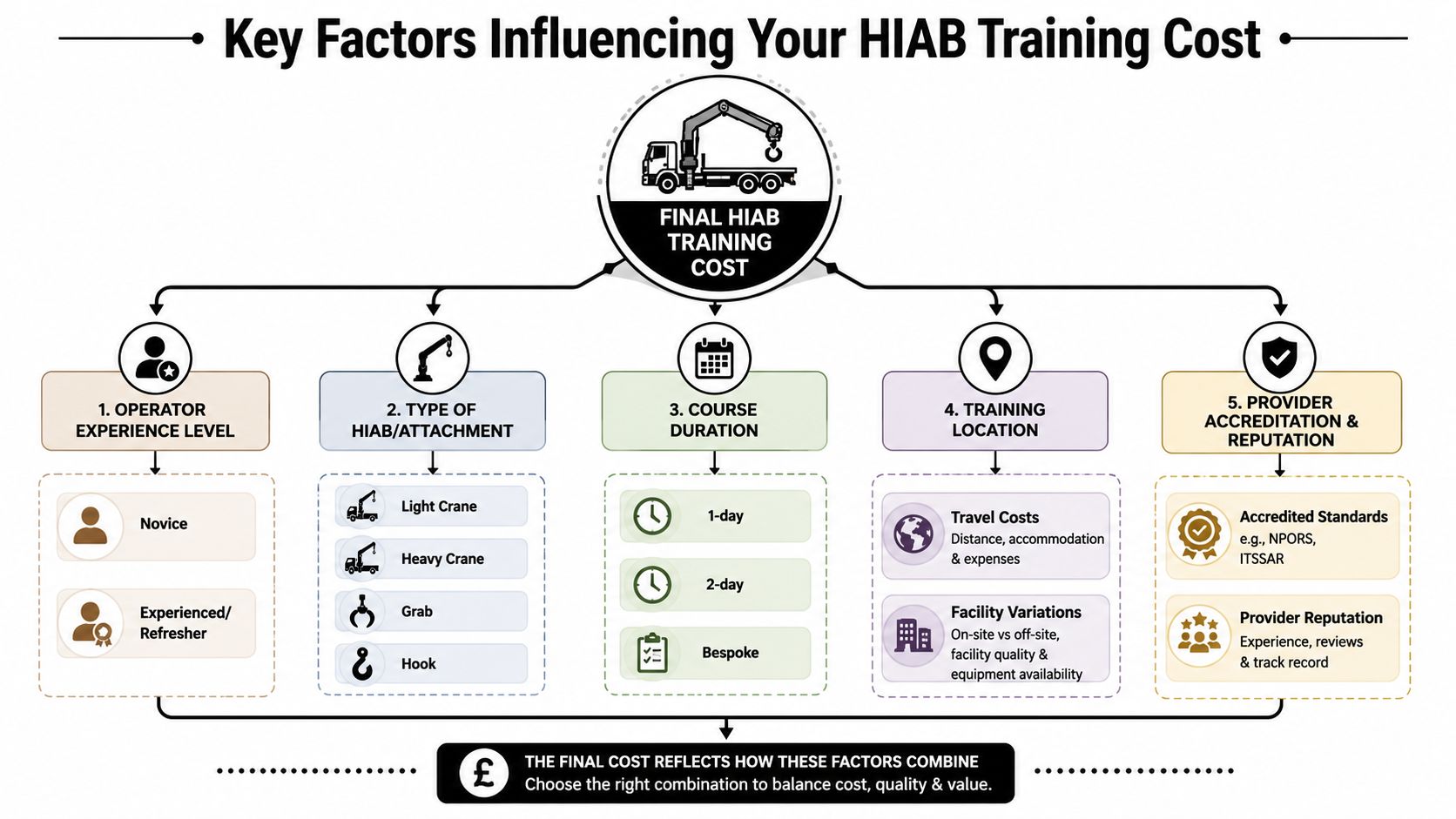
Key Factors That Influence Your Training Cost
The final bill isn't random. It's built from a few practical variables that training coordinators look at straight away.
Experience level changes everything
The biggest cost driver is whether you're a novice or an experienced operator. ALLMI states that its operator course is one day for experienced candidates and a minimum of two days for novice candidates, with both routes ending in written and practical exams (ALLMI operator training structure).
That's why refresher training is cheaper. The provider is delivering fewer contact days while still handling assessment and certification admin.
Training format affects the day rate
Group delivery usually brings the per-person cost down. One-to-one instruction costs more because the trainer, vehicle slot and assessment time are focused on a single learner.
That isn't always bad value. If someone is under time pressure, needs extra confidence with controls, or has to train on a specific work pattern, individual tuition can be the better buy even if the fee is higher.
Attachments and crane scope push the price up
A simple hook set-up is one thing. A wider package covering more attachments is another.
In real jobs, many underbought courses show their weakness. A certificate that doesn't reflect the actual attachment use on site can create downtime later, because the operator still needs familiarisation or further training before they're useful in production.
Buy for the job, not for the cheapest pass. If your work involves a grab or brick clamp, make sure the quote and assessment reflect that.
Accreditation and administration have a cost
Recognised accreditation doesn't make a course more expensive for no reason. It adds structure, exams, documentation and a standard the market understands.
That matters when employers or principal contractors ask for proof of competence. An in-house familiarisation session might have operational value, but it isn't the same as recognised operator training with formal assessment.
How to Fund Your HIAB Training in Scotland
The struggle isn't about HIAB training's value. It's about the timing of the cost. That's a different problem, and it needs a different answer.
Employer funding often makes the most sense
If you're already working in transport, builders' merchants, utilities, plant hire or general haulage, ask your employer first. Many firms would rather train an existing driver than recruit a new one.
For depot-based teams, on-site delivery can be especially cost-effective. One UK provider advertises £375.00 + VAT per day, which is £450.00 total, for training at the client's premises using the employer's own vehicle and equipment, with up to 4 candidates per day, plus a £39.95 per operator ALLMI registration fee. That brings the rough cost to about £112.50 per trainee per day before registration when all places are filled.
That model works well because the team trains on the actual crane, body and attachment set-up used in the business.
Self-funding is easier when the cost is spread
For private learners, the practical answer is often a payment plan. Spreading the cost turns a large one-off bill into something manageable, especially if you're adding HIAB onto an HGV career move and already paying for other licences or CPC elements.
The key is simple. Don't just ask, “What's the total?” Ask, “What can I afford monthly without causing pressure elsewhere?” If the answer is clear, training becomes easier to commit to and finish.
Grants and support are worth checking
Funding routes vary, so it's worth checking any vocational support you may qualify for through local or national schemes. Availability changes, and eligibility depends on your circumstances, but it's sensible to ask before paying in full yourself.
If you're exploring ways to spread or support the cost, this guide to funding for HGV training is a practical place to start.
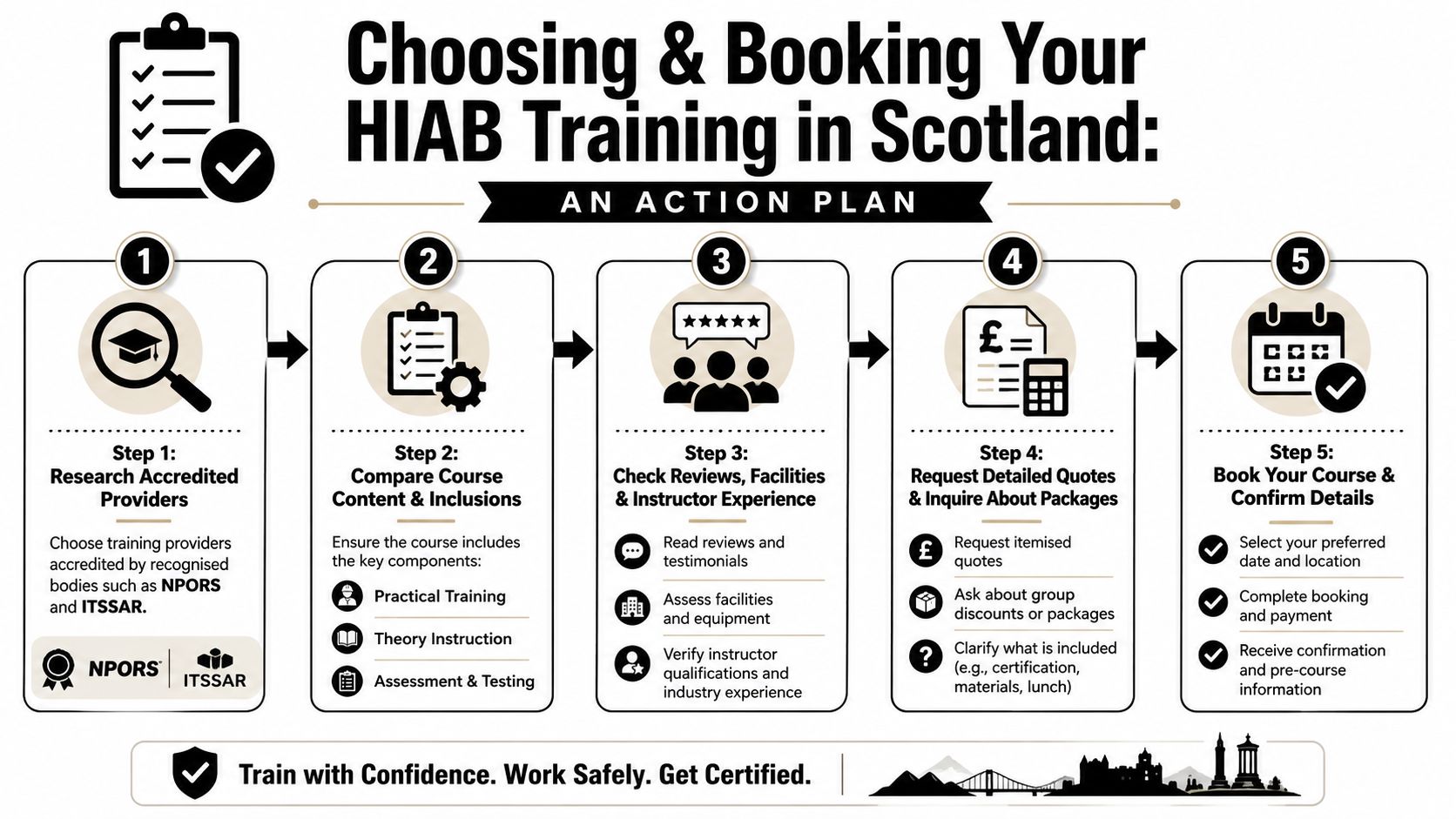
Choosing the Right Provider and Booking Your Course
Price matters, but it shouldn't be the only filter. A poor course costs more in the long run if you leave without the right coverage for the work.
What to look for before you book
Use a simple checklist when you speak to providers:
Accreditation: Ask whether the course is delivered to a recognised standard and what certificate or card you'll receive.
Equipment match: Confirm the training covers the crane type and attachments relevant to your work.
Quote clarity: Make sure the written price shows assessment, admin charges and any certificate fees.
Location practicality: Choose a centre or site arrangement that won't add avoidable travel and downtime.
Reputation: Look for providers that explain their course properly rather than relying on vague sales wording.
Good providers answer direct questions directly
A reliable training provider won't dodge practical details. They should be able to tell you what level you need, how long it will take, what equipment is used, and what the final invoice includes.
If the answers are vague, keep looking. In my experience, vague pricing usually sits next to vague delivery.
A solid booking conversation should leave you knowing the course length, attachment scope, assessment method, certificate route and total payable amount.
Booking with less guesswork
Before you commit, gather two or three written quotes and compare them against the same checklist. Don't compare a refresher against a novice package. Don't compare hook-only against a wider attachment course. Compare like with like.
If you want a starting point for local options and course availability, this page on HIAB training near you can help narrow the search.
Frequently Asked Questions
Do I need an HGV licence before doing HIAB training?
Not always. A person can complete HIAB training without already holding an HGV licence, depending on the training aim and provider arrangement. But if your goal is to work as a lorry loader driver on the road, you'll usually need the correct driving entitlement as well. For most career changers, the HIAB certificate and the vehicle licence go hand in hand.
How long does a HIAB certificate last?
Certificates don't last forever. Operators typically need refresher or renewal training after a period of validity set by the relevant scheme or employer requirement. Always check the expiry details on the certificate or card you receive and don't rely on memory.
What is the difference between ALLMI and RTITB?
Both are recognised names in workplace transport and lifting training. In simple terms, ALLMI is strongly associated with lorry loaders, while RTITB covers a wider range of workplace transport training. What matters most is whether the accreditation suits the job, the employer and the site requirements you'll be working under.
If you're pricing up HIAB training and want help finding a course that matches your budget, work type and location, HGV Learning can help you compare options, arrange training locally, and explore payment plans that make the cost easier to manage.
What Age Can You Start HGV Driver Training? A 2026 UK Guide to Licence Age Requirements
If you're asking what age you can start HGV driver training, the honest answer depends on which licence you're after. A C1 licence, covering vehicles...