Thinking about a career change at 40? It’s a thought that crosses a lot of minds. The good news is, the path forward is a lot clearer than you might imagine. It’s not about starting from scratch; it’s about taking your two decades of life experience and pointing them in a new, more rewarding direction.
Is It Really Too Late to Change Career at 40?
Let’s tackle the biggest myth straight away: the idea that 40 is somehow ‘too late’ to switch gears. It’s a common fear, but the reality of the modern UK job market tells a completely different story. The whole ‘job for life’ concept is a relic of the past. Today, mid-life career pivots aren’t just possible; they’re becoming the norm.
For many, hitting 40 feels like a major crossroads. It’s a natural time to take stock and ask what you really want from your working life. This isn’t a mid-life crisis; it’s a moment of clarity. You now have something you didn’t have in your twenties: a wealth of real-world experience, a better understanding of your priorities, and often, more stability.
Why Your 40s Are a Prime Time for Change
The idea of changing careers at 40 isn’t just wishful thinking. The truth is, it’s often the perfect time for a shift. People are working longer, and launching a ‘second act’ in your career is a smart, practical move.
You bring some serious advantages to the table that younger candidates simply can’t match:
Proven Reliability: You have a 20-year track record of showing up, getting the job done, and being a dependable member of a team.
Developed Soft Skills: All those years of dealing with colleagues, managing tasks, and solving unexpected problems have built communication and problem-solving skills that are gold in any industry.
Clearer Goals: You’re not just guessing what might make you happy any more. You have a much clearer picture of the salary, work-life balance, and job satisfaction you need.
And you’re not alone in feeling this way. Since the pandemic, an estimated 4 million Brits have switched careers. A recent report showed that 33% of workers are planning a change, with 40% pointing to a better salary as the main driver. You can read more on the latest UK career change statistics and see just how common this journey is.
The average UK worker now changes jobs roughly every five years. That tells you everything you need to know. Career reinvention isn’t a risky leap in the dark; it’s a well-trodden path.
The Employer Perspective on Mature Candidates
It’s easy to get hung up on the worry that employers see age as a negative. But in many sectors, the exact opposite is true.
Industries with high demand, like logistics and HGV driving, actively seek out the maturity and professionalism that candidates in their 40s and 50s offer. They aren’t just hiring someone to drive a lorry; they’re investing in a reliable, responsible professional who they can trust to get the job done right.
To a smart employer, your experience isn’t a liability: it’s a massive asset. You’re seen as a safe bet. Someone who is serious about their work, understands responsibility, and is ready to commit. Forget the anxiety. Your age is your advantage.
A Practical Plan for Changing Careers in Your 40s
Knowing you need a change is the easy part. Building a plan to actually make it happen? That’s where things get real. Switching careers isn’t about one massive, risky leap of faith; it’s about taking a series of smart, deliberate steps that get you from where you are now to where you truly want to be.
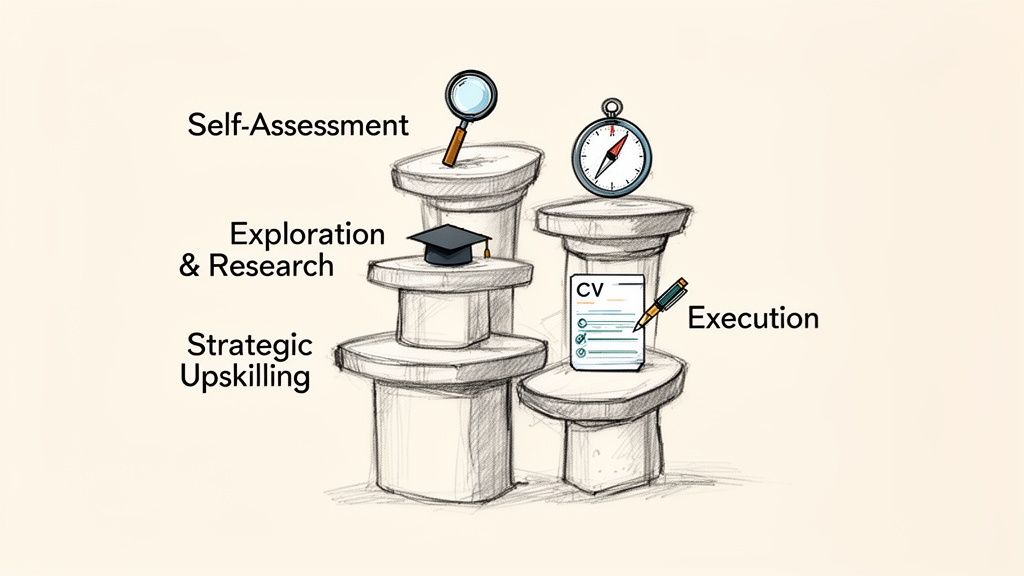
We’ve broken the process down into four core stages. This approach helps you move from just thinking about a new career into actively building it. Let’s get started.
1. The Reality Check: Honest Self-Assessment
Before you can pick a new direction, you need a crystal-clear picture of your starting point. Looking at yourself at 40 is a whole different game than it was at 20. This isn’t about vague dreams any more; it’s about your real-world experience and what you genuinely need from a job.
A great place to start is by figuring out what you don’t want. Is it the awful commute? The constant pressure? Or just feeling like your hard work goes unnoticed? Nailing down the negatives is the fastest way to define what a positive move would look like.
Next, take stock of your skills. After two decades in the workforce, you’ve built up a toolkit of abilities that employers everywhere value. You might not even think of them as skills any more, but they are:
Problem-Solving: You’ve handled countless unexpected issues, from tricky customers to last-minute project disasters.
Time Management: Juggling deadlines and competing priorities is second nature by now.
Communication: You know how to speak to colleagues, managers, and clients to get things done.
Finally, draw your lines in the sand. What are your absolute non-negotiables? This could be salary, work-life balance, location, or the kind of people you work with. This isn’t a wish list; it’s a set of hard requirements to guide your search.
2. The Discovery Phase: Exploration and Research
With that self-assessment in hand, you can start looking at what’s out there. This stage is all about gathering facts and busting myths. Don’t just glance at job titles; you need to dig into what a day in that role actually feels like.
Focus on industries where maturity is a plus, not a minus. Take the logistics sector, for instance. It’s crying out for reliable, professional people for roles like HGV driving. It offers a clear career path, solid wages, and the stability that many of us are looking for at this point in life.
Your research should be laser-focused on practical questions:
What are the typical hours and shift patterns?
What’s a realistic starting salary, and what can you earn down the line?
What are the real physical and mental demands of the job?
The best way to get answers? Talk to people who are already doing the job. Look them up on LinkedIn or in industry forums and ask about the good, the bad, and the ugly. Their honest, firsthand experience is worth its weight in gold.
3. The Smart Move: Strategic Upskilling
Once you’ve zeroed in on a career that looks promising, it’s time to bridge any skills gaps. Changing careers at 40 almost always means you’ll need to do some retraining, but that doesn’t have to mean signing up for a three-year degree.
For a career like HGV driving, the path is incredibly direct. With a good training provider, you can follow a clear roadmap from getting your medicals and provisional licence to passing your theory and practical tests. You could get your Category C or even a C+E licence in a matter of weeks, not years.
This is where a lot of people get stuck. Burnout and a non-existent work-life balance are pushing more people than ever to make a change. In fact, 1 in 3 UK employees report a poor work-life balance, and a huge 88% have felt burnout in the past two years. But with 40% of potential changers worried about the cost of retraining, it’s easy to see why flexible, affordable training is so vital.
4. The Final Step: Execution and Action
This is where all your planning pays off. It’s time to get practical, apply for jobs, and show employers what you’ve got.
First things first: your CV needs a total rethink. It’s no longer a simple list of jobs you’ve had. It needs to be a sales pitch that screams about your transferable skills and shiny new qualifications. Your personal statement is your moment to connect the dots and explain why you’re the right person for the role.
Key Takeaway: You have to frame your career change as a positive, strategic decision. You’re not running away from an old job; you’re actively moving towards a new opportunity, bringing two decades of valuable experience with you.
Get ready for that classic interview question: “So, why the big change?” Practise your answer until it’s second nature. Turn your age and experience into your greatest strengths. Talk up your reliability, work ethic, and mature attitude.
By following this four-stage plan, you can turn a daunting idea into a clear, achievable goal. For a more detailed look at the journey, you might find this to be a practical guide to a career change at 40 in the UK.
Below is a simple table to help you organise your thoughts and kick things off.
Your Career Change Action Plan
Here’s a quick summary of the four stages to get you started on your journey.
Pillar
Core Focus
Your First Action
Self-Assessment
Understanding your needs, skills, and non-negotiables.
List 5 things you dislike about your current role and what the ideal alternative looks like.
Exploration
Researching viable new careers that fit your criteria.
Identify 2-3 potential industries and find someone on LinkedIn who works in one of them.
Upskilling
Identifying and filling any skill or qualification gaps.
Research the specific training or certifications required for your top career choice.
Execution
Updating your CV, networking, and applying for jobs.
Rewrite the personal statement on your CV to tell the story of your career change.
Treat this as your starting map. Each step you take, no matter how small, is a step closer to a more fulfilling working life.
How to Finance and Fit a Career Change Into Your Life
Knowing you want a new career is the easy part. The real challenge? Figuring out how to pay for it and squeeze it into an already packed life. For anyone looking to change careers at 40, the practicalities of money and time are often the biggest roadblocks.
But here’s the good news: with some clever planning, you can navigate these hurdles without turning your world upside down.
It’s completely normal to feel a bit anxious. You’ve got a mortgage, family responsibilities, and bills that won’t just pause while you retrain. The old idea of quitting your job to study full-time isn’t realistic for most of us. Thankfully, modern training is built for people just like you, with flexible options that work around your existing commitments.
Creating Your Transition Budget
First things first, let’s get a clear and honest picture of your finances. This isn’t about finding a huge pot of gold overnight. It’s about understanding your cash flow and finding a little breathing room. Think of this “transition budget” as your financial roadmap for the next few months.
Take a hard look at your income and outgoings. Be realistic about what’s essential and what’s a ‘nice-to-have’ that you could pause for a little while. The aim here is to create a small buffer that can cover your training costs without causing major financial strain.
Focus on these key areas:
Essential Costs: Your mortgage or rent, council tax, utilities, groceries, and transport. These are the non-negotiables.
Variable Spending: Things like subscriptions, eating out, entertainment, and other non-essential shopping. This is usually where you can free up some cash.
Training Fund: A dedicated pot where you can put aside anything you save. Even £50-£100 a month makes a real difference and builds momentum.
This simple exercise puts you back in control. It turns that vague worry of “Can I even afford this?” into a concrete plan with a manageable target.
A common mistake is thinking you need to pay for everything in one go. With flexible payment plans, you’re not facing a huge lump sum upfront. You’re spreading a manageable cost over time, often while you’re still earning in your current job.
Finding the Right Funding for Your Training
Once you’ve got a budget in mind, it’s time to explore how to fund your new qualification. The thought of paying for retraining can be daunting, but many providers offer solutions designed to ease that burden. This is especially true if you’re looking at becoming an HGV driver.
Instead of needing thousands of pounds before you can even start, look for providers with flexible payment plans. At HGV Learning, for instance, we offer in-house financing that allows you to spread the cost of your training over 10 to 12 months.
This breaks a significant investment down into small, predictable monthly payments, making it far more accessible. It means you can get started on your new career path right away, without having to spend months saving up.
To get a better feel for what’s available, it’s well worth exploring our detailed information on funding for HGV training to see exactly how these plans work.
Scheduling Training Around Your Life
Time is just as precious as money, if not more so. The idea of adding hours of study and practical lessons to a full-time job and family life can feel impossible. But again, this is where modern training has adapted.
Look for courses that offer evening, weekend, or part-time schedules. For HGV training, a lot of the theory preparation can be done online, completely at your own pace. You can fit it in during your lunch break, after the kids are in bed, or on a quiet Sunday afternoon.
And when it comes to the practical driving lessons, you don’t need to book weeks off work. These can be scheduled in blocks that fit around your existing commitments. You could use a few days of annual leave or arrange lessons on your days off. This modular approach lets you keep earning while you learn, making the whole process feel achievable rather than overwhelming.
Retraining for the Road: A Look at HGV Careers
Thinking about a career change at 40 can feel overwhelming. But when you zero in on a specific, achievable path, it all starts to click into place. Let’s look at a very real and popular option that many are choosing for stability and great earning potential: professional HGV driving.
This isn’t just about getting ‘a job’. It’s a skilled profession that is the backbone of the UK economy, and the route to getting qualified is faster and clearer than you might imagine. Let’s break down exactly how you can go from your current role to being behind the wheel of a lorry.
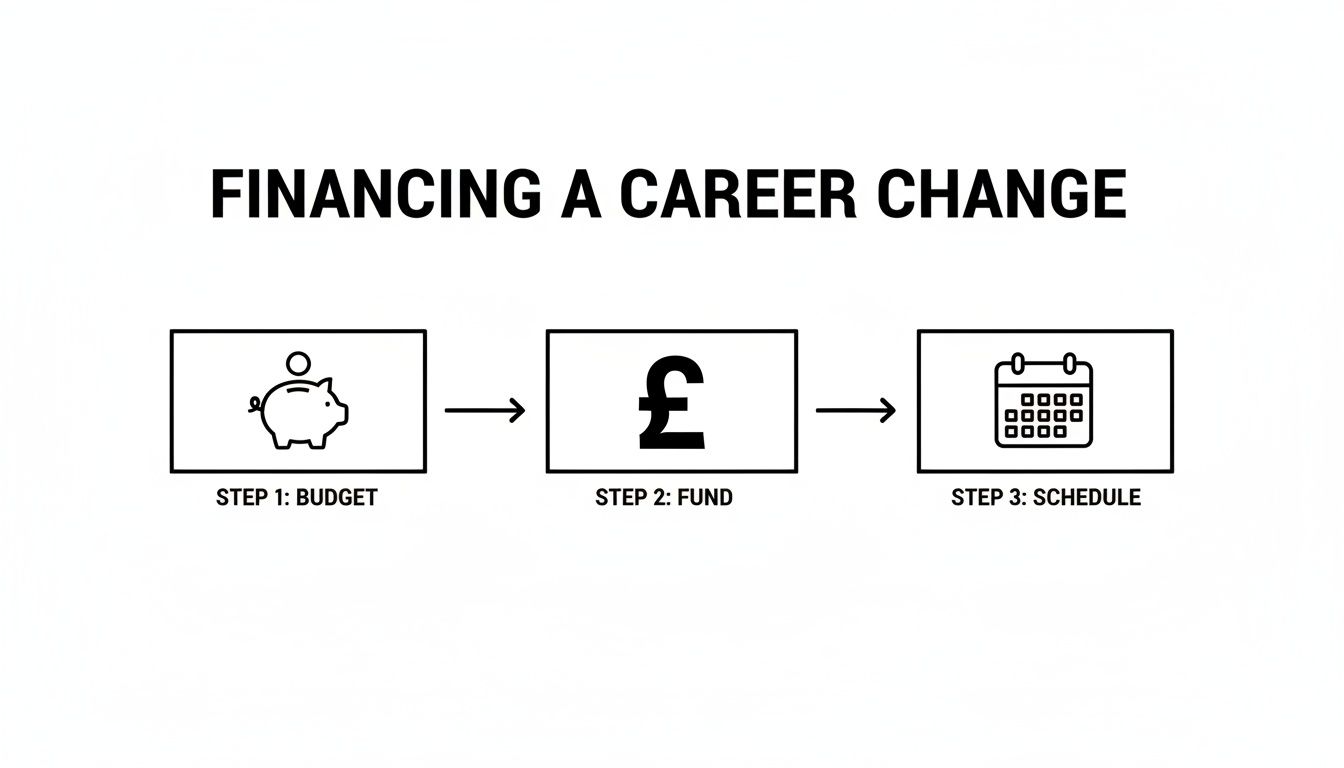
Thinking about the money side of things is often the biggest hurdle. This visual breaks it down into three simple stages, making the whole process feel much more manageable.
It’s all about budgeting for the switch, finding the right funding, and then scheduling your training in a way that works for you.
HGV Licence Categories at a Glance
Your first big decision is choosing the right licence. This isn’t a one-size-fits-all situation; the licence category you go for directly shapes the jobs you can get and the vehicles you’ll be driving.
Here’s a quick comparison of the main licence types and what they mean for your career.
Licence Category
Vehicle Type
Common Job Roles
Category C1
Vehicles between 3.5 and 7.5 tonnes.
Ambulance driver, large van courier, horsebox driver.
As you can see, each category opens up different doors. For many career changers, starting with a Cat C is a fantastic, versatile choice that gets you into the industry quickly.
A very common path is to get your Cat C licence, work for a year to get some solid experience, and then have your employer fund the C+E upgrade. It’s a great way to manage the transition step by step.
The Path to Getting Your Licence
The journey to becoming a qualified HGV driver is a clear, structured process. Here at HGV Learning, we guide people through it every single day.
It all kicks off with a straightforward medical exam to confirm you’re fit to drive commercially. We help you sort this and handle all the DVLA paperwork for your provisional HGV licence. Easy.
Once that provisional licence lands on your doormat, it’s time for the theory tests. There’s a multiple-choice part and a hazard perception test. Our learning platform is designed to get you prepped and confident, with plenty of practice materials and progress tracking.
After passing your theory, the exciting bit begins: practical, hands-on training. We’ll book you into a top-rated training centre near you with expert instructors who teach you the real-world skills you need to pass your test.
A standard HGV licence is your key to the industry, but specialist tickets can seriously boost your pay packet and job prospects.
The most valuable one to aim for is the ADR certificate. This qualification allows you to transport hazardous goods: anything from petrol tankers to industrial chemicals. Drivers with an ADR ticket are always in demand and can command much higher wages because of the specialist skills and responsibility involved.
What Can You Realistically Earn?
Let’s talk numbers. Salary is, after all, a massive factor when you’re changing careers at 40.
As a newly qualified Cat C driver, you can expect a starting salary in the region of £35,000 to £45,000 per year. For many people leaving other sectors, that’s a welcome pay rise right from the start.
Once you gain some experience and get your C+E licence, earnings can comfortably push past £50,000. If you add a specialist ticket like ADR on top, that potential goes even higher. It’s a career with real stability and a clear ladder for financial growth.
A Career Changer’s Story
To put this into perspective, think of someone like ‘David’, a 42-year-old retail manager from Manchester. He was burned out from the relentless pressure and inconsistent hours. He wanted better work-life balance and a more hands-on, practical role.
David decided to retrain as an HGV driver. He used a flexible payment plan to cover his Cat C training, studying for his theory in the evenings. In just three months, he passed all his tests. With a little help from our recruitment support, he landed a job with a regional distribution company.
He now has a stable rota, a better salary, and more time to spend with his family. His story is a perfect example of someone successfully making that change at 40.
Updating Your CV and Mastering Interviews After 40
You’ve done the hard work, completed the training, and now you have a new qualification in your hands. So, what’s next? Facing the job market. For many people changing career at 40, this is where the nerves can kick in.
The good news is, with the right strategy, your age and past experience can become your biggest strengths. It’s all about telling a compelling story – the story of a seasoned professional making a deliberate, smart career move.
Reframing Your CV for a New Industry
First things first: that old CV chronicling a 20-year career in another field needs a complete overhaul. Your focus now needs to be on the future, not just the past. The trick is to shift the emphasis from old job titles to the valuable, transferable skills you’ve built over the years.
For anyone making a midlife career change, framing your experience in the right way is a huge part of the puzzle. A great place to start is by looking at expert advice on how to write a career change resume that sells your potential.
A logistics employer won’t be fussed about your previous title as a retail manager or office administrator. But what they will care about are the skills you mastered in those jobs:
Reliability: You have decades of proof that you show up on time and see a job through.
Problem-Solving: You’ve spent years sorting out unexpected issues, whether with customers, suppliers, or tricky internal processes.
Communication: You know how to talk to colleagues and follow instructions to the letter.
Work Ethic: You understand what a hard day’s work looks like and you take responsibility for your role.
These are the qualities you need to be shouting about from the rooftops.
Crafting a Powerful Personal Statement
Think of the short paragraph at the top of your CV as your elevator pitch. It’s your one chance to grab a recruiter’s attention and explain your career change confidently.
It needs to answer the ‘why’ straight away. Don’t leave them guessing. Your statement should connect the dots between your past experience, your new qualification (like an HGV licence), and what you want to achieve in this new industry.
Pro Tip: Frame your career change as a positive choice for a better future, not an escape from a job you hated. An employer wants to hire someone who is running towards their industry, not just away from another.
For example, you could highlight your desire for a more practical, hands-on role where your proven reliability and problem-solving skills will be a perfect match for the demands of HGV driving.
Acing the Interview as a Mature Candidate
The interview is where you bring your CV to life. You can bet you’ll be asked the big question: “So, why the major career change at this stage?”
Don’t get defensive. This is your golden opportunity to sell yourself. Answer with confidence and turn a potential negative into a massive positive.
Example Answer Structure:
Acknowledge the Change: Kick off by confirming that this was a deliberate decision.
State Your Motivation: Explain what attracted you to logistics. Talk about the stability, the appeal of a practical role, or wanting to be part of an essential industry.
Connect Your Experience: Bridge the gap by linking skills from your old career, like time management or working under pressure, to the demands of being a driver.
Emphasise Your Value: Finish strong. Highlight what makes you a great hire right now, mentioning your maturity, proven reliability, and low-risk profile as a committed employee.
This confident approach shows you’re a thoughtful, motivated candidate, not someone having a mid-life crisis.
Using Recruitment Support to Your Advantage
Don’t go it alone. Many training providers, including us here at HGV Learning, offer recruitment support as part of our packages. We have strong links with logistics firms across the UK who are actively hiring newly qualified drivers.
This kind of support can give you a huge leg-up, connecting you directly with employers who already value career changers and understand the journey you’re on. It’s a fantastic way to find those first crucial opportunities and can fast-track your job search, helping you find relevant lorry driver jobs near you much faster.
Your Questions Answered on Changing Career at 40
Deciding to change your career at 40 is a major move, so it’s completely normal to have some questions and doubts. We’ve tackled some of the most common concerns we hear from people in your exact position to help you move forward with confidence.
Will Employers See My Age as a Disadvantage?
Quite the opposite, especially in an industry like logistics. Many employers actively seek out the reliability, life experience, and professional attitude that more mature candidates bring. You have something younger applicants don’t: a proven track record of commitment spanning two decades.
In sectors with significant skills shortages, companies want dependable people they can count on. To any good hiring manager, your age is a sign of stability, not a weakness.
How Long Does It Realistically Take to Retrain?
The retraining timeline is often much shorter than you might think. Take the path into HGV driving, for instance: it’s a great example of how quickly you can get qualified.
With a full-time commitment, you could have your HGV licence in as little as 8-10 weeks.
If you’re training part-time around your current job, a more realistic timeframe is usually 3-6 months.
Once you qualify, the right job-matching support can place you in a new role within weeks of passing your final test. It’s a genuine fast track to a completely new professional life.
You are not starting from scratch. The skills you’ve built over 20 years in the workplace (problem-solving, time management, and communication) are incredibly valuable and give you a huge head start.
Can I Afford to Retrain Without a Major Pay Cut?
This is a big one, but with a bit of planning, it’s entirely manageable. Modern training programmes are built for people who already have financial responsibilities, letting you keep earning in your current role while you study.
On top of that, financing options can spread the cost of your training over 10-12 months, turning it into smaller, predictable payments.
It’s also vital to look at the long-term picture. A newly qualified HGV driver can start on a salary of £35,000-£45,000, which often exceeds the pay of the job they left. This means you could be financially better off very soon after making the change.
What if I Try a New Career and Don’t Like It?
That’s a perfectly valid worry, but you can minimise the risk with good preparation. That initial ‘Exploration’ phase is your best friend here: speak to people already doing the job and be honest with yourself about the day-to-day realities.
The HGV training process itself is a fantastic trial run. You’ll spend a good amount of time behind the wheel long before you’re fully committed, giving you a real feel for the role.
Even in the unlikely event it’s not for you, you haven’t failed. You’ve just gained a valuable, transferable skill and a professional licence that could open up other doors you hadn’t even considered.
Ready to take the next step towards a rewarding new career on the road? At HGV Learning, we specialise in guiding career changers like you through every stage of the process, from paperwork and theory to practical training and job support. Explore our courses and flexible payment options today at https://hgvlearning.com.