Whether you’re looking to drive for a community group, support a local school, or step into a new career, getting your minibus driver licence is a fantastic move. To drive a minibus professionally or voluntarily, you’ll need what’s known as a Category D1 licence.
Getting qualified involves a few clear steps, from a driver’s medical to theory and practical tests. It might sound like a lot, but we’ll break it all down for you.
Getting Started on Your Minibus Licence Journey
The road to getting your Category D1 minibus licence is more straightforward than you might think. This qualification is your key to driving vehicles that have between 9 and 16 passenger seats, which opens up a whole host of rewarding opportunities.
We’ll walk you through everything, starting with figuring out exactly which licence you need. For some, a standard car licence might be enough, but for most, a D1 or even a D1+E (for towing a trailer) will be the goal. From there, it’s a case of passing your medical, smashing the theory tests, and getting hands-on with practical training.
A Serious Driver Shortage Means Real Opportunity
If you have been thinking about getting qualified, now is the perfect time to act. The UK is facing a huge shortage of qualified minibus drivers, and it is starting to seriously affect vital community services. This is not just a small gap in the workforce; it is what many in the industry are calling a demographic ‘cliff edge’.
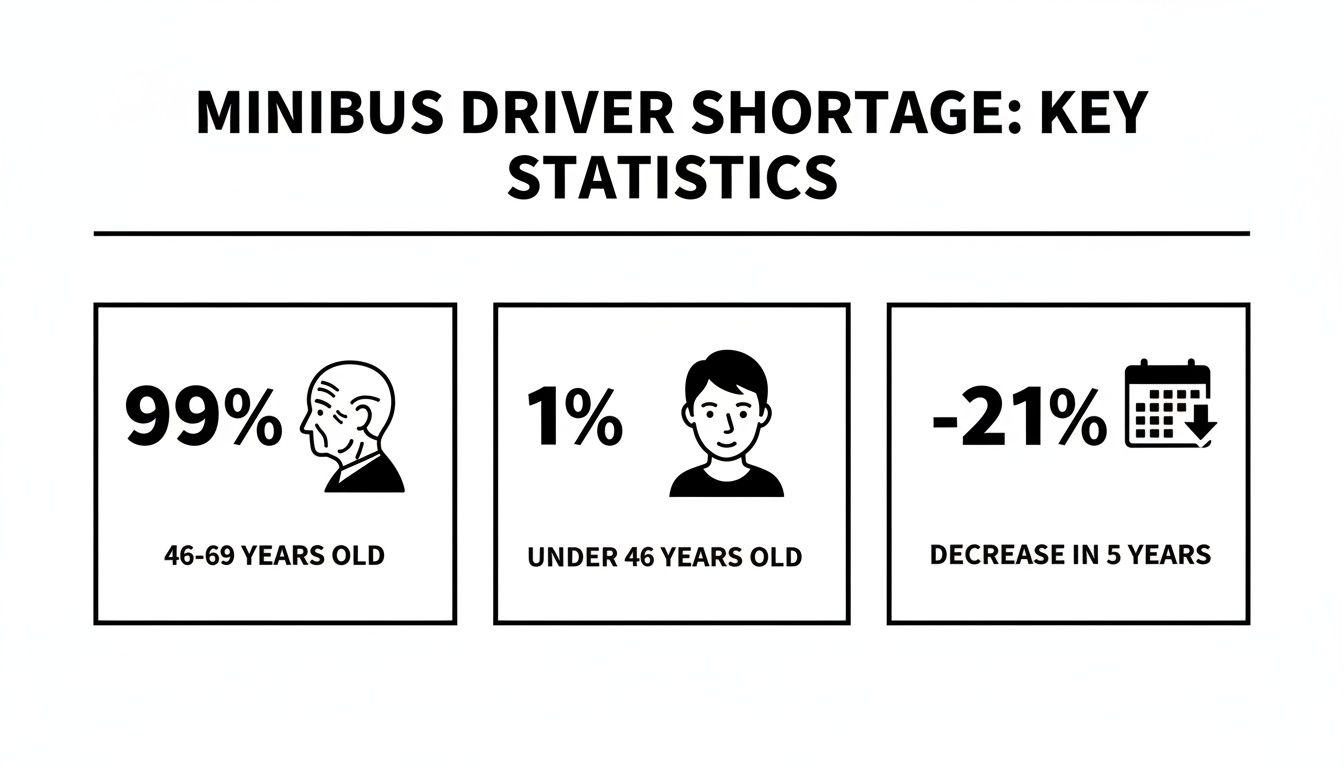
The statistics below paint a stark picture of the situation, highlighting just how urgent the need for new drivers really is.
The numbers do not lie. A massive 99% of all D1 licences in Great Britain belong to drivers aged 46 to 69. With just 1% of drivers under 46, it is clear we have a problem.
Even more worryingly, projections show that over 2.9 million of these licences will simply disappear over the next five years as drivers reach the age of 70. That’s a 21% drop in the number of qualified drivers. This looming crisis, brought to light by the Community Transport Association’s D1 campaign, puts essential services for the elderly, people with disabilities, and those in isolated rural areas at risk.
This ‘cliff edge’ scenario means organisations relying on part-time and volunteer drivers will struggle to find replacements, potentially grounding fleets that serve thousands of people daily. For aspiring drivers, this shortage translates directly into high demand and job security.
Whether you’re a volunteer wanting to support your local community, looking for a flexible part-time role, or aiming to add a valuable skill to your CV, this guide is your first step. Here at HGV Learning, we’re ready to help you turn this national challenge into your next great opportunity.
Confirming Your Eligibility and Medical Fitness
So, you are thinking about driving a minibus? The very first thing to sort out is whether you are eligible. This is not just about your age; it is about meeting specific DVSA (Driver and Vehicle Standards Agency) rules that dictate if your current car licence is enough, or if you need to apply for something new.
Everything hinges on when you passed your car driving test, also known as Category B. If you got your licence before 1st January 1997, you are in luck. You most likely have what are called ‘grandfather rights’, which let you drive a minibus with up to 16 passenger seats without needing a new licence. The catch? It is for non-commercial purposes only, like driving for a school or a voluntary group where you are not being paid for your time behind the wheel.
For anyone who passed their car test on or after that date, your standard licence caps you at driving vehicles with a maximum of eight passenger seats. If you want to drive a minibus carrying between 9 and 16 people, for any reason at all, you will need to apply for a provisional Category D1 licence. This is the specific entitlement you need for a minibus driver licence.
The D4 Medical Assessment
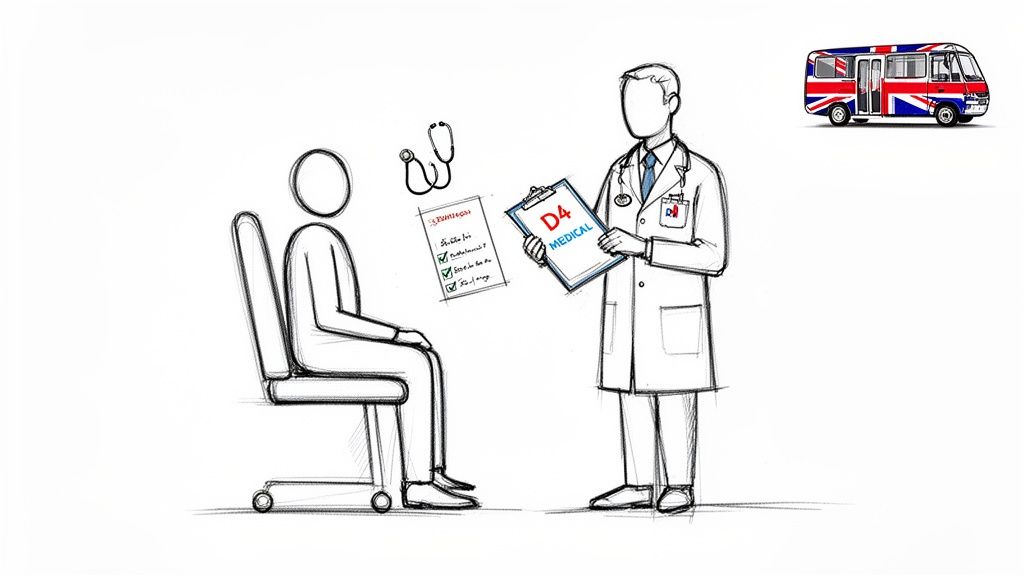
A non-negotiable part of getting your provisional D1 licence is passing a driver’s medical. This is more than just a quick check-up with your GP. It is a specific assessment, known as the D4 medical, designed to meet the higher safety standards for passenger transport. While you can go through your NHS GP, many find it is much faster to book in with a private doctor who specialises in these driver medicals.
The exam itself covers a few key areas:
An eyesight test to make sure your vision, with or without glasses, meets the stricter standard for passenger vehicle drivers.
A review of your medical history to flag any conditions like epilepsy, diabetes, or heart issues that could impact your ability to drive safely.
A physical examination to get a clear picture of your general health and fitness.
The doctor will fill out a D4 medical report form. You will need to send this form to the DVLA along with your D2 application form for the provisional D1 entitlement. It is crucial to get this paperwork spot on, as any errors or a failed medical can cause serious delays.
Top Tip: Always be 100% honest on your D4 form. It is far better to declare a condition that you have under control than for it to be discovered later, which could result in your licence being taken away. Come prepared with your glasses, a list of any medication you are on, and your driving licence for ID.
Once your medical is sorted and the DVLA approves your paperwork, they will post your new provisional licence. This document is your green light to start hitting the books for the theory tests and get your practical training scheduled. If you want to see how this fits into the wider world of passenger transport, you can learn more about obtaining a Passenger Carrying Vehicle (PCV) licence in our detailed guide.
Passing Your Theory and Hazard Perception Tests
So, you have got your provisional D1 entitlement sorted. Great stuff. Now for the theory tests, and it is crucial not to underestimate this part of the journey.
A lot of people assume it is just a re-run of the car theory test they passed years ago. It is not. The questions and hazard scenarios are built specifically for professional drivers of larger vehicles. If you are serious about getting your minibus driver licence, you need to get serious about your revision.
The whole thing is split into two parts, which you will sit back-to-back in one session:
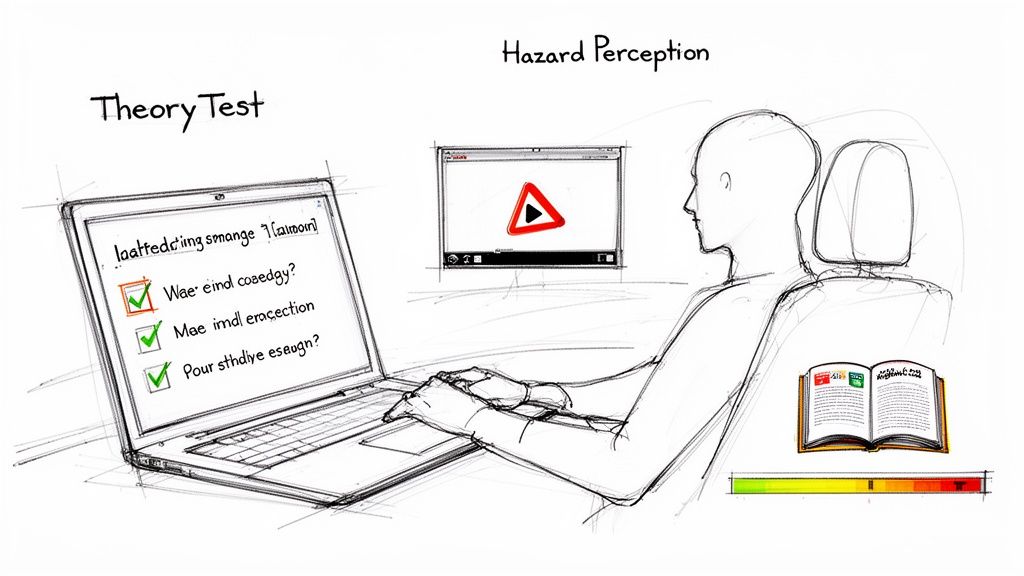
Multiple-Choice Questions: You will face 100 questions that dig into topics far beyond the standard Highway Code. Think vehicle weights, passenger safety protocols, rules on drivers’ hours, and the specific handling characteristics of a minibus.
Hazard Perception: This section shows you 19 video clips of real-world driving. Your task is to spot developing hazards as they appear. One of the clips even has a double hazard, just to keep you on your toes.
Crafting a Winning Revision Strategy
Just flicking through The Highway Code again simply will not cut it. To pass, you need to use proper learning tools designed for vocational drivers. Modern online platforms are a game-changer here.
They let you hammer through countless mock tests that are set up exactly like the real thing. This is the best way to find your weak spots, track how you are improving, and walk into the test centre feeling prepared and confident.
Failing your theory test is a frustrating setback that costs both time and money. We see it all the time. In fact, a surprising number of people fail before they even sit down. Data from Northern Ireland’s DVA showed that no-shows for theory tests hit 3,159 in a single quarter: that is about one in seven applicants just not turning up. This really highlights how tough the pass rates are for vocational categories like D1, so you need to be fully committed. You can explore the full report on DVA performance to see the trends for yourself.
Mastering the Hazard Perception Test
From my experience, it is the hazard perception element that catches most people out. This is not a memory game like the multiple-choice section; it is all about technique. You get points for spotting a developing hazard early, but click too much or in a rhythmic pattern, and you will score a big fat zero for that clip.
The secret is learning to tell the difference between a potential hazard (like a pedestrian walking on the pavement) and a developing one (that same pedestrian looking over their shoulder and stepping into the road). This is where practice software is worth its weight in gold, as it trains you to recognise the exact moment to click.
Getting a pass on both parts of the theory test is a huge milestone. It is the official stamp that says you have the right theoretical knowledge to handle a larger vehicle safely. More importantly, it clears the path for the bit you have been waiting for: getting behind the wheel for your practical training.
Your Practical Training and Driving Test
Right, you have conquered the theory tests. Now for the main event: the practical training and the test itself to get your minibus driver licence. This is where you put all that knowledge into practice on the road, and I cannot stress this enough – professional instruction is non-negotiable. Trying to wing it is a classic false economy. It almost always leads to a failed test, wasted cash, and a real knock to your confidence.
Forget what you know about the standard car test. This is a different league entirely. You are being tested on your ability to handle a longer, wider, and heavier vehicle with the kind of care and skill a professional driver needs. The examiner is looking for a safe, systematic, and smooth drive that puts passenger safety and comfort above everything else.
What to Expect From Professional Training
A good D1 training course is usually an intensive, four or five-day affair that finishes with your test on the last day. It kicks off with an assessment drive where your instructor will see how you handle the minibus and spot any bad habits that need ironing out from your car driving days.
From that point on, the training gets very specific, homing in on the skills you absolutely must master:
Spatial Awareness: You will learn how to really feel the size of the minibus. This means judging its length and width when navigating tight spots, tricky roundabouts, and narrow city streets without a second thought.
Manoeuvring: The reversing exercise is a massive stumbling block for many. Your training will drum a reliable, step-by-step method into you for nailing that ‘S-shaped’ reverse into a bay every single time.
Observation: Get ready to use your mirrors more than you ever have before. You will be taught to constantly scan, checking your mirrors to build a complete picture of the space around you and spot hazards early.
Passenger-Aware Driving: This is all about smoothness. It means accelerating, braking, and taking corners gently to make sure the ride is comfortable for anyone in the back.
An old-school instructor once gave me a brilliant tip: “Drive as if there’s a glass of water on the dashboard, and you’re not allowed to spill a drop.” It is a simple image, but it is the perfect way to get into the smooth, controlled mindset the examiner is looking for.
Understanding the D1 Practical Test Elements
The practical test is a pretty comprehensive assessment that lasts for about 90 minutes. It is designed to make sure you can drive the vehicle safely and confidently across all sorts of real-world road and traffic situations.
The test is split into a few different sections. You have to show you are competent in all of them to walk away with your minibus driver licence.
Key Test Components
Test Element
What the Examiner is Looking For
Vehicle Safety Checks
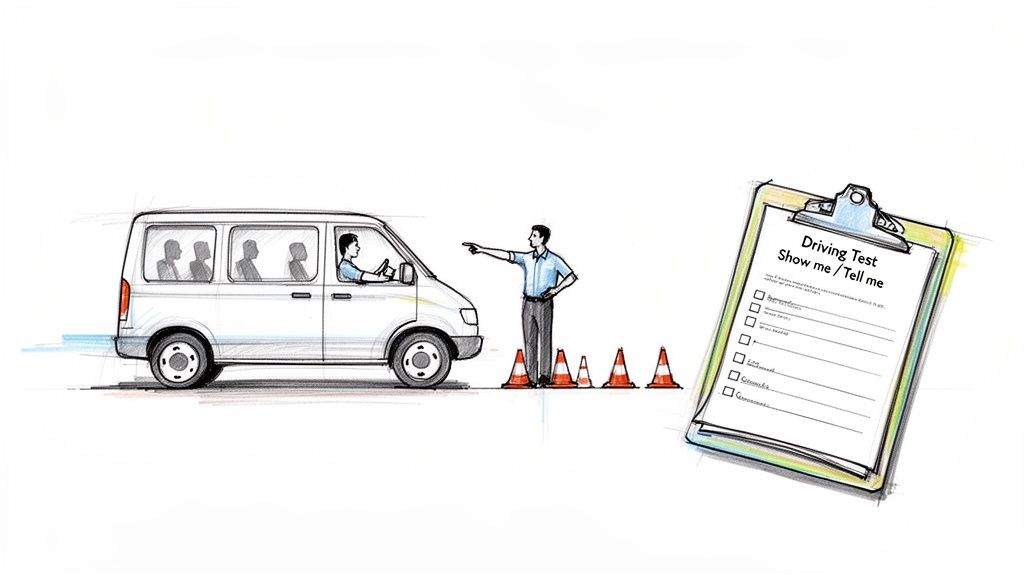
Your ability to answer the ‘show me, tell me’ questions, proving you know the vehicle is safe for the road.
Reversing Exercise
A precise and controlled S-shaped reverse into a bay, demonstrating excellent mirror use and accuracy.
General Road Driving
Around 60 minutes of driving on a mix of roads, from busy town centres to fast dual carriageways.
Independent Driving
Roughly 10 minutes where you follow either road signs or instructions from a sat nav to a destination.
Passing your practical is the final hurdle. With quality training behind you, you will not just know what is coming – you will have the skills and the confidence to prove you are a safe, competent minibus driver ready for the road.
Budgeting for Your Licence and Driver CPC
Getting your minibus licence is a fantastic investment in your career, but it is crucial to go in with your eyes open about the costs involved. A common pitfall is focusing only on the price of the practical training, forgetting about the other fees that pop up along the way. Planning for these from the start helps you budget properly and avoids any nasty financial surprises.
The total cost will naturally vary a bit depending on where you are in the UK and which training provider you go with. By breaking down each expense, though, you can put together a realistic financial plan. The main costs you will need to account for are the medical exam, your provisional licence application, the theory tests, and, of course, the practical training and test fees.
A Clear Breakdown of Expected Costs
To give you a head start, let’s look at the typical costs you can expect when going for your D1 minibus licence in 2026. Remember, while training course prices can fluctuate, the official test fees are set by the government and are fixed.
Here is a clear breakdown of the typical costs involved in obtaining a full D1 licence, which will help you budget for the entire process.
Estimated Costs for a Minibus (D1) Licence in 2026
Item or Stage
Estimated Cost Range (£)
D4 Medical Examination
£50 – £120
Provisional D1 Licence
Free
Theory & Hazard Perception Test
£37
Practical D1 Training Course
£1,000 – £1,500
Practical D1 Driving Test
£115 (weekday)
Driver CPC Part 2 (Case Studies)
£23
Driver CPC Part 4 (Practical Demo)
£55 (weekday)
Initial Driver CPC Card Issue
£25
As the table shows, the total investment is significant. That is why flexible payment options can be a real game-changer. Here at HGV Learning, we offer in-house payment plans that allow you to spread the cost over 10 to 12 months, making your career goals far more manageable.
Demystifying the Driver CPC
If your goal is to drive a minibus for a living (in other words, to get paid for it) you will also need a Driver Certificate of Professional Competence (Driver CPC). This is a legal requirement for nearly all professional drivers of passenger-carrying vehicles and HGVs, designed to improve road safety and maintain high standards across the industry.
The Driver CPC is broken down into two main parts:
Initial Qualification: This is for new drivers and involves passing two additional tests: a case studies theory test (Part 2) and a practical demonstration test (Part 4). You will typically tackle these alongside your main D1 licence training.
Periodic Training: Once you are qualified, you must complete 35 hours of training every five years to keep your Driver CPC valid. This ensures your skills and industry knowledge stay up to date.
For anyone driving professionally, the Driver CPC is non-negotiable. It is a fundamental part of being a professional driver and is vital for landing your first job with your new minibus licence. To get a complete picture, have a look at our detailed guide on what is Driver CPC training.
Understanding these financial and professional commitments from the outset is the key to a smooth journey. It allows you to plan your timeline and budget properly, ensuring you can focus on what really matters: becoming a safe, confident, and qualified minibus driver.
Building Your Career After You Pass
So, you have passed your tests and the D1 licence is officially yours. Congratulations! That is a huge achievement, and it is your ticket into a transport sector that is crying out for skilled, professional drivers.
With your new minibus driver licence, you are in a fantastic position. The demand for qualified drivers is high across several key areas. You could find yourself in a rewarding role doing:
Community Transport: Providing a vital lifeline for the elderly, people with disabilities, or those in rural communities.
Education: Becoming the trusted driver for school runs, college trips, and educational outings.
Tourism: Giving visitors a great experience on local tours and excursions.
Corporate Services: Running professional shuttle services for businesses, airports, and private events.
Your Licence as a Stepping Stone
A D1 licence is a brilliant qualification on its own, but it is also the perfect launchpad for a bigger career in driving. Many drivers we work with use their minibus experience to move on to their Category C1 licence, which is what you need to drive ambulances or larger commercial vehicles up to 7.5 tonnes.
From C1, the path to a full HGV licence, like a Category C for rigid lorries or a C+E for artics, is much more straightforward. Here at HGV Learning, we guide drivers through every stage of this journey, helping turn that first qualification into a stable, long-term profession. Your D1 is a solid first step on that ladder.
The UK is currently facing a significant bus and coach driver shortage, which is a real advantage for anyone just starting out. A recent industry analysis for 2026 showed that while bus driver vacancies had slightly improved, coach driver vacancies shot up to 12.4%. This has a direct knock-on effect on the minibus sector, pushing up demand and often pay rates, too. You can read the full fleet industry analysis on the 2026 driver shortage to get the complete picture.
Ongoing Professional Responsibilities
Getting the licence is just the beginning. Being a professional driver means upholding high standards of safety and compliance every single day. A huge part of this is understanding UK automotive regulations that apply to both you and your vehicle.
Your core duties from now on will include:
Daily Vehicle Checks: You must perform a thorough walk-around check before you drive, every single time. This is non-negotiable for ensuring the minibus is safe and roadworthy.
Passenger Safety: Your job is to make sure passengers are secure, know what to do in an emergency, and have a comfortable journey.
Maintaining Your Driver CPC: If you are driving for a living, you must complete 35 hours of periodic training every five years. This keeps your Driver CPC card valid and your skills up to date.
With your new D1 licence, you are not just a driver; you are a professional responsible for the safety and well-being of up to 16 passengers. Embracing these responsibilities is what sets a great driver apart from a good one.
Common Questions About The Minibus Licence
Getting your head around the specific rules for a minibus driver licence can throw up a few tricky questions. We get asked these all the time, so we have put together some clear, direct answers to help you navigate the process.
Driving for a Club or Voluntary Group
One of the most frequent queries we hear is about driving a minibus for a local sports team or community group. Can you do it on your standard car licence? The short answer is yes, but you have to tick every single box on a very strict list of conditions.
To drive a minibus on your Category B car licence, you must meet all of the following criteria:
You have to be over 21 years old.
You must have held your full car licence for at least two years.
The driving must be on a purely voluntary basis for a non-commercial organisation.
The minibus itself cannot have a maximum authorised mass (MAM) over 3.5 tonnes.
The moment you receive any payment that goes beyond covering your direct running costs, or if the vehicle is heavier, the rules change. In that case, you will need to have a full D1 licence.
D1 vs D1+E Licence Differences
You will often see D1 and D1+E mentioned, and it is crucial to know the difference. It all boils down to whether you need to tow anything.
A Category D1 licence is what you need to drive a minibus with 9 to 16 passenger seats. Simple enough. However, if your job requires you to pull a trailer weighing more than 750kg (say, for carrying luggage, sports gear, or other equipment) you will need to get your Category D1+E licence. You cannot just jump to the D1+E, though; you have to pass your standard D1 test first before you can even take the test for the ‘+E’ part.
The ‘+E’ entitlement is easily overlooked, but it’s an absolute dealbreaker for many roles, especially in tourism or for schools and clubs that transport bulky equipment. Always double-check what you might be expected to tow before you commit to a training path.
How Long Does the Process Take?
So, how long will this all take? From start to finish, a realistic timeline to get your full minibus licence is somewhere between two and four months.
This window covers everything from applying for the provisional licence (which can take 2-3 weeks to arrive), getting your medical sorted, studying for and passing the theory tests (another 2-4 weeks), and then finally completing your hands-on practical training.
Finding and booking a practical test slot can sometimes cause delays, but that is where working with a dedicated training provider really helps speed things up. It is also common for HGV drivers to wonder if their licence already covers them for minibuses; it is a bit of a grey area, which you can explore in our article about driving a minibus with an HGV licence.
Related Articles
16/10/2026
What Age Can You Start HGV Driver Training? A 2026 UK Guide to Licence Age Requirements
If you're asking what age you can start HGV driver training, the honest answer depends on which licence you're after. A C1 licence, covering vehicles...