If you have found yourself searching online for “lorry driver training near me,” you have landed in the right place. The timing could not be better. The UK’s logistics industry is crying out for skilled drivers, which means a new career behind the wheel offers real stability and fantastic earning potential. This is not just a job; it is a direct route into a vital profession that literally keeps the country moving.
Why Now Is The Time To Start Your HGV Career
The demand for new lorry drivers in the UK is higher than it has ever been. This is not some fleeting trend, either. It is a long-term opportunity, born from a perfect storm of economic growth and a major shift in the workforce. For anyone thinking about a career change, this creates a secure and incredibly promising path forward.
What is driving this urgent need? It is a simple fact: the current generation of drivers is heading towards retirement. The Road Haulage Association (RHA) recently pointed out that the UK needs to train 60,000 new HGV drivers every single year for the next five years. That is a huge number, and it is largely because the average HGV driver is now 48 years old, with over half the workforce aged 50 or over.
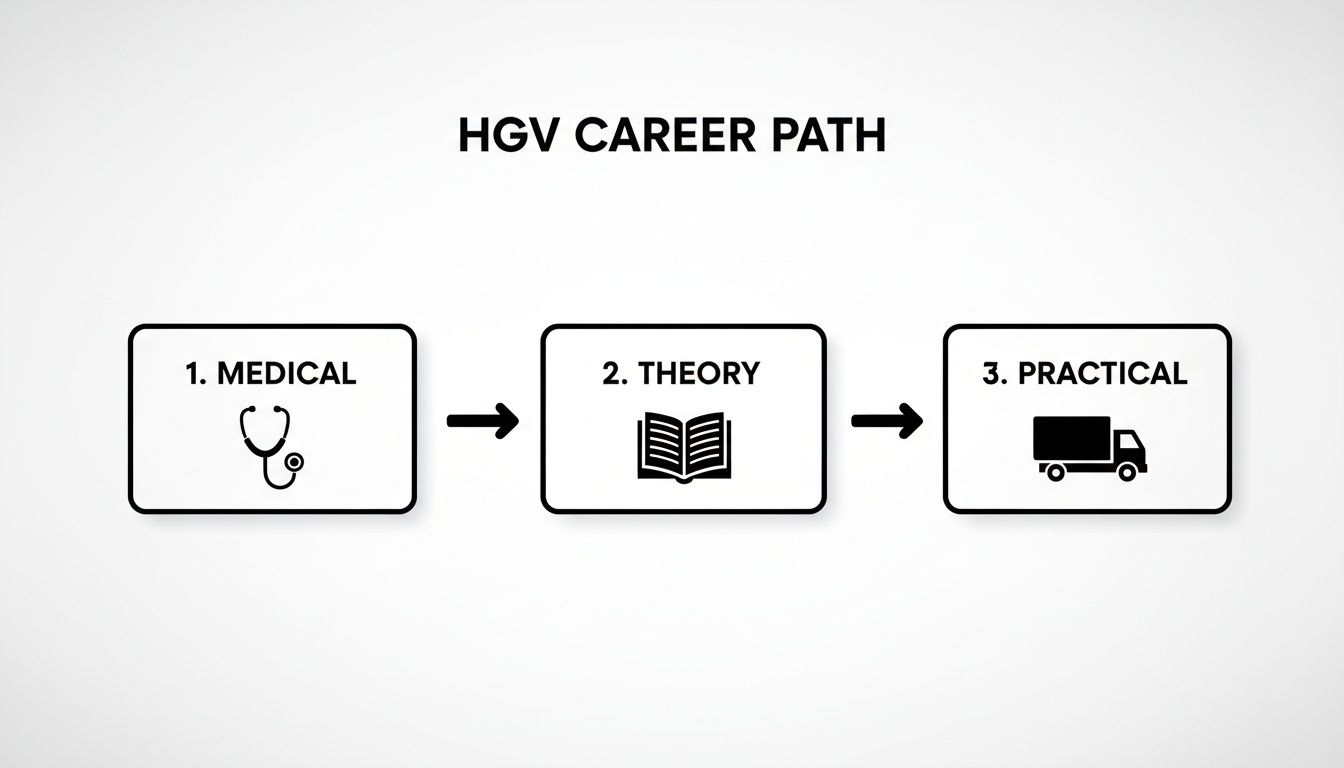
The path to getting your licence is more straightforward than you might think. It really boils down to three key stages.
As you can see, everything kicks off with a routine driver medical. From there, you will move on to preparing for your theory tests, and finally, you will get behind the wheel for your practical, hands-on training.
Your Licence and Career Path
One of the first big decisions you will make is choosing the right licence. This is crucial, as it directly determines the types of vehicles you can drive and, ultimately, the jobs you will be qualified for. Think of it as choosing your specialism: different licence categories open up completely different career doors.
Becoming a professional driver is not just about getting a job; it is about stepping into a well-paid career that offers independence and is critical to the UK economy. It is a role with real responsibility and rewarding challenges.
To help you get your head around the main options, let’s look at the different HGV licence categories and what they mean for your career.
HGV Licence Categories at a Glance
Understanding the different lorry licences available and what vehicles you can drive with each is your first step. This table breaks down the most common categories to help you decide which path is right for you.
National & international haulage, supermarket deliveries
As you can see, a Category C licence (often called a ‘Class 2’) is a fantastic starting point. It gets you behind the wheel of a rigid lorry and is perfect for jobs in local distribution or the construction trade.
However, if you have your sights set on the biggest vehicles and the highest earning potential, the Category C+E licence is the goal. This is what you need to drive an articulated lorry, opening up the world of national and international haulage.
Before you can even think about getting behind the wheel for your training, there are a couple of essential boxes to tick. The first piece of the puzzle is getting your provisional lorry licence. It might feel like a bit of a paper chase, but it is the non-negotiable first step that officially gets you on the path to becoming a professional driver.
To get the ball rolling, you will need two specific forms from the DVLA: the D2 application form for the provisional licence itself, and the D4 medical form. The D2 is your formal application to start learning, while the D4 is the certificate that confirms you are medically fit for the job.
What to Expect from the Driver Medical
The HGV driver medical is not something to worry about; it is a standard check-up to ensure you meet the higher health and safety standards required to operate large vehicles. A doctor will run through a few things, like checking your eyesight and blood pressure, and will ask about your medical history to rule out any conditions that could affect your driving.
A few quick tips to make it a breeze:
Bring your specs: If you wear glasses or contact lenses, make sure you have them with you for the mandatory eye test.
Know your meds: Jot down a list of any prescriptions you are currently taking to show the doctor.
Book it in: Your own GP can do it, but many private clinics specialise in D4 medicals and can often get you in much faster.
It is a great time to be getting into the industry. The latest Logistics UK report showed that the number of HGV drivers fell by 1.9% in the first quarter of 2025, with the number of UK-born drivers dropping by a significant 4.5%. This shortfall means qualified drivers are in higher demand than ever.
Let Someone Else Handle the Paperwork
Let’s be honest, nobody gets into lorry driving because they love filling out forms. When you are eager to find lorry driver training near me and start the practical side of things, the admin can feel like a real drag.
The initial paperwork can seem a bit daunting, and it is easy to make a small mistake that causes a delay. That is why we take it off your hands entirely. We will sort out the forms and book your medical so you can just focus on the training ahead.
A good training provider will manage this whole process for you. They will order your D2 and D4 forms, check them for you, and even schedule your medical with a local doctor they trust. It completely removes the headache and the risk of your application being held up by a simple error.
For instance, at HGV Learning, we handle all the admin as part of our service. By taking care of the application and medical booking, we make sure you can move straight on to preparing for your theory tests without any stress. If you want to know more about the check-up itself, have a look at our guide on what to expect during your https://hgvlearning.com/knowledge-hub/getting-an-hgv-licence/hgv-medical/.
How to Pass Your HGV Theory Tests First Time
Clearing your HGV theory tests is the first major milestone on your journey to becoming a professional driver. It is more than just an exam; this is where you build the essential knowledge of safety and regulations that will serve you every single day you are on the road.
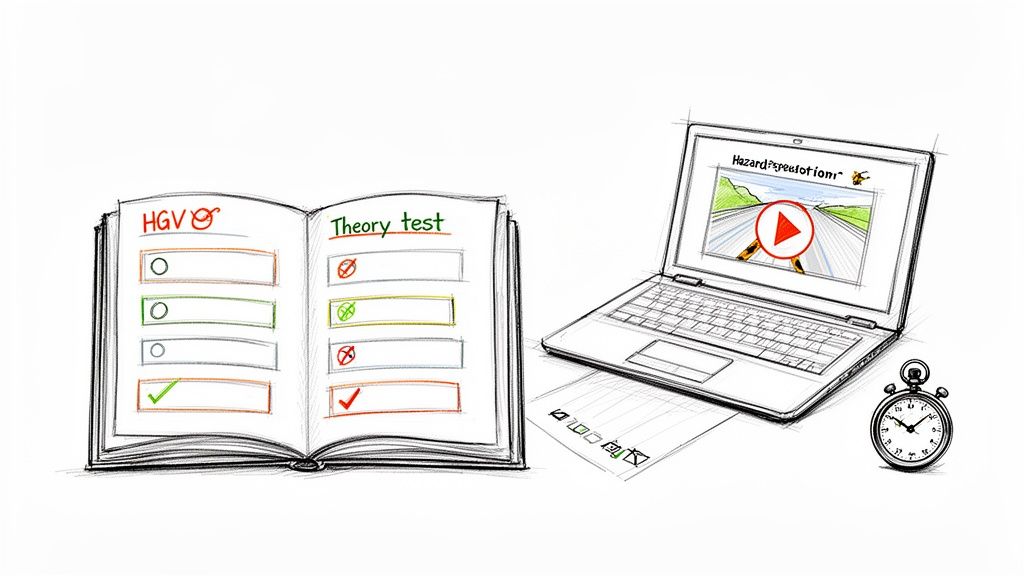
Think of it as two separate challenges you need a strategy for. You have got the multiple-choice questions first, covering everything from road signs and driver hours to vehicle loading. Then comes the hazard perception test, where you will need sharp eyes and quick reactions to spot developing risks in video clips.
Mastering Each Test Component
When it comes to the multiple-choice questions, simply churning through mock tests is not the most effective approach. A much better way to learn is to focus on one topic at a time. Spend one study session purely on tachograph rules, and the next dedicated to vehicle weights and dimensions. This method helps the information stick, giving you a proper understanding rather than just a vague memory of the answers.
The hazard perception test is all about training your brain to see what could happen next. A lot of people stumble here because they click too late, or they click repeatedly in a pattern that the system mistakes for cheating.
The real secret to hazard perception is anticipation, not just reaction. Train yourself to spot the clues: a ball bouncing into the road, a car waiting to pull out of a junction. Click as soon as you recognise the potential for danger. One well-timed click is far more valuable than a dozen panicked ones.
Using Modern Study Tools Effectively
Do not underestimate the power of good training software. The best platforms do more than just offer mock tests; they actually analyse where you are going wrong. They can pinpoint that you are consistently struggling with questions on, say, safe loading procedures. This lets you zero in on that specific module, turning a weakness into a real strength.
Finally, you have the CPC Part 2 Case Studies test. This part presents you with real-world situations you will likely face as a professional driver.
Scenario Example: You might be asked to plan a route through London for a time-sensitive delivery, forcing you to consider the Low Emission Zone (LEZ) and your remaining driver hours.
Your Task: You need to apply all your knowledge to make the safest, most efficient, and legally compliant decision.
Actively working through these scenarios is far more useful than just reading about them. By using these focused techniques, you are not just cramming for a test: you are preparing to be a competent and safe professional. For a deeper dive, our guide on how to pass your HGV theory test the first time has all the extra detail you need to get it right.
Choosing the Right Local Training Provider
Once your theory tests are in the bag, the search for “lorry driver training near me” gets serious. This is easily one of the most important decisions you will make on your path to becoming a professional driver. The quality of your practical training does not just get you through the test; it builds the confidence and skill you will rely on every single day of your career.
You will quickly find there is a dizzying number of options out there. Should you go with the small, independent school around the corner or a bigger, national outfit? Both have their pros and cons, but there are a few non-negotiable things you should look for, no matter who you choose.
What to Look for in a Training Centre
When you start digging into local providers, it is tempting to just compare prices. Do not fall into that trap. The best schools have certain things in common that tell you they are serious about quality. First and foremost, make sure they only use DVSA-approved instructors. This is your guarantee that the person teaching you meets the high standards set by the people who will ultimately be testing you.
Next, have a good look at their lorries. Are they modern, clean, and well-maintained? Learning in a truck that is similar to what you will actually be driving in your first job makes a world of difference.
Here are a few other critical things to ask about:
Local Test Route Knowledge: A school that knows the local test centre inside out is worth its weight in gold. They will be familiar with every tricky roundabout and tight junction you are likely to face on the big day.
First-Time Pass Rates: Do not be afraid to ask for their pass rates. A school with consistently high first-time passes is a great sign that their training methods actually work.
Transparent Pricing: You want to see a clear, all-inclusive price. The last thing you need are surprise costs for test bookings, fuel, or re-tests popping up later.
Comparing Lorry Training Providers
Choosing a training provider can feel like a huge decision, because it is. To help you cut through the noise, we have put together a quick table of the key factors you should be weighing up.
Factor
What to Look For
Why It Matters
Instructor Credentials
DVSA-approved instructors with real-world HGV driving experience.
Ensures your trainer meets official standards and can offer practical, on-the-job insights.
Vehicle Fleet
Modern, well-maintained lorries that reflect current industry standards.
You will learn on equipment that is relevant to what you will be driving professionally, making the transition to a job much smoother.
Pass Rates
A high first-time pass rate for the practical test. Ask for the numbers!
This is the clearest indicator of how effective their training programme is at getting people test-ready.
Test Route Familiarity
The school should be based near your chosen test centre and know the routes intimately.
“Insider knowledge” of tricky junctions and common test routes gives you a massive advantage on test day.
Pricing Structure
Clear, all-inclusive pricing with no hidden fees for tests, fuel, or admin.
You need to know exactly what you are paying for upfront, allowing you to budget properly without any nasty surprises.
Student Reviews
Check Google, Trustpilot, and social media for genuine feedback from past learners.
Real reviews give you an unfiltered look at the student experience, from the quality of teaching to customer service.
Ultimately, finding a provider who ticks all these boxes gives you the best possible chance of not just passing your test, but starting your career as a safe, skilled, and confident driver.
Working with a National Coordinator
Another path you can take is to use a national training coordinator like HGV Learning. Instead of you spending days on the phone vetting dozens of local schools, a coordinator has already done the legwork. We maintain a network of pre-approved, high-quality training centres across the entire UK.
This approach gives you the best of both worlds. You get the convenience of a local school that knows the area, backed by the quality control, booking support, and peace of mind of a larger, dedicated organisation.
Choosing your training provider is the single biggest investment you will make in your new career. A great provider does not just teach you to pass the test; they teach you how to be a safe, confident, and professional HGV driver from day one.
Intensive Courses vs. Spaced-Out Training
Finally, have a think about your learning style and your schedule. Some people love the idea of an intensive, week-long “boot camp” where they can just get it done. Others need a more flexible approach, fitting lessons in around work or family.
Most good providers will offer both options. An intensive course is great if you can clear your diary and want your licence fast, but it can be mentally draining. Spacing your lessons out over a few weeks is less intense and more flexible, but it takes longer and you might need a few extra hours to stay sharp between sessions.
Many schools and coordinators also offer finance plans. These can be a massive help, allowing you to spread the cost over several months and get your training started without having to find the full amount upfront.
Boost Your Earnings with Specialist Qualifications
Passing your Cat C or C+E test is a massive accomplishment, and it is your key to getting started in the haulage industry. But if you really want to kick your career into a higher gear and open up the most interesting, better-paid jobs, you need to think about what comes next.
These extra qualifications are not just nice-to-haves; they are career-makers. When you get certified in a specialist skill, you immediately become more valuable. Certain sectors absolutely depend on drivers with specific tickets and are more than willing to pay a premium for them. It is what separates a standard driver from a go-to specialist.
The Tickets That Lead to Higher-Paid Roles
Three of the most powerful qualifications you can add to your licence are ADR, HIAB, and Telehandler. Each one opens up a completely different part of the logistics world, often with better money and more varied work than you would find in general haulage.
ADR (Carriage of Dangerous Goods): This is your ticket to driving tankers, chemical trucks, or even transporting clinical waste. An ADR certificate shows you are trained to handle hazardous materials safely, a responsibility that always comes with a bigger pay packet.
HIAB (Lorry-Mounted Crane): Ever seen a builders’ merchant lorry with its own crane lifting off pallets of bricks? That driver has a HIAB ticket. It is crucial for roles in construction, forestry, and specialised delivery where you are not just a driver: you are in charge of loading and unloading your own vehicle.
Telehandler (Telescopic Handler): While it is not strictly a lorry licence, having a telehandler ticket is a huge plus on construction sites and in farming. It proves you can operate this versatile piece of kit, making you a much more flexible and useful member of any team.
Which one you choose really depends on the type of work you see yourself doing. But a driver holding a C+E licence with both ADR and HIAB is one of the most in-demand professionals in the entire industry.
Why Ongoing Training is Non-Negotiable
Beyond these specialist tickets, every single professional driver has to meet one ongoing requirement: the Driver CPC (Certificate of Professional Competence). To keep your Driver Qualification Card (DQC) active, you must complete 35 hours of periodic training every five years.
This is not just about ticking a box. It is about staying sharp, keeping on top of new regulations, and proving you are a professional.
Think of specialist qualifications as your career’s turbo-boost. Your main licence gets you on the motorway, but these extra skills let you take the express lane to better jobs and higher earnings.
This commitment to getting better is essential. In fact, DVSA data shows that companies that make ongoing HGV driver training a priority see 60% fewer prohibitions and a 45% drop in fixed penalties. It is this focus on quality that helps our industry thrive, especially as we work to solve the challenges outlined in the UK HGV driver sector.
Landing Your First Job After You Pass
You have done it. The tests are passed, and that shiny new HGV licence is finally in your hands. It is a massive achievement and the moment all your hard work has been building towards.
But after the initial celebration, the big question looms: what now? Making the jump from trainee to a fully-fledged professional driver is the final hurdle. This is where a top-tier training provider really proves its worth, moving beyond just the training to actively help you find work.
When you are searching for “lorry driver training near me,” it is easy to focus only on the licence. But many people do not realise that the best schools offer job placement support, and this can be a game-changer for newly qualified drivers without a long list of industry contacts. They have built relationships with local and national companies that are always on the lookout for fresh, properly trained talent.
Finding Companies That Hire New Drivers
You will likely be surprised by just how many companies are keen to hire new drivers. It is not just the huge logistics giants, though they are certainly a brilliant place to start your search. Countless businesses depend on skilled drivers and are more than willing to give newly qualified people a chance to prove themselves.
It is worth looking at these types of employers:
Large Supermarket Chains: Think of places like Tesco, Sainsbury’s, and Asda. Their distribution networks are enormous, and they are constantly recruiting for their regional depots.
National Haulage Companies: Big names like Wincanton or DHL are always hiring. They often have fantastic, structured onboarding programmes designed specifically for new starters.
Local Builders’ Merchants: Companies such as Travis Perkins or Jewson need drivers for their local and regional delivery routes. These jobs are a great way to build up solid, real-world experience.
Agency Work: Do not dismiss signing up with a specialist driver recruitment agency. It is a fantastic way to sample different types of work and companies, helping you figure out what you enjoy most before committing to a permanent role.
Crafting a CV That Gets Noticed
Your CV is your first, and sometimes only, chance to make a strong impression. It needs to do more than just state your new licence categories; it has to sell the professional skills you gained during your training.
Remember to put your new qualifications front and centre, especially your Driver CPC. A CV that clearly shows you are a professional, fully-certified driver who takes safety and compliance seriously will always stand out.
Make sure your CV details any specialist tickets you hold, like ADR for hazardous goods or a HIAB crane certificate. These qualifications can easily put your application at the top of the pile. Also, be explicit that you hold a valid Driver Qualification Card (DQC), as this is a non-negotiable legal requirement.
When you land an interview, be ready to talk confidently about your training, your understanding of drivers’ hours, and your commitment to safety. This shows that you are not just someone with a licence: you are a professional ready to hit the road.
Your Top Questions About Lorry Driver Training
When you first start looking into a career as a lorry driver, a lot of questions naturally come up. It is a big step, after all. Based on our experience helping thousands of new drivers get started, here are the answers to the queries we hear the most.
How Much Does Lorry Driver Training Cost?
This is usually the first question on everyone’s mind. The total investment for a full Category C licence course (which covers your medical, both theory and practical tests, and the initial Driver CPC) typically falls somewhere between £1,500 and £3,000.
Of course, the final figure can shift depending on your location, the training provider you choose, and if you happen to need any re-tests along the way.
How Long Does The Training Process Take?
From getting your medical sorted to holding your pass certificate, you should realistically budget for a timeline of about 8 to 10 weeks.
This can sometimes be quicker, especially if you opt for an intensive course and all the paperwork with the DVLA goes through without a hitch. The key is being organised from the start.
Is The Driver CPC Really A Must-Have?
In short, yes. If your goal is to drive a lorry professionally and earn a living from it, the Driver Qualification Card (DQC) is non-negotiable. You will get your initial DQC by passing the CPC Part 2 (case studies) and Part 4 (practical demonstration) tests.
Remember, the Driver CPC is not a one-and-done deal. It is a legal requirement to complete 35 hours of periodic training every five years to keep your DQC valid and stay on the road.
Is There Any Funding Available?
Getting your licence is a significant investment, but there are ways to manage the cost. It is always worth checking for government-backed schemes like “Skills Bootcamps” or looking into apprenticeships, as larger logistics companies often run these.
Additionally, many good training providers offer flexible finance plans. This allows you to spread the cost over several months, making it much more manageable to get started without a huge upfront payment.
Ready to stop wondering and start driving? At HGV Learning, we are here to guide you through the entire journey. We will help with the initial paperwork, find you a top-notch local training centre, and even offer support as you look for that first job. Find out more at HGV Learning.
Related Articles
16/10/2026
What Age Can You Start HGV Driver Training? A 2026 UK Guide to Licence Age Requirements
If you're asking what age you can start HGV driver training, the honest answer depends on which licence you're after. A C1 licence, covering vehicles...