The pass mark for the hazard perception test is not the same for everyone; it all depends on what you are planning to drive. If you are getting a car licence, you are aiming for a score of 44 out of a possible 75 points. But for anyone looking to get behind the wheel of an HGV or PCV, the bar is set quite a bit higher. You will need to score at least 67 out of 100.
Understanding the Hazard Perception Pass Marks
So, why the big difference? It all comes down to the extra responsibility and skill it takes to safely handle a much larger vehicle. Think of it like a professional athlete versus a weekend enthusiast: they might play the same game, but the professional is expected to perform at a much higher level. The higher pass mark for lorry drivers is there to make sure they have the sharp, forward-thinking skills needed to manage the unique challenges that come with an HGV.
This is not just some random number they have picked. It directly ties into the real-world physics of driving a lorry, like its much longer stopping distances and significant blind spots. Spotting and reacting to a developing hazard as early as possible is absolutely vital. Remember, to get your theory certificate, you have to pass both the multiple-choice questions and the hazard perception test. You can get the full story on the overall theory test pass mark to see how it all fits together.
The core idea is simple: the bigger and heavier the vehicle, the quicker and sharper your hazard perception skills need to be. The test is specifically designed to confirm you have this advanced level of awareness before you are given the keys.
To make it crystal clear, here’s a quick breakdown of what you need to achieve.
Hazard Perception Pass Marks by Vehicle Type
This table shows the different benchmarks for car drivers compared to professional HGV and PCV drivers.
Vehicle Category
Pass Mark (Minimum Score)
Maximum Possible Score
Car / Motorcycle
44
75
HGV / PCV
67
100
As you can see, the professional test not only has a higher pass mark but also includes more clips and more potential points, reflecting the higher standards required.
How Your Hazard Perception Score Is Calculated
To beat the hazard perception test, you first need to get your head around how it is scored. It is not just about spotting a problem; it is about catching it the moment it starts to unfold.
Think of it like this: every developing hazard in the video clips has a ‘scoring window’. This window opens the very second a situation begins to look like it could become dangerous. The quicker you click your mouse inside that window, the more points you rack up.
The scoring is on a sliding scale from five down to one. Click right as the window opens, and you bag the full five points. Hesitate for a second, and your score starts to drop. If you wait too long, the window slams shut, and you get a big fat zero for that hazard.
Scoring In The HGV Test
When you sit the HGV theory test, you will be faced with 19 video clips showing different road situations. Most of these will have just one developing hazard to spot. But keep your eyes peeled, because one special clip contains two separate hazards, giving you a chance to score double the points. This is a big step up from the standard car test and means you cannot afford to switch off.
A word of warning, though – do not get click-happy. The system is smart enough to spot if you are just clicking randomly or in a set pattern. If it detects this, a warning message will pop up, and you will score zero for that entire clip.
The whole point of the scoring is to reward early and accurate identification. It is a test of foresight, not just how fast you can react, which is why nailing the pass mark is so vital.
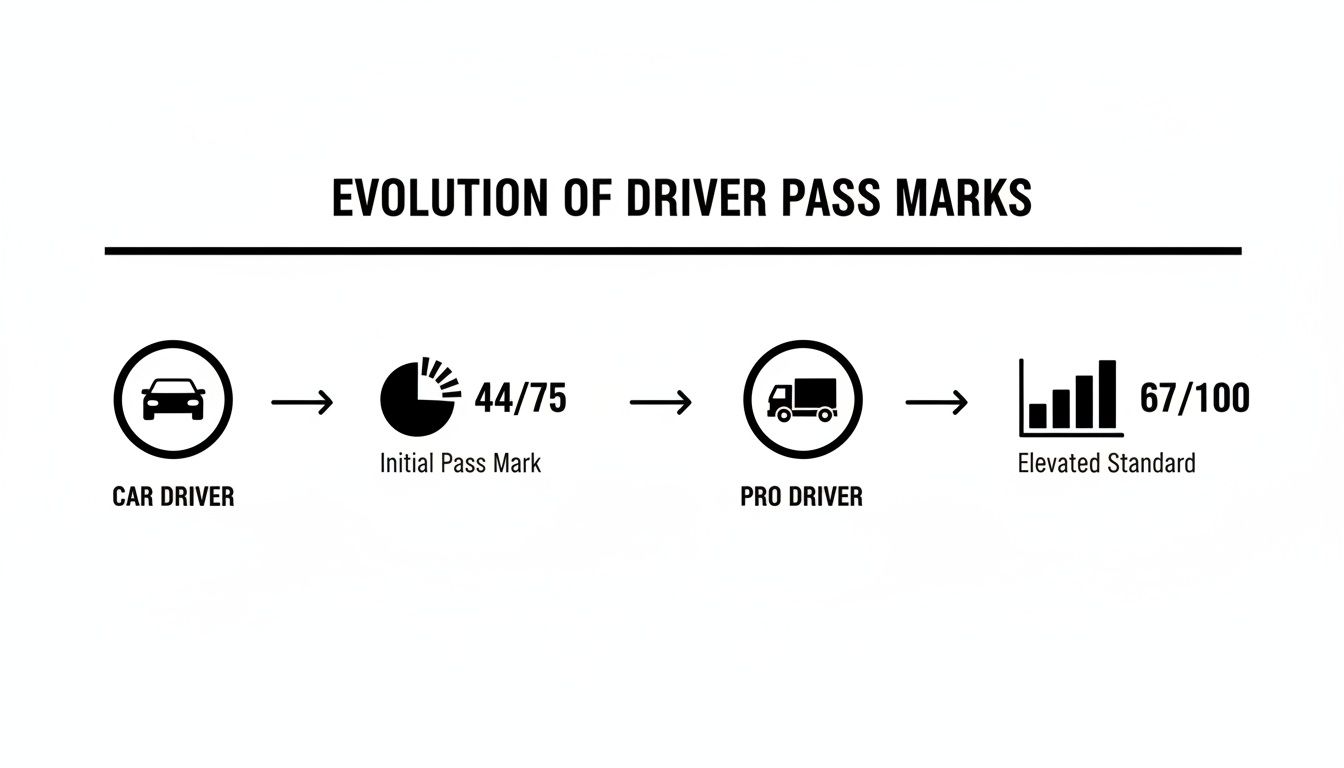
This timeline gives you a clear picture of the different pass marks for car drivers compared to professional HGV drivers.
As you can see, the bar is set much higher for professional drivers, reflecting the greater skill and awareness needed on the job. According to the DVSA, the pass mark for car and motorcycle learners is 44 out of 75. For HGV and other professional LGV drivers, that jumps significantly to 67 out of 100.
Why the HGV Hazard Perception Standard Is Higher
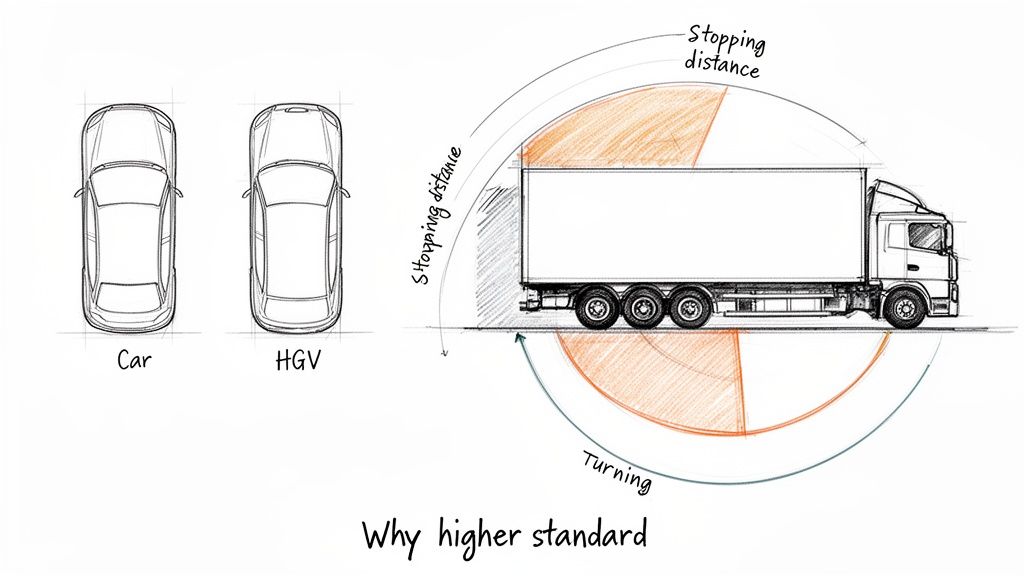
You might notice the jump from a 44-point pass mark for cars to 67 for HGVs and think it is just an arbitrary hurdle. It is anything but. This higher standard is deeply rooted in the fundamental physics and massive responsibilities that come with being a professional driver. Piloting a large goods vehicle is a completely different ball game compared to driving a car.
An HGV’s sheer size and weight have a huge impact on how it behaves on the road. Things like stopping distances, blind spots, and turning circles are worlds apart from a standard vehicle. A situation that is a minor inconvenience for a car driver can escalate into a critical incident for someone behind the wheel of a lorry.
Because of this, a hazard a car driver can react to in a split second requires an HGV driver to have spotted it many seconds earlier. The Driver and Vehicle Standards Agency (DVSA) sets this higher pass mark to make sure professional drivers have truly superior scanning and anticipation skills.
The Physics of Professional Driving
Understanding why the bar is set higher really comes down to the real-world consequences of an HGV’s physical presence. A fully loaded lorry can weigh over 40 tonnes, which massively affects its ability to slow down.
Stopping Distances: An HGV doing 60 mph needs at least 120 metres to come to a complete stop. That is nearly three times the distance a car needs, meaning you have to identify potential problems much, much earlier.
Blind Spots: HGVs are surrounded by huge blind spots, especially on the passenger side and directly behind the trailer. Elite-level perception is vital for tracking smaller vehicles that can simply vanish from your mirrors.
Manoeuvrability: A lorry’s long wheelbase and wide turning circle make getting through junctions and tight corners far more challenging. You have to be able to predict what other road users are going to do well in advance.
The higher pass mark for hazard perception is not a barrier; it is a vital training tool. It is designed to develop the elite level of awareness needed to operate a large vehicle safely and professionally, protecting you and everyone else on the road.
Common Mistakes That Can Cost You the Pass Mark
It is a strange thing, but plenty of experienced, competent drivers end up failing the hazard perception test. They often get caught out by a few predictable traps. Getting to grips with these common mistakes is the best way to avoid them and bag that all-important pass.
The single biggest error is simply clicking too late. The scoring window for any given hazard is surprisingly short, and a moment’s hesitation can easily turn a five-point click into a zero. If you are only reacting when a car has already pulled out in front of you, you have missed your chance.
On the other hand, clicking too early is just as bad. You need to wait for a situation to become a ‘developing’ hazard: something that would actually make you brake or change direction. Clicking on a parked car the moment it appears on screen, for example, is pointless until you see its brake lights or indicators flash on.
Falling Foul of Cheat Detection
Perhaps the most frustrating way to fail is to accidentally trigger the cheat detection software. It is a clever system designed to filter out anyone who is not responding genuinely to what is happening on screen.
You will be flagged and get a score of zero for the entire clip if you:
Click too rhythmically: Clicking in a set pattern, like once every second, looks like you are trying to game the system.
Click excessively: Randomly ‘spam clicking’ all over the screen hoping to hit the right spot is another big red flag that will get your score for that clip wiped.
The system is designed to reward deliberate, well-timed clicks that match a developing hazard. A calm, focused approach will always beat frantic clicking.
This part of the theory test has always been a well-known stumbling block. The official data tells its own story: back in 2011/12, the overall car theory pass rate was a reasonable 60.8%, but this had plummeted to just 44.9% by 2024/25. While that is the car test, it shows just how tough many people find the hazard perception element. You can find out more about these pass mark trends and statistics online.
Proven Strategies to Beat the Hazard Perception Test
Knowing where people go wrong is half the battle. The other half is actively building the right habits to make sure you pass. Let us move beyond just theory and look at a proper game plan for success, helping you sharpen the instincts you will need to ace the test.
Without a doubt, the single most effective thing you can do is practise, practise, practise. But not just any practice: you need to use high-quality, DVSA-approved mock tests. These are designed to feel exactly like the real thing, from the style of the clips right down to the scoring system. Getting familiar with this format is key to feeling prepared on the day.
Adopt the Commentary Driving Method
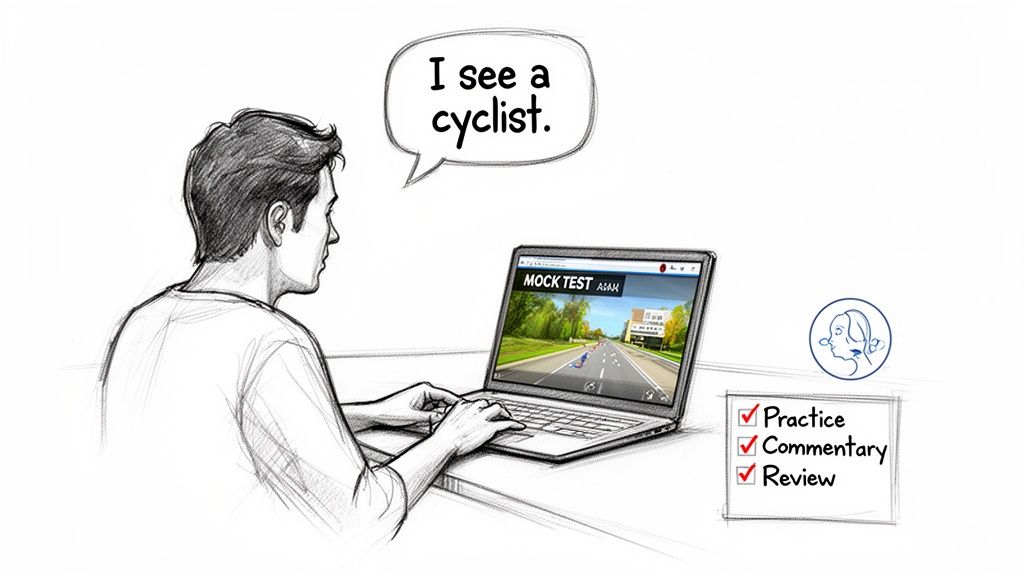
Here’s a powerful technique to train your brain: try what’s known as ‘commentary driving’ while you practise. It’s simple. As you watch the clips, just say what you are thinking out loud. Talk through what you see, point out things that could become a risk, and try to predict what might happen next.
You might say something like, “Right, there’s a cyclist up ahead… coming up to a junction now… I bet he is going to swerve.” This simple act of narrating forces your brain to actively scan and process what is happening, instead of just passively watching. It trains you to spot potential issues well before they become full-blown hazards, which is exactly how you rack up those high scores.
This proactive mindset is absolutely vital for HGV drivers, and you can find more targeted hazard perception tips for HGV drivers in our detailed guide.
Think of it as being a sports commentator for your own test. By describing the action as it unfolds, you stay one step ahead of the game, turning observation into anticipation.
Structure Your Revision for Success
Finally, a bit of structure goes a long way. Do not just mindlessly click through test after test without looking at your results. After each practice run, take a moment to review your performance. You need to pinpoint the types of hazards you are consistently missing or only scoring low marks on.
Is it cyclists? Pedestrians stepping out? Cars pulling out of junctions? Whatever your weak spot is, focus your next few practice sessions on those specific scenarios. Turning those weaknesses into strengths is how you build real confidence and stay calm when you are under pressure in the real test.
What Happens If You Miss the Pass Mark?
Failing the hazard perception test can feel like a real knock, but it is best to see it as a stepping stone, not a dead end. The key is to understand what happens next so you can dust yourself off, plan your next move, and come back stronger.
Under DVSA rules, you cannot just book another test for the next day. You have to wait at least three clear working days before you can have another go. This is not a punishment; think of it as a mandatory cooling-off period, giving you a valuable chance to reflect on what went wrong and sharpen your skills.
Turning Feedback into Success
Do not just bin the result and feel disheartened. Your score report is pure gold: it shows you exactly where you dropped points and gives you a clear map of which types of hazards you need to get better at spotting. This is not the end of the road; it is a chance to fine-tune your technique.
Use this time wisely. Instead of getting frustrated, double down on your practice with DVSA-approved materials. Pinpoint those weak spots and work on them until they become strengths. That way, you will walk into your next test fully prepared to smash the pass mark.
Common Questions Answered
Let us clear up a few of the most common questions people have about the hazard perception test. Getting these sorted will help you feel more confident as you start preparing.
How Many Hazards Are in Each Video Clip?
You can expect to find at least one developing hazard in every single clip. But do not let your guard down: one of the videos in your test will feature two separate hazards.
You will not be told which clip has the extra hazard, so it is vital to stay focused and keep scanning for potential dangers from start to finish on every video.
Can I Still Pass If I Only Fail the Hazard Perception Part?
No, unfortunately, that is not how it works. You must pass both the multiple-choice questions and the hazard perception test in the same sitting to get your overall pass certificate.
If you fail one part, you will need to rebook and retake the entire theory test again.
Think of the theory test as an all-or-nothing challenge. A great score in one section cannot make up for a fail in the other. This is why giving both parts equal attention during your revision is so important.
Are HGV Test Hazards Different from Car Test Hazards?
While the types of hazards are very similar (things like pedestrians, cyclists, or cars pulling out) the way you see and react to them is completely different.
The HGV test clips are filmed from a higher driving position, which changes your perspective. More importantly, you have to think like a professional driver in a large vehicle. This means considering your huge blind spots, the vehicle’s length when turning, and much longer stopping distances. It is this HGV-specific context that you really need to master to score top marks.
At HGV Learning, we offer training materials and support designed to get you fully prepared for every part of your theory and practical tests. Discover how we can help you launch your professional driving career at https://hgvlearning.com.
Related Articles
16/10/2026
What Age Can You Start HGV Driver Training? A 2026 UK Guide to Licence Age Requirements
If you're asking what age you can start HGV driver training, the honest answer depends on which licence you're after. A C1 licence, covering vehicles...