Ever seen a huge lorry thundering down the motorway and wondered what really separates it from the delivery van that drops off your parcels? The short answer is its weight, and that’s what makes it an LGV, or a Large Goods Vehicle.
This is the official UK government term for any goods vehicle that weighs over 3.5 tonnes. You will often hear people call them HGVs (Heavy Goods Vehicles), but do not get confused – in today’s world, the terms are used interchangeably and mean the exact same thing.
What Exactly Is an LGV?
At its heart, the LGV classification is all about weight. This is a critical distinction because it draws a clear line between the big commercial lorries and the smaller vans that anyone with a standard car licence can drive. The moment a vehicle’s main purpose is to transport goods and its gross vehicle weight (the vehicle’s maximum legal weight when loaded) tips past the 3.5-tonne mark, it officially enters the professional world of LGV driving.
This simple fact is the starting point for anyone thinking about a career in logistics. An LGV is officially defined as any lorry with a gross vehicle weight over 3.5 tonnes, which sets them apart from the lighter vans (under 3.5 tonnes) that fall into the N1 category. You can dig deeper into the official classifications on the Wikipedia page for large goods vehicles.
A simple analogy might help here. Think of your car or a small van as a personal backpack – great for carrying your daily essentials. An LGV, on the other hand, is a massive shipping container on wheels. It’s a specialist tool built for the heavy-duty haulage that keeps the entire country supplied and running.
Why This Official Term Matters So Much
So, why is the LGV designation so important? Because it dictates everything that comes next for a professional driver:
Specialised Licences: You cannot just jump in and drive one. You need a specific LGV licence, like a Category C, to get behind the wheel legally.
Stricter Regulations: LGV drivers and their vehicles are held to a much higher standard, with rigorous safety checks and strict rules on how long you can drive.
Professional Responsibility: Driving an LGV is not just another job. It is a recognised profession that demands a high level of skill, ongoing training, and a serious attitude towards safety.
Understanding what an LGV is opens the door to a secure and incredibly important career. These vehicles are the absolute backbone of the UK economy, moving everything from supermarket food and building materials to the fuel in our cars and the parcels we order online. Without a steady supply of qualified LGV drivers, the nation’s supply chains would grind to a halt in a matter of days.
Decoding the Different LGV Licence Categories
Getting into professional driving means you will need to understand the different licence categories. It can feel a bit like alphabet soup at first, but it is simpler than it looks. Think of each category not as a confusing code, but as a key that opens up bigger vehicles and better career opportunities.
Each licence builds on the one before it, creating a clear path from smaller lorries right up to the giants of the road.
Starting Out: The C1 Licence
Your journey will most likely begin with the C1 licence. This is your essential first step into the world of professional driving, authorising you to operate vehicles weighing between 3.5 and 7.5 tonnes. It is the perfect entry point for a huge number of driving roles.
What you can drive: This covers a lot of ground, including large delivery vans (like the bigger supermarket home delivery vehicles), small removal lorries, and most standard ambulances.
Who it is for: It is an incredibly popular choice for local delivery drivers, tradespeople who need to move heavier kit, and anyone looking to become a paramedic.
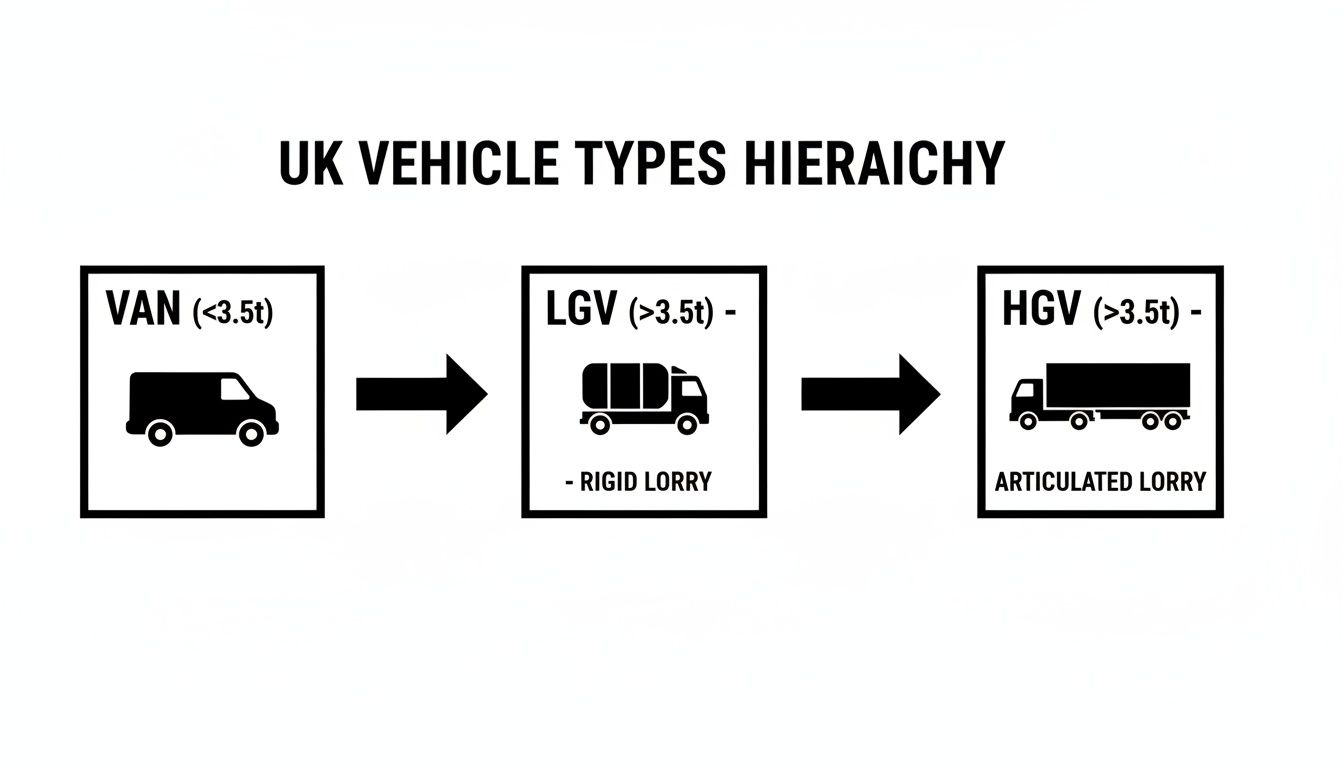
This diagram helps show where these vehicles fit in the grand scheme of things.
As you can see, there’s a clear step-up from a standard van to the larger LGV category, showing how the vehicle size and what you can do with it increases.
UK LGV Licence Categories at a Glance
To make it even clearer, let’s break down the main LGV licence categories, what they let you drive, and the kinds of jobs they open up. This table gives you a quick side-by-side comparison.
Choosing the right category really comes down to where you see your career going. Each one is a step up, offering more responsibility and often, better pay.
Stepping Up to Rigid Lorries: Category C
The next level up the ladder is the Category C licence, which many in the industry call a “Class 2” licence. Getting this qualification means you can drive any ‘rigid’ lorry – where the cab and the load area are all one solid unit. These are the true workhorses of the UK’s road network.
A Category C licence allows you to operate vehicles weighing over 7.5 tonnes, with no upper limit on the lorry itself. You will see them everywhere: making deliveries to supermarkets, hauling materials to building sites, or working as bin lorries. To get a deeper understanding of this popular option, check out our guide on what a Class 2 licence is.
Reaching the Top with Articulated Lorries: Category C+E
Finally, we have the pinnacle of LGV driving: the C+E licence. This is your ticket to drive the biggest vehicles on Britain’s roads – articulated lorries, or ‘artics’, as well as drawbar combinations. An ‘artic’ is what most people picture when they think of a massive lorry: a separate tractor unit pulling a long trailer.
The C+E licence is arguably the most versatile LGV qualification, opening doors to national and international haulage jobs. It demonstrates a high level of skill in manoeuvring and handling the largest vehicle combinations.
With a C+E licence, you can get behind the wheel of a vehicle and trailer combo with a total weight often hitting the 44-tonne maximum. These are the long-haul lorries you see cruising down the motorway, shifting huge amounts of goods across the country and into Europe. If you are aiming for the top-tier roles in logistics and haulage, this is the licence you need.
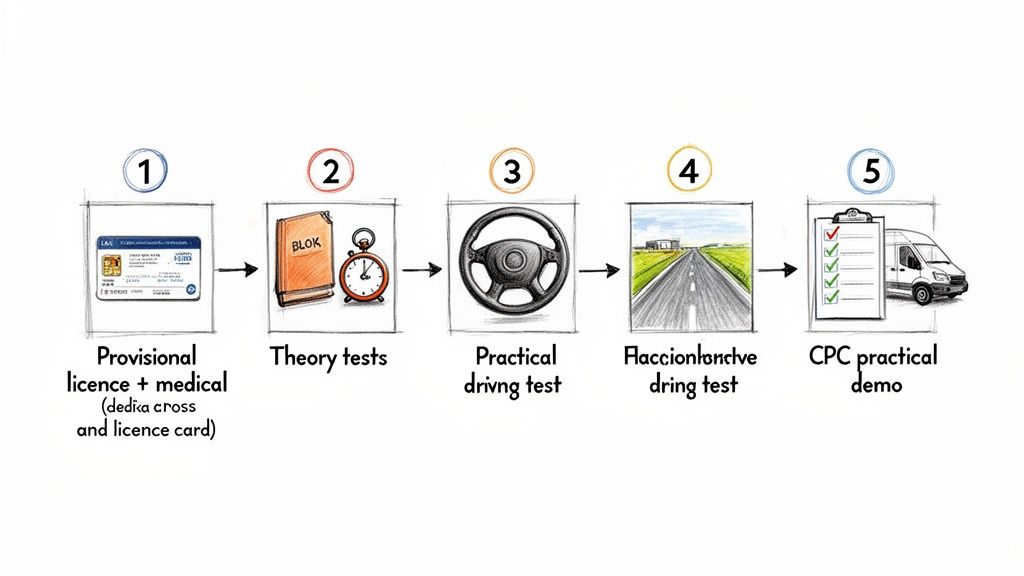
Your Step-by-Step Journey to Becoming an LGV Driver
Getting your LGV licence might seem like a huge mountain to climb, but it’s really a series of smaller, manageable hills. Think of it less as one big exam and more as a clear roadmap that takes you from a complete novice to a qualified professional driver behind the wheel.
When you follow a proven path, you take the guesswork out of the equation. It just makes sense. You simply tick off each requirement set by the Driver and Vehicle Standards Agency (DVSA) one by one. Let’s walk through what your journey will look like, from the first form to your final test.
Stage 1: Laying the Foundations
Before you even dream of starting the engine, there are a couple of essential admin tasks to sort out. This first stage is all about proving you’re medically fit and getting the green light from the DVLA to start learning.
First up, you’ll need to pass a driver medical. It’s a specific assessment called the D4 medical. A doctor will check your health and eyesight to make sure you meet the higher standards required for driving these big vehicles.
With your D4 medical certificate in hand, you can apply for your provisional LGV licence. This means sending the right forms off to the DVLA. They’ll then add the provisional entitlement to your licence, making it official – you can now begin your practical training.
The D4 medical and provisional licence are your official starting line. You cannot book any theory or practical tests without them, so getting these done correctly and quickly is your top priority.
Stage 2: Building Your Knowledge with Theory Tests
Once that provisional licence lands on your doormat, it’s time to hit the books. This part is all about building the knowledge base you’ll need on the road, proving you understand the rules, can spot hazards, and know your professional duties as an LGV driver.
This stage is made up of two parts of the Driver Certificate of Professional Competence (CPC):
CPC Part 1 Theory: This is a two-part test. You will have a multiple-choice test covering everything from vehicle safety to drivers’ hours, plus a hazard perception test where you click to identify dangers in video clips.
CPC Part 2 Case Studies: This test presents real-world scenarios – situations you’ll likely face as a driver. Your answers will show you can apply your knowledge in a practical, common-sense way.
Passing both of these is a must before you can even think about booking your practical driving tests.
Stage 3: Proving Your Skills in Practical Tests
Right, this is it – time to get behind the wheel and put all that theory into practice. This is the most hands-on part of the journey, where a qualified instructor will teach you everything you need to know to handle a large goods vehicle safely and confidently. For a full rundown of what is involved, you can learn more about getting an HGV licence in our in-depth guide.
Your practical skills are checked with two final tests:
CPC Part 3a Off-Road Manoeuvres: You’ll be at an approved test centre for this one. The examiner will test your reversing skills and, if you’re going for a C+E licence, your ability to couple and uncouple a trailer.
CPC Part 3b On-Road Driving: This is the big one. You will be out on public roads with a DVSA examiner who assesses your overall driving, how you handle the vehicle, and your awareness of what’s happening around you in real traffic.
Once you’ve passed these final tests, that’s it! You have officially earned your LGV licence and your full Driver CPC. You are now fully qualified and ready to kick-start your new career.
Understanding the Costs and Timelines for Your Licence
Two of the biggest questions on every aspiring driver’s mind are: how much is this going to cost, and how long will it all take? Deciding to get your LGV licence is a major investment in your future career, so it is vital to get a clear picture of the financial and time commitments right from the start.
The total price is not a single lump sum. It is actually made up of several individual parts, each with its own cost. A good way to think about it is like building a house – you have separate costs for the foundation, the frame, and the roof, which all combine to make the final price.
Breaking Down the Main Expenses
Your journey to a full LGV licence has several key stages, and each one comes with a fee. Here’s a typical breakdown of what you will need to budget for:
Driver Medical (D4): This is your first stop. You’ll need a GP to complete a medical exam to confirm you are fit and healthy enough to drive a large goods vehicle.
Provisional Licence: Once your medical is sorted, you apply to the DVLA for your provisional entitlement. There is a small administrative fee for this.
Theory Test Suite: This is not just one test. It includes the multiple-choice questions, the hazard perception videos, and the CPC Part 2 case studies test.
Practical Training: This is usually the biggest part of your investment. These costs cover the expert instructor’s time and the use of a proper training vehicle.
Practical Test Fees: Finally, you will pay the DVSA’s fees for the two parts of the practical test – the 3a (off-road manoeuvres) and 3b (on-road driving).
The total cost for a Category C licence typically falls somewhere between £1,500 and £3,000. This can vary depending on the training provider you choose, your location in the UK, and how many hours of instruction you end up needing. A C+E licence will naturally cost more because the vehicle is more complex to handle.
Location plays a surprisingly big role here. You will often find that training costs in major cities like London are higher than in other parts of the country. For a more detailed look at all the numbers, you might find our guide that explores how much an HGV licence costs really helpful.
How Long Does the Process Take?
Just like the cost, the timeline can vary quite a bit. While some people get qualified relatively quickly, it’s realistic to expect the entire process to take a few months from start to finish. Trying to rush things can lead to failed tests, which just adds more time and expense in the long run.
The biggest factor influencing your timeline is often the availability of DVSA test slots. Waiting times for both theory and practical tests can change significantly from region to region. This is completely out of anyone’s control, so planning ahead is absolutely key.
Your own schedule is important, too. If you can dedicate consistent time to revising for your theory and taking practical lessons, you will naturally move through the process faster than someone who can only train on weekends. Many good training providers offer payment plans, which allow you to spread the cost over several months. This makes the financial side much more manageable and lets you focus on learning at a steady, effective pace.
Exploring Career Opportunities in the UK Logistics Industry
Earning your LGV licence is much more than just a qualification; it is your key to a huge range of stable, well-paid careers. The entire UK economy depends on road freight, and that creates a powerful, non-stop demand for skilled, professional drivers like you.
Getting qualified does not automatically mean a future in long-distance haulage, though that is certainly an excellent path for many. Your licence is a ticket to dozens of specialist roles across different industries, some of which might surprise you.
More Than Just Motorway Miles
It’s a common myth that all LGV driving involves spending weeks on end away from home. The reality is that many roles are local, offering predictable hours and a solid work-life balance. An LGV licence opens doors to careers that are essential to our daily lives here in Britain.
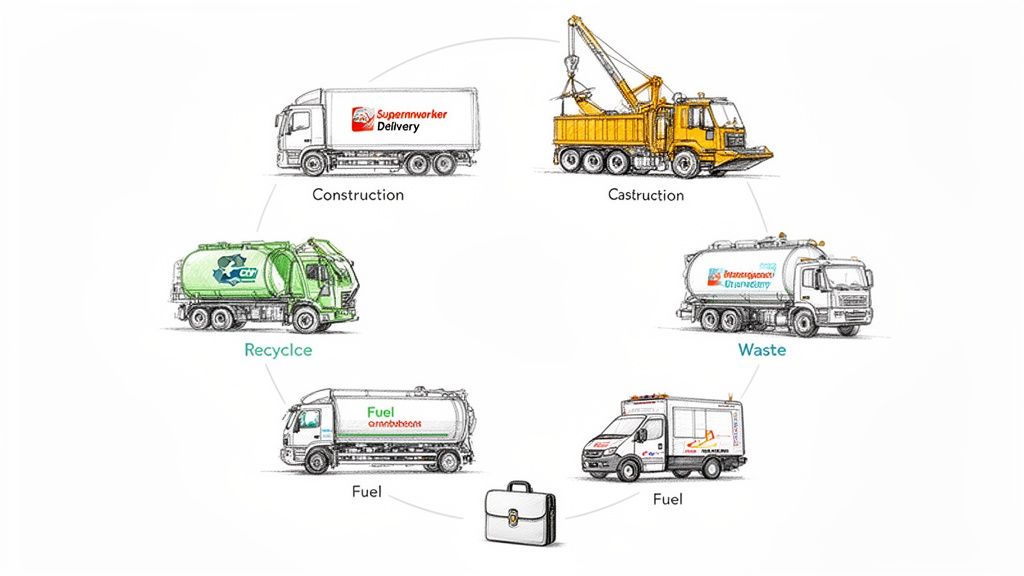
For example, a Category C licence is in high demand for jobs like:
Construction: Operating tipper trucks, concrete mixers, or flatbeds delivering crucial materials to building sites.
Waste Management: Driving refuse or recycling lorries, providing a vital public service in every single community.
Local Distribution: Working for major supermarkets or retailers, making sure the shelves stay stocked day in, day out.
Fuel Transport: A specialist role delivering petrol and diesel to forecourts, which requires extra qualifications like an ADR certificate.
These jobs are often stable, well-paid, and right on your doorstep. They show just how varied the life of a professional driver can be.
The Scale of the Opportunity
If you want to understand the job security this career offers, just look at the sheer volume of goods moving across the country. The logistics industry is not just big; it is the lifeblood of the nation, and the need for qualified drivers reflects this.
The latest government figures paint a very clear picture. In a single year, goods lifted by UK lorries reached 1.59 billion tonnes. Key commodities like manufactured products and construction materials alone made up 73% of this, weighing a massive 1.16 billion tonnes. With around 684,000 HGV drivers operating a fleet of 625,800 vehicles, the demand for skilled professionals is always there. You can dig into the data yourself in the full government report on road freight statistics.
This constant movement of goods means that holding an LGV licence makes you a valuable asset to almost any industry. It is a qualification that provides genuine, long-term job security in an ever-changing world.
Ultimately, understanding what an LGV is and how to get your licence is the first step towards a smart and secure career move. It’s a chance to become part of the essential network that keeps the country running, opening up a future filled with opportunity and stability.
Why a Supported Training Pathway Makes Sense
While you can technically arrange every part of your LGV licence journey yourself, the process can feel like trying to navigate a maze blindfolded. You would be responsible for finding a certified doctor for your medical, booking your own theory tests, tracking down a reputable instructor, and wrestling with all the complex paperwork.
A far smoother route is to use a supported training pathway. Imagine having a dedicated coordinator who handles all the logistics for you. It’s their job to turn a complicated process into a simple, step-by-step plan you can actually follow.
Removing the Stress and Guesswork
A training coordinator acts as your personal guide, taking care of all the tricky details behind the scenes. They have established relationships and proven systems in place to make everything happen efficiently, which is a massive advantage when you’re just starting out.
This support includes:
Booking Your Medical: They will arrange your D4 medical appointment with a qualified doctor at a time and place that works for you.
Scheduling All Your Tests: They handle booking your theory tests and find practical test slots at a DVSA-approved centre near you, saving you the headache.
Providing Structured Learning: You get access to proven theory preparation materials to give you the best possible chance of passing your tests the first time.
This structured approach means you’re not left guessing what to do next. It frees you up to focus on what really matters: learning to drive.
Using a supported pathway is the difference between navigating a confusing journey alone and being given a map with an expert guide right by your side, pointing you towards the quickest and safest route.
Getting You on the Road Faster
Ultimately, a supported pathway is designed to get you from learner to qualified professional driver as efficiently as possible. By removing administrative delays and providing a clear, structured learning plan, you avoid the common pitfalls that can cost you both time and money.
Instead of spending weeks trying to coordinate everything yourself, you can be confident that every step is being handled by professionals. This means you’ll be ready for your new career much faster, armed with the right skills and qualifications to impress employers from day one.
Frequently Asked Questions About LGV Licences
To round things off, let’s dive into a few of the most common questions we get from aspiring drivers. Getting these answers straight can help you move forward with real confidence, knowing exactly what to expect on your journey to getting an LGV licence.
Can I Go Straight to a Category C+E Licence?
Yes, you can! This is a fantastic change for new drivers. Before 2021, the rules forced you to pass the Category C (rigid lorry) test first, and only then could you even think about tackling the C+E (articulated lorry) test. Thankfully, that rule has been scrapped.
This is a huge plus for anyone who knows they want to be behind the wheel of the biggest vehicles on the road. You can now train and test directly for the C+E licence, which can save you a serious amount of time and money.
How Long Is My Driver CPC Qualification Valid?
Your initial Driver Certificate of Professional Competence (CPC) is valid for five years from the date you get it. This is not just a recommendation; it is a legal requirement for nearly all professional LGV drivers here in the UK.
To keep your qualification active, you will need to complete 35 hours of periodic training before that five-year deadline is up. This is not just a box-ticking exercise. The training keeps your skills sharp and ensures you are up-to-date with industry standards on everything from road safety to fuel-efficient driving.
Think of the Driver CPC not as a one-time hurdle, but as an ongoing commitment to being a true professional. Keeping on top of your periodic training is absolutely essential for a long and successful career in logistics.
What Is the Difference Between an LGV Medical and a Regular Check-Up?
While both involve a trip to the doctor, an LGV medical is a very specific type of examination. It’s called the D4 medical. It’s a non-negotiable requirement from the DVLA to confirm you’re medically fit to drive a large vehicle.
A D4 is much more thorough than your standard check-up. It focuses laser-sharp on health standards that could directly affect your ability to drive a lorry safely, including your eyesight, neurological health, heart conditions, and other specific issues.
Ready to stop wondering and start driving? HGV Learning can manage the whole process for you. From booking your medical and theory tests to setting up practical training with a qualified local instructor, we’ve got your back. Get in touch today. Find out how we can support you on your journey to becoming a professional LGV driver. Learn more about our training pathways at HGV Learning.
What Age Can You Start HGV Driver Training? A 2026 UK Guide to Licence Age Requirements
If you're asking what age you can start HGV driver training, the honest answer depends on which licence you're after. A C1 licence, covering vehicles...