So, you’re asking yourself, “is HGV driving a good career?” The short answer is a definite yes. It’s a solid path to excellent job security and a strong, reliable income. While it does mean getting properly qualified and investing in training, the sheer demand for skilled drivers in the UK puts you in a profession that is genuinely essential.
A Realistic Look at an HGV Driving Career
Deciding to become an HGV driver is a big life decision. It’s not just another job; it’s a commitment to a particular lifestyle that comes with its own unique rewards and challenges. Before we get into the details of pay and training, it’s vital to get a balanced, big-picture view of what the job really involves. This is about more than just getting behind the wheel: it’s about understanding the crucial role you play in keeping the country running.
The demand for HGV drivers is easily one of the biggest attractions. Think about it: around 80% of all goods and materials in the UK get from A to B by road. That makes drivers the lifeblood of our economy. The Road Haulage Association has made it clear that the UK needs to recruit 60,000 new drivers every year for the next five years just to keep our supply chains stable. Those numbers speak for themselves: this is a career with real security.
The Trade-Offs You Should Know
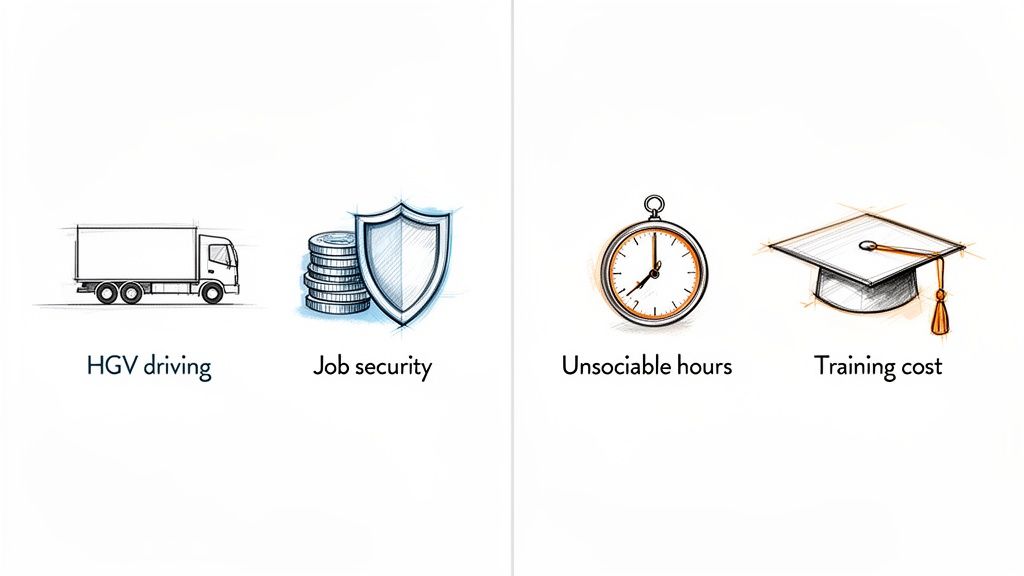
Of course, no career is perfect, and it’s important to be honest about the downsides. The most common challenges you’ll hear drivers talk about are the unsociable hours and the time spent away from home, especially in long-haul roles. The upfront cost of getting your licence can also feel like a hurdle when you’re just starting out.
A successful HGV driving career is all about finding the right balance for you. It’s about weighing the fantastic earning potential and job security against the lifestyle demands and finding a role that fits your life.
However, don’t make the mistake of thinking all HGV jobs are the same. Far from it. Many roles, like local multi-drop delivery or construction-site driving, offer much more regular hours and have you home every night. If that sounds interesting, you might want to check out our guide on the top reasons to consider a career in HGV driving.
To help you get a clear picture, here’s a quick summary of the key pros and cons of life on the road.
HGV Driving as a Career at a Glance
This table breaks down the main factors to consider when you’re weighing up whether HGV driving is the right move for you.
Factor
Summary
Job Security
Extremely high. There’s a persistent driver shortage, and road haulage is essential to the UK economy.
Salary Potential
Strong starting salaries with great potential to earn more through experience, overtime, and specialist tickets.
Working Hours
Can be long and unsociable, especially for long-distance work, but regular 9-to-5 style hours are available in certain sectors.
Training
Requires an upfront investment in both time and money to get the necessary licences and certifications.
Independence
Offers a high degree of autonomy and personal responsibility, which is a big plus for those who prefer to manage their own day.
Ultimately, looking at these factors together gives you a realistic starting point for making your decision.
Why Is HGV Driving Such a Hot Career Choice Right Now?
To really understand why HGV driving is such a solid move, you need to see the sheer scale of the demand. This isn’t just a passing trend; it’s a fundamental need for skilled, qualified professionals. That simple fact shapes the entire job market and puts you, the driver, in an incredibly strong position.
Think about it: the UK runs on roads. From the food in our supermarkets to the fuel in our cars and the bricks for new homes, almost everything has been on the back of a lorry at some point. This makes HGV drivers the absolute backbone of the economy. When drivers stop, the country stops.
That constant, underlying need translates directly into job security. While other industries might wobble with economic ups and downs, the demand for logistics professionals stays remarkably steady. That kind of reliability is a huge plus when you’re planning a long-term career.
The Perfect Storm: An Ageing Workforce and Brexit
The high demand we’re seeing today is being fuelled by two major factors coming together at once. First up, the industry is facing a bit of a demographic crunch. A lot of the existing workforce is getting older, with many experienced drivers now looking towards retirement.
This creates a natural gap that needs to be filled by a new generation of qualified drivers. Industry data shows the average age of a professional HGV driver in the UK is between 50 and 64. The International Road Transport Union has even warned that a third of Europe’s drivers are set to retire within a decade, with unfilled positions across the continent rising to around 426,000.
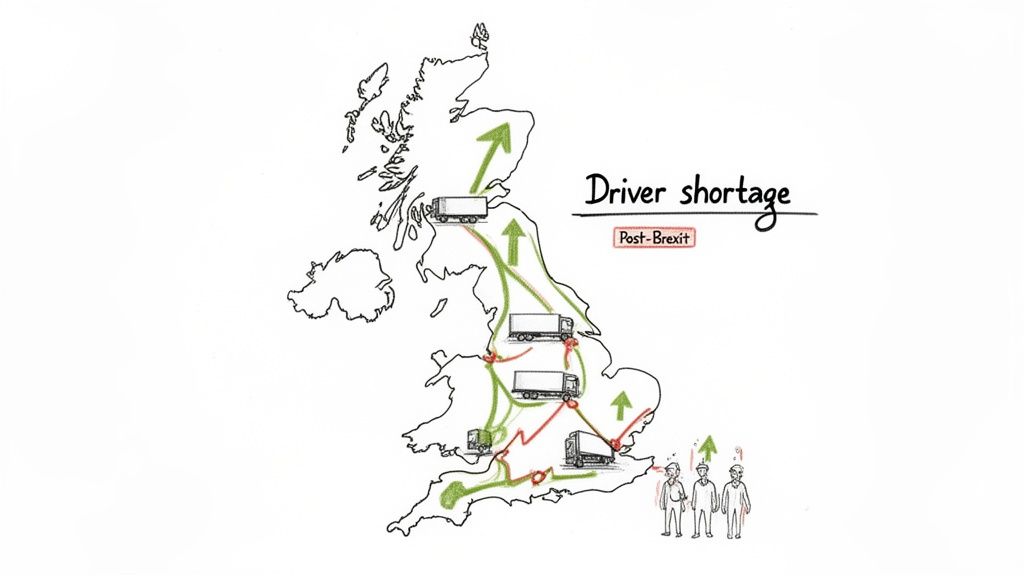
On top of that, Brexit has changed the game for the UK labour market, reducing the pool of available drivers from the EU. This has cranked up the domestic shortage even more, making UK-licenced drivers more valuable than ever and creating huge opportunities for anyone just starting out.
Your Opportunity in a High-Demand Market
So, what does all this mean for you, someone thinking about HGV training? In short, it means you’re entering a market where you have real bargaining power.
The persistent driver shortage isn’t a problem for new drivers: it’s an opportunity. It means better pay, more job choices, and greater long-term security for anyone willing to get qualified.
This isn’t just about finding any old job; it’s about finding the right job. With so many companies crying out for skilled drivers, you’re in the driver’s seat. You can choose a role that actually fits your lifestyle, whether that’s long-haul trucking with bigger pay packets or local delivery routes with more predictable hours.
The government and the logistics industry have woken up to how critical this shortage is, and they’re actively trying to attract new talent. These efforts include:
Apprenticeship schemes designed to bring younger people into the industry.
Improved roadside facilities to make life on the road more comfortable.
Streamlined testing processes to help new drivers get their licence more efficiently.
These aren’t just quick fixes; they signal a real, long-term commitment to making this a better profession. That adds another layer of security for anyone investing their time and money in training. Understanding why the demand is so high paints a clear picture of a career path that offers not just a job, but a stable and rewarding future.
Want to learn more about where the industry is heading? Check out our detailed article on the future of HGV driving.
The Reality of Pay and Your Working Life
When you’re weighing up HGV driving as a career, two questions probably jump to the front of the queue: how much will I earn, and what will my daily life actually look like? Let’s cut through the noise and look at the real, on-the-ground facts for both.
The pay is a massive draw, and for good reason. High demand means salaries are strong right from the start. A newly qualified Category C driver can realistically expect a starting salary somewhere between £28,000 and £34,000 a year. Think of this not just as a starting point, but as a solid foundation you can build on pretty quickly.
But your basic salary is just the beginning. Seasoned drivers, especially those who upgrade to a C+E licence for articulated lorries, often see their earnings push well past the £40,000 mark. Throw in a few specialist qualifications, and the numbers just keep getting better.
Maximising Your Earning Potential
Your payslip is rarely just your basic wage. Several factors can give your income a serious boost, putting you firmly in control of what you take home each month. It’s all about being smart with your skills and time.
Here are the main ways you can top up your earnings:
Overtime: Most driving jobs offer plenty of overtime, usually paid at a much better rate. It’s one of the quickest and most direct ways to increase your pay.
Bonuses: Many firms offer bonuses for hitting targets, maintaining a great safety record, or delivering on time.
Night and Weekend Work: Driving at unsociable hours almost always comes with a premium. Night trunking or weekend shifts can be a very lucrative choice.
Specialist Tickets: Holding qualifications like ADR for hazardous materials or HIAB for crane operation makes you a far more valuable asset, and your pay will reflect that.
The earning potential in HGV driving is directly tied to your willingness to gain experience and qualifications. It’s a career where investing in your skills pays real, tangible dividends year after year.
For a more detailed breakdown, you can explore our full guide on the average HGV driver salary in the UK to see how different roles and regions compare.
Finding a Work-Life Balance That Works
While the money is great, a good career has to fit your life. It’s true that some HGV roles involve long hours and nights away. Long-haul “tramping,” where you live in the cab for a few nights a week, pays fantastically well but demands a big lifestyle shift. It’s a brilliant option for some, but it’s definitely not the only way.
The key thing to understand is that the HGV industry offers incredible variety. You are not locked into one way of working. It’s like a menu – you can pick the job that best fits what you want from life.
Just think about the contrast between these two common roles:
Long-Haul Trunking: This usually involves depot-to-depot runs on motorways, often at night. You’ll spend less time in traffic and have very little manual work, but you’ll be away from home more.
Local Multi-Drop: This means making multiple deliveries in a set region. The hours are often much more like a regular 9-to-5, so you’re home every evening. The trade-off is that it can be more physical.
Choosing between roles like these allows you to find a balance that suits you. If being home for dinner every night is non-negotiable, a job in construction logistics or local delivery could be ideal. If you want to max out your earnings and enjoy the freedom of the open road, long-haul work might be your calling. The power is in your hands to shape a career that delivers both a great wage and a life you enjoy.
Your Roadmap to Becoming a Qualified HGV Driver
Deciding that HGV driving is a good career move is the first step. The next is figuring out exactly how to get qualified. At first glance, the journey might seem a bit daunting with all the different licences and acronyms, but it’s actually a pretty logical and manageable process. Think of it as a clear roadmap, where each step you complete opens up new and better career opportunities.
The whole thing kicks off with a bit of essential paperwork. Before you can even think about getting behind the wheel of a lorry, you’ll need to get a provisional HGV licence and pass a medical examination. This is just to make sure you meet the legal and health standards required for professional driving. At HGV Learning, we handle all this for you, booking your medical and managing the forms to make the start of your journey as smooth as possible.
The Core HGV Licences Explained
Once your provisional licence is sorted, the next stage is to decide which licence you’re aiming for. The one you choose will determine the size of the vehicle you can drive and, ultimately, the kinds of jobs you can land. Each licence builds on the last, creating a natural progression as your career grows.
There are two main licence categories to consider when you’re starting out:
Category C: This is usually the first licence new drivers get. It qualifies you to drive any rigid vehicle over 3,500kg, which covers everything from large delivery lorries and bin lorries to construction vehicles. A Category C licence opens the door to a huge range of local and regional driving jobs, making it a fantastic place to start.
Category C+E: This is the big one, the top-tier licence that lets you drive an articulated lorry, or “artic” as you’ll hear them called. This qualification is essential for most long-haul and trunking work and usually comes with the highest earning potential. You must pass your Category C test before you can even start training for your C+E.
The licence you hold is your key to the industry. Starting with a Category C is a brilliant way to gain experience, and adding a C+E later is the single best way to maximise your salary and career options.
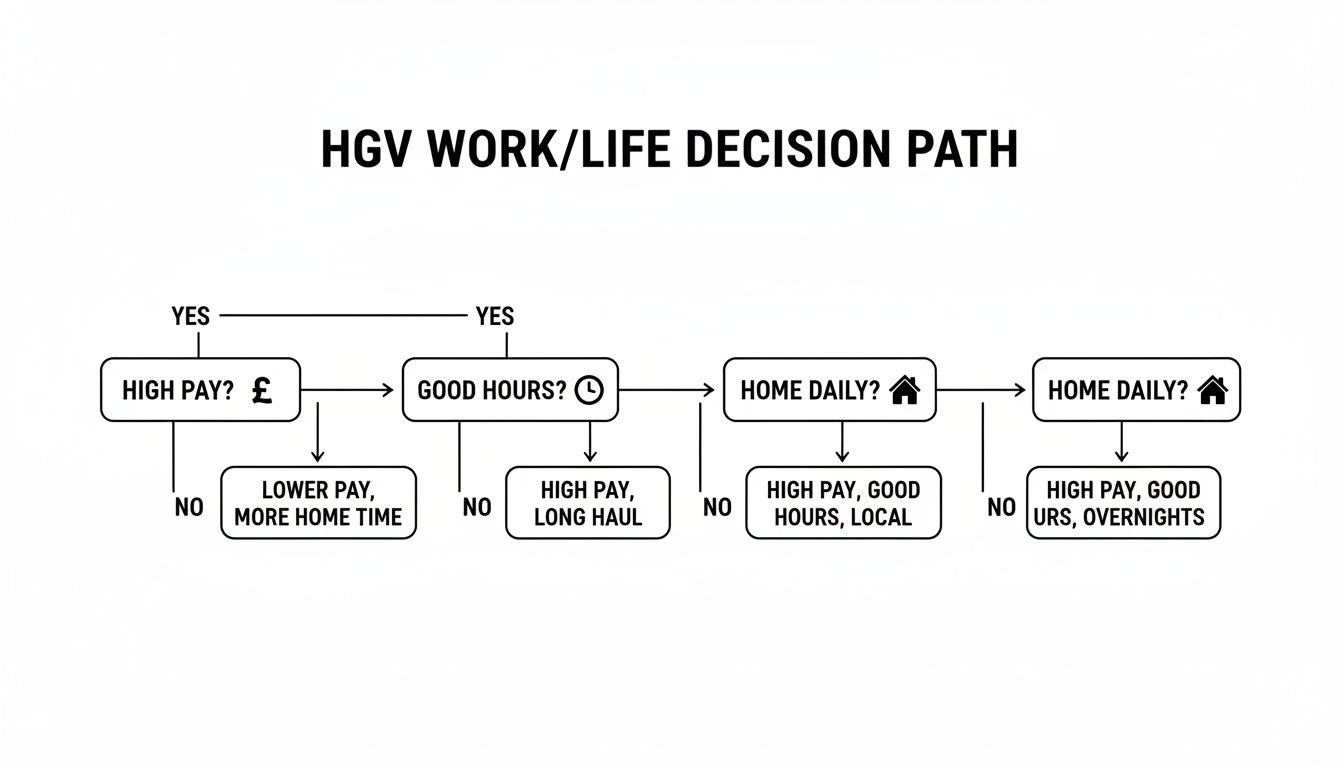
This simple decision tree can help you see how your career choices might influence your work-life balance.
As you can see, while high pay and being home daily are both achievable, they often lead down different career paths within the HGV world.
From Theory to Practical Test
With your target licence in mind, your training begins in earnest. The process is broken down into two main parts: theory and practical. The theory tests cover multiple-choice questions, hazard perception, and case studies. These are all designed to ensure you have the core knowledge needed for safe, professional driving.
Next up is the practical training, where you get hands-on experience in a lorry with a qualified instructor. This is where you learn everything from vehicle safety checks and manoeuvring to real on-road driving skills. Our local training centres across the UK mean you can learn in a familiar environment, guided by expert instructors who know exactly how to get you ready for test day.
Opening up Higher Pay with Specialist Skills
Getting your main HGV licence is a huge achievement, but it’s not the end of the road. To truly turn HGV driving into a great career with excellent pay, you’ll want to add some specialist qualifications to your name. These “tickets” allow you to handle specific types of cargo or operate specialist equipment, making you a much more valuable, and better-paid, driver.
The table below breaks down the main licences and some of the key specialist certifications you can add to boost your career.
HGV Licence and Certification Pathways
Licence/Cert
Vehicle Type
Common Job Roles
Category C
Rigid lorries over 3,500kg (e.g., box trucks, tippers, bin lorries)
Articulated lorries (‘artics’) and drawbar trailers
Long-haul driver, supermarket trunking, general haulage, international transport
ADR
Vehicles carrying hazardous materials (e.g., tankers, chemical transport)
Fuel tanker driver, chemical transport specialist, hazardous waste driver
HIAB
Lorry with a vehicle-mounted crane
Builder’s merchant driver, delivery of heavy/bulky goods, plant machinery transport
Telehandler
Forklift/telehandler vehicle, often used for loading/unloading
Warehouse operative, agricultural driver, construction site logistics
Each of these specialist courses is relatively short, often taking just a few days to complete. The return on that small investment of time can be huge, immediately boosting your employability and your pay packet. This roadmap, from the initial medical to getting specialist tickets, shows a clear and achievable path to a secure and prosperous career on the road.
Building Your HGV Career Path
Getting your HGV licence is a brilliant achievement, but it’s best to see it as the starting line, not the finish. Thinking about is HGV driving a good career isn’t just about the first job you land; it’s about the long-term journey ahead. Your licence is the launchpad for a varied and rewarding career with multiple paths for growth and specialisation.
Many people mistakenly view driving as a static, dead-end job, but the reality couldn’t be more different. The skills and discipline you develop on the road are a strong foundation for moving into senior roles, running your own business, or becoming an expert in a high-value niche. Your career can, and should, evolve with you.
With the UK’s economy so reliant on road transport, opportunities for advancement are always there for the taking. With 80% of all goods and materials moved by road, the sector is fundamental to how the nation functions.
Although the latest data for Q4 2024 shows HGV business vacancies dropped to 24% from 28%, this slight dip doesn’t erase the deep-rooted need for skilled drivers. Those with the right training and attitude will always enjoy exceptional job security. You can read more about these UK driver shortage trends and what they mean for the industry.
From Driver to Business Owner
One of the most exciting progression routes is becoming an owner-operator. This is where you make the leap from being an employee to running your own haulage business. It’s a big step, but it gives you complete control over your work, your hours, and your earning potential.
Starting with a single lorry, you can build a reputation for reliability and gradually expand your fleet. You’ll be your own boss, taking on contracts that suit you and building a business from the ground up. It takes experience and a good business head, but it’s a common and achievable goal for many seasoned drivers.
Moving into Management and Training
Not everyone wants the responsibility of owning a business, but there are other fantastic ways to progress off the road. With a few years of driving under your belt, you become an invaluable asset in other areas of a logistics company.
Your real-world experience on the road (understanding routes, delivery pressures, and vehicle management) is exactly what companies look for when hiring for office-based roles.
Here are some common career moves for experienced drivers:
Transport Manager: You’ll be responsible for planning routes, scheduling drivers, ensuring legal compliance, and making sure the entire logistics operation runs like clockwork.
Driver Trainer: You can pass on your skills to the next generation by becoming a qualified instructor, teaching new drivers how to operate safely and professionally.
Compliance Officer: Your deep knowledge of drivers’ hours, tachograph rules, and vehicle safety makes you a perfect fit for roles that ensure the company is meeting all its legal obligations.
Specialising for Better Pay and Conditions
Another powerful way to build your career is by specialising. A general haulage driver is always in demand, but a driver with specialist tickets can command much higher pay and often secure more desirable working conditions. These qualifications open doors to niche sectors that are less crowded and more lucrative.
Consider these high-value specialisms:
Petrochemical Transport (ADR): Moving fuels and chemicals is a high-responsibility role that requires an ADR certificate. The risk is higher, but so is the pay packet.
Heavy Haulage: Transporting abnormal loads like wind turbine parts or construction machinery is a highly skilled job with excellent earning potential.
Construction Logistics (HIAB): Operating a lorry-mounted crane makes you a vital part of any building site, often leading to more regular, sociable hours.
Each specialisation you add makes you more versatile and more valuable to an employer. By carefully choosing your path, you can shape a long-term HGV driving career that is not only secure and well-paid but also full of opportunities for growth.
Frequently Asked Questions About an HGV Career
Deciding to change careers is a big deal, and it’s only natural to have a few questions before you commit. When you’re weighing up if HGV driving is the right move for you, a few final queries often pop up. We’ve pulled together some of the most common questions we hear from aspiring drivers to give you clear, honest answers and help you take the next step with confidence.
How Long Does It Take to Get an HGV Licence in the UK?
This is always one of the first things people ask, and the good news is, it’s probably quicker than you think. For most people, getting a Category C licence usually takes somewhere between 8 and 12 weeks from the moment you start to the day you pass your test. That timeline covers everything: from the initial paperwork right through to your final practical exam.
The whole process is broken down into a few manageable stages. You’ll start by applying for your provisional licence and getting a medical check-up. After that, it’s time to hit the books for your theory tests before you can get behind the wheel for your practical, on-road training.
To stop it all feeling a bit overwhelming, a good training coordinator will sort out all the logistics for you. They’ll book your medical, schedule your theory prep, and get your practical driving course lined up at a local centre that works for you. It just makes the whole thing run that much smoother, so you can focus on the learning.
What Are the Biggest Challenges of Being an HGV Driver?
While the job security and pay are brilliant, it’s important to go in with your eyes open. The biggest hurdles for most drivers are lifestyle-related. Depending on the job, you might be looking at long or unsociable hours, which can take some getting used to. For long-haul drivers, time away from home is another major factor to consider.
Another common complaint is the quality of roadside facilities in some parts of the UK, which can make a long journey feel even longer. On top of that, you’ve got the day-to-day pressures of traffic, tight delivery slots, and unpredictable road conditions to deal with.
The key to overcoming these challenges is to actively choose a role that aligns with your personal life. The variety in the HGV industry means you don’t have to accept a lifestyle that doesn’t suit you.
For instance, plenty of drivers find a great work-life balance in jobs with more regular, sociable hours. Roles in local multi-drop delivery, construction, or even waste management often mean you’re home every evening. These jobs let you enjoy all the benefits of being a professional driver without the biggest lifestyle trade-offs.
Can I Get Help with the Cost of HGV Training?
Yes, absolutely. We know the initial cost of training is a real concern for many, but there are several ways to make it affordable. You don’t have to find the full amount upfront.
Most reputable training providers offer flexible payment options designed specifically to help new drivers get qualified without a massive financial hit. These plans let you spread the cost of your training over time, making that initial investment feel much more manageable.
At HGV Learning, for example, we have our own in-house payment plans that allow you to spread the cost over 10 to 12 months. This way, you can get your licence, land a job, and start earning a proper driver’s salary while paying for your training in smaller, affordable chunks. It’s always worth having a chat with your training coordinator to see exactly what payment options are on the table.
Is HGV Driving Physically Demanding?
That’s a great question, and the answer really comes down to the specific job you go for. Modern lorries have come a long, long way. They’re built for driver comfort now, with things like power steering, automatic gearboxes, and well-designed cabs making the actual driving part not very strenuous at all.
Where the physical effort comes in depends entirely on the role. Some jobs involve a decent amount of manual work. For example:
A multi-drop delivery driver for a supermarket might be loading and unloading roll cages at every stop.
A HIAB operator for a builder’s merchant will be using the crane, but they’ll also need to get hands-on with securing heavy loads.
On the flip side, plenty of roles involve almost no physical work. A long-distance “trunking” driver might just be swapping trailers at a depot, which is about as low-effort as it gets. Ultimately, you can steer your career towards a job that fits the level of physical activity you’re comfortable with, whether that’s an active, on-your-feet role or one that’s pretty much all driving.
Ready to take the next step and see if an HGV driving career is right for you? At HGV Learning, we provide end-to-end support to get you qualified and on the road to a secure, well-paid future. Explore our courses and payment options today at https://hgvlearning.com.
Related Articles
23/10/2026
Driver CPC Card Renewal: How to Avoid a Lapsed DQC (2026 UK Guide)
If your Driver CPC card is sitting in your wallet with a date on it you haven't looked at properly in years, you're not alone....