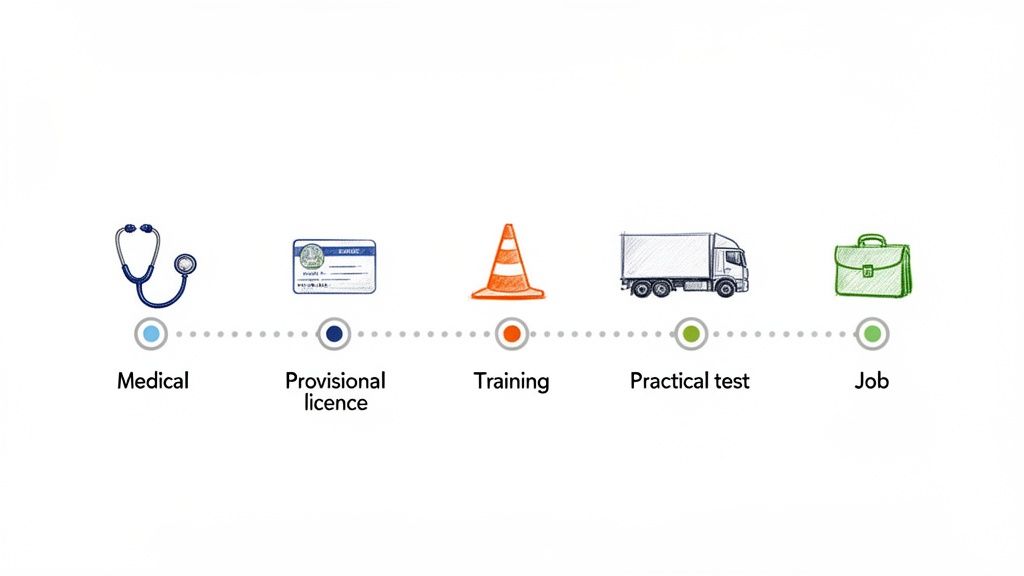
Getting your HGV licence is the key that opens up a stable and rewarding career on the road. The whole process is broken down into a series of clear steps. It starts with a driver medical and getting your provisional licence, before moving on to the four Driver CPC modules that turn you into a safe, competent professional.
Your Roadmap to Becoming an HGV Driver
Starting a career as a Heavy Goods Vehicle (HGV) driver is a big move, but the path to getting qualified is much more straightforward than you might think. It is not just about passing a single test; it is a journey through several key stages. Each one builds on the last to make sure you are fully prepared for life behind the wheel.
This guide will break down the entire process into simple, manageable parts. We will cover everything from figuring out which licence category matches your career goals to mastering the theory and practical tests. This will give you a clear overview to build your confidence from the ground up.
Why Now Is the Perfect Time to Start
The demand for qualified HGV drivers in the UK is as high as it has ever been. Ongoing workforce shortages have created huge opportunities for people new to the industry. In fact, the Road Haulage Association estimates the country needs around 40,000 new HGV drivers every year for the next five years just to keep things running smoothly.
This skills gap is great news for newly qualified drivers. It means your licence will make you a valuable asset to employers in logistics, retail, construction, and countless other sectors.
To give you a clearer picture of the journey ahead, here is a quick breakdown of the main stages you will go through.
Quick Overview of the HGV Licence Process
Stage
What It Involves
Key Objective
Paperwork First
Getting a driver medical and applying for your provisional licence.
To get the legal permissions needed to start training.
Module 1 (Theory)
A computer-based test on road safety and vehicle knowledge.
To prove you have the essential theoretical understanding.
Module 2 (Case Studies)
Applying your knowledge to real-world driving scenarios.
To show you can think like a professional driver.
Module 3 (Practical)
An on-road driving test with an examiner.
To demonstrate safe and competent control of the HGV.
Module 4 (Demonstration)
A hands-on test of vehicle safety and loading procedures.
To confirm your practical, day-to-day operational skills.
As you can see, it is a logical progression designed to build your skills and confidence step-by-step.
Understanding the Core Components
The journey to getting your HGV licence is built around the Driver Certificate of Professional Competence (CPC). This framework splits the qualification into four key parts, making sure every new driver has the right mix of skills and knowledge.
Here is a closer look at the stages you will work through:
Initial Paperwork: Before you even think about getting in a lorry, you need to pass a medical exam and apply for your provisional HGV licence.
Module 1 (Theory Test): This is the computer-based part. It tests your knowledge of road safety, basic mechanics, and regulations using multiple-choice questions and hazard perception clips.
Module 2 (Case Studies): This test checks if you can apply what you have learned to real-life situations you will face on the job.
Module 3 (Practical Driving): The main event! This is your on-road driving test where an examiner watches how you handle the vehicle and react to traffic.
Module 4 (Practical Demonstration): A hands-on test where you show you understand vehicle safety, security, and how to correctly handle loads.
Becoming a professional driver is a structured process designed to build competence step-by-step. Think of it less as a single hurdle and more as a clear pathway to a long-term, valuable career.
By understanding this roadmap right from the start, you can plan your training properly and approach each stage with confidence. For a really detailed walkthrough, check out our complete guide on getting your first HGV licence in the UK.
Choosing the Right Licence for Your Career
Picking the right HGV licence is the first real choice you will make on your journey to becoming a professional driver, and it is a big one. You need to match the licence to the kind of work you see yourself doing in the future. Think of the different categories as keys to different doors in the industry: choosing the right one now sets you up for success later on.
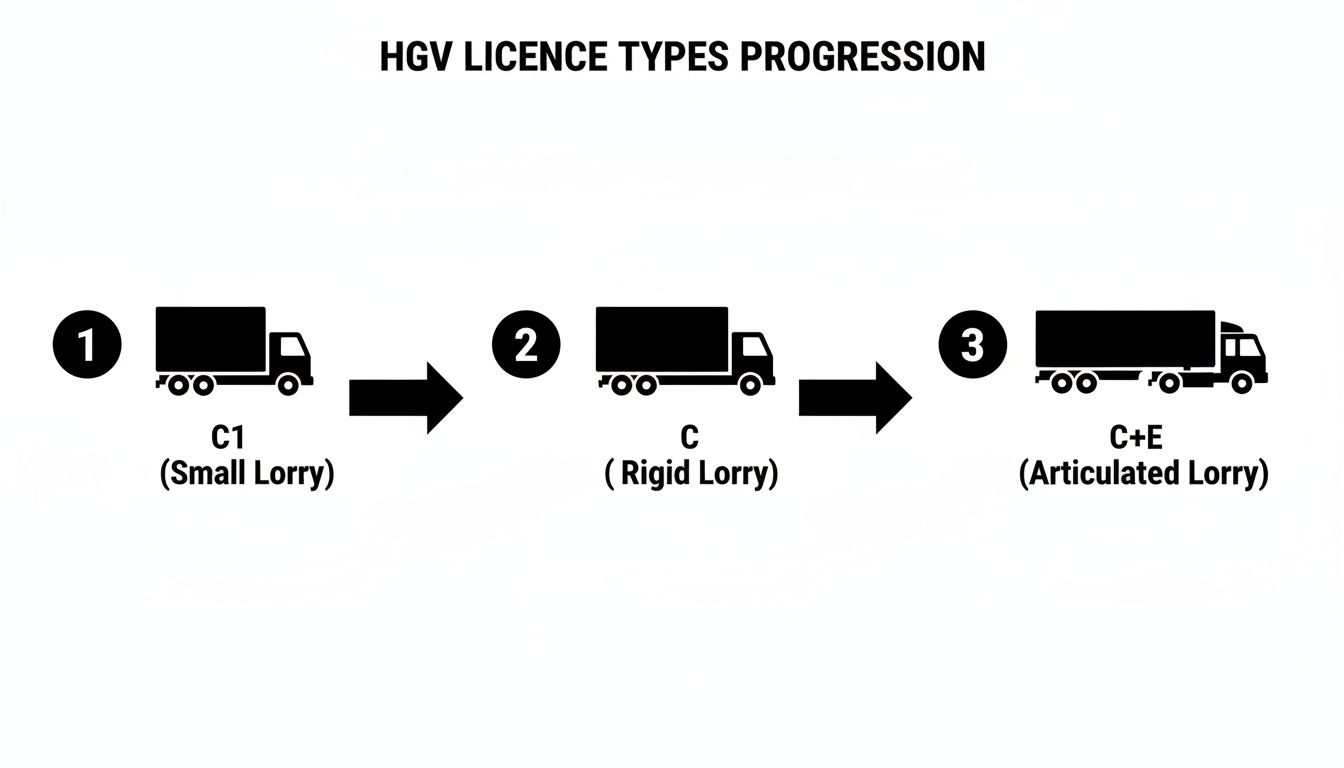
Your career starts with one of three main licence categories. Each one lets you drive bigger and more complex lorries, opening up different career paths as you go.
Let’s break down what each one actually means for you on the road.
Category C1: The Starting Point
The Category C1 licence is your first step into the world of commercial goods vehicles. It gives you the qualification to drive any rigid vehicle weighing between 3.5 and 7.5 tonnes. This might sound a bit technical, but you see these vehicles every single day.
Picture a large supermarket home delivery van, a multi-drop courier lorry, or even an ambulance. Those are all perfect examples of C1 vehicles. This licence is a great fit for anyone looking for local or regional driving jobs that do not involve the biggest lorries on the road.
Typical Jobs: Local delivery driver, paramedic, horsebox driver, or operating smaller removal lorries.
Vehicle Type: These are rigid chassis vehicles, meaning the cab and the load area are all one fixed unit.
Career Path: It is an excellent starting point if you need a licence quickly for a specific job, or if you just want to get some experience before moving up to a larger class.
This category offers a solid way into the industry without the pressure of jumping straight into the biggest and most challenging vehicles.
Category C: The Industry Standard
Often called a “Class 2” licence, the Category C is the real workhorse of the UK haulage industry. It qualifies you to drive any rigid vehicle over 3.5 tonnes, with no upper weight limit.
This is a major step up from the C1. With a Category C licence, your options expand massively: you could be driving anything from large supermarket lorries and bin lorries to tipper trucks on a building site. It is the most common licence for drivers doing national distribution runs in rigid lorries.
The Category C licence is the backbone of the logistics world. It opens up a huge range of jobs and gives you the core skills for a long, stable career in haulage.
For many drivers, this licence hits the sweet spot between opportunity and vehicle size, which makes it an incredibly popular choice. It is the standard ticket for a huge number of driving jobs right across the country.
Category C+E: The Ultimate Qualification
The Category C+E, known to everyone in the industry as “Class 1,” is the top-tier qualification you can get in the HGV world. It allows you to drive articulated lorries, the classic tractor unit and long trailer combination, weighing up to 44 tonnes.
Holding a C+E licence means you are qualified to drive the biggest vehicles on UK roads, period. This opens the door to the highest-paying driving jobs, like long-haul national and international routes, supermarket trunking between depots, and specialised heavy transport. If you dream of driving the biggest rigs and taking on the most serious jobs, this is the licence to aim for.
Here is a simple way to look at how the main categories stack up against the jobs they open up:
Licence Category
Vehicle Type
Common Job Examples
C1
Small Rigid Lorry (up to 7.5t)
Home delivery driver, Ambulance driver
C
Large Rigid Lorry (over 3.5t)
Supermarket logistics, Construction driver
C+E
Articulated Lorry (up to 44t)
Long-haul driver, Fuel tanker operator
Ultimately, the right path comes down to your own ambition. Whether you want to start small with local deliveries or have your sights set on the open road in an artic, understanding these categories is your first proper step toward passing the HGV driving test and building a great career.
Navigating The Four Driver CPC Modules
To get behind the wheel professionally, you will need to do more than just pass a single driving test. The journey to becoming a qualified HGV driver involves completing the four-part Driver Certificate of Professional Competence (CPC). Think of it as four essential building blocks – you need to stack each one correctly before you are fully qualified to work.
This system ensures every new driver has a solid grasp of theory, hazard perception, practical driving, and crucial safety checks. Let’s break down each module so you know exactly what is coming at every stage.
Module 1: The Theory Test
Your journey kicks off with the theory. Module 1 is a computer-based test split into two distinct parts, both of which you will tackle on the same day at a designated test centre.
First up is the multiple-choice section. This is not just about the Highway Code; it tests your knowledge on everything from traffic signs and driver hours rules to basic mechanical principles. You will be presented with 100 questions, and the pass mark is a firm 85 out of 100.
Next is the hazard perception test. For this part, you will watch 19 video clips showing everyday road scenes. Your job is to click the mouse as soon as you spot a developing hazard – something that would make you, as the driver, take action. It is not about spotting the obvious, but about identifying potential risks early. The sooner you click, the more points you get, with a maximum of five per hazard.
A common mistake is to click frantically or in a set pattern. The system can detect this and will score you zero for that clip. The trick is to click deliberately, just once, as soon as you see a genuine hazard unfolding.
Module 2: The Case Studies Test
With the theory fundamentals covered, Module 2 is all about applying that knowledge to real-world situations. This is not about reciting rules from a book; it is about showing you can think like a professional driver.
This is another computer-based test, where you will be given seven case studies. Each one lays out a scenario you could easily face on the job – things like planning the safest route, dealing with bad weather, managing your legal driving hours, or making sure your load is secure.
You will answer a series of multiple-choice questions based on each story.
Test Structure: You will face 50 questions spread across the seven case studies.
Passing Score: You need to get at least 40 out of 50 to pass.
Core Skill: This module really tests your problem-solving skills and whether you can be a safe, efficient, and compliant driver out on the road.
Passing Module 2 shows you can think on your feet. For a deeper dive into preparation, our guide to CPC training has some great pointers.
This visual shows how the licence categories build on each other, starting with smaller rigid lorries and moving all the way up to the largest articulated combinations.
Module 3: The Practical Driving Test
This is the one everyone pictures when they think of the HGV test. Module 3 is where you get in the cab with a DVSA examiner and prove you can handle the lorry safely and confidently. The test lasts about 90 minutes and covers a wide range of road and traffic conditions.
It starts with a few “show me, tell me” questions about vehicle safety. Then, you will perform a reversing manoeuvre in an off-road area – a non-negotiable skill for any HGV driver. After that, it is out onto the public road for about an hour of driving.
The examiner is looking for a consistently high standard of driving, focusing on:
Observation: Are you using your mirrors correctly? Are you scanning properly at junctions and roundabouts?
Control: How smooth are you with the steering, clutch, and gears?
Positioning: Can you keep the vehicle in the correct lane and position it well for turns?
Awareness: Are you anticipating what other road users might do and reacting in good time?
You are allowed up to 15 minor driving faults. However, just one serious or dangerous fault means an automatic fail. This module is the ultimate test of your roadcraft and vehicle handling.
Module 4: The Practical Demonstration Test
The final piece of the puzzle is Module 4. This is a hands-on, practical test focusing on everything but the driving. It is about proving you can handle the daily responsibilities that come with being a professional driver.
You will not actually drive the vehicle. Instead, you will use it as a prop while an examiner quizzes you on five key topic areas. You will need to demonstrate how to load the vehicle safely, prevent illegal immigrant trafficking, assess emergency situations, and perform thorough walk-around safety checks.
To pass, you must score 80 out of 100 overall, with a minimum of 15 out of 20 in each of the five sections. Nailing this final module confirms you have the all-round competence needed to start your career.
Here is a quick summary of the four Driver CPC modules you will need to complete.
| HGV Driver CPC Modules at a Glance | |:— |:— |:— | | Module | Test Type | What It Assesses | | Module 1 | Theory & Hazard Perception | Your knowledge of road law, vehicle mechanics, and ability to spot developing hazards. | | Module 2 | Case Studies | Your ability to apply theoretical knowledge to solve real-world driving scenarios. | | Module 3 | Practical Driving | Your on-road driving skills, vehicle control, and awareness in various traffic conditions. | | Module 4 | Practical Demonstration | Your hands-on knowledge of vehicle safety, load security, and emergency procedures. |
Each module builds on the last, ensuring that by the end of the process, you are not just a driver: you are a professional.
Mastering Your Practical Driving Test
This is it: the moment all your training comes together. The Module 3 practical test is where you prove to a DVSA examiner that you have the skill, awareness, and cool head needed to handle a large goods vehicle safely on public roads. It is the most famous part of the HGV driving test process, blending precision off-road challenges with real-world driving.
Your test will last around 90 minutes. This is not just a quick spin around the block; it is a comprehensive assessment designed to see how you perform across a whole range of road and traffic scenarios. It is not just about steering the lorry: it is about showing that you can think and act like a professional driver from start to finish.
The test is split into two distinct parts. First, you will tackle an off-road exercise at the test centre, followed by about an hour of driving on public roads.
The Critical Off-Road Manoeuvres
Before you even hit the open road, your control of the vehicle will be put under the microscope. This part is vital because it proves you can handle the sheer size and length of the lorry in tight spaces: a skill you will rely on every single day in depots and delivery yards.
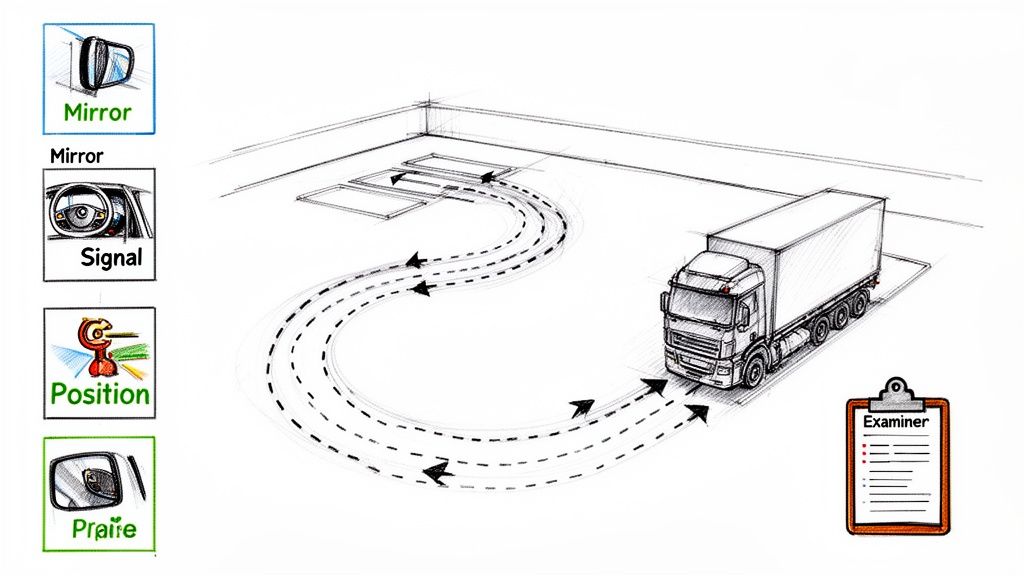
For every candidate, the fun starts with the ‘S’ shaped reversing exercise. The objective is to reverse the lorry smoothly and accurately from a starting point into a coned-off bay, just as you would when backing into a loading bay.
The examiner is watching for three key skills during this manoeuvre:
Accuracy: Can you place the vehicle perfectly within the bay without nudging any cones?
Control: Are your steering inputs smooth and deliberate? Are you managing your speed effectively?
Observation: Are you constantly checking all your mirrors and blind spots throughout the entire manoeuvre?
Getting the reversing manoeuvre right is about more than just passing the test. It builds the muscle memory and spatial awareness that are absolutely essential for a safe career. Think of it as a core skill, not just a test-day obstacle.
If you are taking the Category C+E test, you have an extra off-road task to complete. You will need to show the examiner the correct procedure for uncoupling the tractor unit from the trailer and then recoupling it safely. This involves a very specific sequence of checks on brakes, airlines, and the fifth-wheel connection to ensure the whole combination is secure and ready for the road.
What the Examiner Assesses On the Road
Once you are out on the public highway, the examiner will be observing your every move. They are not trying to trick you; they are simply making sure your driving is consistently safe, methodical, and up to the professional standard required.
This part of the test will take you through various environments, from busy town centres and tricky roundabouts to fast-moving dual carriageways. Your ability to adapt your driving style to these changing conditions is what really counts. For a deeper dive into what to expect, check out our guide on how to pass your HGV test the first time.
Your driving is judged against a strict set of criteria. Here is a breakdown of what the examiner is looking for:
Mirrors and Observation: Proper and consistent use of mirrors is non-negotiable. You must show you are constantly aware of what is happening around your vehicle, especially before you change speed or direction.
Signalling: Your signals must be used correctly and in good time to let other road users know your intentions. That means not too early, and definitely not too late.
Road Positioning: The examiner will be watching how you position your lorry. This includes maintaining a safe lane position, approaching junctions correctly, and navigating roundabouts with confidence and precision.
Control and Speed: You need to demonstrate that you are in full control of the vehicle at all times. This means using a speed that is appropriate for the road and traffic, all while staying within the legal limits.
During the test, the examiner will also ask you to pull over and move off safely a few times, which could include a hill start. You will also have a section of independent driving where you will follow either traffic signs or a sat-nav, proving you can plan ahead and navigate without constant direction. Nailing the practical test is the culmination of all your hard work, and it is the final confirmation that you are ready to join the ranks of professional HGV drivers.
Avoiding Common HGV Test Faults
One of the smartest ways to prepare for your test is to understand where other drivers commonly go wrong. The practical HGV test is not about flawless driving; it is about proving you are consistently safe, aware, and in full control of your vehicle.
To pass, you need to know exactly how the examiner marks your performance and which mistakes to steer clear of. Every decision you make is being watched, and any error gets logged as a fault. These are broken down into three categories, and knowing the difference is key.
Understanding the Fault System
Your performance during the test is measured against a strict framework. The examiner will log any mistakes you make into one of these three buckets:
Driving Fault (Minor): Think of this as a small slip-up that does not create any real danger but highlights a small gap in your technique. It could be signalling a bit late or a moment of hesitation. You are allowed up to 15 of these before you fail.
Serious Fault (Major): This is a mistake that could have led to a dangerous situation. Pulling out of a junction without a proper look or forgetting your mirror checks before turning are classic examples. Just one serious fault means you have failed.
Dangerous Fault (Major): The most critical error. This is when your action causes actual danger to you, the examiner, the public, or property. A single dangerous fault is an instant fail, no questions asked.
The takeaway is simple: a few minor blips might be okay, but even one serious or dangerous fault will bring your test to an early end.
Top Reasons for Failing the HGV Test
While no two tests are the same, instructors and official DVSA data point to the same recurring mistakes that trip up learner drivers time and time again. If you can master these areas during your training, you will massively boost your chances of passing first time.
Here are the most common pitfalls to watch out for:
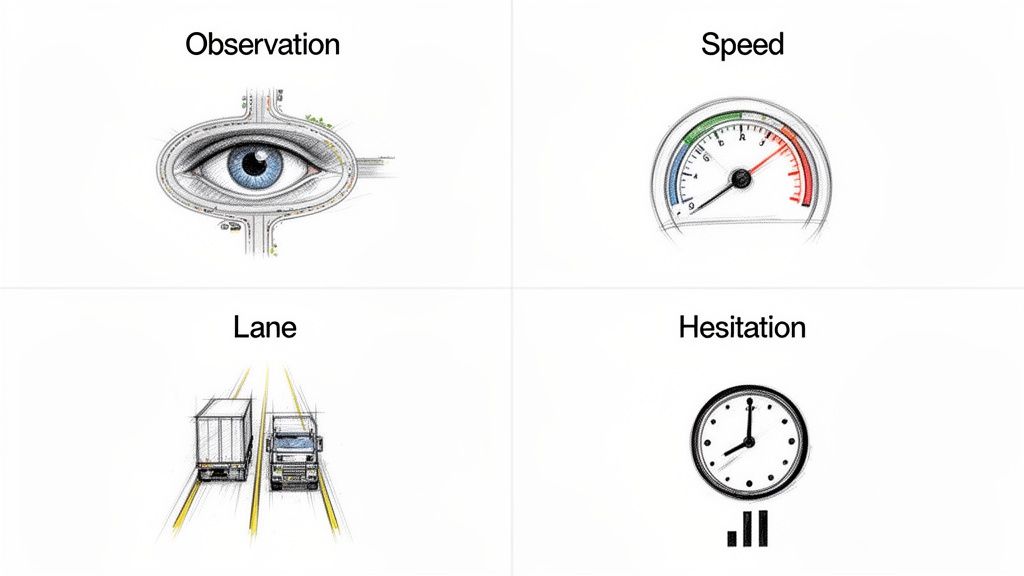
Inadequate Observation: This is the big one, especially at junctions, roundabouts, and when manoeuvring. You have to prove you are constantly scanning and using all your mirrors to build a 360-degree picture of what is happening around your vehicle.
Incorrect Use of Speed: Driving too fast is an obvious fail, but being overly cautious can be just as bad. Hesitating or driving too slowly can frustrate other road users and create problems. You need to show you can make safe, confident progress.
Poor Lane Discipline: An examiner is looking for precision. Drifting between lanes, cutting corners, or straddling the white lines will quickly add up to faults. A lorry takes up a lot of road, and you have to prove you can manage that space.
Lack of Awareness: This is all about thinking ahead and anticipating what other road users might do. It means reacting to signs, signals, and other drivers in good time, showing you are always one step ahead of the situation.
“A successful HGV driver is a proactive driver. The test isn’t just about controlling the lorry; it’s about demonstrating that you can see, think, and react well ahead of any potential hazard.”
Knowing these common failure points gives you a huge advantage. Quality training is designed to build the right habits from day one, turning these potential weaknesses into strengths. The UK’s HGV driving test sector has seen big differences in performance. DVSA statistics from 2023 show the national average pass rate for lorry tests is 59.7%. However, specialist training providers often report much higher success rates, with some reaching as high as 86.8% in 2024, which shows just how much good preparation can boost your outcome.
Life After You Pass Your HGV Test
Passing your final test is a huge milestone and the official launchpad for your professional driving career. After the well-deserved celebration, there are a few straightforward but vital steps to get you out on the road and earning.
Your examiner will hand you a pass certificate on the day. Your new photocard licence should then arrive in the post automatically, usually within about three weeks. You will also get your Driver Qualification Card (DQC) – this is the physical proof of your Driver CPC qualification, and you must carry it whenever you are driving for work.
But your journey of professional development does not stop here. This initial qualification is your entry ticket to the industry, and keeping it current is key.
Staying Qualified and Building Your Career
To keep your DQC valid and stay on the road legally, you need to complete 35 hours of periodic training every five years. This is not another high-pressure test. Instead, think of it as a series of short top-up courses designed to keep your skills sharp and your knowledge current with the latest industry rules.
Once you are qualified, a massive range of jobs opens up in sectors like logistics, retail, construction, and more. The industry is incredibly active. To give you an idea of the scale, in the first quarter of the 2024-2025 financial year alone, the DVSA conducted 110,889 HGV tests.
The good news is that pass rates have been steadily improving. Fail rates have dropped from over 17% back in 2015-2016 to around 11% today, which shows that modern training is really doing its job preparing new drivers. You can dig into all the HGV testing trends over on GOV.UK.
Thriving in Your First Driving Role
Your first professional driving job is where all that training truly comes to life. The key to success is building a reputation for being reliable and safe right from the very start. Your first task is to get your CV updated, highlighting your new qualifications and your eagerness to get started.
You will quickly find that being efficient is just as crucial as being safe. Once you are working, understanding concepts like route optimisation can make a huge difference to your performance and how valuable you are to your employer.
Your HGV licence is more than just a piece of paper; it’s a passport to a long-term, in-demand career. Approach your first few months with a professional attitude, a willingness to learn, and a solid commitment to safety.
Your HGV Test Questions, Answered
Getting started on the path to an HGV licence naturally brings up a lot of questions. We have pulled together some of the most common queries from aspiring drivers to give you clear, straightforward answers.
How Long Does It Take to Get an HGV Licence?
Realistically, the whole journey, from sorting your medical to passing that final practical test, usually takes between 8 to 10 weeks. This can shift a bit depending on how much time you can dedicate to training and the waiting times for test slots in your area. Following a structured training plan is always the quickest route.
Can I Go Straight to a Category C+E Licence?
Yes, you absolutely can. Thanks to changes made back in 2021, you no longer have to pass the Category C (rigid lorry) test before you can start training for a Category C+E (articulated lorry). This “direct access” approach is a great way to save time and money if your ultimate goal is to drive the biggest artics from day one.
What Happens if I Fail One Part of the Test?
Do not worry, failing one module is not the end of your driving career before it has even started. You simply need to rebook and retake the specific part you failed, whether that is one of the theory papers or a practical module. You do not have to go back to square one. It just gives you a chance to focus your practice on the area that needs a bit more work.
Think of the HGV driving test as a process of building your skills piece by piece. A failed module is just a signpost showing you where to reinforce your learning before you move on with total confidence.
Is the HGV Test Difficult to Pass?
Let’s be honest, the HGV test is designed to be tough: it has to be to make sure our roads are safe. But with high-quality, professional training, it is completely achievable. While national pass rates tend to hover around the 60% mark, good training schools often see much higher success rates. It just goes to show that proper preparation is the real key to passing the first time.
Ready to get your journey started and get behind the wheel? HGV Learning provides complete, expert-led training packages across the UK, guiding you through every single step. Find the perfect course and book your training at https://hgvlearning.com.