So, what exactly is a Category C licence? You have probably heard it called a ‘Class 2’ licence if you have been around the industry. Put simply, it’s the official qualification you need to drive rigid heavy goods vehicles (HGVs) that weigh over 3,500kg.
Think of it as the cornerstone of a professional driving career in the UK. For most people looking to get behind the wheel of a lorry, this is where the journey begins.
Your First Step into Professional Driving
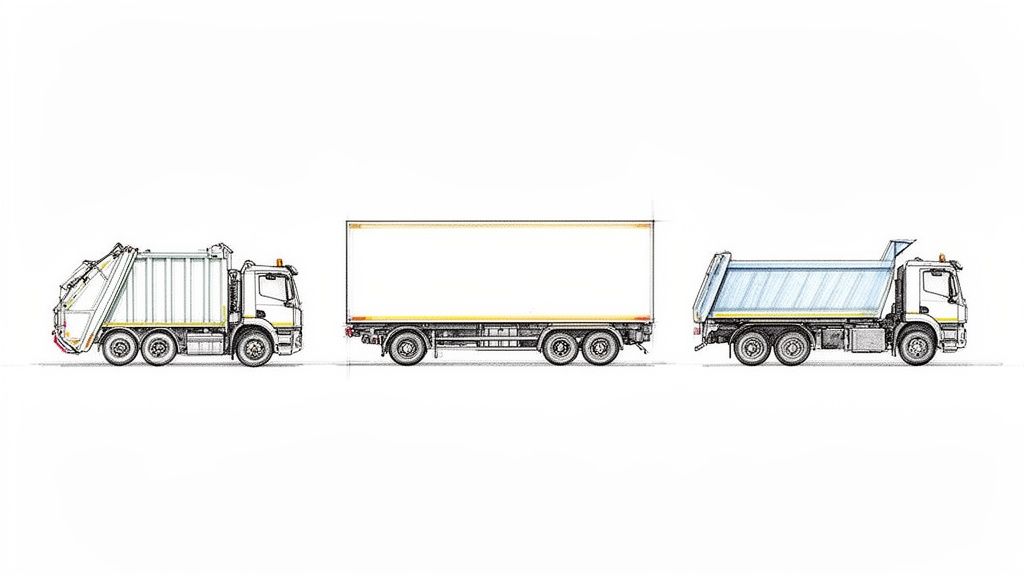
You see Category C vehicles on the road every single day. That big supermarket lorry delivering fresh produce, the tipper truck on a construction site, or even your local bin lorry – they are all Class 2 vehicles.
The term ‘rigid’ just means the driver’s cab and the trailer part are all one solid unit, built on a single chassis. This is the main difference between a Cat C vehicle and an articulated lorry (the big ‘bendy’ ones), where the cab and trailer are separate.
Getting your Cat C licence opens up a huge range of commercial driving jobs, making it an incredibly useful and valuable qualification to have in logistics, construction, or even public services.
Who is the Cat C Licence For?
The Cat C licence is the go-to choice for a wide mix of people, not just seasoned drivers. It is a very popular and accessible starting point.
It might be the perfect fit for you if you are:
A career-changer looking for a stable job with good pay and a clear path for progression.
A school leaver wanting a skilled, hands-on trade that does not need a university degree.
An existing van driver ready to step up to bigger vehicles and earn a much better wage.
Someone wanting local routes, as many Class 2 jobs are based on regional deliveries, which means you are home every night.
In short, if your goal is to become a professional lorry driver, the Cat C licence is nearly always the right place to start. It’s the essential stepping stone you need before you can even think about driving the biggest articulated trucks (the C+E licence).
The Financial and Career Benefits
Investing in your Cat C licence is a direct investment in your future earnings. It’s one of the most sought-after HGV qualifications, and good drivers are always in high demand right across the UK.
Of course, the training cost is a big consideration, but the return on that investment is often impressively fast. The all-in cost to get fully qualified typically falls between £2,300 and £2,800, which covers everything from medicals to training and tests.
With starting salaries for newly qualified drivers often hitting up to £38,000, the licence can pay for itself in a matter of months. You can see how the numbers stack up by checking our full breakdown of average HGV driver salaries. It’s this blend of a manageable training cost and strong starting pay that makes it such an attractive career move.
The Essential Requirements for Starting Your Journey
Before you can even think about climbing into the cab of a large lorry, there are a few foundational steps you need to complete. These are not obstacles designed to trip you up; instead, think of them as the first official milestones on your professional driving journey. They are straightforward checks and balances to ensure every new driver is ready for the road.
The first couple of requirements are simple. To start the process, you must:
Be at least 18 years old.
Already hold a full UK car driving licence (Category B).
These are the non-negotiable starting points. They prove you have basic road experience before you get behind the wheel of something much bigger.
The HGV Medical Exam
Once you have confirmed you meet the age and licence criteria, your first active step is to pass a professional driving medical assessment. This is a routine check-up with a doctor to confirm you are medically fit to safely operate a heavy goods vehicle. It’s a vital part of maintaining road safety for everyone.
The examination is nothing to worry about. The doctor will look at several key areas, including:
Eyesight: Your vision will be tested to ensure it meets the minimum standards for HGV drivers.
General Health: This includes checking your blood pressure and asking about your medical history to identify any conditions that could affect your driving.
Neurological Health: The doctor will check for any conditions that might impact your reaction times or control of a vehicle.
Passing this exam proves you are fit and well, and it is a mandatory requirement before you can even apply for your provisional HGV licence. If you would like to understand more about the specifics, you can learn more about the HGV medical exam in our detailed guide.
Introducing the Driver CPC
Finally, you will need to get your Driver Certificate of Professional Competence (CPC). The Driver CPC is an essential qualification for anyone wanting to drive an HGV professionally in the UK. It was introduced across Europe to improve road safety and maintain high standards across the industry.
Your initial CPC is completed as part of your licence acquisition process: it is not a separate course you do later. It is integrated into your theory and practical tests, proving you have the skills and knowledge to be a safe, professional driver from day one.
Navigating the Four-Part Qualification Process
Getting your Cat C licence is a structured journey, broken down into four distinct parts. It might seem like a lot at first, but each stage is a logical step designed to build your skills and knowledge from the ground up, making sure you’re a safe and competent professional driver.
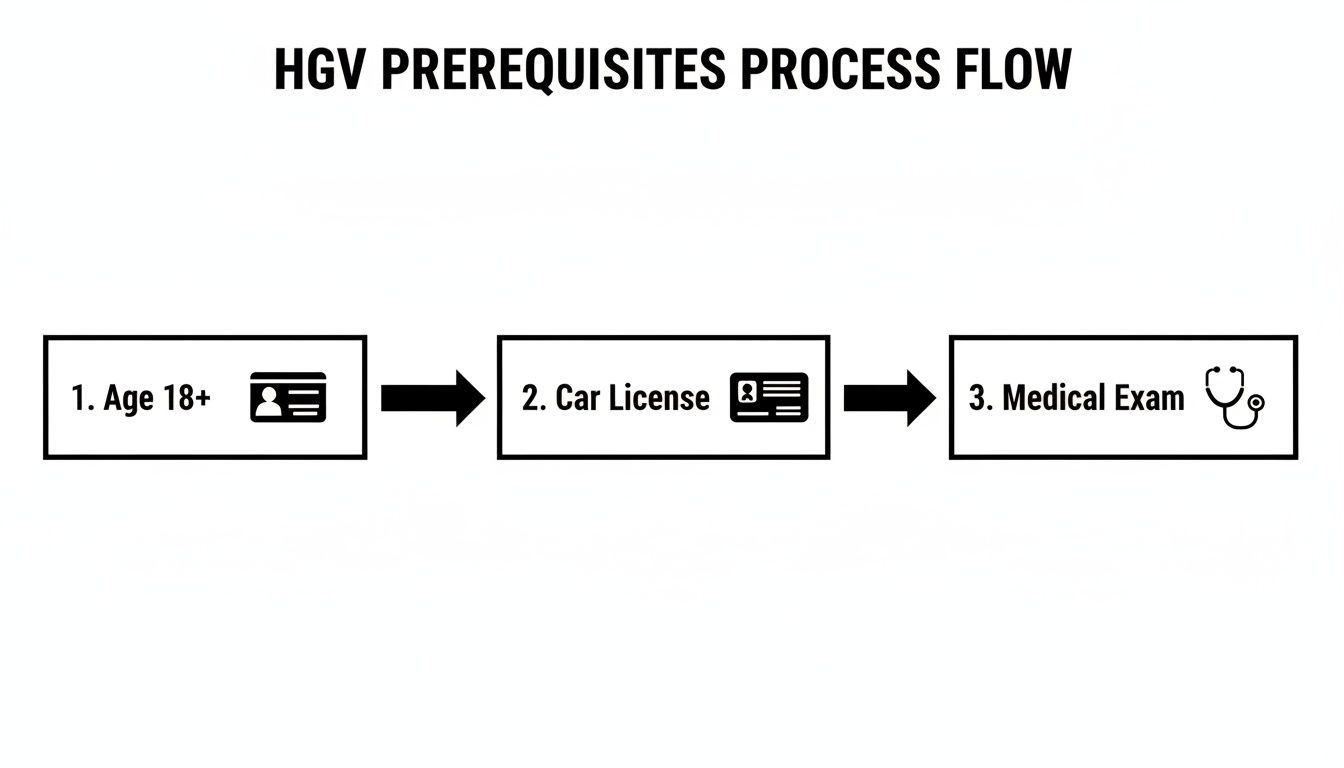
Let’s walk through exactly what you can expect. This whole process kicks off once you have completed the initial prerequisites: being at least 18, holding a full car licence, and passing your HGV medical exam.
As the diagram shows, clearing these three initial gates opens up the door to the four-part qualification process itself.
The Two Theory Modules
Your first big milestone is tackling the theory tests. This is split into two parts and forms the first half of your initial Driver CPC qualification.
Module 1 Theory Test: Think of this as the HGV version of the car theory test. It’s made up of multiple-choice questions covering everything from road signs to vehicle safety, plus the all-important hazard perception test where you will need to spot developing dangers in video clips.
Module 2 Case Studies: This is where you move beyond the black-and-white rules of the road. You’ll be presented with seven case studies based on real-life driving scenarios. The questions test your decision-making and problem-solving skills, checking how you’d handle situations you will genuinely face on the job.
Passing both of these proves you have the solid theoretical foundation needed before you even think about getting behind the wheel. You can see how this all fits together in our guide on how to get a Driver CPC.
The Two Practical Modules
With the theory modules under your belt, it is time to get hands-on. The practical side of your training is also split into two distinct parts.
Module 3 Practical Driving Test: This is the one everyone thinks of – the on-road driving assessment. An examiner will ride alongside you, assessing your ability to handle the lorry safely and professionally in a variety of real-world road and traffic conditions. You’ll also be tested on an ‘S’ shaped reversing manoeuvre and how to correctly couple and uncouple a trailer.
Module 4 Practical Demonstration: The final piece of the puzzle focuses entirely on vehicle safety and awareness. You’ll face a series of ‘show me, tell me’ style questions, where you will need to physically demonstrate your knowledge of daily checks, like inspecting tyre conditions or checking fluid levels. This test also covers your understanding of how to prevent risks like illegal trafficking and how to ensure your vehicle is loaded securely.
This four-part structure is there for a reason. It’s designed to produce well-rounded, professional drivers who don’t just have the physical skill to handle a large vehicle, but also the critical thinking and safety-first mindset that the job truly demands.
Understanding Your HGV Licence Options
Knowing where the Cat C licence fits into the bigger picture is key to planning your driving career. The world of HGV licensing has a few different categories, and picking the right one from the get-go saves you time and money down the line. Let’s break down the main options so you can see exactly which path matches your ambitions.
Think of the licence categories like steps on a ladder. Each one lets you drive bigger, more complex vehicles, opening up different kinds of jobs as you climb.
C1 vs Cat C vs C+E
The three main HGV licence categories you will come across are C1, Cat C, and C+E. While they all fall under the “lorry licence” umbrella, they are worlds apart in terms of the vehicles they cover and the work you can do.
A Category C1 licence is the very first rung on the HGV ladder. It lets you get behind the wheel of vehicles weighing between 3,500kg and 7,500kg. We are talking large delivery vans, horseboxes, and ambulances. It is a great choice for specific roles but can feel a bit restrictive if your goal is to drive standard-sized lorries.
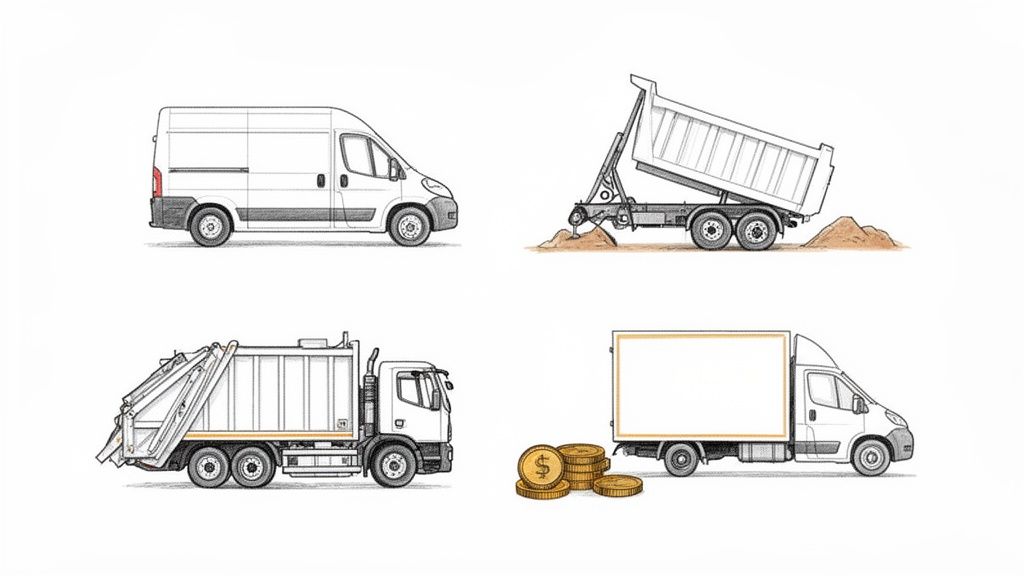
The Category C licence is what we are focusing on, and for good reason: it is the most common starting point for a professional driving career. This licence covers any rigid vehicle over 3,500kg, which includes most of the delivery lorries, tipper trucks, and bin lorries you see on UK roads every day.
The Cat C licence is often called the “gateway licence.” It is the essential qualification you must hold before you can even think about driving the biggest trucks on the road: the articulated lorries.
Finally, there is the Category C+E licence, the top tier of HGV driving. This is the one that lets you drive an articulated lorry, where the cab is a separate unit from the trailer. These are the huge ‘artics’ you see cruising down the motorway, handling long-haul jobs and large-scale distribution.
UK HGV Licence Categories Compared
To make the differences crystal clear, here is a simple side-by-side look at how the main HGV licences stack up. This table breaks down what each category allows you to drive, helping you map out your career path.
Licence Category
Vehicle Type
Maximum Weight
Common Examples
C1
Medium Rigid
Up to 7,500kg
Ambulances, large horseboxes, removal vans
Cat C (Class 2)
Large Rigid
Over 3,500kg
Supermarket delivery lorries, tipper trucks
C+E (Class 1)
Articulated
44,000kg (UK max)
Full-sized motorway haulage trucks
As you can see, the Cat C sits perfectly in the middle. It opens up a huge range of jobs straight away while also acting as the mandatory stepping stone to getting your C+E licence. By starting with a Cat C, you are keeping all your future career options wide open.
Exploring Your Career Path with a Cat C Licence
Getting your Category C licence is much more than just ticking a box. Think of it as a key that opens up a huge range of stable, in-demand careers right on your doorstep. It’s your ticket into the world of professional driving, opening up jobs that often have a far better work-life balance than long-haul trucking.
A lot of Cat C jobs are built around local or regional routes. This means you can realistically expect to be home every evening. For anyone who wants the security of a driving career without giving up family time, it’s a fantastic choice. The demand for skilled drivers is consistently high, so you will always be needed.
Common Jobs for Cat C Drivers
With a Cat C licence in your wallet, you can step into all sorts of roles that keep the UK economy ticking over. You are not just a driver; you are an essential part of the supply chain.
Some of the most popular career paths include:
Local and Multidrop Delivery: This is the backbone of retail and e-commerce, getting goods to supermarkets, shops, and parcel depots in a specific area.
Construction and Trades: You could find yourself behind the wheel of a tipper truck, concrete mixer, or a flatbed lorry delivering vital materials to building sites.
Waste Management: An essential public service, this involves operating bin lorries and other refuse collection vehicles for local councils or private firms.
Removals: Working for a removals company means you will be trusted to transport people’s homes and businesses safely from A to B.
These roles offer a good mix of variety and steady work, making the Cat C licence a really smart investment in your future. To get a better picture of the pay, check out our detailed guide on how much HGV drivers earn in the UK.
Boosting Your Skills and Salary
Once you have your Cat C licence, your professional development does not have to stop. Adding specialist qualifications is a brilliant way to make yourself more employable and push your salary even higher. These extra tickets make you a more versatile and valuable driver for any employer.
Think of your Cat C licence as the solid foundation of your career. By adding extra tickets like HIAB or ADR, you’re not just getting another qualification; you’re building a specialised skillset that puts you ahead of the competition and opens doors to higher-paying, more interesting work.
For example, you could train for:
HIAB Certification: This qualifies you to operate a lorry-mounted crane, a skill that is always in high demand in construction and logistics.
ADR Certification: This allows you to transport hazardous goods, a specialist role that naturally commands a much higher wage.
Taking Your First Step with HGV Learning
Knowing the steps to get your Cat C licence is one thing, but actually taking that first step with confidence is a whole different ball game. Here at HGV Learning, we have fine-tuned a supportive process that guides you every step of the way, from your initial thoughts to your first day on the job.
We see ourselves as your career partner, not just another training provider. We manage the entire journey for you, leaving you free to focus on what really matters: learning to drive. Our unique three-stage pathway is designed to strip away the stress and confusion, making the whole process clear, simple, and manageable.
Stage 1: The Paperwork and Medicals
Your journey kicks off with the essential admin. We know that dealing with DVLA forms and trying to book a medical can be a real headache, which is why we handle all of it for you.
Our team will help you fill out your provisional licence application correctly and get your HGV medical exam booked at a convenient spot. This makes sure all your documents are spot-on from the very start, so you do not face any annoying delays down the line.
Stage 2: The Theory Training
Once your shiny new provisional licence arrives, it’s time to hit the books and tackle the theory. We provide you with interactive online training materials built to help you learn faster and really absorb the information.
You can easily track your progress as you work through the different modules. This helps you build confidence and be fully prepared for both the multiple-choice questions and the case studies test, giving you the best possible chance of passing the first time.
We firmly believe that getting your licence should be an achievable goal for anyone. That’s why we offer flexible payment options to help spread the cost and provide dedicated support to help you find a job once you’re qualified.
Stage 3: The Practical Training
The final stage is the one everyone looks forward to: getting behind the wheel. We will connect you with one of our top-rated, fully approved training centres in your local area.
Thanks to our nationwide network of partners, we can find a practical training course that fits around your schedule. You’ll learn from seasoned instructors who will give you the hands-on skills needed not just to pass your test, but to become a safe, confident, and professional driver.
Our goal is simple: to see you succeed, from your first phone call to us right through to your first day in your new career.
Your Cat C Licence Questions Answered
Have a few questions before you get started? That’s completely normal. Here are some quick, straightforward answers to the things we get asked most often by new drivers.
How Long Does It Take to Get a Cat C Licence?
From start to finish – that’s from your medical exam right through to passing your final practical test – the whole journey can often be wrapped up in as little as 8 to 10 weeks. The hands-on, practical training is usually a focused, five-day course.
That said, things can sometimes take a little longer depending on DVLA processing times for your provisional licence or how busy your local test centre is. It always pays to plan ahead.
What Happens After I Pass My Tests?
Congratulations! Once you have passed all four modules, your new professional driving licence is officially on its way. The DVSA automatically sends out your Driver Qualification Card (DQC), which is your proof of having the initial Driver CPC.
Remember, you will need to carry both your driving licence and your DQC with you any time you are driving for work. You cannot legally drive an HGV professionally without them.
How Do I Keep My Licence and CPC Valid?
Your photocard driving licence needs to be renewed every five years until you reach 65, and then it is an annual renewal after that. This usually involves a medical check-up to confirm you are still fit and healthy to be behind the wheel.
To keep your Driver CPC active, you must complete 35 hours of periodic training every five years. Think of it as professional top-up training – it keeps your skills sharp and ensures you’re current with the latest industry rules and safety standards.
Ready to get on the road to a new career? At HGV Learning, we handle everything for you, from booking your medical and getting you ready for the theory tests, right through to practical training with our network of expert instructors across the country. Find out more about our supportive training pathway at hgvlearning.com.
Related Articles
16/10/2026
What Age Can You Start HGV Driver Training? A 2026 UK Guide to Licence Age Requirements
If you're asking what age you can start HGV driver training, the honest answer depends on which licence you're after. A C1 licence, covering vehicles...