Online ADR training offers a modern, flexible way for professional drivers to complete the mandatory theory coursework for transporting hazardous goods. It’s a smart blend of self-paced digital learning and official, in-person exams. This means you can study from home, the cab, or anywhere you like, before heading to an approved test centre to sit the final exams. It’s an approach that makes getting or renewing your vital ADR certification much more convenient. Once the theory’s done, our ADR training course covers the practical side and the exams.
What Is Online ADR Training and Who Needs It?
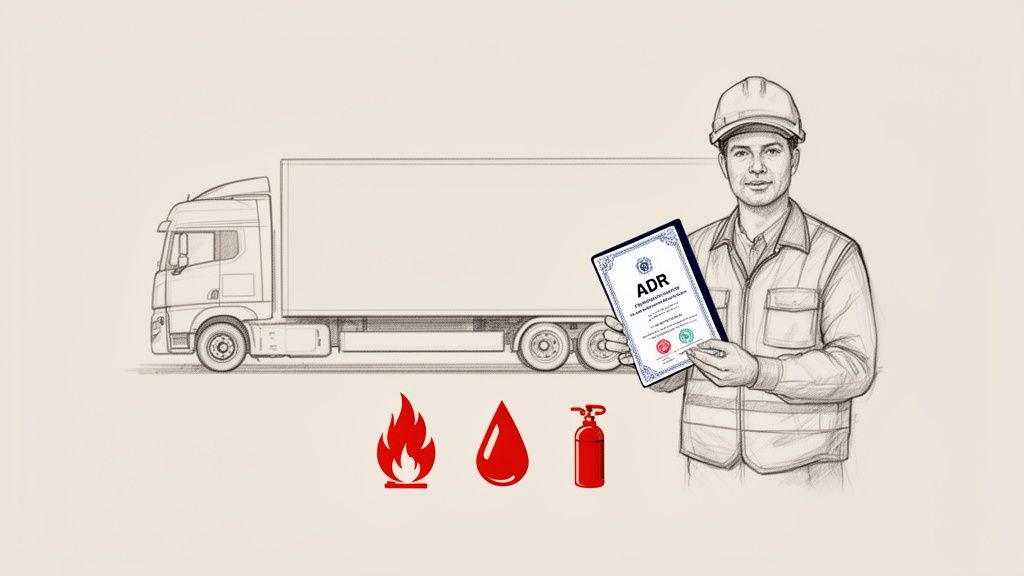
Think of an ADR certificate as a specialist passport that attaches to your HGV licence. Your standard HGV licence proves you can drive the truck, but the ADR qualification gives you the legal authority to transport specific classes of dangerous goods across the UK and Europe. It’s not just a bonus: it’s a legal requirement and a clear sign of professional competence.
The term ‘ADR’ itself comes from the French title of the European agreement that governs this area: Accord Dangereux Routier. This treaty sets out a unified rulebook for packing, loading, and moving hazardous materials to keep everyone safe on the roads.
The Role of Online Learning
Traditionally, all ADR training meant sitting in a classroom for several days straight. For most drivers, this involved taking a big chunk of time off work, not to mention the travel and accommodation costs of getting to a training centre. It was often a logistical headache.
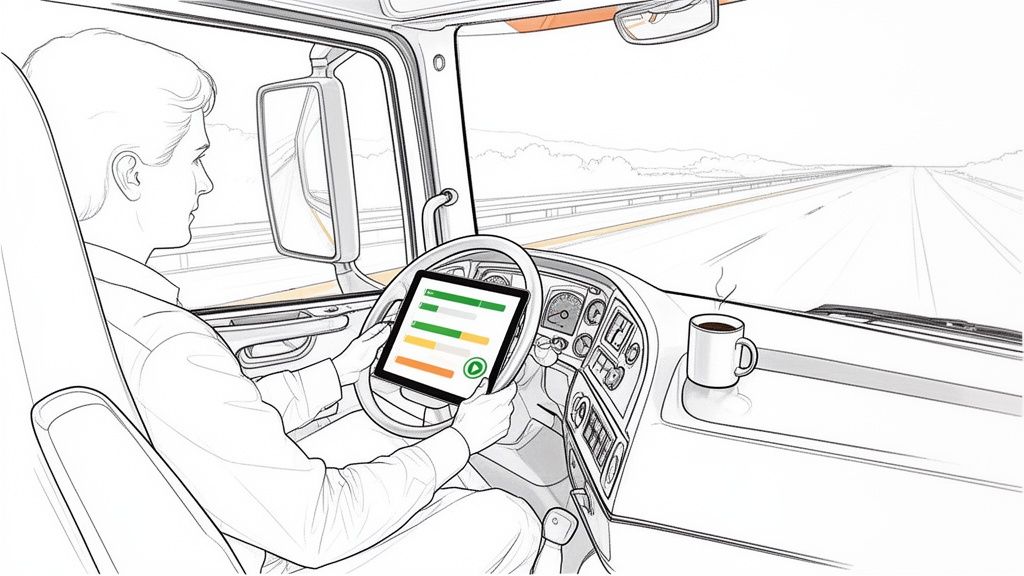
Online ADR training completely changes that. It lets you tackle the heavy theory part of the course using a digital platform. You’ll cover everything from the different hazard classes and safety protocols to the complex regulatory requirements, all at a pace that works for you. You can fit your learning around your driving schedule, study on weekends, or chip away at it whenever you have a spare hour. Once you’re ready, you just book your mandatory in-person exams.
Who Is This Training Essential For?
This certification isn’t just a ‘nice-to-have’: for many drivers, it’s a career necessity, and for others, it’s a very smart move. If you plan on moving anything from fuel and chemicals to medical waste and flammable gases, you absolutely must hold a valid ADR card.
Here’s a quick look at who benefits most from an online ADR training course:
HGV Drivers Transporting Hazardous Goods: This is the main group. If your job involves anything classified as dangerous under ADR rules, this training is non-negotiable.
Newly Qualified Drivers: Getting your ADR certificate right after passing your HGV test opens up a much wider range of job opportunities and can lead to better-paying roles from day one.
Experienced Drivers Needing to Renew: Your ADR certificate is valid for five years. To stay compliant and keep working with dangerous goods, you must complete a refresher course and pass the exams before it expires.
Drivers Aiming for Career Progression: An ADR licence makes you a far more versatile and valuable driver. It’s your ticket to specialist roles in sectors like petroleum, chemical logistics, and waste management.
In short, anyone involved in the commercial transport of hazardous materials needs this specific training. It’s a cornerstone of road safety and professional responsibility, ensuring dangerous substances are handled correctly from start to finish.
The beauty of online learning is that it makes achieving this crucial qualification much more manageable for busy professionals. You get the exact same high-quality, regulated training without having to put your entire working life on hold. For a deeper dive, learn more about what an ADR licence entails and why it’s so important in our industry.
Why Flexible Learning Works for Professional Drivers
The old way of doing professional training just doesn’t cut it any more. Expecting a busy HGV driver to sit in a classroom for a solid week is a big ask. It’s not just an inconvenience; it can create a real financial and logistical headache when you’re trying to keep the wheels turning.
This is exactly where flexible, online ADR training comes in. It’s a modern solution built for the real world of a professional driver, not the rigid schedule of a training centre. It puts you firmly in the driver’s seat of your own learning.
Instead of trying to jam a fixed course into an already packed rota, you can weave your training around your life. That means you can study whenever you have a spare moment: during a rest break, while waiting at a depot, or even from the comfort of your own sofa on a weekend.
Learn at Your Own Pace
One of the best things about online theory modules is that you get to set the speed. In a typical classroom, the instructor has to aim for the middle ground. The result? Some people struggle to keep up, while others are left feeling bored.
Online learning completely solves this problem. You’re in control. You can go back over tricky subjects like chemical compatibility or emergency procedures as many times as you need to until it clicks. On the other hand, if you’re already confident with a topic, you can move right along.
This self-paced approach helps you build a much stronger grasp of the material. It’s not about cramming to pass an exam; it’s about properly understanding the critical safety knowledge that protects you, and everyone else, on the road.
By letting you master each section before moving on, online training builds real competence. You’re not just memorising facts for a test: you’re building a solid foundation of knowledge you can depend on in real-world situations.
This move to virtual learning is now well and truly mainstream. In the UK, nearly half of the workforce (44.68%) has completed an online training course for work. That figure is catching up fast to the 50.92% who have attended in-person training, showing just how popular and effective it’s become. It’s a great fit for professionals like HGV drivers who need to get vital qualifications. You can find out more about these virtual learning trends and how they’re shaping the industry.
Designed for Engagement and Success
Forget the image of staring at a dry textbook for hours on end. Good online learning platforms are designed to be interactive and keep you switched on. They use a smart mix of different methods to make the information stick and keep you motivated.
A well-put-together course will usually include:
Short Video Lessons: These are perfect for breaking down complex topics into simple, easy-to-follow visual explanations.
Interactive Quizzes: Quick, regular knowledge checks help lock in what you’ve just learnt and show you any areas that might need another look.
Progress Tracking: Being able to see how far you’ve come gives you a real sense of achievement and helps you stay on course.
This modern, multimedia approach is far more effective than just passively reading a manual. It gets you actively involved, which makes it much more likely you’ll remember the vital details needed to pass your exams and do your job safely. It gives you the tools you need to succeed, on your own terms.
Breaking Down the Core ADR Course Modules
Getting your ADR certificate isn’t a one-size-fits-all deal. Think of it like building with LEGO: you start with a mandatory base piece, then add the specific blocks you need for the job you want to do. The qualification is modular, so you can tailor your training to the exact types of hazardous goods you’ll be carrying.
Understanding this structure is key to spending your time and money wisely. It means you qualify for the work you want without paying for modules you don’t need. The whole system is built around three main parts: a mandatory core module, specific hazard classes, and modules for the type of container you’ll be using.
The Foundation: Your Core Module
Every single driver going for an ADR certificate has to start with the Core module. This is the non-negotiable foundation of your training. It covers the essential, big-picture principles of transporting dangerous goods that apply no matter what’s in the back of your vehicle.
You can think of it as the main rulebook for handling hazardous materials on the road. In this module, you’ll get to grips with general safety requirements, what to do in an emergency, and how to read hazard warning labels. It’s the essential knowledge that keeps you, the public, and the environment safe. You have to pass this module before you can specialise in anything else.
Choosing Your Hazard Classes
Once you’ve got the Core module sorted, you need to add the specific hazard classes that are relevant to your work. There are nine distinct classes, each covering a different type of dangerous substance. The good news is you don’t need to learn all of them: only the ones for the goods you’ll actually transport.
For instance, a fuel tanker driver will obviously need Class 3 (Flammable Liquids), while someone moving medical supplies might need Class 6 (Toxic and Infectious Substances). Each class has its own exam, and the more classes you add to your ADR card, the more versatile you become as a driver.
The smartest move for many drivers is to get qualified in multiple classes. It broadens your job prospects significantly, making you a much more attractive candidate for a wider range of logistics companies.
To help you figure it out, here’s a simple breakdown of the main ADR hazard classes you’ll come across.
ADR Hazard Classes at a Glance
This table breaks down the main ADR hazard classes drivers need to be aware of, with examples of goods for each category.
Class Number
Hazard Type
Common Examples
Class 2
Gases
Propane, oxygen, nitrogen
Class 3
Flammable Liquids
Petrol, diesel, paints, alcohol
Class 4
Flammable Solids
Matches, sulphur, metal powders
Class 5
Oxidising Substances & Organic Peroxides
Fertilisers, swimming pool chemicals
Class 6
Toxic & Infectious Substances
Medical waste, pesticides, arsenic
Class 8
Corrosive Substances
Battery acid, drain cleaner
Class 9
Miscellaneous Dangerous Goods
Lithium-ion batteries, asbestos
Picking the right classes is a strategic career move. Have a look at the industries you want to work in and see what they’re transporting most often.
Packages or Tanks: The Final Pieces
The last part of building your ADR qualification is deciding how you will carry the goods. This choice comes down to two final, but crucial, modules: Packages and Tanks.
Packages Module: This one is for drivers who will transport hazardous goods in any form other than a large, fixed tank. This covers a huge variety of containers, like drums, cylinders, boxes, and IBCs (Intermediate Bulk Containers). If you’re driving a curtainsider or a rigid lorry carrying pallets of chemicals, this is the module for you.
Tanks Module: This specialisation is for drivers operating road tankers or tank containers with a capacity of more than 1,000 litres. It involves completely different safety procedures, loading and unloading protocols, and knowledge of vehicle stability. This is the essential module for anyone looking at roles in the fuel, chemical, and food-grade liquid transport sectors.
You can choose one or both, depending on where you want your career to go. A driver with Core, several key classes, Packages, and Tanks is qualified for almost any hazardous goods role out there, making them incredibly employable. Understanding these building blocks helps you create the perfect online ADR training plan for your future.
Your Step-by-Step Path to Getting ADR Certified
Getting your ADR qualification might seem like a complex maze, but it’s actually a pretty straightforward journey when you break it down. With a blended online training approach, you can tackle the process in manageable chunks that fit neatly around your work schedule.
The whole idea is to give you control. You start by figuring out exactly which modules you need, then you complete all the theory at your own pace online. Once you’re confident with the material, you head to an approved centre to sit the final, in-person exams. It’s the best of both worlds: flexible learning backed by official, recognised testing.
Step 1: Choose Your Modules Wisely
Before you even think about booking a course, you need to pinpoint which ADR modules will actually benefit your career. Every single driver has to pass the Core module – that’s the foundation for everything else. After that, it’s all about adding the specific hazard classes and transport types you plan to handle.
This decision is critical, so give it some thought. Are you aiming for the petroleum industry? You’ll absolutely need Class 3 (Flammable Liquids) and the Tanks module. If you’re looking at transporting medical supplies, you’ll be heading for Class 6 (Toxic and Infectious Substances) and the Packages module. Plan ahead to make yourself as valuable as possible to employers.
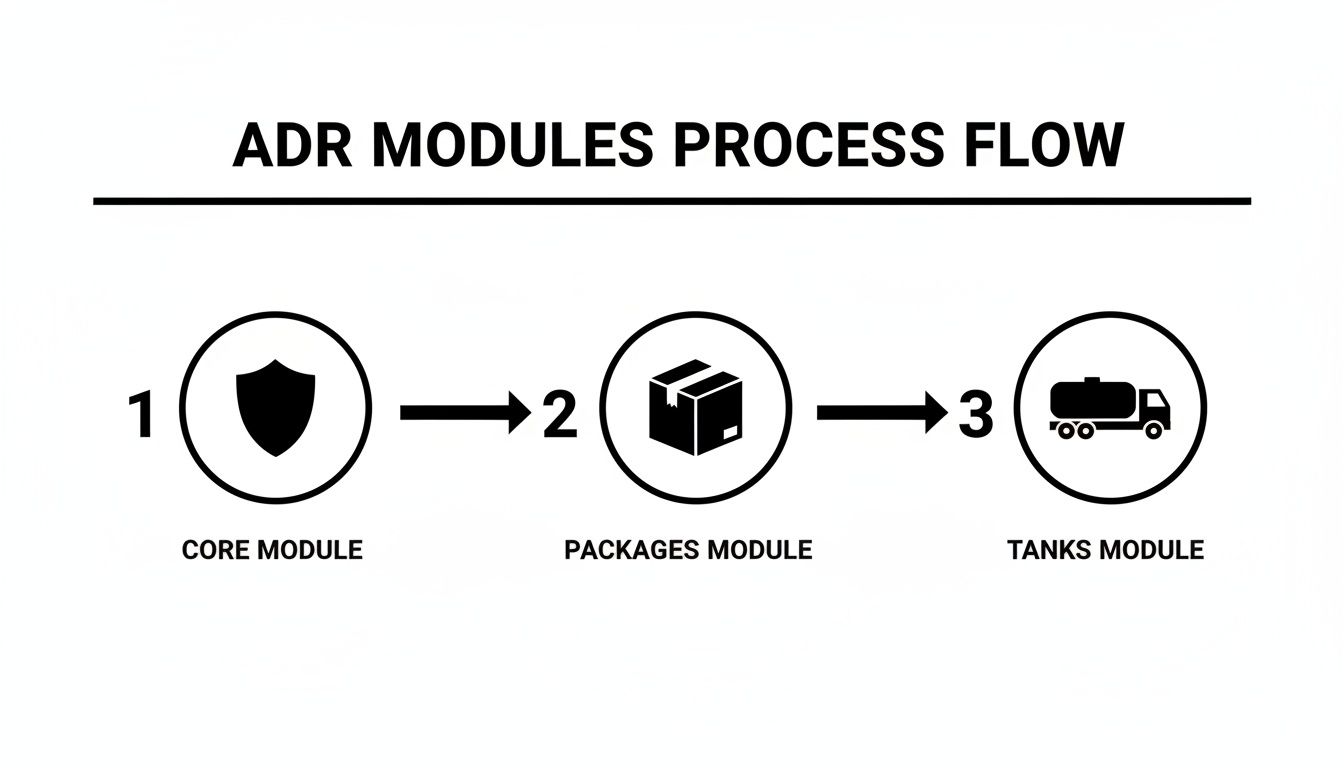
This diagram shows how you build up your qualification, starting with the mandatory Core and adding the specialisms you need.
It’s all about building from the ground up to make sure you’re certified for the exact job you want to do.
Step 2: Complete Your Online Theory Training
Once your modules are sorted, it’s time to hit the books. This is where the real beauty of online ADR training comes into play. You can get into all your course materials through a digital platform, meaning you can study whenever and wherever you like.
A good online course gives you everything you need to walk into the exam feeling prepared. You should expect a solid mix of video lessons, interactive quizzes, and mock exams to test yourself along the way. This approach lets you really get to grips with the material and makes sure there are no nasty surprises on exam day. For more practical tips, check out our guide on the essentials of ADR preparation.
Step 3: Booking and Sitting Your Exams
After you’ve mastered the theory online, the final hurdle is booking and sitting your official exams. These have to be taken in person at a DVSA-approved examination centre. Don’t worry, your training provider will help you find a local centre and book a slot that works for you.
The exams themselves are multiple-choice. You’ll sit a separate paper for each module you’ve studied (Core, Packages, Tanks, and each individual class). You need to hit the pass mark on each paper to qualify. Once you’ve successfully passed, the SQA (Scottish Qualifications Authority) issues your official ADR photocard, which is your ticket to transport dangerous goods for the next five years.
Step 4: Renewing Your ADR Card
Your ADR certificate doesn’t last forever – it’s valid for five years. It’s up to you to renew it before it expires if you want to keep legally transporting dangerous goods. Thankfully, the renewal process is much simpler than getting qualified the first time.
You just need to complete a refresher course and pass the relevant exams within the last 12 months of your card’s validity. This makes sure your knowledge is current with all the latest regulations. It’s a straightforward process that ensures you can maintain this vital qualification with minimal fuss.
How to Choose the Right Online ADR Training Provider
Picking where to do your online ADR training is a big deal. It’s one of the most important decisions you’ll make in your driving career. The right provider won’t just sell you a course; they’ll act as a partner, genuinely invested in helping you pass your exams and advance your career. With so many choices out there, it can be tough to know what to look for.
The trick is to ignore the flashy marketing and focus on what really matters. A solid training partner offers officially recognised qualifications, provides real support when you need it, and is completely transparent about everything from costs to the exam process. Think of it as an investment in your future – it pays to do your homework.
DVSA Alignment and Experienced Instructors
First things first, check for official recognition. This is non-negotiable. The provider you choose absolutely must be aligned with the Driver and Vehicle Standards Agency (DVSA) and the Scottish Qualifications Authority (SQA), as these are the bodies that oversee ADR qualifications in the UK. If they aren’t, your certificate won’t be legally recognised, and you’ll have wasted your time and money.
Once you’ve confirmed they’re legit, look at who’s actually doing the teaching. Who are the instructors? Good providers hire trainers with years of real-world experience driving HGVs and handling dangerous goods. This practical background is priceless because they can explain complicated rules with real-life examples you’ll actually encounter on the road.
A provider’s value isn’t just in their online platform but in the human expertise and support they offer. Access to experienced professionals who can answer your questions is a clear sign of a high-quality training programme.
The UK’s online education and training market has really taken off, now boasting 741 businesses. This growth gives drivers more choice than ever, making it easier to find providers that mix flexible online theory with the essential, hands-on, in-person exams.
Transparent Pricing and Learner Support
A trustworthy provider is always upfront about what you’ll pay. Be very cautious of any company that’s vague about the total cost, which should include VAT, exam fees, and the fee for issuing your ADR card. Hidden charges are a massive red flag.
Look for providers that offer flexible ways to pay. For example, here at HGV Learning, we have in-house payment plans that let you spread the cost over a few months, which makes the investment a lot more manageable. It shows an understanding of the financial pressures drivers are under and a commitment to making training accessible.
Just as important is the level of support you’ll get. Before you commit, ask a few key questions:
Is there a dedicated support team? How easy is it to get hold of someone if you run into a technical glitch or have a question about the course material?
Do they help with booking exams? A good provider will help you find a local test centre and get your exams scheduled without any fuss.
What happens after you pass? Do they offer any advice or support to help you put your new qualification to good use in the job market?
Excellent support can make all the difference, turning what could be a stressful experience into a smooth and successful one.
Look at the Quality of Training Materials
Finally, take a close look at the learning resources. Their quality is a direct reflection of the provider’s professionalism. The online modules should be engaging, easy to navigate, and cover everything you need to know. When you’re weighing up providers, think about how they present information. Knowing a bit about how to create effective training manuals can give you a better eye for quality content.
A top-tier provider will use a mix of video lessons, interactive quizzes, and mock exams to get you fully prepared. This blended approach ensures you’re not just memorising facts for the test but actually understanding the safety principles behind them. You can also check out our guide on how to get an ADR licence for a full rundown of the process.
By focusing on these key areas (accreditation, instructor experience, transparent pricing, solid support, and quality materials) you can choose a partner that will truly set you up for success.
Your Questions About Online ADR Training, Answered
Deciding to go for an online ADR training course is a big step, and it’s perfectly normal to have a few questions before you get started. We’ve put together the most common queries we get from drivers and answered them in a clear, no-nonsense way. This is all about clearing up any doubts so you can move forward with confidence.
Is Online ADR Training Legally Recognised?
Let’s get the most important question out of the way first. The answer is a simple, straightforward yes. The blended learning approach – where you do your theory online and then sit the official exams in person – is fully recognised and approved here in the UK.
The key thing to remember is that the exams must be taken at a DVSA-approved centre. The online part of the course is all about giving you the knowledge and preparation needed to walk into that exam room and pass. The final certificate you get is issued by the SQA, and it’s identical to one earned through a traditional classroom course. It’s legally valid across the UK and the rest of Europe.
Will the Online Theory Actually Prepare Me for the Exams?
Absolutely. A good quality online course is designed from the ground up to get you exam-ready. In fact, many drivers find it even better than being in a classroom because you can go at your own pace, revisiting tricky topics until you’ve got them nailed down.
Reputable online providers make sure you’re fully prepared using a few key tools:
Structured Modules: The information is broken down into manageable chunks that follow the official exam syllabus, making it easy to digest.
Interactive Quizzes: Regular self-checks are built in to help you remember what you’ve learnt and show you which areas might need a bit more work.
Mock Exams: These are crucial. You’ll get to practise with tests that look and feel just like the real thing, so you’ll know exactly what to expect on the day.
By the time you’ve worked through the online theory, you should feel completely confident and ready to pass with flying colours.
How Long Does the Whole Process Take?
This is one of the best parts of the online route – the timeline is largely up to you. How quickly you get your ADR card depends on how fast you work through the online material.
Here’s what a typical timeline looks like:
Online Theory (Self-Paced): Most drivers manage to complete the online modules in one to two weeks, fitting it in around their work. But there’s no pressure; you can take as long as you need.
Booking Exams: Once you feel ready, you book your exams at a test centre. It’s a good idea to book at least a week ahead to get the slot you want.
Sitting Exams: The exams themselves usually take one or two days, depending on the number of modules you’re taking.
Receiving Your Card: After passing, your new ADR photocard is usually issued by the SQA and will be with you within 10-15 working days.
All in all, many drivers can go from starting the course to being fully certified in about three to four weeks. But the control is all yours.
The real advantage of online learning is that you dictate the schedule. You can complete the theory quickly if you have the time, or spread it out over several weeks if you have a busy rota.
Does ADR Training Count Towards Driver CPC Hours?
Yes, it often does, which is a fantastic bonus. Completing an ADR course can count towards the 35 hours of periodic training every professional HGV driver needs to complete every five years to keep their Driver CPC.
There is one important condition, though. The training provider you choose must be JAUPT (Joint Approvals Unit for Periodic Training) approved to offer ADR as part of the Driver CPC. It’s vital to check this before you sign up.
At HGV Learning, our ADR courses are fully JAUPT-approved. This means you can tick off two essential qualifications at once, saving you a significant amount of time and money. It’s an incredibly efficient way to keep your skills sharp and stay compliant.
We hope that clears things up! An ADR qualification is a brilliant addition to any professional driver’s licence, and with the flexibility of online learning, it’s never been easier for busy drivers to get it.
Ready to open up new career opportunities and boost your earning potential? HGV Learning offers fully approved online ADR training courses designed for professional drivers. With our flexible payment plans and expert support, getting certified has never been simpler.
What Age Can You Start HGV Driver Training? A 2026 UK Guide to Licence Age Requirements
If you're asking what age you can start HGV driver training, the honest answer depends on which licence you're after. A C1 licence, covering vehicles...