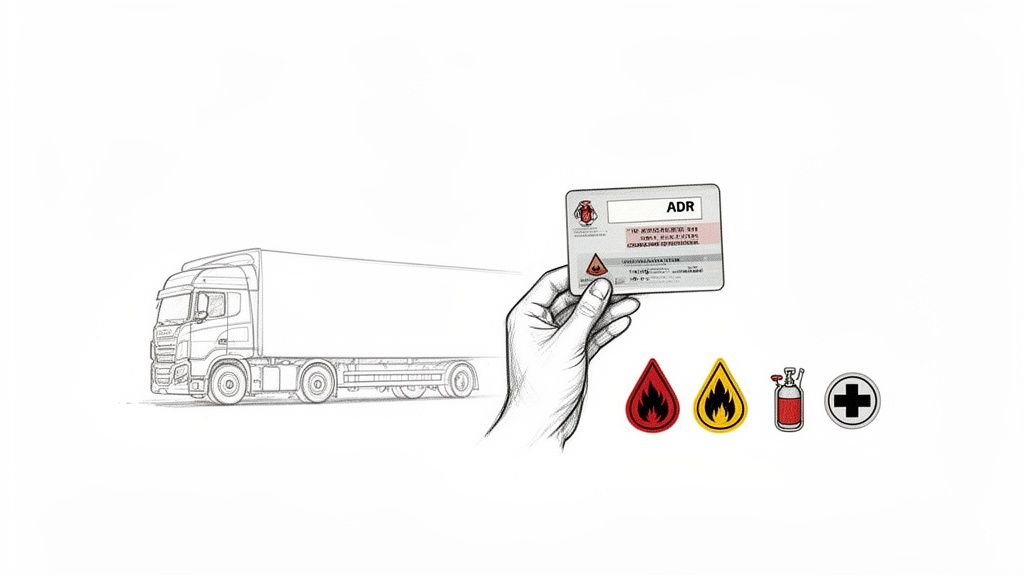
If you’ve ever wondered how essential goods like petrol, industrial chemicals, or medical gases get from A to B, the answer lies with a special group of HGV drivers. These drivers hold an ADR licence, a specialist qualification for transporting hazardous materials by road.
Officially, it’s known as the European Agreement concerning the International Carriage of Dangerous Goods by Road. In the real world, it’s your ticket to a more specialised, and often better-paid, career in logistics. It proves you have the skills and knowledge to handle high-stakes cargo safely and legally. If you’re ready to get started, see our ADR training course for dates and pricing.
What Is an ADR Licence and Why Does It Matter?
Think of an ADR certificate as more than just another bit of plastic in your wallet. It’s a specialist ‘passport’ for your HGV career, opening doors that are closed to drivers with standard licences. It is the industry’s way of knowing you’re trained and trusted to transport dangerous goods safely and professionally.
While the term ‘ADR’ sounds a bit technical, what it means for your career is very simple: better jobs and higher pay. Without it, you’re cut off from a huge chunk of the haulage work that keeps the country running.
The Career Opportunities Opened up by ADR
A surprising number of everyday materials are officially classed as hazardous, and moving them is a tightly regulated business. This creates a constant demand for qualified drivers. By getting your ADR certification, you become eligible for these crucial roles.
Sectors that are always on the lookout for ADR drivers include:
Fuel Distribution: Getting petrol and diesel to filling stations.
Chemical Logistics: Transporting industrial chemicals for manufacturing and farming.
Medical and Industrial Gases: Delivering compressed gases like oxygen to hospitals.
Waste Management: Moving hazardous waste for safe and legal disposal.
These aren’t niche jobs; they are the backbone of the UK’s supply chain. Holding an ADR in UK qualification immediately makes you a more valuable and versatile driver in the eyes of any employer. It shows a real commitment to safety and professionalism that companies actively seek.
An ADR licence signals that a driver is trusted with high-consequence cargo, immediately setting them apart from the crowd. It’s a direct investment in your earning potential and long-term career stability.
More Than Just a Certificate
For any professional driver, getting ADR certified is one of the smartest career moves you can make. It’s a clear path to taking on more responsibility and earning a better wage. Because companies are legally required to use qualified drivers for these loads, the demand for your skills will always be there.
As you start looking into the qualification process, it’s helpful to understand the different classes of hazardous goods you can be certified to carry. If you want to dive deeper, you can learn more about what an ADR licence is and see how it works as a gateway to these rewarding jobs. At the end of the day, it’s not just about what you can drive; it’s about what you are trusted to carry.
Navigating the ADR Qualification Structure
Getting an ADR qualification isn’t a one-size-fits-all affair. It’s better to think of it as building a specialist toolkit, where you choose the tools you need for the specific jobs you’ll be doing. This modular approach is designed to be flexible, perfectly matching the diverse needs of the UK’s logistics industry.
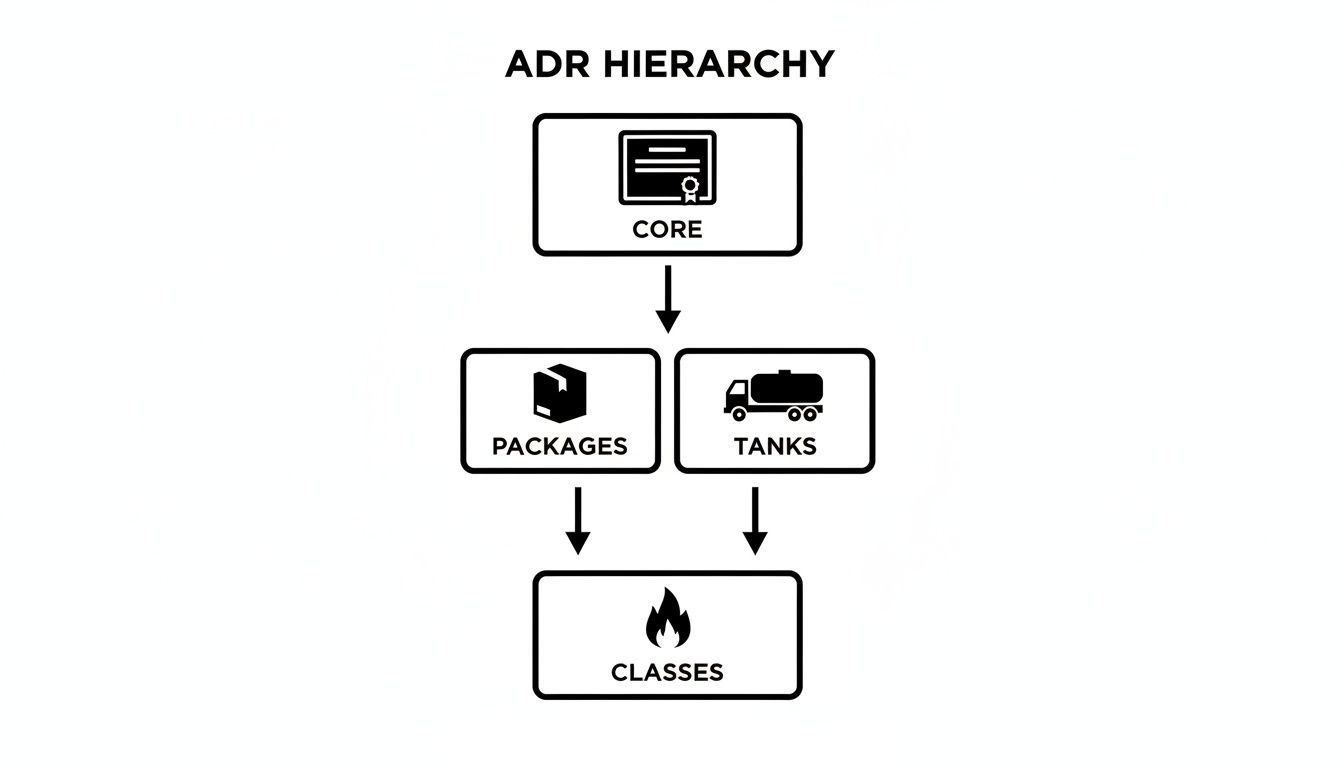
At the foundation of any ADR licence is the compulsory Core module. This is the starting block for everything else, covering the essential knowledge that applies to all dangerous goods transport. It teaches you the fundamentals of identifying hazards, following safety procedures, and knowing exactly what to do in an emergency, no matter what substance you’re carrying.
Once you’ve sorted the Core module, you can start to specialise. The qualification then branches out into two key areas: the type of container you’ll be using and the specific class of hazardous goods you’ll be transporting.
Choosing Your Transport Mode
First, you need to decide how you’ll be carrying the goods. The qualification splits this into two distinct categories. Depending on your career goals, you can choose to qualify in one or both.
Packages: This is all about transporting dangerous goods in non-bulk forms. Think drums, barrels, boxes, sacks, and cylinders. It’s the most common qualification and is absolutely essential for general haulage and multi-drop delivery drivers.
Tanks: This specialisation is for drivers operating road tankers or tank containers with a capacity over 1,000 litres. It’s a vital ticket for anyone looking at roles in fuel distribution or the bulk chemical industry.
This choice directly affects the types of vehicles you can drive and the jobs you can apply for. A driver with just a ‘Packages’ qualification cannot legally jump in a fuel tanker, and the same goes the other way around. To keep their options open, many drivers choose to get qualified in both.
Selecting Your Hazard Classes
After figuring out the transport mode, the next step is to add specific hazard classes. Each class corresponds to a different type of dangerous substance. You only need to train for and pass the exams for the classes relevant to your line of work.
The ADR system is built for precision. It ensures a driver moving flammable liquids has received specific training on those risks: which are worlds away from the risks of corrosive or toxic substances.
This tailored approach means you aren’t wasting time learning about materials you’ll never come into contact with. If your ambition is to be a petrol tanker driver, you’ll focus on Class 3. If you’re aiming to work for a company delivering industrial gases, then Class 2 will be your priority.
Here’s a simple breakdown of the main ADR hazard classes you can add to your ADR in UK qualification, along with some real-world examples of what they cover. This table shows how each class relates to products you see on UK roads every single day.
By combining the Core module, your chosen transport mode (Packages or Tanks), and the specific hazard classes you need, you create a completely bespoke ADR qualification. This lets you build a certification that directly lines up with your career path, whether that’s in fuel logistics, chemical transport, or specialised waste management.
Your Step-by-Step Guide to ADR Training and Exams
Knowing what an ADR qualification is made of is one thing, but what is the actual journey to getting certified like? Let’s walk through the process, from booking your course right through to that ADR card landing on your doormat. It’s a clear, structured path designed to get you skilled up for a specialised career on the road.
The very first, and most important, step is picking the right training provider. Your qualification is only worth the plastic it’s printed on if it comes from a DVSA-approved centre. This is your guarantee that the course meets all the national standards and your final certificate will be recognised everywhere, by employers and enforcement agencies alike.
What to Expect From Your Initial ADR Course
A typical initial ADR course usually takes about five days. The exact length depends on the modules you’ve chosen, but a standard setup covering the Core module, Packages, and a few of the most common classes will fit neatly into a working week. It’s an intensive few days, but incredibly rewarding.
The training itself is a mix of classroom learning and practical exercises. You’ll dig into the regulations, learn how to read those crucial hazard placards, and go over emergency procedures in detail. This theory is then backed up with hands-on sessions, like learning how to use different types of fire extinguishers – an essential skill for anyone carrying dangerous goods.
The qualification builds up in layers, as this diagram shows.
As you can see, every driver starts with the Core module. From there, you add your specialism for either Packages or Tanks, and then bolt on the specific hazard classes you need to carry.
Understanding the Exam Format
The exams are designed to be straightforward. At the end of your training week, you’ll sit a series of multiple-choice tests, with one paper for each module you’ve taken. You can expect separate exams for:
The Core Module: This is the foundation that everyone has to pass.
Packages or Tanks: A specific test for your chosen transport method.
Each Hazard Class: A dedicated exam for every class you’re adding (e.g., Class 3 Flammable Liquids).
Each exam has a fixed number of questions and a clear pass mark. For instance, the Core exam typically requires you to get 21 out of 30 questions right to pass. The other modules follow a similar structure, which keeps the standard of knowledge consistent across the board.
One of the biggest advantages is the modular exam system. If you fail one module, you haven’t failed the whole thing. You can simply come back and re-sit that one specific exam without having to go through the entire training week again.
This setup really takes the pressure off. It means you can focus your energy, and if you do stumble on one section, it’s not a disaster. Your training provider will explain the re-sit process, which is usually very simple to arrange.
From Passing Your Exams to Getting Your Card
Once you’ve successfully passed all your exams, your results are forwarded to the Scottish Qualifications Authority (SQA). The SQA is the official body that issues ADR cards for the Department for Transport. They process your results and post your new ADR photocard licence straight to your home address.
It’s important to factor in the delivery time, which usually takes between two and four weeks. Remember, you cannot legally drive a vehicle carrying dangerous goods until that physical card is in your hand.
By following these steps and working with a trusted provider, getting your ADR qualification is a completely manageable process. For a deeper dive, check out our guide on the essentials of ADR preparation and getting ready for certification. It’s packed with extra tips to make your training experience a success.
Understanding ADR and the Wider Compliance Framework
An ADR licence isn’t just a piece of paper for the driver. Think of it as a crucial part of a much bigger safety network that keeps the entire UK supply chain in check when dangerous goods are on the move. It’s a signal that the whole operation, not just the person behind the wheel, is serious about safety.
This framework extends to everyone involved. From the company sending the goods (the consignor) to the team loading the vehicle, every single person has a legal responsibility. An ADR-qualified driver is the final, most visible link in this chain. If any link breaks, it’s not a minor issue. We’re talking about hefty fines, having your vehicle seized, and facing serious legal trouble for both individuals and the business.
This shared responsibility makes safety the priority from the very beginning. It’s built into every step, from the moment a package is labelled to its final delivery.
A System Built on Clear Rules
To get a handle on why this system works so well, let’s look at another well-known UK framework. In the world of finance, the Financial Ombudsman Service (FOS) offers a clear, rule-based way to sort out disputes. In the 2024-25 period, it handled an enormous 293,155 complaints, proving it’s a cornerstone of Alternative Dispute Resolution (ADR) for consumers. The fact that fewer than 2% of cases were dismissed or discontinued shows just how fair and accessible it is.
Just as the FOS provides a clear set of rules for financial disagreements, the ADR in UK framework does the same for transporting hazardous materials. It cuts out the guesswork and sets firm expectations for everyone. This structure is what turns a potentially high-risk job into a managed, professional process.
Everyone Has a Part to Play
ADR regulations are crystal clear about who does what, leaving no gaps in the safety procedures. This collective responsibility is what makes the whole system tick.
The Consignor: This is the person or business sending the goods. Their job is to classify the materials correctly, use the right packaging, and give the driver all the essential paperwork and safety information.
The Loader: The loading team must check that all packaging is intact and that the correct placards and markings are displayed on the vehicle. They also have a duty to ensure the cargo is loaded and secured properly.
The Driver: The driver makes the final checks. They confirm they have the right documents and safety gear, and they must follow all ADR rules for the entire journey. Understanding exactly what’s needed is vital, and resources covering ADR Transport Documentation Essential Requirements can be incredibly helpful.
This interlocking system of checks and balances means that several people have confirmed the load is safe before it even turns a wheel.
ADR isn’t just bureaucracy. It’s the operational backbone of a safe, efficient, and professional logistics industry, ensuring everyone from the warehouse to the roadside plays their part in public safety.
Ultimately, this wider framework shows that an ADR qualification is about much more than knowing what to do in an emergency. It’s about being a trusted professional in a system where every detail counts. If you’re thinking about this career, figuring out what licence you need for ADR transport is the perfect place to start.
How to Keep Your ADR Qualification Valid
Earning your ADR certificate is a massive step forward in your HGV career, but keeping it current is just as vital. Luckily, the process is designed to be straightforward, ensuring you can stay on the road without hitting any snags.
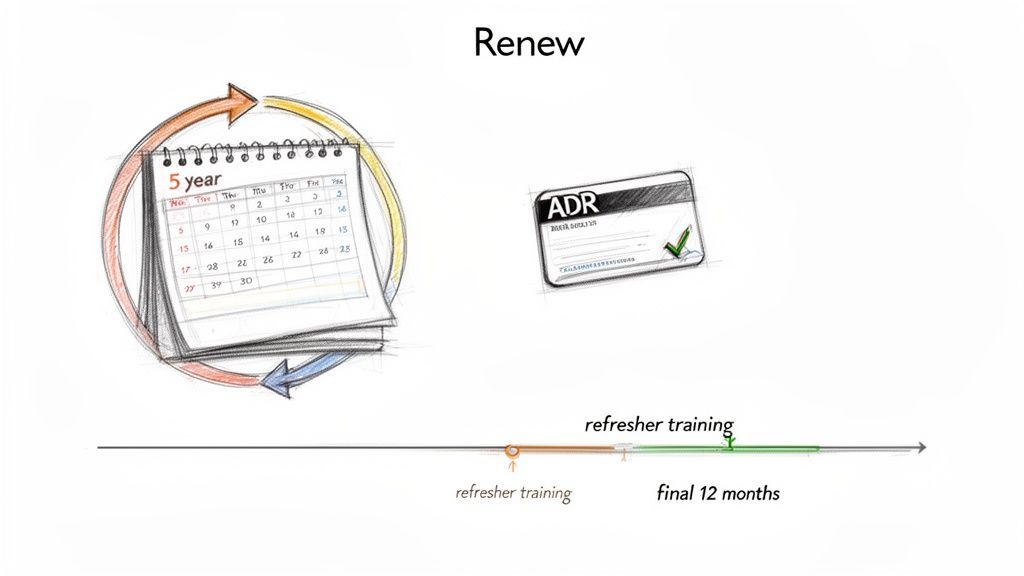
Your ADR photocard licence is valid for five years from its issue date. To keep it active, all you need to do is complete a refresher training course and pass the exams before your current certificate runs out. It’s a simple system that ensures your knowledge of safety protocols and regulations is always sharp.
The Renewal Window
You can take your refresher course at any point within the final 12 months of your certificate’s validity. This gives you a massive window to fit the training around your work schedule, so there’s no need to stress.
It really pays to plan ahead. Think of it like renewing your passport before a big holiday: getting it sorted early saves a lot of last-minute panic. If you leave it too late, you risk having a gap where your old certificate has expired but the new one hasn’t arrived, which could stop you from working.
Refresher Training Versus the Initial Course
Worried you’ll have to sit through another intense, five-day course? Relax. The refresher training is a much quicker and more focused affair.
Shorter Duration: Refresher courses are much more condensed, usually lasting just two or three days.
Targeted Content: The training zooms in on key updates and reinforces what you already know, rather than teaching everything from the ground up.
Selective Renewal: You only need to refresh the specific qualifications you already hold and want to keep.
So, if your card covers Core, Packages, Tanks, and Classes 3 and 8, but your work only involves flammable liquids in packages, you can choose to just renew the Core, Packages, and Class 3 modules. This flexibility makes maintaining your ADR in UK qualification both time-efficient and much easier on the wallet.
Staying compliant isn’t just about ticking boxes to avoid a fine; it’s about cementing your professional reputation. A valid ADR certificate tells employers you’re a reliable, safety-first driver who’s ready for any opportunity.
The Importance of Timely Renewal
The principle of staying ahead of the game is crucial in many industries. Take UK R&D tax disputes, for example. Using Alternative Dispute Resolution (ADR) has an impressive success rate of 85-90%, with most cases wrapped up within 120 days: a fraction of the time a tribunal would take. For businesses in logistics and utilities, which rely heavily on HGV drivers, this proactive approach keeps things running smoothly. You can find more insights on how proactive compliance helps UK businesses.
Just as tackling official disputes head-on leads to quicker resolutions, renewing your ADR card on time ensures you remain compliant, employable, and ready for any job without interruption. It’s a small action that protects your career and keeps you a valuable asset in the logistics world.
Take the Next Step in Your HGV Career
Knowing what an ADR qualification is worth is one thing, but taking action is what really moves your career forward. Getting this certificate makes you a much more valuable asset to any logistics firm, opening doors to better jobs and higher pay. Think of it as a direct investment in your future on the road.
This is where the theory ends and reality begins. The journey from your first enquiry to actually holding that new qualification can seem complicated, but it does not have to be. The key is to find a dedicated training partner to see you through.
A good provider does more than just book your exams. They’ll walk you through the entire process, offering end-to-end support that takes the stress and guesswork out of it. It’s about finding someone who is genuinely invested in seeing you succeed.
Why a Training Partner Makes a Difference
Getting your head around the world of ADR in UK regulations demands a bit of expertise. A good training partner gives you a clear, straightforward path to success, making sure you’re fully prepared for both the theory exams and the practical side of things.
It’s a bit like how other regulated UK sectors demand transparency and accountability. For instance, the UK Civil Aviation Authority (CAA) handles passenger complaints through approved bodies. By publishing quarterly data, it highlights trends in aviation disputes and keeps the industry accountable. This empowers both consumers and airlines, ensuring fair outcomes. For transport professionals, this mirrors the compliance-focused world you work in. You can actually learn more about the CAA’s data on passenger complaints to see how it works.
Just as the CAA’s system brings clarity to aviation, a reliable HGV training partner provides a transparent route to your ADR qualification, getting you ready to handle the regulatory landscape with confidence.
From Aspiration to Achievement
Deciding to get ADR certified is a real commitment to your professional growth. It tells employers that you’re serious about safety, compliance, and taking on more responsibility. With the right support behind you, the process is surprisingly straightforward.
Here at HGV Learning, we offer a complete pathway to achieving your ADR qualification, designed to fit around you. Our end-to-end support covers everything:
Initial Consultation: We’ll sit down with you to figure out exactly which modules you need to meet your career goals.
Comprehensive Training: Our courses are led by expert, DVSA-approved instructors who know this stuff inside out.
Ongoing Support: We’re here to answer your questions from the moment you sign up right through to when your new card lands on your doormat.
Investing in your ADR licence is about more than just passing a test. It’s about partnering with a team that provides the structure, expertise, and encouragement you need to push your HGV career to the next level and secure your professional future.
The demand for qualified ADR drivers in the UK never stops. By taking this next step, you’re putting yourself right at the front of the queue, ready to grab the best opportunities out there. Start your journey today and open up the full potential of your HGV career.
Frequently Asked Questions About ADR in the UK
Stepping into the world of ADR qualifications naturally brings up a few practical questions. To give you a clear picture, we’ve tackled some of the most common queries drivers have when they’re looking to get their ADR certificate.
How Much Does an ADR Course Cost in the UK?
The price tag on an ADR course can shift a bit, mostly based on the training provider you go with and how many modules you need. For an initial course covering the core module, packages, and a few key classes, you should budget for something in the range of £500 to £800.
Refresher courses are typically a bit lighter on the wallet. It’s always a smart move to find a provider who is upfront about their pricing, making sure all exam fees and materials are included from the start so you don’t get hit with any surprise costs down the line.
Can ADR Training Count Towards My Driver CPC Hours?
Yes, it absolutely can. This is one of the most popular ways for drivers to stay on top of their professional qualifications efficiently. You can use up to 21 hours of your ADR training to count towards the 35 hours of periodic training required for your Driver Certificate of Professional Competence (CPC).
To make it happen, you just need to ensure you book your ADR course with a training provider that is also JAUPT-approved to deliver Driver CPC. It’s a savvy way to tick two boxes at once, saving you a good deal of time and money.
How Long Does It Take to Get My ADR Card After Passing the Exams?
Once you’ve successfully passed all your exams, your results are sent to the Scottish Qualifications Authority (SQA). They’re the official body that issues the ADR photocard licences for the Department for Transport.
Generally, you can expect your new card to land on your doormat within two to four weeks. It’s crucial to remember that you cannot legally transport dangerous goods until you have the physical card in your hand, so be sure to factor this waiting period into your work schedule.
Do I Have to Renew All My ADR Classes?
No, you do not. You only need to complete the refresher training and pass the exams for the specific classes you want to keep active on your licence. This flexibility is a huge advantage of the ADR system.
The modular nature of ADR renewal means your qualification evolves with your career. You maintain the skills you need and can let go of those that are no longer relevant to your day-to-day work.
If you no longer handle a certain class of goods in your job, you can just let that part of the qualification lapse at renewal. This lets you keep a certification that’s perfectly matched to what you do now, ensuring you’re only paying to maintain the skills you actually use.
Ready to open up better job prospects and higher earning potential? HGV Learning provides complete, end-to-end support to guide you through your ADR training and certification. We handle everything from booking your course to preparing you for the exams, so you can focus on building your career. Explore our ADR courses today and take the next step: https://hgvlearning.com.
Related Articles
16/10/2026
What Age Can You Start HGV Driver Training? A 2026 UK Guide to Licence Age Requirements
If you're asking what age you can start HGV driver training, the honest answer depends on which licence you're after. A C1 licence, covering vehicles...