Thinking about a career change? Getting your forklift licence is a solid, direct path into a skilled trade that’s always in demand. It’s not just about learning to drive a machine; it’s about becoming a certified professional—the kind of person who keeps the UK’s logistics, construction, and retail industries moving.
Why Forklift Training Is Your Next Smart Career Move
Finding yourself at a career crossroads can feel overwhelming, but earning your forklift operator certification is one of the most practical steps you can take. Properly qualified operators are the lifeblood of modern industry, making sure goods get moved smoothly from warehouse shelves to shop floors and building sites. Forget thinking of it as just another job; this is a skilled trade with real stability.
The route to becoming a certified operator is clear and well-defined. It gives you a concrete skill that employers are actively looking for, which makes it a fantastic investment in your future. If you’re seriously weighing up this kind of move, a good career change guide can offer some great advice on navigating a new professional path.
The Critical Role of Safety and Certification
In any warehouse or on any site, safety is everything. That’s where professional training isn’t just a good idea—it’s a legal requirement. The Health and Safety Executive (HSE) has strict standards for workplace safety, and accredited training is how employers make sure they’re meeting them.
This isn’t just about ticking boxes. HSE stats show that there are over 5,000 serious workplace accidents involving transport vehicles every year. Almost a quarter of those are directly linked to forklift operator mistakes or a lack of proper training. This really brings home why proper forklift training is so vital, especially when you see that vacancies for drivers shot up by 25.5% in the first quarter of this year alone.
A formal certification isn’t just a piece of paper. It’s your professional stamp of approval. It tells employers you can operate machinery safely and efficiently, protecting yourself, your colleagues, and the company’s equipment.
Building a Foundation for Career Growth
Completing a proper forklift course does more than just land you a job—it opens up a career path. Many operators use their first certificate as a launchpad for other roles down the line.
Skill Diversification: Once you’re qualified on a standard forklift, like a counterbalance truck, you can take conversion courses for more specialised gear like reach trucks or telehandlers.
Career Progression: With a bit of experience under your belt, you could move up into supervisory roles like a Warehouse Team Leader or a Logistics Supervisor.
Increased Earning Potential: Naturally, the more specialised your skills and experience become, the more you can expect to earn.
At the end of the day, investing in accredited training is an investment in yourself. It proves you’re a professional who takes the job seriously, which makes you stand out in the job market and sets you on the path to a secure and rewarding career.
Choosing the Right Forklift Training Class
Getting into forklift operation isn’t a one-size-fits-all deal. The first, and most important, decision you’ll make is picking the right training class. It all boils down to two simple things: what kind of forklift you’ll be using, and how much experience you already have behind the wheel.
It’s a bit like learning to drive. You wouldn’t jump into a massive lorry for your first lesson on a quiet street, would you? The same logic applies here. The forklift you train on needs to be the right fit for the job you’re aiming for.
Matching the Machine to the Mission
Different jobsites have completely different demands, and that means they use different kinds of forklifts. If you get certified on the right machine from day one, you immediately become a much more attractive candidate to employers.
Let’s break down the two main types you’ll come across.
The Counterbalance Forklift is the absolute workhorse of most warehouses and stockyards. Think of it as the reliable family car of the material handling world—it’s versatile, tough, and gets a huge range of jobs done, from loading lorries to shifting pallets across an open floor. It’s almost always the first machine new operators learn.
Then you have the Reach Truck. This is more like a nimble city car built for tight spaces. It has the unique ability to extend its forks forward, letting it ‘reach’ deep into high racking. This makes it perfect for the narrow aisles of a modern warehouse where every inch of space counts. Driving one takes a special kind of precision and a steady hand, especially when working at height.
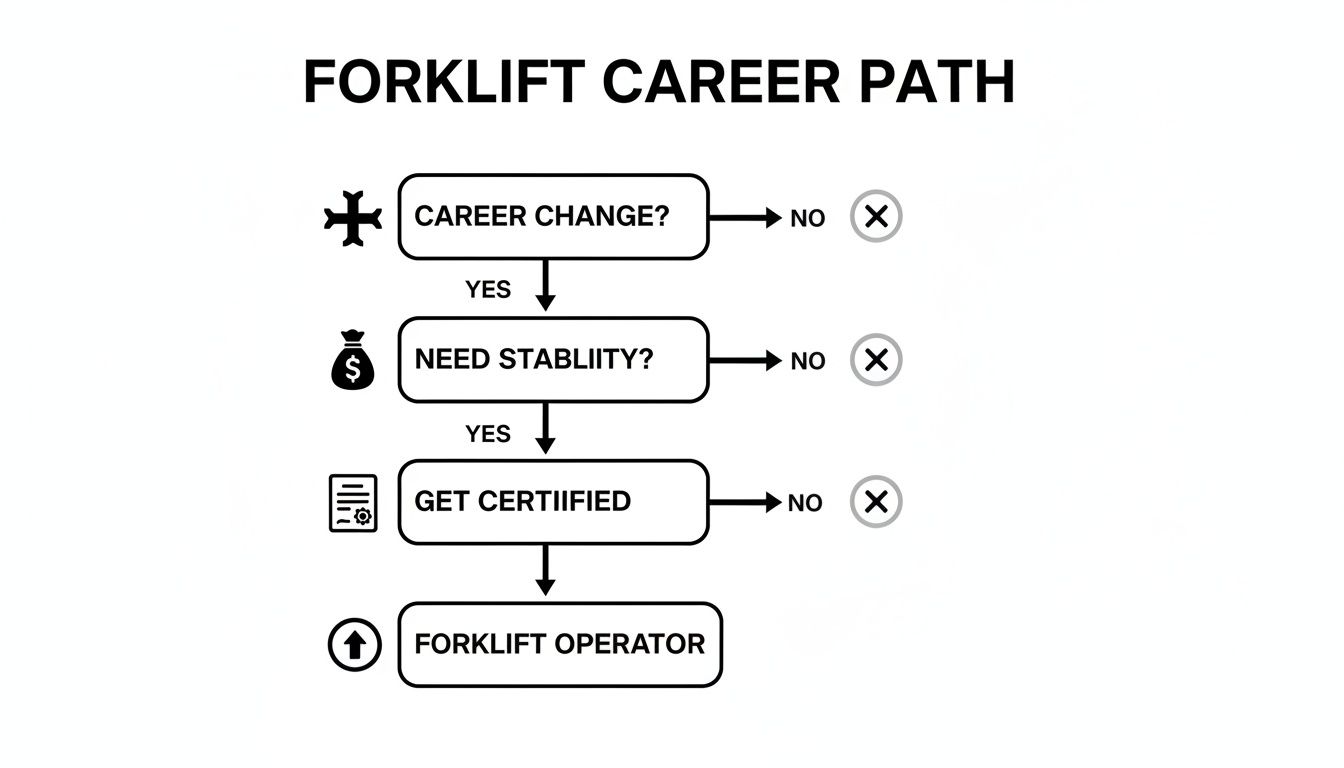
This simple flowchart shows the direct path from deciding on a new career to getting your qualification.
It highlights that once you’ve decided you need a stable, hands-on career, professional certification is the clear and vital next move.
Finding the Right Course Level for You
Once you’ve figured out which machine you need to master, the next job is to pick a course that matches where you are right now. Training providers have different levels to make sure every learner gets exactly what they need. Be honest about your current skill level – it’s the best way to ensure you get proper, thorough training.
Choosing the right course level isn’t about ego; it’s about safety and competence. A Novice course builds that crucial foundation from scratch, while an Experienced course helps polish existing skills with an expert instructor watching over your shoulder.
This approach guarantees that every single operator, no matter their starting point, finishes their training at the same high standard of safety and skill.
Matching the Course to Your Experience Level
To make it easy to see where you fit in, we’ve broken down the main types of forklift courses based on experience.
Course Level
Who It’s For
Typical Duration
Key Outcome
Novice
Absolute beginners with zero or very little experience.
3-5 days
A complete foundation in safe operation, from basic controls to stacking.
Experienced
Operators who’ve used forklifts a lot but never got a formal certificate.
2-3 days
Formalises skills, corrects bad habits, and provides official certification.
Refresher
Certified operators needing to renew their qualification.
1 day
Updates skills, covers new regulations, and reinforces safety best practices.
Conversion
Operators certified on one truck type (e.g., Counterbalance) needing to use another (e.g., Reach).
1-2 days
Bridges the skill gap, focusing only on the differences between the machines.
Each path is designed to get you certified efficiently and safely, without wasting time on things you already know or skipping fundamentals you need.
Some machines, like Telescopic Handlers, are a different beast altogether and demand more specialised training because of how complex they are. You can learn more by checking out the key benefits of Telescopic Handler training, which shows how adding these skills can unlock completely new career paths.
Picking the right course from the get-go saves you both time and money. More importantly, it puts you on the fastest track to becoming a confident, certified, and employable professional operator.
Understanding Accreditations and Legal Standards
When it comes to operating a forklift, why is a formal certificate so important? After all, if you know how to drive it, that’s all that matters, right? Not quite. In the eyes of both employers and the law, ‘just knowing how to drive’ simply doesn’t cut it.
Completing an accredited forklift training course is your official proof of competence. It’s a clear signal to everyone that you can handle powerful machinery safely and responsibly. This isn’t just about ticking a box for a company policy; it’s a fundamental legal requirement. That certificate is the industry-wide standard that keeps you and your colleagues safe on site, and it’s the first thing any reputable employer will ask to see.
The Key UK Accrediting Bodies
As you start exploring forklift training classes, you’ll come across a few key acronyms time and time again. These are the main UK accrediting bodies, and their seal of approval is what gives your training certificate its real value. Think of them as the official examiners of the forklift world.
Their role is to set and maintain the high standards that training providers have to follow. This ensures that whether you get your training in Glasgow or Cornwall, the core principles of skill and safety are consistent. An employer who sees a certificate from one of these bodies knows instantly that you’ve received quality, compliant training.
Here are the main players you should be aware of:
RTITB (formerly the Road Transport Industry Training Board): One of the most widely recognised names, setting the benchmark for workplace transport training across the UK and Ireland.
ITSSAR (Independent Training Standards Scheme and Register): A highly respected body that accredits a huge range of operator and instructor courses.
AITT (Association of Industrial Truck Trainers): This organisation is focused squarely on industrial truck training, dedicated to upholding the highest standards for both training centres and instructors.
NPORS (National Plant Operators Registration Scheme): While NPORS covers a wide variety of plant machinery, it’s a major player in forklift accreditation, especially within the construction and industrial sectors.
Legal Requirements You Need to Know
The bedrock of all UK workplace safety law is the Health and Safety at Work etc. Act 1974. This vital piece of legislation puts a direct responsibility on employers to provide all the necessary information, instruction, and training to keep their employees safe.
What does this mean in practice? It means letting an untrained person operate a forklift is a direct breach of the law. It’s precisely why employers are so strict about certification—it’s their documented proof that they’ve met their legal duties. Backing this up are more specific rules, like the Provision and Use of Work Equipment Regulations 1998 (PUWER), which doubles down on the need for proper training for anyone using work equipment.
It’s a common misconception, but in the UK, there’s no such thing as a government-issued ‘forklift licence’ like the one you have for your car. The legal standard is proof of adequate training from an accredited provider. That certificate is your true key to getting a job.
This is a really important distinction. It places the responsibility for safety on two shoulders: the employer, who must provide the training, and the operator, who must follow it. Your accredited certificate is the professional handshake between the two, confirming you have the skills to work safely and effectively.
Why Accredited Training Is Non-Negotiable
When you choose an accredited course, you’re not just learning from any old curriculum. You’re learning from a syllabus that has been rigorously checked, vetted, and approved by industry experts. It covers everything from the physics of how a forklift balances a heavy load to the simple daily checks that can stop a serious accident before it even begins.
A cheaper, unaccredited ‘in-house’ certificate might seem like a good deal, but it often isn’t worth the paper it’s printed on. More often than not, it won’t be recognised by other employers, effectively trapping you in your current job.
On the other hand, a certificate from a provider accredited by RTITB, ITSSAR, AITT, or NPORS is a nationally recognised qualification. It’s your professional passport—portable, credible, and proof that you’ve been trained to the highest safety standards required by UK law. It is the only sensible way to build a secure and successful career as a forklift operator.
What to Expect During Your Forklift Course
Stepping into a training centre for the first time can feel a bit intimidating. What exactly happens? Will you be stuck in a classroom all day, or do you get to jump straight onto a machine? Let’s pull back the curtain on what a typical UK forklift course actually involves.
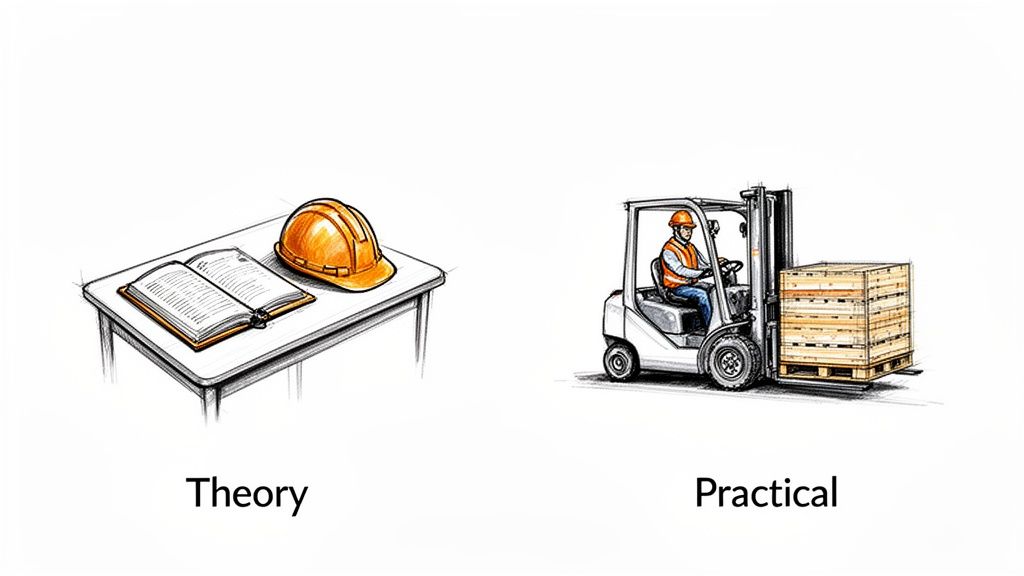
A good course is all about balance. It’s designed to build your skills logically, blending the why with the how. You’ll spend time understanding the theory behind safe operation before you ever get your hands on the controls. This combination is what turns a complete beginner into a confident and capable operator.
You won’t be thrown in at the deep end. The entire process is structured to build your confidence from the ground up, starting with simple concepts and moving on to more complex manoeuvres.
Building Your Foundation in the Classroom
Before you even touch a forklift, your training begins in the classroom. This isn’t about nodding off over a dusty textbook; it’s about learning the fundamental ‘rules of the road’ for a busy industrial site. Think of it like learning the Highway Code before you get behind the wheel of a car—it’s the essential knowledge that keeps everyone safe.
Here, your instructor will walk you through the core principles that underpin everything you’ll do on the machine. The goal is to give you a solid mental toolkit before you start putting your physical skills to the test.
The theory is the bedrock of your entire skill set. Understanding the physics of stability and the reasons for safety checks is what separates a truly professional operator from someone who just knows which levers to pull.
The key topics you’ll cover in the classroom almost always include:
Operator Safety Code: The essential list of do’s and don’ts that every operator must follow.
Forklift Stability: Getting to grips with the ‘stability triangle’—the physics that explains how a forklift stays upright with a heavy load and, more importantly, what can cause it to tip over.
Pre-Use Inspections: A step-by-step guide to the daily checks you must carry out before work. Getting this right can prevent up to 70% of forklift accidents.
Hazard Awareness: Learning to spot potential dangers in a warehouse or on a building site, from uneven ground to nearby pedestrians.
Getting Hands-On with Practical Training
Once you’ve grasped the theory, it’s time for the part everyone looks forward to: getting behind the wheel. The practical training is where all that classroom knowledge comes to life. Under the close supervision of your instructor, you’ll start applying what you’ve learned in a safe and controlled environment.
This phase starts with the absolute basics. You’ll begin by just getting familiar with the truck itself—learning what each lever and pedal does, mastering the steering, and practising smooth acceleration and braking. It’s all about building that initial muscle memory and confidence.
As you get more comfortable, the tasks will become more challenging. You’ll progress from driving around in open spaces to navigating tight corners and other confined areas. This gradual build-up ensures you’re never out of your depth.
Mastering Real-World Scenarios
The whole point of a good forklift course is to get you ready for a real job. The final stages of your practical training are all about simulating the precise tasks you’ll be doing day-to-day as an operator.
This is where you learn to handle loads safely and efficiently. You’ll practise crucial skills such as:
Approaching and Lifting a Load: Learning the correct angle, height, and technique to insert the forks into a pallet without causing damage.
Travelling with a Load: Mastering how to carry a load at the right height and tilt to keep the truck stable.
Stacking and De-Stacking: Carefully placing pallets onto racking at different heights and retrieving them safely—often the trickiest part of the job.
This part of the course is all about precision, control, and developing a smooth operating style. By the end, you’ll feel comfortable performing the core duties expected of a professional.
The Final Assessment: Your Path to Certification
To earn your certificate, you’ll need to pass a final assessment. This isn’t designed to catch you out; it’s simply a final check to confirm you’ve taken on board all the training and can operate a forklift safely.
The assessment is split into two parts: a theory test (usually multiple-choice) to check your knowledge and a practical skills test. For the practical, an examiner will observe you as you perform a series of set tasks, just like the ones you’ve been practising. It’s your chance to put everything you’ve learned into practice, from the initial pre-use checks to safely stacking that final pallet.
Breaking Down Course Costs and Refresher Training
Let’s talk about the practical side of things. When you’re looking to get qualified, two questions always come up: how much is this going to set me back, and how long is my certificate good for? Getting a clear picture of the costs and the ongoing training needs is the first step in planning your career move.
The price of forklift training in the UK isn’t one-size-fits-all. It really depends on the type of truck you’re learning to operate and how long the course is. A novice course on a standard Counterbalance truck, for instance, will naturally cost less than a more specialised conversion course for something like a Telescopic Handler.
What to Expect to Pay
Think of it like buying any tool for a specific job—a simple spanner costs less than a complex piece of power equipment. The same logic applies here, with prices reflecting the skill level and machinery involved.
While costs can vary a bit between training centres, here’s a general idea of what you can expect:
Novice Courses: These usually run from £300 to £800, depending on the truck and the course length, which is typically 3-5 days.
Experienced Operator Courses: Being shorter, these tend to fall between £200 and £450.
Conversion and Refresher Courses: As the quickest options (often just one day), these are the most affordable, usually costing between £150 and £300.
Many training providers know that this can be a significant upfront expense and offer payment plans to make it more manageable. To get an idea of how these work, you can look at our guide on how to finance HGV training; the principles are very similar.
Keeping Your Skills Sharp with Refresher Training
Your initial certificate of basic training doesn’t have a formal expiry date, but that doesn’t mean your training is a one-and-done deal. The Health and Safety Executive (HSE) strongly recommends that every operator takes regular refresher training to stay sharp.
The accepted industry standard, guided by the HSE, is for operators to complete a refresher course every 3 to 5 years. This isn’t just about ticking a box; it’s about being a safe and professional operator.
It’s easy for small, bad habits to develop over time without you even noticing. A refresher course is like a professional reset. It reinforces your core skills, corrects any unsafe shortcuts you might have picked up, and brings you up to speed on any new regulations or best practices.
The True Value of Staying Certified
Investing in regular refresher training is one of the smartest career moves you can make. It proves to any employer—current or future—that you take your professional responsibilities and safety seriously.
Forklift refresher courses are recommended by the Health and Safety Executive (HSE) to ensure operators remain competent. They typically cost between £95 and £225 per person. This is a small price to pay when you consider that 25% of all transport and storage accidents are caused by forklift impacts. The costs of damage in these incidents can spiral to be 5-30 times the initial cost of the accident itself.
Ultimately, this ongoing commitment keeps you safe, efficient, and highly employable for the long haul. It’s an essential part of a successful career that protects you, your colleagues, and the business.
Launching Your Career After Certification
You’ve done it. You’ve passed the course, nailed the practical, and now you’re holding that accredited certificate. A huge congratulations is in order! This is a massive achievement, but it’s not the finish line – think of it as the starting block for a brilliant new career. Now the real work starts: turning that ticket into a steady, well-paid job.
This is about more than just firing off a few applications. It’s about being smart, targeting the industries where your new skills are in red-hot demand, and selling yourself as the competent, safety-first professional you’ve become. Your certificate is the key, and it’s time to find the right doors to unlock.
Targeting High-Demand Industries
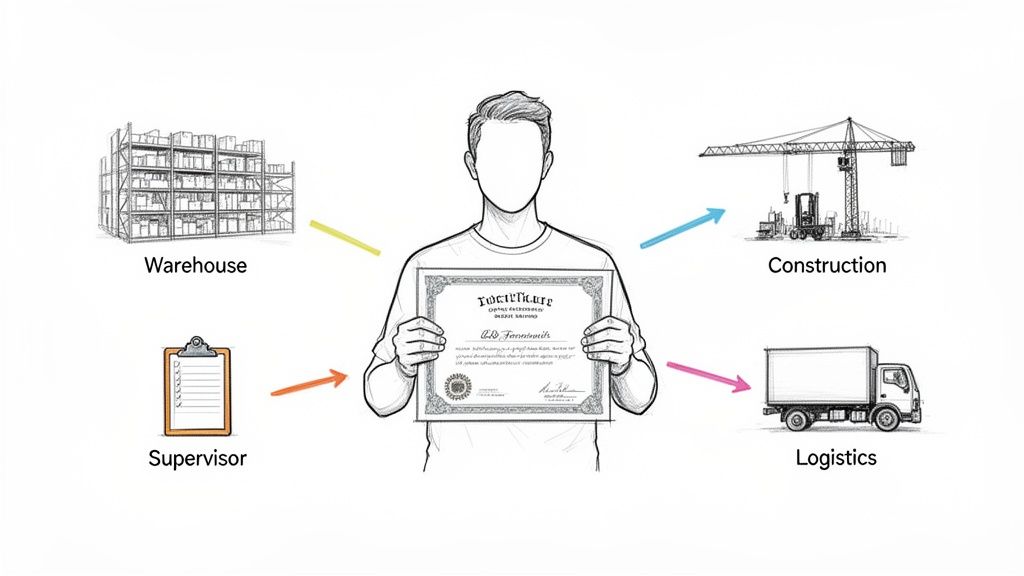
Your forklift qualification makes you a valuable player in several key sectors of the UK economy. These industries are the backbone of our logistics and infrastructure, and they are always on the hunt for skilled operators to keep things moving.
You’ll want to focus your job search on these three powerhouse sectors:
Warehousing and Logistics: This is the big one and the largest employer of forklift operators by far. From sprawling e-commerce distribution centres to local storage units, your skills are the lifeblood of managing inventory.
Construction: Building sites are hives of activity that rely heavily on forklifts, especially Telescopic Handlers. You’ll be the one moving heavy materials like bricks, timber, and steel safely and efficiently.
Manufacturing and Production: In any factory setting, operators are needed to get raw materials to the production lines and shift finished goods into storage. You become a crucial link in the supply chain.
Making Your CV Stand Out
When a hiring manager glances at your CV, they’ll probably spend just a few seconds deciding if you’re worth a closer look. You need to make that new qualification jump off the page. Don’t just list it; showcase it.
Your CV is your professional handshake. Frame your forklift training not just as a course you passed, but as proof of your commitment to safety, efficiency, and professional standards.
Get specific under your qualifications section. Instead of just “Forklift Licence,” spell out exactly what you’ve achieved. For example: “RTITB Accredited Counterbalance Forklift Operator (B1 Category), completed Nov 2025.” This tells an employer the exact truck type, the accrediting body, and how fresh your training is. Mentioning your solid grasp of pre-use checks and workplace safety will also put you ahead of the pack.
Beyond Your First Job: A Career Path
Landing your first forklift operator role is a fantastic milestone, but it’s also just the first step on the ladder. This qualification opens up a much wider career path within the logistics and industrial sectors. Don’t see your certificate as the end goal, but as the foundation for future growth.
The UK forklift market is valued at USD 5.01 billion and is projected to hit USD 6.99 billion by 2030. This incredible growth is fuelling massive demand for skilled operators, with certified operator salaries now climbing to between £28,000-£35,000 annually.
Once you have some experience under your belt, you can progress into roles like:
Warehouse Supervisor or Team Leader: Managing workflow and overseeing other operators.
Logistics Planner: Using your on-the-ground experience to coordinate wider supply chain movements.
HGV Driver: Many operators use their experience as a springboard into truck driving. If that sounds like you, it might be worth finding HGV training near you to see what’s involved.
Your certificate is more than just a piece of paper; it’s your ticket to a long-term journey in a stable and growing industry.
Your Forklift Training Questions Answered
We get a lot of questions about forklift training classes, so we’ve put together some quick, clear answers to the most common ones. This should help you feel confident before you book your course.
Do I Need a UK Driving Licence to Get Started?
No, you don’t. A standard car driving licence is not a requirement to get your forklift certification. This is a common misconception.
Forklift operation falls under workplace safety laws set by the Health and Safety Executive (HSE), not the rules of the road. The training is all about operating safely on private property, like a warehouse, factory floor, or construction yard. That said, some employers might prefer candidates with a driving licence, especially for jobs at massive sites where you might need to drive between buildings on access roads.
How Long is a Forklift Certificate Valid For?
Your initial certificate of basic training doesn’t technically expire. But don’t let that fool you. The Health and Safety Executive (HSE) is very clear in its recommendation that all operators need regular refresher training to stay safe and competent.
The accepted industry standard across the UK is for operators to complete a refresher course every 3 to 5 years. Most employers see this as non-negotiable for their health and safety policies.
Think of it like a skills top-up. It keeps your knowledge sharp, brings you up to speed on the latest safety practices, and irons out any bad habits that might have crept in over time. It’s all about maintaining high standards and keeping everyone on-site safe.
Can I Use My Certificate to Work Anywhere in the UK?
Yes, absolutely! As long as your training is from a nationally recognised accrediting body, your qualification will be welcomed by employers right across the UK. This portability is one of the biggest advantages of getting properly certified.
The names you want to see on your certificate are:
RTITB (formerly the Road Transport Industry Training Board)
ITSSAR (Independent Training Standards Scheme and Register)
These organisations set the gold standard for training. When an employer sees one of these logos, they know you’ve been trained to a high, consistent standard. Your certificate effectively becomes a professional passport, opening up job opportunities wherever you go in the country.
At HGV Learning, we connect you with accredited training that employers trust. If you’re ready to start building a stable and rewarding career as a certified operator, we can help find the perfect course for you. Get started today by visiting https://hgvlearning.com.
Related Articles
09/03/2026
UK CPC Course Cost: A Complete 2026 Pricing Guide
When you're looking to get on the road professionally, one of the first questions on your mind is bound to be about the cost. In...