Before you can hop on a forklift and start your practical training, you need to pass the theory test. This isn’t just a box-ticking exercise; it’s designed to prove you have a solid grasp of the critical safety rules before you even touch the controls. Think of it as building your foundation—covering everything from stability principles to workplace hazards.
Getting to Grips with the Forklift Theory Test
To put together a winning study plan, you first need to know exactly what you’re up against. The forklift theory test is a formal assessment, and understanding its format is the first step toward walking into that test centre with confidence.
Knowing the structure demystifies the whole process. Instead of worrying about what might come up, you can focus your energy on targeted revision and walk in ready for anything.
For a quick overview of what to expect, here’s a simple breakdown of the UK forklift theory test.
Forklift Theory Test at a Glance
Component
Details
Total Questions
Typically 25 questions in total.
Question Types
A mix of multiple-choice and written-answer questions.
Time Limit
You’ll have one hour (60 minutes) to complete the test.
Pass Mark
The required pass mark is 80%, meaning you must answer at least 20 questions correctly.
Key Topics
Covers operator safety, vehicle stability, pre-use checks, and hazard awareness.
This table gives you the essential facts, but let’s dive into what those question formats really mean for your preparation.
Question Formats and Content
The test uses a mix of question styles to get a full picture of your knowledge. You won’t just be recalling facts; you’ll need to apply them to real-world situations you’re likely to face on the job.
Multiple-Choice Questions: These make up most of the exam. You’ll be given a question or a scenario followed by a few possible answers, and you have to pick the right one. They’re great for testing your knowledge of specific rules, safety procedures, and what different warning signs mean.
Written-Answer Questions: A smaller part of the test will ask you to write short, sentence-based answers. This is to check you can clearly explain key concepts, like how to carry out a pre-use inspection or what the ‘stability triangle’ actually is.
This combination ensures you can not only recognise correct information but also explain important safety ideas in your own words.
Pass Marks and Time Limits
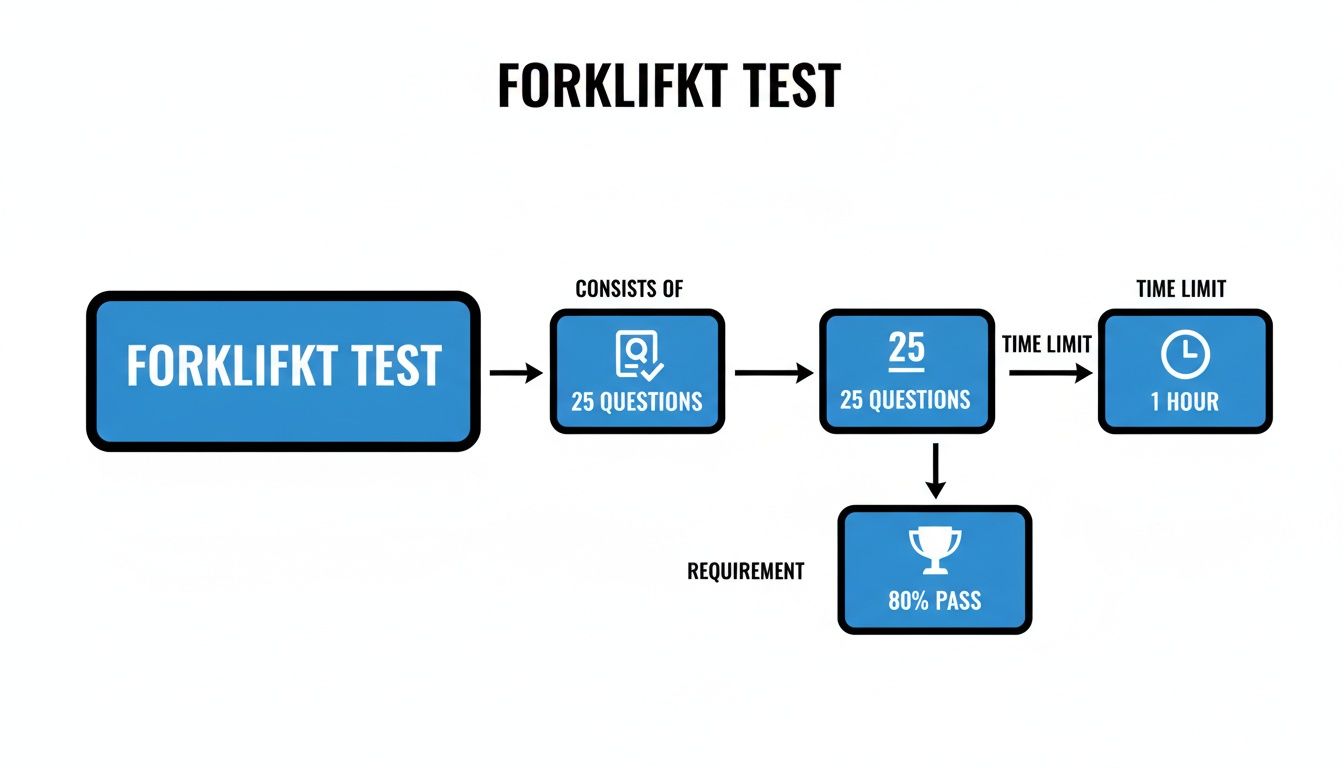
In the UK, a major accrediting body is the CPCS (Construction Plant Competence Scheme), which sets a high standard for operators. Its forklift theory test is a key hurdle, consisting of 25 questions that must be answered within a strict one-hour timeframe.
The test is usually split into 20 multiple-choice and 5 written-sentence questions. To pass, you need to score at least 80%, which means getting a minimum of 20 questions right. It’s worth noting that this theory test has a 90% pass rate—much higher than the 74% pass rate for the practical test. This shows that with the right preparation, success is well within your reach. You can find out more about these standards over at ConstructionTest.co.uk.
Think of the theory test as the blueprint for your practical skills. Every question about load centres, stability, or pedestrian safety directly relates to a real-world action you’ll perform daily. Mastering the theory makes you a safer, more efficient, and more employable operator from day one.
With 60 minutes for 25 questions, you have just over two minutes for each one. That’s usually plenty of time, but you still need to manage it well. A good strategy is to go through and answer all the questions you’re certain about first. This builds momentum and confidence, and you can then loop back to the trickier ones without feeling rushed.
Core Topics You Absolutely Need to Know
Passing your forklift theory test isn’t about cramming a textbook the night before. It’s about understanding the core principles that keep you and everyone around you safe. Think of it as learning the unwritten rules of the warehouse floor – knowledge that separates a truly competent operator from someone just going through the motions.
Let’s break down exactly what you need to focus on. This is the stuff that really matters, both for the test and for your day-to-day work.
First, get familiar with the test structure itself. It’s pretty straightforward, but knowing what to expect is half the battle.
As you can see, you’ll have one hour to answer 25 questions, and you need to get at least 20 right to pass. That doesn’t leave much room for error, so a targeted approach to your revision is key.
Operator Responsibilities and Legal Duties
Your job as a forklift operator starts long before you ever turn the key. The test places a huge emphasis on your duties, which are all rooted in workplace safety legislation.
The pre-use check is a big one. You need to know the daily inspection inside and out – not just as a checklist, but understanding why each part is critical. For example, a question might ask about the consequences of ignoring a minor hydraulic fluid leak. While it might seem small, you need to know it could lead to a catastrophic failure under a heavy load.
You’ll also be quizzed on the operator’s manual. Can you find the truck’s load capacity or its maintenance schedule? Proving you can navigate this document shows you know where to find the most vital information about your machine.
The Principles of Forklift Stability
This is probably the single most important topic, and it’s where a lot of people trip up. A forklift isn’t a car. Its stability is constantly changing, shifting with every single load you handle. Expect a good chunk of your test to focus on this.
The key concept you have to nail down is the stability triangle. It’s an invisible triangle formed between the two front wheels and the pivot point of the rear axle. As long as the combined centre of gravity (the truck plus its load) stays inside this triangle, you’re stable.
The second that combined centre of gravity moves outside the triangle, it’s game over. The truck will tip. This can happen from lifting a load that’s too heavy, raising it too high while moving, or even just driving on a slight incline. It’s simple physics with incredibly serious consequences.
The test will throw real-world scenarios at you, like:
Load Centre: Why does the safe lifting capacity drop as a load is moved further away from the mast?
Lift Height: How does raising the forks high in the air dramatically reduce the forklift’s stability?
Dynamic Forces: What happens to the centre of gravity when you brake, accelerate, or turn a corner too quickly?
Getting your head around these principles is non-negotiable for passing the test and, more importantly, for preventing a serious accident on site.
Workplace Safety and Hazard Awareness
Forklifts operate in busy, sometimes chaotic environments filled with people, racking, and other vehicles. A huge part of your job is spotting hazards before they become accidents, and the theory test will assess this skill thoroughly.
You need to know the specific rules for navigating common workplace situations:
Pedestrians: What’s a safe distance to keep from people on foot? Who has the right of way?
Slopes and Ramps: Why must you always travel with the load facing uphill on a ramp, but in reverse when coming down?
Tight Spaces: What’s the correct procedure for approaching blind corners, doorways, or narrow aisles?
Safe operation isn’t just about driving carefully; it’s about protecting the environment you work in. This includes knowing about things like proper forklift pallet rack protection to prevent collisions that cause costly damage. This kind of situational awareness is very similar to the hazard perception skills needed for larger vehicles. In fact, many of the same principles in these hazard perception tips for HGV drivers apply here too.
Loading and Unloading Procedures
Finally, the test will cover the bread and butter of the job: actually handling a load. This is about more than just picking things up and putting them down; it’s about the correct, safe procedure every single time.
You absolutely must be able to read a load capacity plate. These can look complicated, showing different weight limits for different lift heights and load centres. A classic test question will give you a scenario – say, a pallet weighing a certain amount with specific dimensions – and ask if it’s safe to lift to a particular height.
Securing the load correctly is another critical area. You’ll be expected to know how to position the forks for perfect balance, check the pallet is sound, and apply the right amount of backward tilt to keep the load stable against the carriage before you move off. The test is designed to confirm you know these steps are mandatory, not optional.
Building a Study Plan That Actually Works
Knowing what’s on the forklift theory test is one thing, but how you prepare is what really separates a pass from a fail. A solid study plan is your best tool for turning a mountain of information into manageable, bite-sized chunks, helping you learn properly without that last-minute panic.
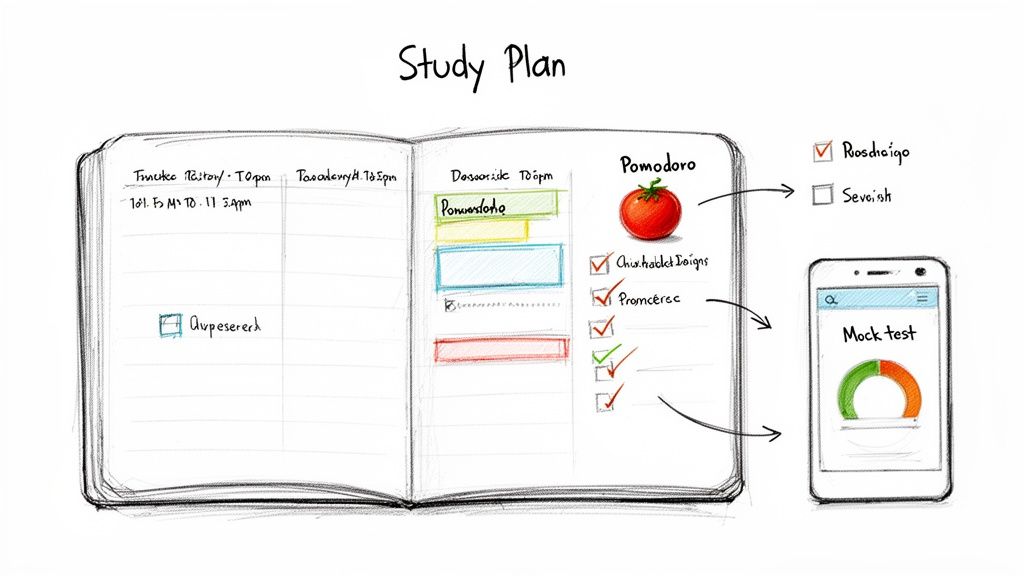
The idea isn’t to memorise everything in one go. It’s all about consistent, focused effort. Whether you’ve got a month or just a week, a clear plan makes sure you cover all the essentials and walk into that test feeling genuinely confident.
Tailoring Your Study Schedule
We all learn differently and have different demands on our time. That’s why your study plan needs to fit your life, not the other way around. First off, be realistic about how much time you can actually set aside each day or week.
Is it 30 minutes on your lunch break? An hour after work? Maybe a longer session at the weekend works better for you. Whatever it is, be honest with yourself and block that time out.
Once you know your availability, break down the key topics—operator duties, stability, safety checks, and loading procedures—into small, focused sessions. Something like this could work:
Monday: 30 minutes on pre-use checks.
Wednesday: 45 minutes getting to grips with the stability triangle.
Friday: An hour running through workplace hazard scenarios.
This approach stops you from burning out and helps your brain actually retain the information, which is far more effective than a frantic, all-night cramming session.
The Pomodoro Technique: A Simple Focus Hack
If you find your mind wandering, the Pomodoro Technique is a bit of a game-changer. It’s incredibly simple but works wonders for keeping you locked in during your study sessions for the forklift theory test.
Here’s the breakdown:
Set a timer for 25 minutes: Pick one topic and give it your full, undivided attention. No phone, no distractions—just you and the material.
Take a 5-minute break: When the timer pings, step away. Have a stretch, grab a coffee, and clear your head.
Repeat the cycle: After you’ve done four of these “Pomodoros,” give yourself a proper break of 15-30 minutes.
This method uses the brain’s natural rhythm of focusing in short bursts, making your study time feel less like a chore and much more productive. For more great ideas on making your learning stick, especially if you’re studying online, check out these useful online course tips.
Choosing the Right Study Resources
Your study plan is only as good as the materials you’re using. By sticking to official and reputable sources, you can be sure you’re learning the right information—the stuff that will actually be on your test.
Focus your energy on high-quality materials from recognised bodies. Using out-of-date or unofficial guides is a false economy. It wastes your time and could teach you the wrong procedures, costing you vital marks on the day.
Your go-to resources should include:
Official Training Body Guides: Manuals from accrediting bodies like RTITB or CPCS are the gold standard. They’re written specifically for the test you’ll be sitting.
Training Provider Materials: The training centre you choose will give you essential coursebooks and handouts. Treat these as your primary study tools.
Online Mock Exams: Practice tests are absolutely crucial. They get you used to the question formats, help you manage your time under pressure, and flag up any weak spots in your knowledge.
The forklift theory test in the UK requires accuracy and speed. Some mock test platforms use shorter formats, like a test with 20 multiple-choice questions in 45 minutes where you need 18/20 (90%) to pass. This really helps build your confidence for the real thing. It’s a similar approach to the wider DVSA theory testing for large goods vehicles (LGV), where pass rates can vary a lot between test centres, proving just how important solid preparation is. For more insights on effective revision, take a look at our tips for HGV theory test revision.
Using Mock Tests to Prepare for the Real Thing
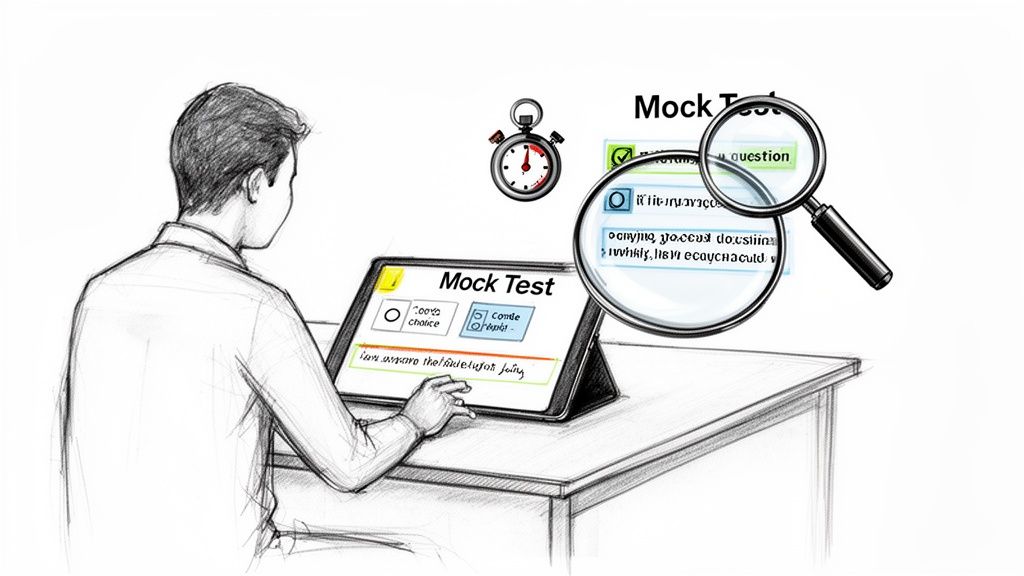
You can read every manual and study guide out there, but nothing gets you ready for the real forklift theory test quite like a proper practice run. Knowing the material is one thing. Performing well when the clock is ticking is a whole different ball game. This is where mock tests become your single most powerful preparation tool.
When you treat mock tests seriously, they stop being simple quizzes and turn into valuable learning experiences. They give you a safe space to get things wrong, helping you find and fix any gaps in your knowledge long before the real test day. By getting used to the test environment now, you’ll walk in feeling calm and ready, because you’ve already been there.
Why Practice Exams Are So Effective
Mock tests are about more than just checking your memory; they’re a core part of any smart study plan. They offer insights you just can’t get from reading a book and help you get a feel for the pacing and pressure of the actual exam.
One of their biggest advantages is time management. You’ve got a one-hour limit to answer 25 questions, so you need to be efficient. A practice test forces you to work against the clock, teaching you to answer confidently without getting stuck on the trickier questions.
They also shine a bright light on your weak spots. It’s easy to feel you’ve mastered a topic until you’re faced with a specific, tricky scenario. Getting a question wrong on a mock test is a gift—it tells you exactly where to focus the rest of your study time.
Analysing Questions Like a Pro
How you tackle each question can make a huge difference to your final score. The forklift theory test isn’t designed to catch you out, but it will check if you can apply your knowledge in a practical way. A structured approach is your best bet.
When you see a question, especially a multiple-choice one, try this:
Read the full question properly. Don’t just skim it. Look out for keywords like “always,” “never,” or “most likely.”
Spot the distractors. Examiners often include answers that are almost right but have one incorrect detail. They’re designed to trip up anyone who hasn’t read the question carefully.
Eliminate obviously wrong answers first. This simple trick can often narrow your choices down to just two, massively improving your odds.
Connect it to a core safety rule. Ask yourself, “What safety principle is this question really about?” This helps you cut through the noise and focus on what’s being tested.
By the time you sit the actual exam, it should feel like just another practice session. This familiarity is your secret weapon against test-day nerves, allowing you to focus completely on demonstrating what you know.
The official UK forklift theory tests are a key part of certifications like the CPCS A16 for industrial trucks. These one-hour exams feature 25 questions and have an impressive 90% pass rate—much higher than the 74% pass rate for the practical test. This just goes to show that solid preparation really pays off.
Common Test Mistakes vs Smart Strategies
It’s easy to fall into common traps during preparation. Here’s a quick look at some frequent mistakes and how to turn them into smart, effective strategies.
Common Mistake
Effective Best Practice
Cramming everything at the last minute.
Spaced repetition. Study in short, regular bursts over weeks to build long-term memory.
Only reading the manual.
Active learning. Use mock tests, flashcards, and explain concepts to someone else.
Ignoring weak areas.
Targeted revision. Analyse mock test results and dedicate extra time to topics you struggled with.
Panicking over the timer.
Practise under timed conditions. Get comfortable with the one-hour limit so it feels natural on the day.
Skimming questions too quickly.
Read every word. Pay close attention to keywords that can completely change the question’s meaning.
Guessing randomly when unsure.
Use the process of elimination. Rule out obviously wrong answers to improve your odds.
Adopting these best practices will give you a significant edge, turning potential weaknesses into strengths.
From Multiple Choice to Written Answers
Most of the test is multiple-choice, but you’ll also face a few questions that need a written sentence. This is your chance to prove you can explain a concept clearly, not just pick the right answer from a list.
When writing your answers, keep these tips in mind:
Be direct. Get straight to the point. The examiner is looking for a clear, correct statement, not an essay.
Use key terminology. Using terms like “stability triangle,” “load centre,” and “pre-use check” shows you know the professional language.
Focus on the “why.” Don’t just state a rule; briefly explain why it’s important. For instance, instead of just saying “travel with the load facing uphill,” add “…to maintain stability and prevent the truck from tipping.”
This level of detail shows a deeper understanding that will help you secure full marks. For those looking to get even more practice, it’s useful to see how other professional drivers prepare. You might be interested in our guide on where to find a practice HGV theory test, as many of the same principles for good test preparation apply across different vehicle categories.
Your Plan for Test Day and Beyond
You’ve put in the hours and done the revision. Now, the only thing standing between you and the next stage of your training is the forklift theory test itself. All that knowledge is locked in; the final piece of the puzzle is making sure test day goes off without a hitch.
A calm, organised approach is just as vital as knowing your stuff. Thinking ahead eliminates any last-minute panic, letting you focus completely on the questions. Let’s walk through what to expect on the day and how to smoothly transition from a theory pass to getting hands-on with a forklift.
Arriving Prepared and Staying Focused
The key to a successful test day is simple: be prepared. Knowing you have everything in order before you even leave the house is a massive confidence booster. The last thing you need is a mad scramble for documents moments before your test.
Get a simple checklist ready the night before. It’s a small step, but it can make a huge difference to your mindset on the day.
Your test day checklist should include:
Photo Identification: You’ll need a valid photo ID. A driving licence or passport is usually required.
Booking Confirmation: Have your booking details handy, either printed out or on your phone. It’ll have your appointment time and reference number.
Directions to the Centre: Plan your journey well in advance. Check for traffic updates and aim to get there at least 15-20 minutes early. This gives you plenty of time to check in, find your bearings, and relax.
Once you arrive, the test centre staff will walk you through the process. They’ll check your ID, show you to your computer, and run through the rules. After you’re seated, take a moment to breathe and get comfortable before the timer officially starts.
Remember all the work you’ve put in. You’ve studied the principles, you’ve completed mock tests, and you understand the safety rules. Trust in your preparation and read each question carefully, just as you did during your revision sessions.
Managing Last-Minute Nerves
It’s completely normal to feel a bit jittery before a test. The trick is not letting those nerves get the better of you. A few simple techniques can help you stay calm and focused, ensuring you can recall everything you’ve learnt.
If you start feeling anxious, try a quick breathing exercise. A slow, deep breath in and a long, controlled breath out can do wonders for calming your nervous system. Remind yourself that you’re well-prepared and this is just the final step. Don’t rush; you have a full hour to answer all 25 questions.
From Theory Pass to Practical Skills
Passing your forklift theory test is a huge achievement, but it’s really just the beginning. That certificate is your ticket to the most crucial and exciting part of your training: the practical, hands-on sessions. This is where all the concepts you’ve learnt finally come to life.
Your theoretical knowledge is the foundation you’ll build all your practical skills on. Think about it:
The Stability Triangle: That diagram you studied isn’t just a theory anymore. You’ll feel it every time you lift a load, navigate a tight corner, or drive on an incline.
Pre-Use Checks: The checklist you memorised becomes a vital, hands-on daily routine. It’s what ensures your machine is safe before you even turn the key.
Load Capacity Charts: Reading those charts correctly in the test directly translates into making safe, critical decisions in a real warehouse, preventing costly accidents and damage.
This is the link between theory and practice that turns you from someone who knows the rules into a competent, confident, and employable operator. Your practical training will transform that knowledge into skill, setting you up for a rewarding career where safety and precision are everything.
Frequently Asked Questions
Even with the best study plan, it’s normal to have a few nagging questions as test day gets closer. We’ve put together this list of the most common queries we hear from trainees to clear up any final uncertainties. Think of it as a final check-in before you go for it.
How Many Questions Can I Get Wrong?
This is the big one, and knowing the numbers helps you understand what you’re aiming for. The typical forklift theory test is made up of 25 questions, with a pass mark of 80%.
So, what does that mean in real terms? You need to get at least 20 questions right to pass. That leaves a very slim margin for error – you can only get a maximum of five questions wrong. It really drives home why practising with mock tests is so crucial for spotting and fixing your weak areas before the real thing.
How Long Is My Theory Certificate Valid For?
Passing your theory is a huge step, but it’s not the end of the journey. Your pass certificate is essentially your ticket to the practical training stage, and that ticket has an expiry date.
Generally, your forklift theory test pass is valid for two years. You have to complete your practical test and get your full operator certification within this window. If you don’t, the theory pass expires, and you’ll have to sit the test all over again before you can move forward.
Are There Different Tests for Different Forklifts?
Yes, and this is a critical detail to get right. While a lot of the core safety principles are universal across all industrial trucks, the theory tests are often tailored to specific types of forklift to cover their unique operational risks.
For instance, the questions for a Counterbalance truck (B1 category) will likely focus on things like load stability in wide, open spaces. In contrast, a test for a Reach truck (D1 category) will almost certainly include scenarios about operating in narrow-aisle racking systems.
Make absolutely sure you know which category of forklift you’re being tested on. Studying the wrong material is a common but completely avoidable mistake. Always double-check with your training provider to ensure your revision matches the truck you’ll be using.
What Happens If I Fail the Theory Test?
Failing any test is a knock, but it’s definitely not the end of the road. If you don’t hit that 80% pass mark, you’ll need to re-book and take the exam again. The good news is that most training providers will give you feedback on the areas where you dropped marks.
This feedback is gold. Use it to go back to your study materials and zero in on the topics you struggled with. Treat it as a chance to properly cement your knowledge and come back even more prepared. Sometimes, a first-time fail can actually make you a much safer and more knowledgeable operator in the long run.
At HGV Learning, we provide comprehensive training support to get you ready for every stage of your professional driving career, from the theory test to advanced practical skills. If you’re ready to take the next step towards your forklift or HGV licence, explore our courses at HGV Learning.
Related Articles
09/03/2026
UK CPC Course Cost: A Complete 2026 Pricing Guide
When you're looking to get on the road professionally, one of the first questions on your mind is bound to be about the cost. In...