If you’ve been typing “lorry driver jobs near me” into a search bar lately, you’ve landed in the right place at exactly the right time. The UK is crying out for newly qualified drivers, making this a genuinely excellent career move for anyone looking for real stability and opportunity. This isn’t just about finding another job; it’s a chance to become a vital part of the nation’s backbone.
Why the UK Urgently Needs New Lorry Drivers
Have you noticed more stories on the news about supply chain problems? Or seen more ‘drivers wanted’ signs on the back of lorries than ever before? It’s not your imagination. The UK logistics industry is dealing with a perfect storm of issues, which has created an unprecedented demand for skilled HGV drivers. This isn’t a temporary blip: it’s a major shift that opens up a huge opportunity for new starters and career changers.
The situation is being driven by a few key factors all hitting at once. For one, a big chunk of the current driver workforce is heading towards retirement, which is creating a natural gap that needs to be filled. At the same time, recent economic changes and past disruptions have shaken up the job market, leaving many haulage companies scrambling to find enough qualified drivers to keep their goods moving.
The Scale of the Opportunity
To really get a sense of the numbers, the Road Haulage Association (RHA) has stated the industry needs to recruit a staggering 60,000 new HGV drivers every single year for the next five years. That urgency is dialled up even further when you learn that over 117,000 qualified drivers let their Driver Qualification Cards (DQC) lapse in the past 12 months alone. This has created a massive vacuum for new talent to step into essential roles across logistics, construction, and even the emergency services.
This isn’t just about filling empty seats. It’s a national call for reliable, professional drivers who are ready to build a long-term career in a sector that’s more crucial than ever. For anyone considering a new path, the road ahead is wide open.
This high demand translates directly into real, tangible benefits for anyone starting out:
Improved Pay and Conditions: To attract and keep good drivers, companies are putting better salaries and benefits on the table.
Greater Job Security: Lorry drivers are essential workers. It’s a service that’s always needed, which means solid stability even when the economy is uncertain.
Faster Career Progression: With so many open positions, there are more chances to get experience under your belt quickly and move into specialised or better-paying roles.
Getting the right guidance can make the whole process feel achievable, turning what seems like a daunting journey of training and licensing into a clear, manageable plan. If you’re still weighing things up, you can learn more about why HGV driving is a smart career choice for 2025. The demand is definitely real, and the opportunities are waiting.
Getting Your HGV Licence and Qualifications
Before you start looking up “lorry driver jobs near me,” you need to get the right paperwork sorted. It might seem like a lot, but the path from hopeful trainee to fully qualified professional is pretty clear once you know the steps. This is the foundation of your entire career on the road, so it pays to get it right.
First things first, you’ll need to apply for a provisional HGV licence, which gets added to your current car licence. This is your green light to start practical training. At the same time, you must pass a D4 medical exam with a doctor. It’s a standard check to make sure you meet the health requirements for driving large commercial vehicles safely.
Understanding Licence Categories
The type of lorry you’re allowed to drive is determined by your licence category. Each one opens up different types of work and career paths, so it’s worth understanding what they are from the get-go.
To give you a clearer picture, here’s a simple breakdown of the main HGV licence categories and the kinds of jobs they lead to.
UK HGV Licence Categories at a Glance
Licence Category
Vehicle Type
Common Jobs
Category C1
Vehicles between 3.5 and 7.5 tonnes
Local delivery driving, horseboxes, smaller removal lorries
Category C (Class 2)
Rigid vehicles over 3.5 tonnes
Bin lorries, tipper trucks, standard delivery lorries
Category C+E (Class 1)
Articulated lorries (tractor unit + trailer)
Long-haul routes, international transport, supermarket deliveries
Knowing which licence to aim for helps you target the right training and, eventually, the right jobs for your career goals. Class 1 (C+E) tends to open up the best-paid, steadiest work: see our Class 1 driver training guide for costs and how to get there.
The demand for drivers right now is huge, partly because of a training backlog that built up over the last few years. In 2021, the UK driver shortage was hit hard by Brexit, which led to a loss of 16,000 EU workers, and the pandemic, which created a shortfall of 25,000 driving test passes.
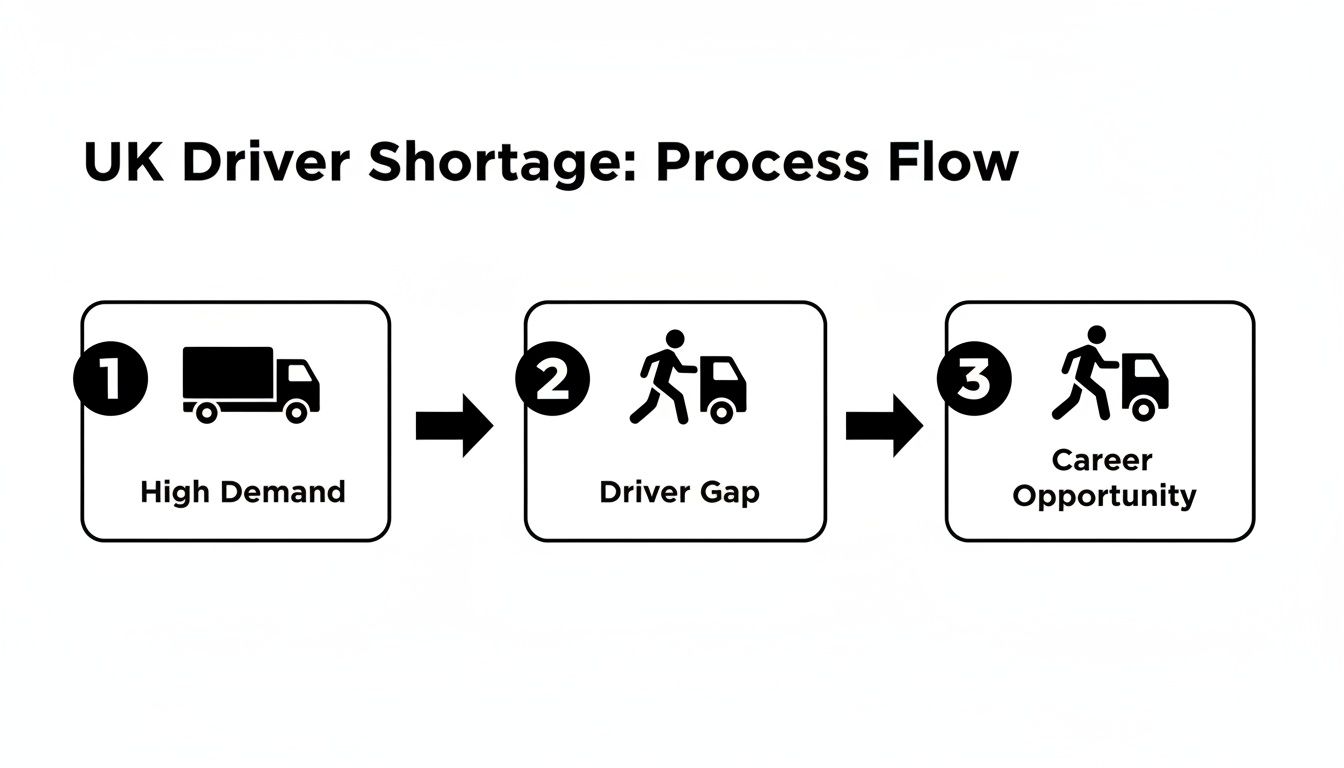
This diagram really highlights the current situation, showing how the high demand and driver gap have created a massive career opportunity.
It makes it plain to see: for every driver leaving the industry, a new position opens up for a qualified candidate ready to step in.
The Essential Driver CPC
Finally, every professional lorry driver in the UK must hold a Driver Certificate of Professional Competence (CPC). This isn’t just a tick-box exercise; it’s your proof that you meet the high professional standards for safety and knowledge that the industry demands.
The Driver CPC is split into initial theory tests and practical tests covering driving ability and vehicle knowledge. Once you’re qualified, you must complete 35 hours of periodic training every five years to keep your CPC valid.
This qualification is absolutely essential for anyone wanting to drive for a living. It ensures every driver on the road is up-to-date with the latest regulations and best practices. If you want a more detailed look at the entire journey, our guide on how to get an HGV licence in the UK breaks everything down.
Crafting a CV That Gets You Noticed
Think of your CV as your first handshake with a potential employer. Long before you get to talk about your skills face-to-face, this single document has to do the heavy lifting. It needs to prove you’re a professional, reliable driver and it’s the key to turning a casual search for “lorry driver jobs near me” into a diary full of interviews.
Forget about those generic templates that just list old jobs without any real context. A busy transport manager needs to see the crucial details straight away. Your CV should immediately put your qualifications front and centre, making it obvious you’re a serious candidate. A great starting point is learning how to write a resume that wins interviews: it makes your suitability undeniable.
Highlighting Your Key Qualifications
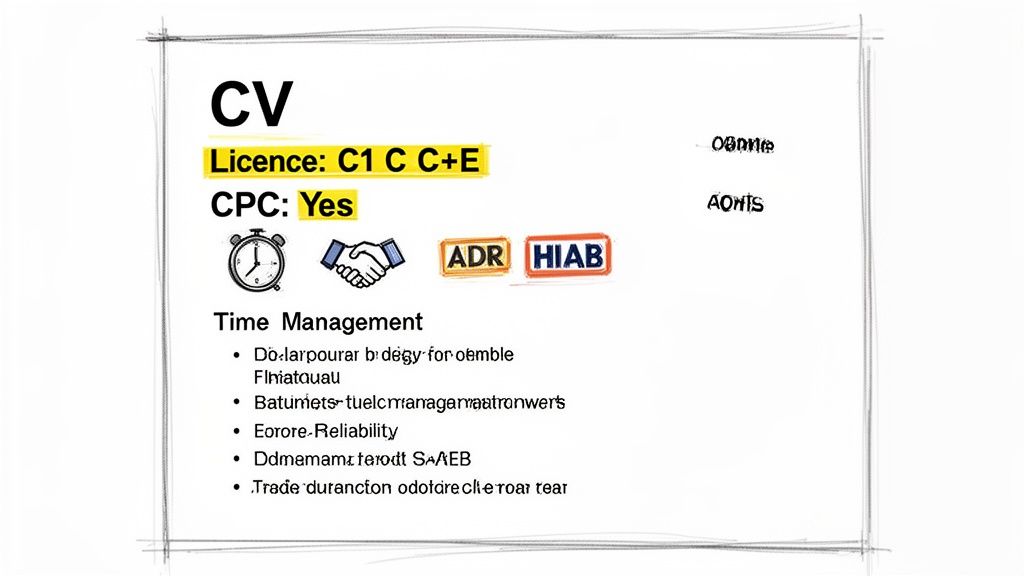
Your licences and certifications are your most valuable assets on paper, so don’t bury them at the bottom of the page. The best approach is to create a standout section right at the top, just after your name and contact details.
A clean, bulleted list is your best friend here. It’s easy to scan and guarantees no recruiter will miss your core skills.
HGV Licence Categories: Be specific. Clearly state which licences you hold (e.g., Category C, Category C+E).
Driver CPC Status: Confirm you have a valid Driver Certificate of Professional Competence and, importantly, include your expiry date.
Specialist Tickets: List any extra qualifications you’ve earned, like ADR (for hazardous goods), HIAB (for lorry-mounted cranes), or Forklift licences.
Digital Tachograph Card: A simple confirmation that you have a valid driver card is all that’s needed.
This method instantly shows an employer that you meet the essential legal requirements for the role. It saves them time and pushes your application straight to the top of the pile.
Turning Past Experience into Driving Strengths
But what if you’re new to the industry? Don’t panic. A surprising number of skills from other jobs are highly valued in logistics. It’s all about how you frame them. Put yourself in a transport manager’s shoes: they’re looking for someone punctual, responsible, and great at solving problems on the fly.
For instance, did you work in retail? That means you have proven time management skills from handling stock deliveries and solid customer service experience from dealing with the public. Maybe you came from hospitality? You’ll have developed excellent problem-solving abilities and know what it’s like to work under pressure to hit tight deadlines.
By translating your past roles into the language of logistics, you present yourself as a capable, well-rounded candidate, not just another new driver with a licence. For more tips on making your application stand out, take a look at our guide on HGV recruitment advice.
Smart Strategies to Find Local Driving Vacancies
With your CV polished and ready to go, it’s time to switch gears from preparation to action. Finding the right “lorry driver jobs near me” isn’t just about a quick online search; it’s about having a smart, focused strategy that hits all the best places to find local work.
The most effective way forward is to tackle it from a few different angles at once. When you combine the massive reach of online job boards with the insider knowledge of specialist recruiters and the directness of approaching local firms, you cast a much wider net. This massively boosts your chances of landing the perfect role.
Master the Online Job Boards
Websites like Indeed, Totaljobs, and Reed are fantastic places to start, but just typing in “lorry driver” will probably leave you scrolling through hundreds of irrelevant results. The trick is to get clever with your filters and keywords to zero in on jobs that are a perfect match for your new licence and where you live.
For instance, get specific with your searches:
“Category C driver jobs in Manchester” to find Class 2 roles in a specific city.
“7.5 tonne driver Basildon” if you’ve got a C1 licence and are looking for local delivery gigs.
“Newly qualified HGV driver” to find employers who are happy to take on new drivers.
Make sure you set up email alerts for these specific searches. That way, the best local driving jobs land directly in your inbox the minute they’re posted, putting you right at the front of the queue.
Partner with Specialist HGV Recruitment Agencies
While the job boards are great, many of the best driving jobs never even get advertised to the public. Haulage companies often go straight to specialist HGV recruitment agencies to find good, reliable drivers without the hassle. Getting yourself registered with a few of these is a brilliant move.
These agencies have strong relationships with local transport firms and are tapped into a kind of “hidden job market.” They know the industry inside out and can match your exact skills, whether it’s a shiny new C+E licence or a HIAB ticket, with an employer who needs them right now. Unlike the generalist agencies, they speak your language and won’t waste your time with jobs that aren’t right.
Think of a good HGV recruitment consultant as your personal career agent. They can give you solid feedback on your CV, prep you for interviews, and even negotiate pay rates for you. They’re a powerful ally to have in your corner.
Go Direct to Local Employers
Don’t underestimate how effective a direct approach can be. Loads of small and medium-sized haulage firms, builders’ merchants, and local distribution centres are always on the lookout for good drivers, even if they don’t actively advertise online. Just think about the businesses in your area: who’s running lorries?
Make a list of local companies and have a look at the careers section on their websites. Even better, if you feel up to it, why not drop your CV off in person? Walking into a local depot with your C1 licence in hand and a professional attitude can make a really strong, memorable impression.
Here are a few types of local employers to think about targeting:
Local Haulage and Transport Companies: The most obvious choice for all licence categories.
Builders’ Merchants and DIY Stores: Often need C1 or Category C drivers for local drops.
Scaffolding and Construction Firms: Regularly need drivers for their tippers and flatbeds.
Supermarket Distribution Centres: A huge employer of C+E drivers for trunking work.
Waste Management and Recycling Services: Consistently hiring Category C drivers for their collection routes.
This kind of proactive approach really shows you’ve got initiative and are genuinely keen to work locally: qualities every transport manager looks for. By combining this with your online searches and agency contacts, you create a powerful, all-round strategy for finding that ideal driving job.
Passing the Interview and Driving Assessment
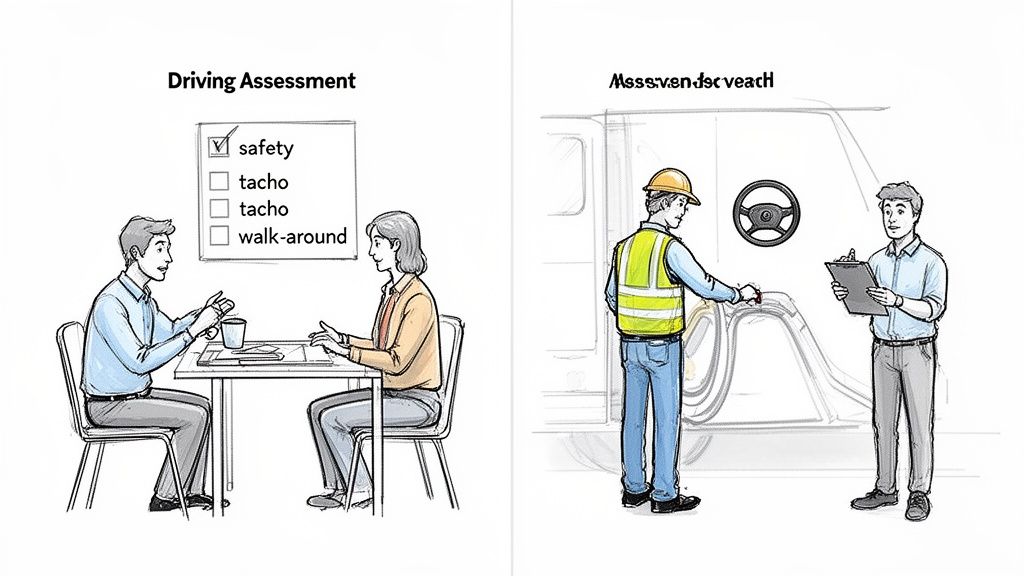
Getting that call for an interview is a fantastic sign. It means your CV has hit the mark, and now it’s your chance to show you’re the right person behind the wheel. The process usually involves two parts: a formal sit-down interview and a practical driving assessment. Both are equally crucial for landing the best local lorry driver jobs.
The Interview: More Than Just a Licence
The interview is where you prove your professionalism and depth of knowledge. Employers aren’t just looking for someone with the right licence; they want a driver who lives and breathes safety and compliance. You should fully expect questions about your understanding of drivers’ hours, tachograph rules, and defect reporting.
Common Interview Questions and How to Handle Them
Preparation is everything. Before you walk in, think about how your experience matches what a transport manager is looking for. They need reliable candidates who can think on their feet and put safety first, no matter what.
Here are a few questions that almost always come up:
“Talk me through your daily walk-around check.” Don’t just rattle off a list. Explain why you check each item. For instance, you check tyre pressures and treads not just because it’s on the list, but to ensure the vehicle is roadworthy and to prevent dangerous blowouts.
“What would you do if you were running late for a delivery due to traffic?” The only right answer revolves around safety and communication. Explain that your first move would be to find a safe place to pull over, then contact your transport manager to update them on the delay. You’d make it clear that you would never compromise speed limits or driving hours just to make up time.
“How do you ensure you stay compliant with drivers’ hours regulations?” This is your chance to show you know your stuff. Mention your solid understanding of daily and weekly driving limits, mandatory rest periods, and the critical importance of using your tachograph card correctly to log every bit of activity.
Answering with specific examples from your past experience and maintaining a safety-first mindset shows you’re not just quoting a textbook. It proves you know how to apply the rules in the real world, which builds immediate trust with an interviewer.
The Practical Driving Assessment
Once you’ve nailed the interview, it’s time for the driving assessment. This isn’t another driving test; you’ve already passed that. Think of it as an opportunity for an assessor, often a senior driver or instructor, to see how you handle a big rig in a real-world environment.
They’ll be watching for several key things. Assessors want to see smooth gear changes, good forward planning, and excellent spatial awareness, particularly when you’re navigating tight junctions or tricky roundabouts. Your observation skills are also under the microscope. Are you checking your mirrors constantly and anticipating what other road users might do next?
Another massive part of this is demonstrating fuel-efficient driving. This means avoiding harsh acceleration and braking, using your gears intelligently, and keeping a steady speed where possible. Showing you can drive economically is a huge plus for any employer, as it directly saves them money.
The best advice? Stay calm, drive the way you were taught, and don’t be afraid to communicate with the assessor. A confident, safe, and considerate drive will leave a brilliant, lasting impression.
Your Career Partner from Training to Employment
Making the leap from a new trainee to a fully employed driver can feel like a mountain to climb. Passing your test is a massive achievement, but what comes next is often the most important part of the journey. This is where a proper training partner really shows their value, acting as a bridge between your new qualifications and the best local lorry driver jobs out there.
The support shouldn’t just stop the second you have your licence in hand. A proper pathway guides you right from the very start of your training through to your first day on the job. It’s a structured approach designed to cut out the confusion and build your confidence every step of the way.
The Three-Stage Pathway to Success
A clear, well-organised plan makes all the difference. Think of it as a three-part journey where every detail is managed for you, so you can focus entirely on learning the ropes.
Documentation and Medicals: All the initial admin is handled for you, from booking your D4 medical to helping you apply for your provisional licence. It takes the stress right out of the paperwork.
Theory and Practical Training: You’ll get engaging theory prep tools to track your progress before you get behind the wheel for hands-on, practical training with DVSA-approved instructors at a local centre.
Post-Training Job Support: This is the crucial final step. It involves dedicated recruitment guidance and job-matching support to connect you directly with employers who are actively hiring in your area.
This complete, end-to-end support system is what turns a training course into a genuine career launchpad.
The real value is in that final stage. Having an experienced team helping you find work means you’re not just left to scroll through job sites on your own. You get access to a network of employers in logistics, construction, and utilities who already trust the quality of your training.
Making a Driving Career Accessible
Worries about cost should never be a barrier to starting a brilliant new career. That’s why flexible payment plans are so important. Having options that let you spread the cost of your training over a manageable period makes the whole thing much more accessible.
These plans mean you can invest in your future without facing a huge upfront bill. It’s a practical solution that allows anyone who is serious about becoming a professional driver to take that first important step. By combining comprehensive training, dedicated job support, and manageable payment options, the road to becoming a lorry driver is clearer and more achievable than ever before.
Your Questions Answered: Pay, Timetables, and Job Types
We get a lot of the same questions from people looking into lorry driver jobs, so let’s tackle them head-on. Here are some straightforward answers about what you can expect in terms of earnings, how long it takes to get on the road, and what the job market looks like.
How Much Can I Realistically Earn as a New Lorry Driver?
This is the big one, isn’t it? Let’s break it down.
As a newly qualified Category C (Class 2) driver, your starting salary will typically fall somewhere between £28,000 and £34,000 a year. This is the most common entry point for drivers fresh out of training.
The real jump in earning potential comes when you get your C+E (Class 1) licence. At that point, you can expect starting salaries to be in the £35,000 to £45,000+ bracket. From there, your pay can climb nicely with a bit of experience under your belt, especially if you add specialist tickets like ADR for handling hazardous goods or a HIAB for crane operation.
How Long Until I Find a Job After Qualifying?
The whole process, from the day you apply for your provisional licence to the day you pass your final practical test, usually takes about 8 to 12 weeks. This can shift a bit depending on how busy your local test centres are.
But the good news? The job market is crying out for qualified drivers. With the current shortage, many of our trainees who use our job-matching support land their first professional driving role within a couple of weeks of getting their licence.
The key is to be proactive. With the right support connecting you to local employers, you can move from training to employment much faster than going it alone.
What Is the Difference Between Agency and Permanent Work?
Getting your head around this is vital when you’re just starting out. They’re two very different ways of working, and each has its pros and cons.
Agency Work: This route offers brilliant flexibility. You can try different types of work, different routes, and often get a higher hourly rate. The trade-off is that you usually don’t get guaranteed hours, holiday pay, or sick pay.
Permanent Job: This is the more traditional route. You get a stable, predictable monthly salary, a set work pattern, and the security of full employee benefits. It’s the safer long-term bet for most people.
A lot of new drivers start out with agency work. It’s a fantastic way to build up your experience across a few different sectors before you decide to settle into a permanent role.
Ready to turn your search for “lorry driver jobs near me” into a reality? HGV Learning provides the complete pathway from initial training and licensing to dedicated job-matching support, connecting you with top local employers. Start your journey today at https://hgvlearning.com.
Related Articles
16/10/2026
What Age Can You Start HGV Driver Training? A 2026 UK Guide to Licence Age Requirements
If you're asking what age you can start HGV driver training, the honest answer depends on which licence you're after. A C1 licence, covering vehicles...