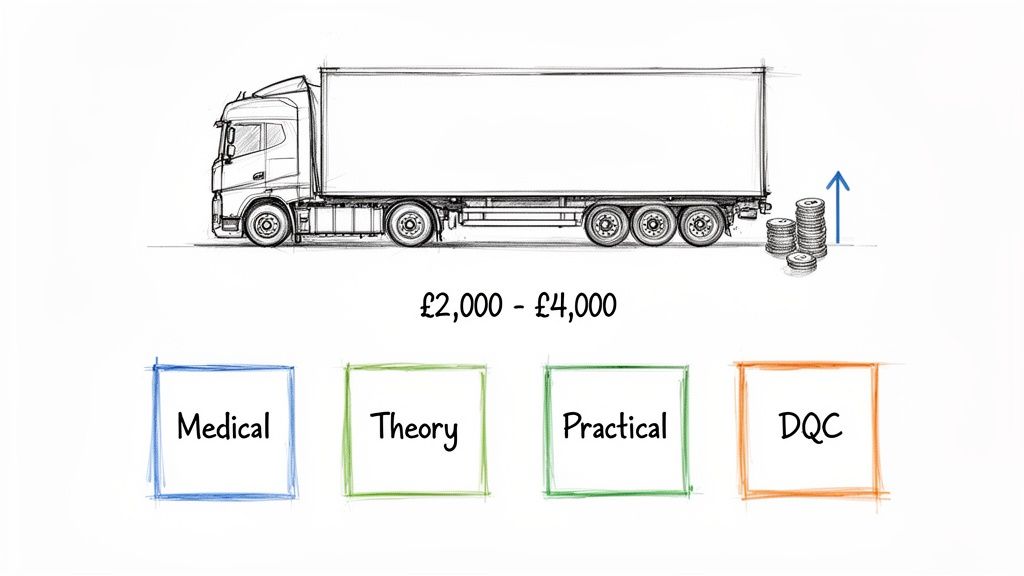
The total cost for your Class 1 HGV training in the UK will likely be somewhere between £2,000 and £4,000. This ballpark figure covers everything you’ll need to get on the road professionally – from the initial doctor’s medical and theory exams right through to your practical lessons and final Driver CPC card.
Understanding Your Investment in a Class 1 Licence
Starting a career as a professional HGV driver is a big move, and getting your head around the costs involved is the first real step. Think of it less as an expense and more as a direct investment in a solid, in-demand career. With great earning potential and real job security, that Class 1 (C+E) licence is your ticket to a whole new future.
Instead of seeing one big, intimidating number, it’s much easier to break the cost down into manageable chunks. Each part of the process, from the medical check-up to the practical tests, has its own fee. This way, you can pay for each stage as you go, which makes the whole thing feel a lot less daunting.
The Key Stages of Your Training Costs
Your journey to getting qualified is split into three main parts, and each one contributes to the final cost. Every single driver has to go through these steps to get their licence and start earning.
Medical and Provisional Licence: This is where it all begins. You need to prove you’re medically fit to drive a large vehicle and get the right provisional entitlement added to your car licence.
Theory Test Preparation: Before you can even think about climbing into a cab, you’ll need to pass your theory tests. This includes multiple-choice questions, hazard perception, and the initial Driver CPC (which is Part 2, the case studies).
Practical Training and Tests: This is the biggest part of your investment. It covers all your one-to-one driving lessons in an artic, the hire of the lorry for your test day, and the test fees themselves.
The flowchart below gives you a clear picture of how that total investment is typically split across these key areas.
As you can see, the practical training takes up the lion’s share of the budget, but you can’t get there without first ticking off the medical and theory stages. They are absolutely essential first steps.
Why This Investment Matters Now More Than Ever
The need for qualified drivers isn’t just a talking point; it’s a critical reality for the UK economy. The Road Haulage Association (RHA) now reckons a massive 60,000 new HGV drivers are needed every single year just to keep things moving. This incredible demand is exactly why getting your Class 1 licence is such a secure and valuable career move right now.
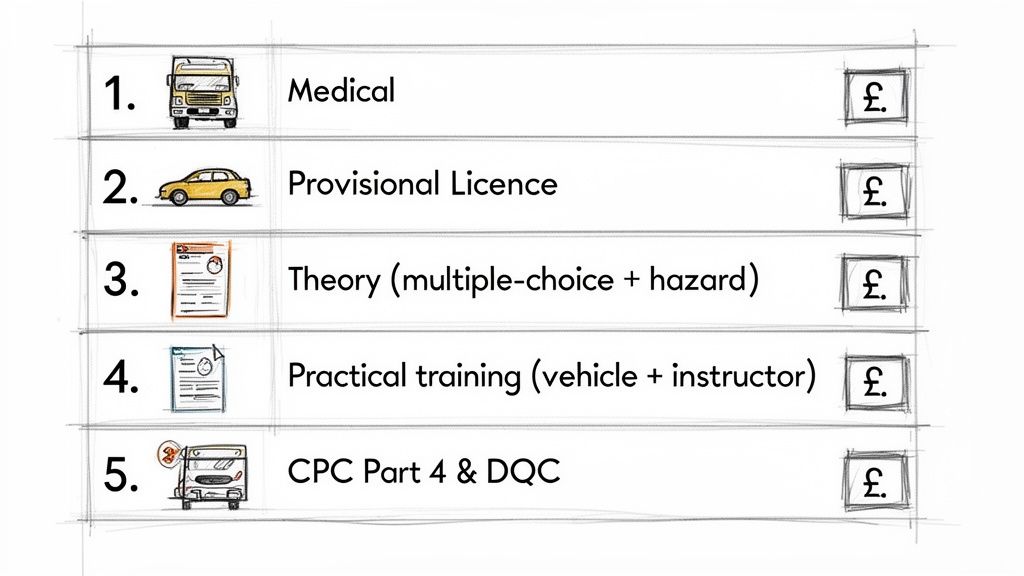
Breaking Down Your HGV Training Bill Step by Step
Knowing exactly where your money is going is the key to feeling confident about your HGV training investment. When you get a quote, you’re not just looking at a single figure; you’re seeing a breakdown of several essential steps, each with its own price tag. Viewing it this way makes the total cost much clearer and easier to manage.
Let’s walk through the entire journey, from that initial doctor’s appointment right through to getting your final Driver Qualification Card. This guide will demystify the cost of your HGV training for Class 1 and make sure there are no nasty surprises waiting for you.
The First Hurdles: Medical and Provisional Licence
Before you even think about climbing into a cab, you need to sort out the official paperwork. This first stage is non-negotiable and lays the foundation for your entire HGV career.
The very first thing on your to-do list is a driver medical. Think of it as a slightly more thorough version of a normal check-up, where a doctor confirms you meet the DVSA’s health and eyesight standards. You can expect this to cost anywhere from £50 to £100.
With your medical certificate (the D4 form) in hand, you’ll use the D2 form to apply for your provisional HGV licence. Sending these off to the DVLA is usually free, but it’s a vital administrative step you can’t skip.
Conquering the Theory Tests
Once your provisional licence arrives, it’s time to hit the books. The theory tests are there to make sure you have the road knowledge and hazard awareness needed to be a safe professional. This part is split into three sections, which you’ll often hear referred to as Modules 1 and 2 of the Driver CPC.
Part 1a Multiple-Choice Questions: This test costs £26 and covers everything from road signs to safe vehicle loading.
Part 1b Hazard Perception: For £11, this video-based test checks how quickly you can spot developing dangers on the road.
Part 2 CPC Case Studies: This £23 test uses real-world scenarios to see how you’d handle situations you’ll face as a pro driver.
Passing all of these is your ticket to the practical training. You cannot book your driving test until these are all successfully completed.
Remember, the theory tests aren’t just a hurdle to jump. They give you the essential knowledge that keeps you, your lorry, and everyone else on the road safe. Mastering this material is the first sign of a true professional.
The Main Event: Practical Training and Tests
This is where the biggest chunk of your budget will go. Your practical training is where you get behind the wheel of an artic with a qualified instructor, learning the skills you need for the final two parts of your Driver CPC. For a closer look at budgeting for this stage, check out our guide on how much an HGV licence costs.
A good all-inclusive training package will typically bundle these costs together:
Instructor Fees: This pays for the expert one-to-one tuition, usually over a set number of days like a 5-day course.
Vehicle Hire: You’ll be using the school’s lorry for your lessons and the test itself.
Insurance: This ensures you’re fully covered while you’re learning.
Test Fees: The cost of the practical tests themselves is built-in.
The practical tests are split into two parts, which together form Module 3 of the Driver CPC.
Part 3a Off-Road Manoeuvres: This £40 test covers the reversing exercise and showing you can safely uncouple and recouple the trailer.
Part 3b On-Road Driving: This is the main event. Costing £115 on a weekday, an examiner will assess your driving skills on public roads for about an hour.
Final Certification: Your Driver Qualification Card
After passing all your theory and practical tests, there’s just one more step to go: the CPC Part 4. This is a practical, hands-on test where you demonstrate your knowledge of vehicle safety.
The test, which costs £55, involves walking around the vehicle and answering questions on things like securing loads, preventing illegal trafficking, and doing your daily safety checks. Passing this final module qualifies you for your Driver Qualification Card (DQC), or CPC card. The fee for issuing the card is included in the test price, officially making you a qualified HGV driver, ready to hit the road.
How Location and Choices Affect Your Final Training Cost
The final figure on your invoice for HGV training isn’t set in stone. Several key factors can shift the total amount you’ll end up paying, meaning the cost for HGV training Class 1 can look quite different from one person to the next. Understanding these variables puts you back in the driver’s seat, letting you make smart choices that suit your career goals and your wallet.
Just like house prices, training costs often reflect the local economy. A training school in central London is going to have higher overheads—rent, fuel, you name it—and those costs inevitably get passed on to you. Head out to a school in a more rural spot, however, and you might find a much more competitive price for the exact same qualification. That difference can easily be several hundred pounds.
It really does pay to shop around. While the local school might be convenient, widening your search could unlock some serious savings. If you want to see what’s out there, our guide to finding HGV driver training near you is a great place to start comparing providers.
Automatic vs Manual: Which Is Right for You?
Another big decision is the type of gearbox you train on. Choosing between an automatic or a manual lorry isn’t just about what you prefer; it has a direct impact on your job prospects and can even affect the initial training cost.
Most modern HGV fleets are automatic. They’re more fuel-efficient and easier on the driver during a long haul. Because of this, training in an automatic is pretty much the standard now, and it can sometimes be a bit cheaper as the lorries are more common at training schools. It’s also generally seen as easier to learn, which could mean you need fewer lessons to get test-ready.
However, going for a manual licence gives you ultimate flexibility. If you pass your test in a manual, you’re qualified to drive both manual and automatic HGVs. Pass in an automatic, though, and your licence will be restricted, meaning you can only drive automatics. While most jobs are in automatic lorries, some specialist roles or older fleets still rely on manual skills.
Think of it like this: passing in an automatic gives you the key to most doors, but passing in a manual gives you the master key to all of them. The small extra effort upfront could open up more opportunities down the road.
Your Previous Experience: A Cost-Saving Advantage
Perhaps the biggest thing that will influence your final training bill is your existing driving experience. Your journey to a Class 1 (C+E) licence can take one of two paths, and one is significantly quicker—and cheaper—than the other.
The two main routes are:
Direct Access: This is for drivers starting from scratch with a standard car (Category B) licence. You’ll be trained to pass the Category C (rigid lorry) test first, then move straight onto the C+E (articulated lorry) training and test. It’s the most complete route, and naturally, the most expensive.
Staged Training: This path is for drivers who already hold a Category C licence. If you’ve previously qualified to drive rigid lorries, you’ve already done a huge chunk of the work. You can jump straight to the C+E practical training, which slashes the time and money required.
For anyone who already has their Cat C, the cost to upgrade to Class 1 is a fraction of the full price. You do not need to do the medical, provisional application, or theory tests all over again. You’re simply adding the “E” entitlement to tow a trailer. It’s a much smaller, more focused investment for drivers looking to take the next step in their career.
Smart Ways to Fund Your Class 1 HGV Licence
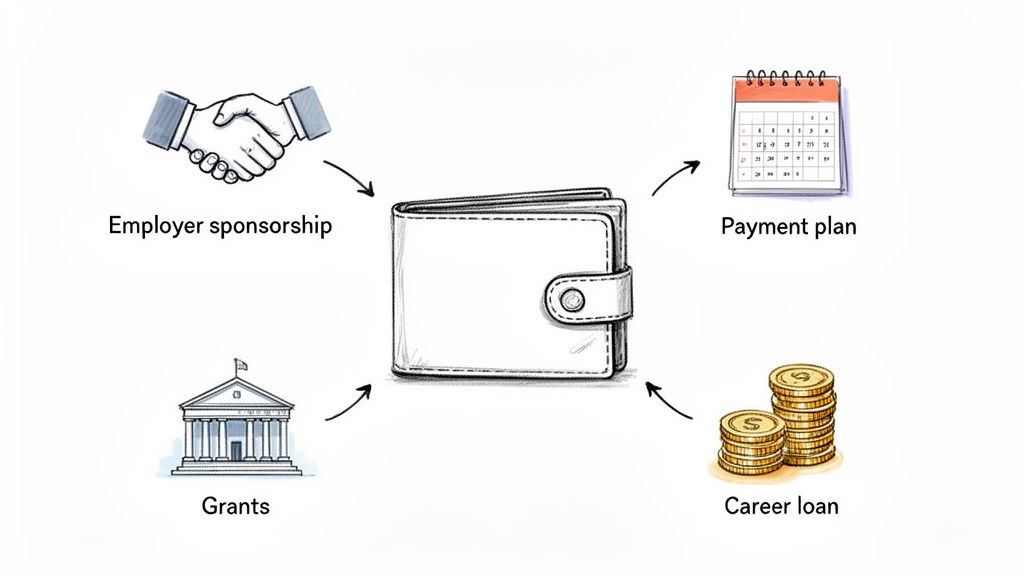
Seeing the upfront cost for HGV training can feel like a barrier, but it absolutely should not be the thing that stops you from starting a new career. The good news is there are plenty of practical ways to cover the cost of HGV training for Class 1, making it far more manageable than you might first think.
Understanding these options is the key to turning your goal into a reality, without putting a huge strain on your finances. From getting your boss to foot the bill to spreading the payments out, you have more choices than you probably realise. Let’s walk through the most common routes.
Employer Sponsorship a Popular Route
One of the most straightforward ways to get funded is through your current employer. Haulage firms, logistics companies, and even big retailers are crying out for qualified drivers and are often more than willing to invest in their own staff to fill those empty seats. This is a brilliant option if you’re already in the industry, maybe working in the warehouse or as a driver’s mate.
How does it work? A company pays for your training from start to finish. In return, you agree to work for them for a fixed period once you have your licence. It’s a win-win: they secure a skilled, loyal driver, and you get your licence without spending a penny. If this sounds like it could work for you, have a chat with your manager or HR department to see what upskilling opportunities are on the table.
Spreading the Cost with Payment Plans
If employer sponsorship isn’t on the cards, don’t worry. Most good training providers know that the full cost is a big lump sum to find all at once. That’s why they offer flexible payment plans, letting you spread the expense over several months.
Think of it like a monthly subscription for your new career. Instead of one large payment, you make smaller, regular payments that are much easier to fit into your budget. This approach removes the immediate financial pressure and lets you focus on your training.
These in-house finance plans often come with zero or very low interest, which makes them a much better deal than a standard bank loan. Always ask a training school about their payment options when you first get in touch. You can also get more ideas from our detailed guide on how to finance your HGV training.
Government Schemes and Grants
In the past, government-funded schemes were a massive help for getting new drivers on the road. The HGV Skills Bootcamp programme, for example, was a huge success, training just over 11,000 people on fully paid-for courses. However, that scheme’s central funding is ending after September 2025, and things are changing. Now, the responsibility is shifting to local councils, so the availability of similar support might depend on where you live. You can learn more about the impact of these funding changes from Fagan & Whalley.
It’s always worth keeping an eye out for any local or national grants that pop up, especially when there’s a push to fix driver shortages. Websites like the National Careers Service are a good place to start your search.
Other Financial Avenues to Explore
Beyond those main routes, there are a couple of other options worth considering. They need a bit more careful thought, but for some people, they can be the perfect solution.
Career Development Loans: These are specific loans from banks designed to help pay for courses that boost your career. The interest rates can be better than a typical personal loan, but you’ll still need to pass the lender’s credit checks.
Personal Savings: If you’re in a position to use your own savings, it gives you complete freedom. You will not owe anyone, and you can pick any training provider you like without being tied to a specific employer.
By looking into all these different avenues, you can build a funding plan that works for your situation. The key is to be proactive, ask lots of questions, and find the path that makes your new HGV career both affordable and achievable.
Calculating the Return on Your HGV Career Investment
It’s easy to look at the training fee as just another bill to pay, but that’s missing the bigger picture. Think of it instead as one of the smartest investments you can make in your professional future. The initial outlay for a Class 1 licence is quickly dwarfed by the strong, stable earning potential that comes with it, making the cost of HGV training for Class 1 a launchpad for long-term financial security.
Let’s break down the impressive return you can expect from that investment. We’ll look at realistic salaries, how your career can grow, and the extra perks that really show the value of getting your C+E licence.
Realistic Salary Expectations for New Drivers
As soon as you have your Driver Qualification Card in hand, you can start earning. The demand for qualified HGV drivers is huge, meaning newly passed Class 1 professionals are snapped up quickly—and the starting salaries reflect that urgency.
You can expect to step straight into a role where the pay makes that initial training cost feel very manageable. Recent industry data shows that brand-new Class 1 drivers typically earn between £30,000 and £35,000. When you put that against the average training cost, you can see just how fast you’ll earn back your investment, often well within your first year of full-time work.
Your Earnings Potential Over Time
That starting salary is just the beginning. One of the best things about a career in logistics is the clear path for financial growth. With just a few years of experience under your belt, your value as a driver skyrockets, and your pay packet grows to match.
The average HGV driver salary has climbed to around £42,000, with experienced pros commanding anywhere from £35,000 to over £50,000 a year. Projections for 2025 suggest this could climb even higher, potentially hitting £55,000 as companies compete for the best talent. These figures prove the initial investment isn’t just paid back quickly; it pays you back for years and years to come. You can find out more about HGV driver earnings from HOV Training.
Your Class 1 licence isn’t just a certificate; it’s an asset that appreciates in value. Every mile you drive and every year of experience you gain directly translates into higher earning potential, making it a career that truly rewards your dedication.
More Than Just a Basic Salary
A driver’s annual income is rarely just their basic pay. Most HGV driving roles come with extra financial benefits that can seriously boost your take-home earnings. Understanding these perks gives you a much clearer picture of what your financial future on the road really looks like.
Common additional earnings include:
Overtime Pay: Logistics never sleeps, so there are almost always opportunities to take on extra hours at a higher rate. This can make a massive difference to your monthly income.
Performance Bonuses: Many firms incentivise safe and efficient driving. These bonuses reward you for your professionalism, paying out for things like fuel efficiency and accident-free records.
Night Out Allowances: If your job involves nights away, you’ll typically get a tax-free allowance to cover your expenses. This really adds up over the year.
Specialist Skill Premiums: Getting extra tickets, like an ADR licence for hazardous goods or HIAB crane certification, opens the door to higher-paying, specialised work.
When you add these common extras into the mix, the overall financial package becomes even more attractive. This career offers not just a job, but a stable and prosperous future in an industry vital to the UK economy, proving the long-term value of your initial investment.
Your Top HGV Training Questions Answered
Let’s wrap things up by tackling the questions that are probably on your mind right now. Getting clear, honest answers is the best way to feel confident about taking the next step. This section is all about clearing up any last bits of confusion around the cost of your HGV training for Class 1 and what the journey really looks like.
We’ll look at everything from how long it all takes to what happens if you have a bad day and need a retest. Think of it as a final chat before you pick up the phone to a training provider.
How Long Does Class 1 Training Take From Start To Finish?
This is a big one. From the moment you commit to getting your licence until you’re holding your Driver Qualification Card, you should plan for a timeframe of around 8 to 10 weeks.
What can slow things down? Waiting for a doctor’s appointment for your medical or delays at the DVLA while they process your provisional licence can add a few weeks. But once that provisional licence lands on your doormat, things speed up considerably. The practical training is usually done as an intense, one-week course.
The key thing to remember is this: you can go from a standard car licence to being a fully qualified, professional HGV driver in less than three months. It’s one of the fastest routes into a stable, well-paid career.
Do I Need A Category C Licence First?
This used to be a common stumbling block, but the rules changed a few years back to make life easier. The short answer is no, you do not need to pass your Category C (rigid lorry) test before you start Class 1 (C+E) training.
This is what’s known as the ‘direct access’ route. It lets you go straight from your car licence (Category B) to training for the biggest lorries on the road. This is a massive plus, saving you the time and money of taking two completely separate practical tests.
Of course, if you already have your Cat C licence, your path is even quicker. You can skip the medical, provisional application, and theory tests and jump straight into the practical C+E training. Upgrading becomes a much smaller and cheaper step.
Are There Hidden Costs Like Retest Fees?
Any good training school will be completely transparent about their pricing, but it’s always smart to ask about retest fees upfront. Nobody goes into a test planning to fail, but it’s a real possibility, and you need to know what the backup plan costs.
If you do not pass one of the practical tests (either the 3a reversing exercise or the 3b on-road drive), you will have to pay for another go. That fee typically covers two things:
The DVSA Test Fee: The official charge from the government for the test slot.
Vehicle and Instructor Hire: You’ll need the lorry and your instructor for the retest appointment.
You can expect a retest to cost a few hundred pounds. Some schools offer ‘pass protection’ deals for an extra fee at the start, which covers the cost of one or two retests if needed. It’s well worth asking about, as it can buy you real peace of mind and protect your budget from surprise expenses.
What Happens If I Fail A Test?
Failing a test feels rough, but it is absolutely not the end of the road. Plenty of fantastic drivers did not pass everything first time. What matters is how you bounce back.
Your instructor will get detailed feedback from the examiner, showing exactly where you picked up faults. This is gold dust. It tells you precisely what you need to focus on.
From there, the process is straightforward. You’ll book some more training time with your instructor to iron out those specific issues. Once you both feel you have cracked it, you book the retest. It’s a chance to learn from a mistake, improve your skills, and come back stronger to get the pass you deserve.
Ready to invest in a rewarding new career? At HGV Learning, we offer clear, upfront pricing and flexible payment options to make your Class 1 licence a reality. Find out more and get your personalised quote today at https://hgvlearning.com.
Related Articles
01/07/2026
ADR Driver Salary UK: Your 2026 Earnings Guide
You're probably here because you typed something like “ADR driver salary UK” into Google and got a mess of answers. One page shows a fairly...