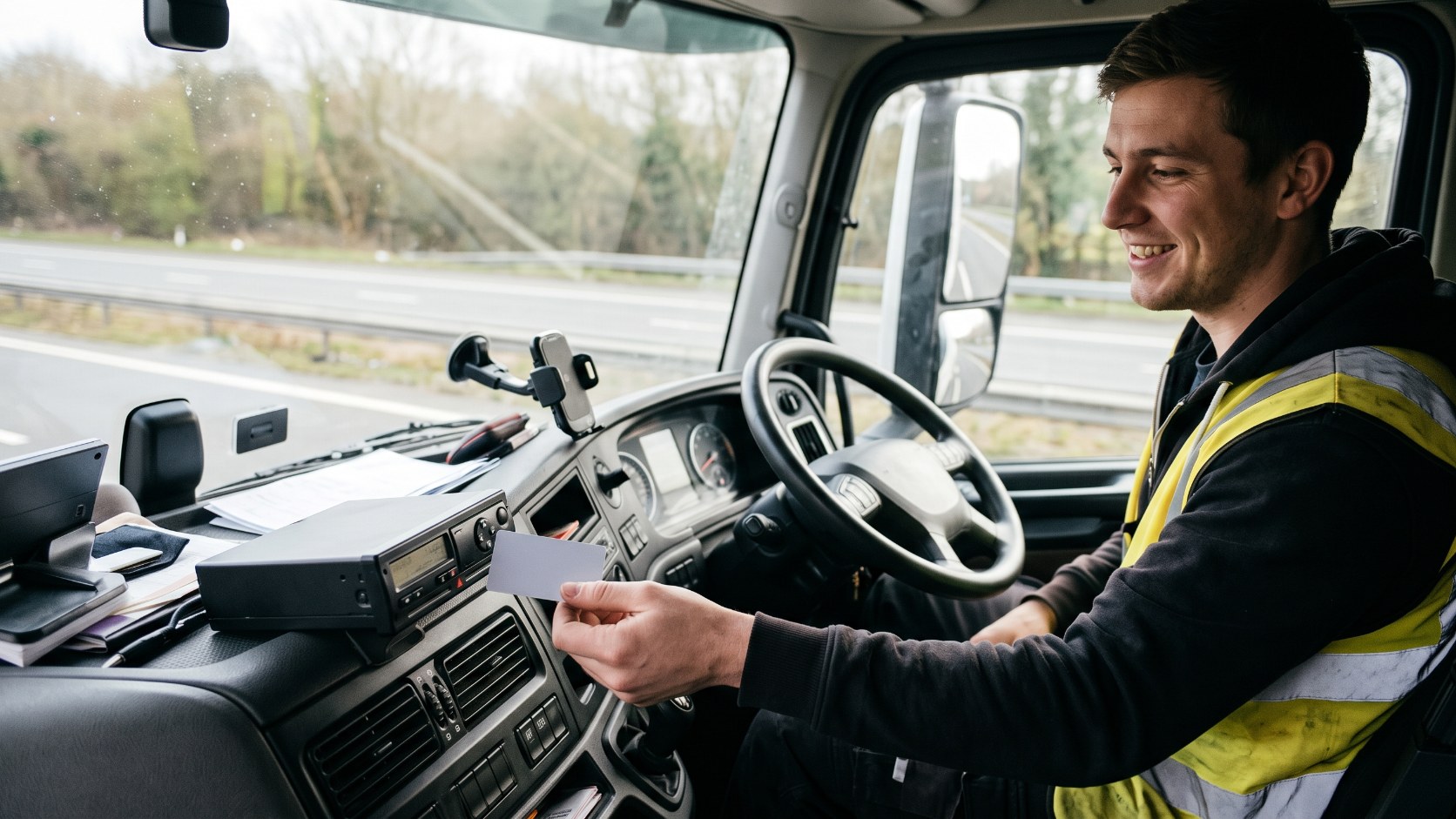
It’s a classic mistake, but the term ‘3.5-tonne van’ isn’t about how much you can load into it. That number actually points to something far more important: the van’s absolute maximum legal weight when it’s fully loaded. This is what the industry calls the Gross Vehicle Weight (GVW), and getting your head around it is the first step to driving safely and staying on the right side of the law.
What a 3.5 Tonne Van Really Means
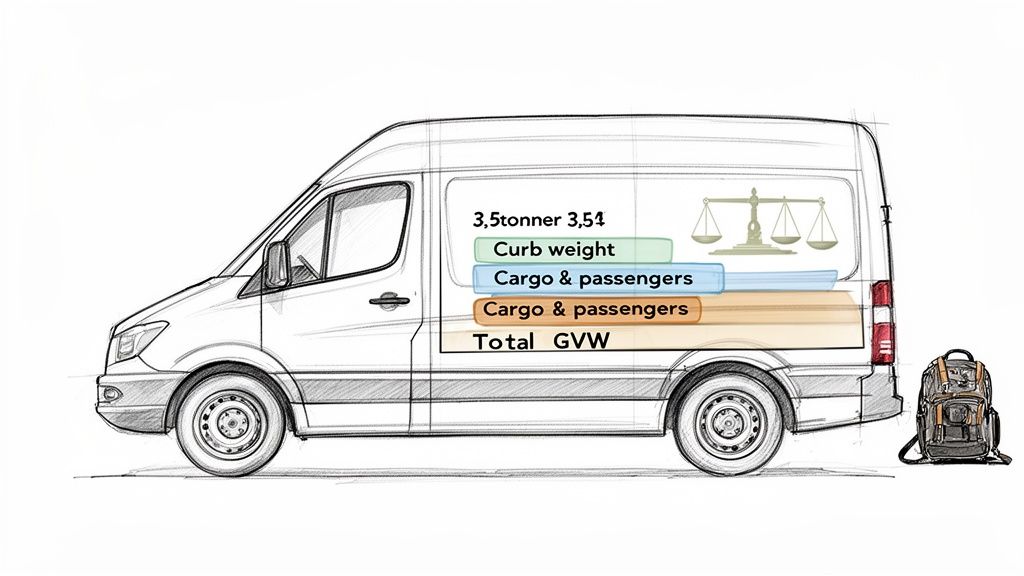
Think of it this way: the 3.5-tonne (3,500kg) limit is the total weight of everything combined. That includes the van itself, you and any passengers, a full tank of fuel, and of course, all your cargo. The whole lot added together can’t tip the scales over that crucial 3,500kg mark.
Getting this wrong is a bigger deal than you might think. Overloading a van isn’t just a slap on the wrist; it can lead to hefty fines, points on your licence, and even having your vehicle taken off the road. More importantly, it’s a huge safety risk. An overloaded van takes longer to stop, is harder to handle, and becomes dangerously unstable.
Understanding Gross Vehicle Weight
To keep everything above board, you need to know two key numbers for any van you drive:
Kerb Weight: This is simply the weight of the van when it’s empty, but with all its standard kit and a full tank of fuel.
Payload Capacity: This tells you the maximum weight of goods, tools, and people you can safely add before hitting that 3,500kg GVW ceiling.
For instance, if your van has a kerb weight of 2,200kg, your maximum payload is 1,300kg. It’s a straightforward calculation (3,500kg – 2,200kg = 1,300kg), but it’s one you need to have in your head for every single trip.
It’s worth noting that the annual MOT test failure rate for Light Goods Vehicles (LGVs) is roughly four times higher than for HGVs. This really drives home how vital proper weight management and professional standards are in the 3.5-tonne category to keep our roads safe.
The Licence Factor: Your Key to Driving
The type of driving licence you hold ultimately decides if you can legally get behind the wheel. When it comes to a 3.5-tonne van, the rules all pivot on one simple fact: the date you passed your car driving test.
This one detail splits drivers into two camps – those who are covered by their standard Category B licence, and those who might need a Category C1. You can learn more about what you need to drive an LGV vehicle in our detailed guide.
Figuring out which group you’re in is the starting point for anyone looking to drive these vans, whether for personal jobs or as a professional. It sets the stage for the specific training and qualifications you might need to get on the road.
Understanding the Licence You Need to Drive
When it comes to driving a 3.5 tonne van, the biggest question is always the same: is my licence up to the job? The answer isn’t as simple as you might think. It all boils down to one very specific date: 1st January 1997.
That single date is the dividing line in UK licensing. When you passed your driving test determines what you can legally drive without needing any extra tests or qualifications. Figuring out which side of that line you’re on is the first, most crucial step.
The Power of Grandfather Rights
If you passed your car driving test before1st January 1997, you’re in luck. You automatically have what’s known as ‘Grandfather Rights’ (or ‘acquired rights’). In short, your standard car licence (Category B) came bundled with extra entitlements, including the all-important C1 category.
This C1 entitlement means you can legally drive any vehicle with a Gross Vehicle Weight (GVW) between 3,500kg and 7,500kg. So, not only can you hop into any 3.5 tonne van, but you can also handle much larger vehicles right up to the 7.5-tonne limit without sitting another test. These rights are yours until your licence expires, which is usually at age 70.
The Post-1997 Rules
For anyone who passed their test on or after1st January 1997, the situation is very different. Your standard Category B car licence only covers you for vehicles with a GVW of up to3,500kg.
This means you’re fine to drive most standard panel vans, like a Ford Transit or a Mercedes Sprinter, as long as their total weight, including everything inside, doesn’t tip over that limit. The moment the GVW goes over 3,500kg, even by a tiny amount, your Category B licence is no longer enough. This is a critical point that trips up a lot of drivers.
It’s a common myth that a ‘3.5 tonne van’ is always covered by a regular car licence. The reality is that once you load them up, many of these vans, especially larger models like Luton box vans or anything with a tail lift, can easily push past the weight limit. For post-1997 drivers, this makes a C1 licence a legal must-have.
When Is a C1 Licence Essential?
In many professional roles, the need for a C1 licence is non-negotiable. For anyone without Grandfather Rights, upgrading is often the only way to get the job.
Here are a few real-world examples:
Ambulance Services: A huge number of NHS and private ambulances are built on a chassis with a GVW that exceeds 3.5 tonnes. If you want to become a paramedic or emergency care assistant, getting your C1 licence is a mandatory first step.
Delivery and Logistics: While a multi-drop courier in a standard van might be fine on a Category B, the driver for a removals or furniture company using a larger Luton van will almost certainly need a C1 licence to handle the vehicle’s weight.
Trades and Construction: Think about a scaffolder or builder using a flatbed truck to haul heavy materials. The combined weight of the vehicle and its load will often be over the 3,500kg threshold, making the C1 licence a requirement.
This simple table breaks down exactly what you need based on when you passed your test.
Driving Test Pass Date
Vehicle Gross Vehicle Weight (GVW)
Licence Required
Before 1st January 1997
Up to 7,500kg
Category B (with C1 Grandfather Rights)
On or After 1st Jan 1997
Up to 3,500kg
Standard Category B
On or After 1st Jan 1997
Between 3,500kg and 7,500kg
C1 Licence (must be taken as a separate test)
At the end of the day, checking your licence and knowing these rules is vital. For anyone who passed their test from 1997 onwards, getting that C1 licence is the key to opening up a much wider range of vehicles and far more job opportunities.
Why Are 3.5 Tonne Van Drivers So In Demand?
Choosing to become a professional driver isn’t just about finding a job; it’s a smart career move. In today’s economy, very few roles can match the stability and consistent demand for drivers qualified to handle a 3.5 tonne van and larger vehicles. This isn’t just a passing trend: it’s a deep-seated shift in how goods get from A to B across the country.
The boom in e-commerce and the urgent need for ‘last-mile’ delivery have completely changed the face of logistics. We all now expect everything from our weekly shop to a new sofa to land on our doorstep quickly and without fuss. This has created a huge, ongoing need for skilled drivers who form the final, vital link in the supply chain.
The Workhorses of Modern Commerce
Every time you click ‘buy now’, a whole delivery network kicks into gear, and more often than not, the 3.5 tonne van is its most critical player. These vans are the perfect size for navigating the tight city streets and residential roads where a massive lorry just wouldn’t fit. They are the true workhorses keeping our modern economy ticking over.
This heavy reliance on local delivery means that qualified drivers are more crucial than ever. For anyone holding the right licence, especially the C1 entitlement, this translates directly into fantastic job security and a wide range of opportunities.
A driving career in this sector is a direct route to stable, reliable work. As long as people keep shopping online and businesses need to move stock, there will always be a high demand for professional, licensed drivers.
Thriving When Other Markets Falter
While other parts of the vehicle market are facing uncertain times, the demand for vans in the 3.5-tonne category and just above remains incredibly strong. This resilience is a brilliant indicator of the sector’s health and its importance to UK businesses.
In fact, recent industry data shows this growth in a spectacular way. While the overall market for light commercial vehicles took a big hit, registrations for rigid vehicles in the 3.5–6 tonne bracket absolutely exploded. This segment shot up by a massive 202.6% year-on-year, making it the only category to see any positive growth during a wider downturn. You can see the full market analysis from the Society of Motor Manufacturers and Traders to check the data for yourself.
A statistic like that tells a clear story: businesses are investing heavily in these specific vehicles. And, as you’d expect, the demand for legally qualified drivers is rising right alongside it.
More Than Just Parcels: Diverse Career Paths
The need for skilled van drivers goes way beyond just delivering parcels. A C1 licence opens up a whole host of essential, and often better-paid, roles across several key industries.
Here are just a few examples of where this qualification could take you:
Construction and Trades: Companies rely on drivers to move heavy materials, tools, and equipment to job sites. This often involves flatbeds or specialised vans that easily tip over the standard 3,500kg GVW limit.
Logistics and Removals: Handling bigger house moves or commercial deliveries in Luton box vans will almost always require a C1 licence, simply because of the vehicle’s weight when it’s fully loaded.
Emergency Services: It’s a very common career path for C1 licence holders to become paramedics or emergency care assistants, as the vast majority of modern ambulances fall squarely into this weight category.
Getting your C1 licence isn’t just about ticking a legal box; it’s a solid investment in your own future. It broadens your professional horizons, makes you eligible for more specialised and secure jobs, and marks you out as a valuable asset in an industry that’s only going to keep growing. It’s your ticket to a more rewarding and stable driving career.
Your Step-by-Step Path to a C1 Licence
Getting your C1 licence might seem like a huge task, but it’s much simpler when you break it down. Think of it less as one giant mountain to climb and more as a series of straightforward, logical steps. With a clear plan and the right support, you’ll go from applicant to qualified driver smoothly and with total confidence.
We’ve mapped out the entire journey into a proven three-stage process. This structure removes all the guesswork, guiding you from the first bit of paperwork right through to passing your final test. Let’s walk through exactly what’s involved at each stage.
Stage 1: The Medical and Provisional Application
Before you can even think about cracking open a theory book or getting behind the wheel, you have to prove you’re medically fit to drive a larger vehicle. This is the first, non-negotiable step required by the DVLA to keep our roads safe. The process is simple and starts with booking a driver medical with a doctor.
During this check-up, the doctor will test your eyesight, go over your medical history, and fill out a D4 form – think of it as your health MOT for driving. At the same time, you’ll need to complete a D2 form, which is your official application to add the provisional C1 entitlement to your licence. We take the hassle out of it by booking the appointment for you and sending both completed forms straight to the DVLA on your behalf.
Once the DVLA has processed everything, you’ll get your driving licence back with the provisional C1 category added. That’s your green light to move on to the next phase.
Stage 2: Theory Training and Testing
With your provisional licence in your pocket, it’s time to tackle the theory. This isn’t just about memorising answers to pass a test; it’s about building the solid foundation of knowledge that every professional driver needs to work safely and effectively. This stage is split into two or three parts, depending on whether you plan to drive for a living.
The main parts are:
Multiple-Choice Theory Test: This checks your understanding of the Highway Code, vehicle safety, and the specific rules for driving larger vehicles.
Hazard Perception Test: A computer-based test that assesses how quickly you can spot developing dangers on the road – a crucial skill for any driver.
Driver CPC Case Studies (Module 2): If your goal is to drive a 3.5 tonne van professionally, you’ll need to pass this test too. It uses real-world situations to see how you’d apply professional driving rules.
To help you get ready, we provide access to supportive training software. It lets you revise at your own pace, try mock tests, and see how you’re improving, so you walk into the test centre feeling completely prepared. We’ll even book your tests for you at a local centre at a time that works for you.
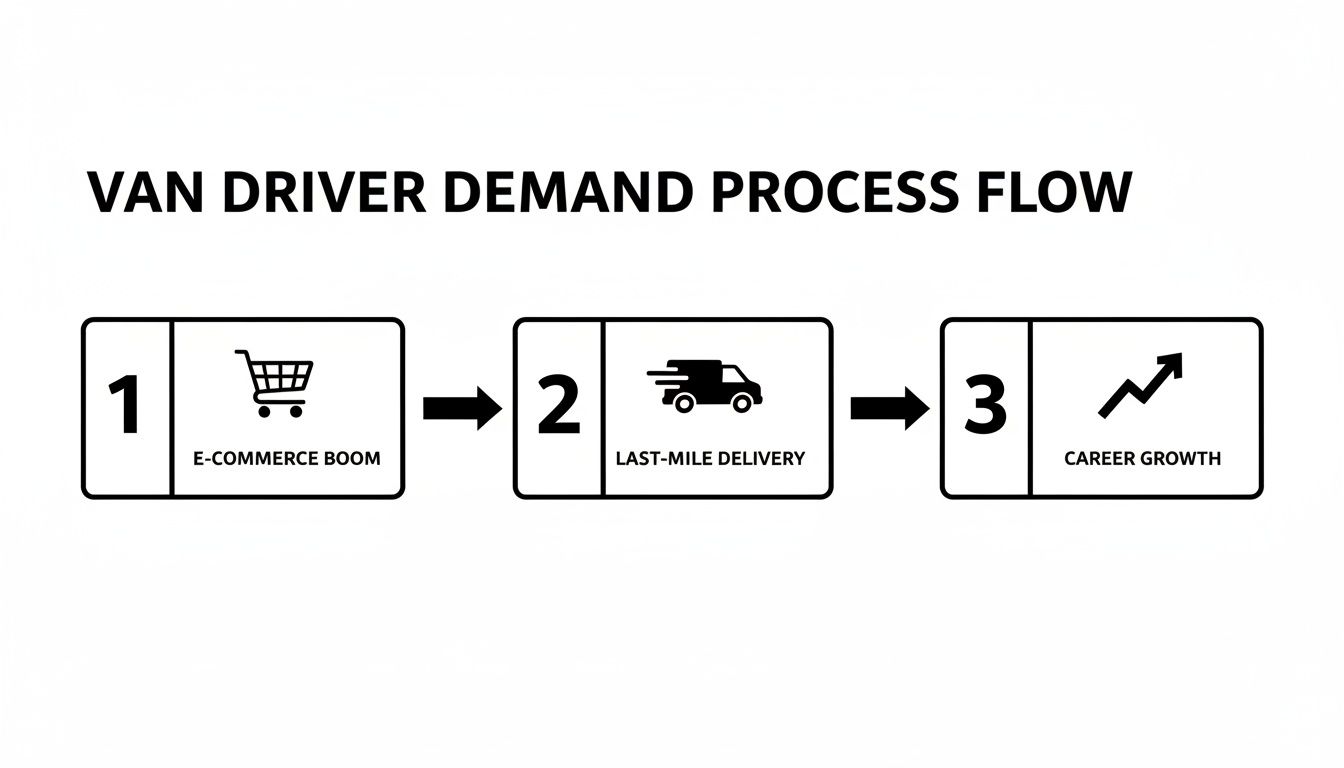
The image below shows how the boom in online shopping is creating more and more demand for drivers like you.
As you can see, the e-commerce explosion directly fuels the need for last-mile delivery drivers, opening up a clear career path for qualified professionals.
Stage 3: Practical Driving and Final Test
This is the final, most exciting part of the journey where everything you’ve learned comes together. Once the theory tests are passed, it’s time to jump in the driver’s seat for your practical training. This is where you’ll build the real-world skills and confidence needed to master a larger vehicle.
Your practical training isn’t just about learning to pass a test. It’s about becoming a safe, competent, and professional driver who can handle the challenges of the road with skill and awareness.
We’ll arrange an intensive block of one-to-one training with a top-notch instructor at one of our centres across the country. Over these sessions, you’ll cover it all – from daily vehicle checks and tricky manoeuvres to handling complex road layouts and traffic. The training is designed to build your skills step-by-step, making sure you feel comfortable and in control.
Your practical test (Module 3) is booked for the end of your training week, so you can take it while everything is still fresh in your mind. For those going pro, the last piece of the puzzle is the Driver CPC practical demonstration test (Module 4), which covers vehicle safety and security. Our instructors make sure you’re fully prepped for both. By following these clear stages, getting your C1 licence is a very achievable goal.
How Electric Vans Are Shaping Your Future Career
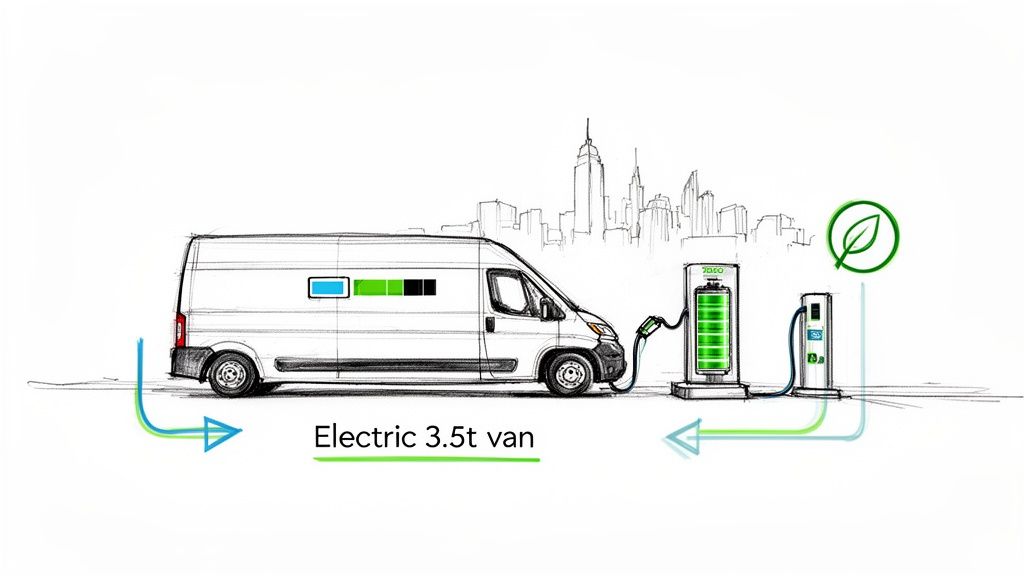
The future of professional driving is plugging in, and the move towards electric power is an opportunity you can’t afford to miss. The rise of the electric 3.5 tonne van isn’t just a fleeting trend; it’s a genuine shift in the industry, pushed forward by the UK’s goal of achieving zero-emission transport. This change is creating a fresh wave of demand for skilled, forward-thinking drivers.
For anyone looking at a career on the road, this electric revolution is your chance to get ahead of the curve. Yes, challenges like charging infrastructure are still being ironed out, but the direction of travel is unmistakable. Businesses are busy modernising their fleets, and they need drivers who are ready to get behind the wheel of these advanced, battery-powered vehicles.
Getting your C1 licence now is a smart, strategic move. It puts you in the perfect position for high-demand jobs that require handling not just today’s vans, but tomorrow’s too. Think of it as future-proofing your career.
The Growing Demand for Electric Van Drivers
As companies all over the UK work to shrink their carbon footprint, the switch to electric commercial vehicles is picking up real pace. This isn’t just about being green; it’s about hitting government targets and making sure their operations are sustainable for the long haul. The result? A surge in demand for drivers who can step straight into these new roles.
Major logistics firms, public sector bodies, and local councils are all in the process of transitioning their fleets. They are on the lookout for drivers who are not only licensed to handle the weight but are also comfortable with the new tech that comes with an electric 3.5 tonne van.
This means understanding things like regenerative braking, how to manage battery range effectively, and using charging networks. These are the new skills that will make you stand out in the job market and open up roles with leading employers at the forefront of this change.
The move to electric is creating a skills gap in the market. Drivers who get qualified now and embrace this new technology will be in the strongest position to secure the best roles as the industry evolves.
Understanding the Market Shift
The switch to electric is clear when you look at recent vehicle registration data. While the wider van market has its challenges, the electric segment is showing powerful growth. Statistics reveal that registrations for battery electric vans (BEVs) weighing between 3.5 and 4.25 tonnes shot up by a massive 202.7%. This tells you exactly where business investment is going.
This data sends a clear signal: the future of the 3.5 tonne van category is electric. For anyone wanting to become a professional driver, this means earning your C1 licence isn’t just about getting today’s jobs; it’s about preparing for the jobs of the very near future. If you’re looking to get into the sector, this UK guide to electric commercial vehicles offers some brilliant insights.
Why Your C1 Licence Is Your Key to the Future
So, where does a C1 licence fit into this electric future? The answer is all about weight. Electric vans are almost always heavier than their diesel counterparts because of their hefty battery packs.
This extra weight means many electric vans designed to carry a decent payload will have a Gross Vehicle Weight (GVW) that tips them over the standard 3,500kg limit of a normal Category B car licence.
A Standard Licence Isn’t Enough: An electric van might look like a regular panel van, but its increased kerb weight could easily push it into the C1 category once it’s loaded up.
Career Versatility: Holding a C1 licence gives you maximum flexibility. You can legally drive both traditional diesel and new electric models up to 7,500kg, making you a far more valuable hire.
Access to Premier Fleets: Companies investing in the latest electric fleets will naturally prioritise hiring drivers who already have the right qualifications. C1 holders will be at the front of the queue.
By securing your C1 licence, you make sure you’re legally qualified and fully prepared to operate the next generation of commercial vehicles. You can also learn more about how technology is changing HGV driving in our related article. Taking this simple step now guarantees you won’t be left behind as the industry powers forward.
Ready to Start Your Driving Career?
You’ve seen the opportunity out there on the open road, and now it’s time to take the wheel. Making the move to become a professional driver in the 3.5 tonne van sector isn’t just about landing a job: it’s about building a solid, rewarding career for yourself. Getting your C1 licence is the key that opens up the door to this stable and seriously in-demand industry.
Choosing the right people to help you get there is the single most important decision you’ll make. We’re not just another training school; think of us as your partner for the whole journey. We’re here to guide you every step of the way, from your first phone call right through to the day you pass your test. Our only goal is to make your career change as smooth and successful as it can be.
Your Partner on the Road to Success
We’ll handle everything, from start to finish. That means we book your initial medical, sort out the DVLA paperwork, and even set you up with supportive software for your theory test. We manage all the fiddly details so you can just focus on what matters: learning to drive. With our nationwide network of training centres, you’re guaranteed top-quality instruction that’s local to you.
We know that investing in your future is a big step, which is why we offer flexible payment options to make it that much easier to get started.
We don’t believe that money should ever be a roadblock to a great career. Our mission is to open up a clear, accessible path for anyone with the drive to become a professional.
Take the First Step Today
With our team in your corner, you can be confident you’re on the right track to becoming a fully qualified driver. We’re ready to answer your questions, break down the process into simple terms, and get you started. The demand for skilled C1 drivers is higher than ever, and your new career is waiting.
Getting the ball rolling is simple. Here’s all it takes:
Get in Touch: Give our friendly team a call for a no-obligation chat about what you want to achieve.
Create a Plan: We’ll walk you through the steps and build a training plan that fits around you.
Start Training: Begin your journey with our full support, from the medical and theory right through to your practical test.
Let us help you get on the road to a better future. Reach out today and start your driving career with confidence.
Frequently Asked Questions
Getting your head around the rules for driving bigger vans can throw up a few questions, especially when you’re starting out. To help you get straight to the point, we’ve tackled some of the most common queries we hear from new drivers.
How Long Does It Take to Get a C1 Licence?
This is a big one, and the answer depends a bit on your own schedule and how quickly the DVLA processes things. That said, most people find they can get through the entire process, from the initial medical and theory tests right through to passing the practical test, within about 6 to 8 weeks.
Our job is to build a training plan that fits your life, not the other way around. We’ll handle all the bookings and admin to keep things moving along, leaving you free to concentrate on the important bit: learning to drive.
What Is the Average Payload of a 3.5 Tonne Van?
This is a really important question for anyone looking to haul goods. While a 3.5 tonne van has a Gross Vehicle Weight (GVW) of 3,500kg, its payload – the actual weight of the stuff you can carry – is always going to be less than that. How much less depends entirely on the van itself.
Take a classic 3.5 tonne Luton van. You’re typically looking at a payload capacity somewhere between 1,000kg and 1,200kg. The rest of the weight is the van itself (its kerb weight), which includes the chassis, bodywork, fuel, and everything else.
A very common mistake is thinking you can load 3.5 tonnes of cargo into the back. You can’t. Always check the specific payload for the van you’re driving to avoid being overloaded, which is both dangerous and illegal. You’ll usually find this info on a plate inside the driver’s door frame.
Can I Drive a 3.5 Tonne Van for Personal Use?
Yes, absolutely. If you’re moving house or helping a mate out, you can drive a 3.5 tonne van for personal, non-commercial jobs. As long as your driving licence has the correct entitlement (either from passing your test before 1997 or by getting a full C1 licence), you’re good to go.
The key difference is that you don’t need a Driver CPC qualification for personal use, as you’re not driving professionally. However, all the rules about the van’s weight limits and driving safely still apply.
Does My Car Insurance Cover a 3.5 Tonne Van?
Almost certainly not. A standard car insurance policy is not designed to cover a vehicle of this size and weight. Vans need their own specific insurance policies that reflect their different risk profile, size, and how they’re used.
Whether you’re hiring a 3.5 tonne van for a weekend or driving one for work, you must make sure it’s covered by the right van insurance policy. Always double-check this is sorted before you turn the key.
Ready to take the first step towards your new career? At HGV Learning, we provide end-to-end support to help you get your C1 licence. We’ll help you get on the road with confidence. Find out more and start your journey today at https://hgvlearning.com.