So, you’re thinking about starting a career as a professional driver? A fantastic choice. HGV driver training is the structured path that gets you from where you are now to being fully qualified to operate commercial lorries safely and legally in the UK. The whole process is a mix of medical checks, theory learning, and, of course, hands-on practical driving tuition.
Your Roadmap to Becoming an HGV Driver
With the huge demand for drivers across the UK, there has never been a better time to get into the logistics industry. It is the backbone of our economy, which means stable, well-paid work for new drivers and career-changers alike. Think of this guide as your personal roadmap, designed to make the journey ahead clear and simple.
We are going to break down the entire process into a series of achievable steps. It is not an impossibly complex challenge, but a logical progression where each stage builds on the last, getting you one step closer to that new licence in your pocket.
What to Expect on Your Journey
Getting your HGV licence involves a few key stages. Understanding them from the start makes the whole thing feel much less daunting. Here’s what you can expect to cover:
Initial Checks: First things first, you will need to pass a medical exam and apply for your provisional licence.
Theory Tests: Next up is hitting the books to master the multiple-choice questions and hazard perception tests.
Practical Skills: This is the exciting part—getting behind the wheel with a professional instructor to learn the ropes.
Final Certification: The last hurdle is the final practical test, where you prove you have what it takes to be safe and competent on the road.
Following a structured training plan is not just about passing a test. It is about building the solid foundation you need for a long, safe, and successful career as a professional driver.
HGV driving is not the only profession that requires a specific, structured learning path. It is interesting to see how other sectors approach it; for instance, you can find insights into similar vocational training to see how different industries build up essential skills.
By the time you finish this article, you will have a crystal-clear picture of what HGV training involves and feel ready to take that first step towards a rewarding new career on the open road.
The Three Essential Stages of HGV Training
Becoming a professional lorry driver is not something that happens overnight. It is a structured journey, best thought of as a mission broken down into three core stages. Each one builds on the last, taking you step-by-step from a complete beginner to a test-ready, confident driver.
This is not about just jumping into a cab and hoping for the best. The whole pathway is designed to give you the solid knowledge, safety awareness, and practical skills you need to succeed on the road. It all starts with the essential paperwork and medicals, moves into the theory, and finishes with you behind the wheel. Let’s break down exactly what each stage involves.
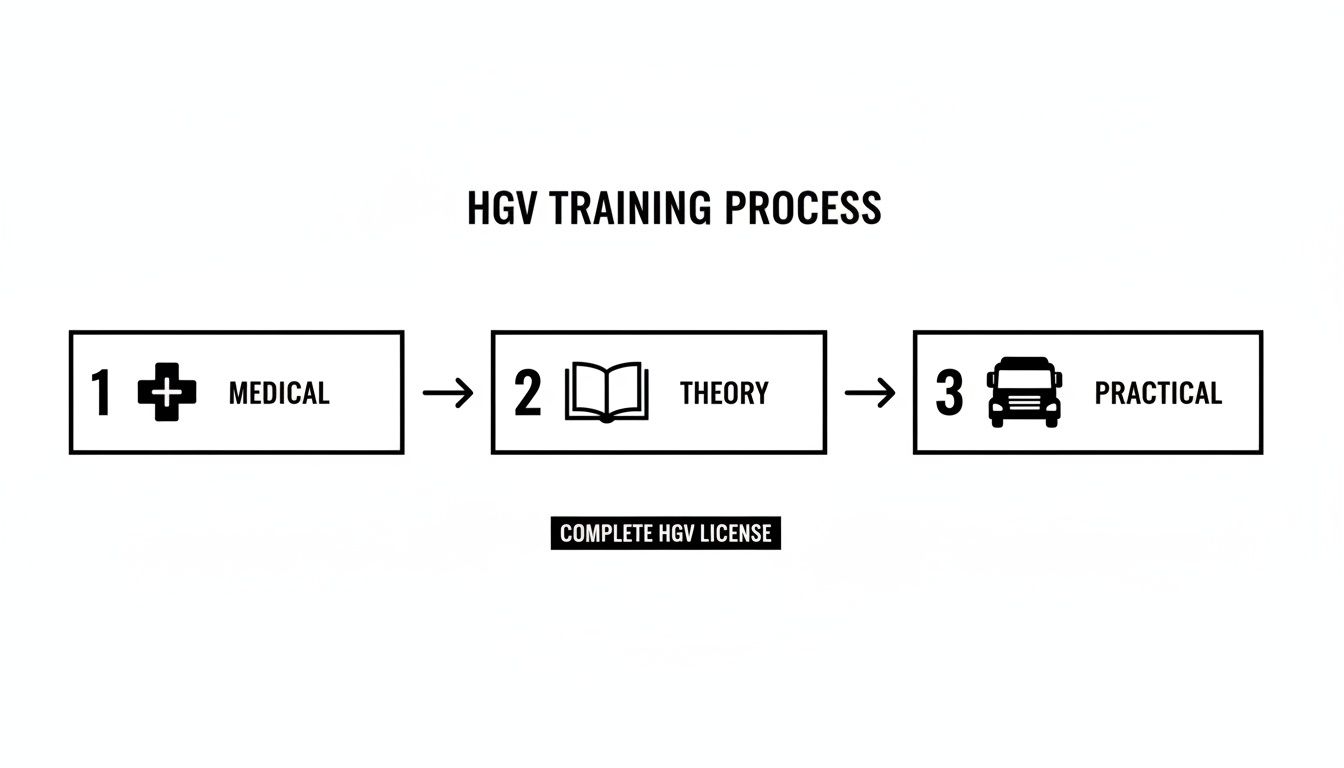
This flowchart maps out the clear, sequential process you will follow on your training journey.
As you can see, the path is a simple sequence of medical, theory, and practical stages, designed to prepare you fully for life on the road.
Stage One: Getting Your Provisional Licence
Before you can even think about driving a lorry, you need to get the paperwork sorted. This first stage is all about getting the legal essentials in place, proving you are medically fit and officially cleared to start learning.
First up is the HGV medical examination. This is a fairly straightforward check-up with a doctor who will confirm you meet the health and eyesight standards set by the DVLA. It is a vital safety check for you and everyone else on the road.
With your medical certificate in hand, you can then apply for your provisional HGV licence. This means filling out the D2 and D4 forms and sending them off to the DVLA. Think of your provisional licence as the official green light to move on to the next phase of your training.
Stage Two: Mastering the Theory
Once your provisional licence is sorted, the focus shifts from paperwork to knowledge. This is where you build the theoretical foundation you will need for safe, professional driving. It is split into two distinct parts: Module 1 and Module 2.
Module 1 is actually two separate tests:
Multiple-Choice Questions: This covers a massive range of topics, from road signs and vehicle safety checks to the crucial rules on drivers’ hours. You will need to show you have a solid grasp of the Highway Code and more.
Hazard Perception: In this test, you will watch a series of video clips and have to click as soon as you spot a developing hazard. It is all about training your eyes and your mind to be proactive, not reactive, which is critical when you are in charge of a large vehicle.
Module 2 is the Case Studies test. Here, you will be given several real-world scenarios a professional driver might face on any given day. Your job is to answer questions on them, showing you can apply your knowledge in a practical, problem-solving way. We provide modern learning tools to help you revise and track your progress with mock tests, so you know exactly when you are ready.
Mastering the theory is not just about passing an exam; it is about embedding the core principles of safety and compliance that you will rely on every single day of your professional driving career.
Stage Three: Practical Training and Testing
This is the final, and most exciting, part of the process. It is where theory meets reality. You will get in the cab with one of our qualified instructors and put everything you have learned into practice. This hands-on part of your hgv driver training is also broken down into two modules.
Module 3 is your practical driving training and test. You will spend dedicated time with an instructor, learning how to handle the vehicle, manoeuvre it safely in tight spots, and confidently navigate public roads. This all leads up to the practical test, where a DVSA examiner will assess your driving skills.
Finally, there is Module 4, the practical demonstration test. This is not about driving. It is about showing the examiner you know your vehicle inside and out. You will demonstrate how to perform safety checks, secure loads correctly, and assess potential risks. Passing this final hurdle means you have done it! You have successfully completed your training and are ready for your Driver Certificate of Professional Competence (CPC) card.
It is worth noting that government-backed initiatives often support this training pathway. The Skills Bootcamps in HGV Driving, for instance, have seen huge success, with 77.6% of nearly 3,500 graduates receiving job offers right after completing their training. You can explore more about the success of these bootcamps and see how they are tackling the driver shortage.
Choosing the Right HGV Licence for Your Career
Stepping into the world of professional driving means understanding that not all lorries are created equal. Just as a mechanic needs different tools for different jobs, a driver needs the right licence for the specific vehicle they want to operate. Choosing the correct category from the start is a crucial part of your HGV driver training journey, as it sets the direction for your entire career.
Think of the licence categories as a ladder. You start on a lower rung and can climb higher as you gain experience and further qualifications. Each rung opens up new doors, new vehicle types, and new earning potential. Making the right choice now ensures your training is perfectly aligned with your long-term goals.
This section will act as your guide, breaking down the main licence categories in a simple, straightforward way. We will look at the vehicles you can drive, the jobs they are used for, and who each licence is best suited for.
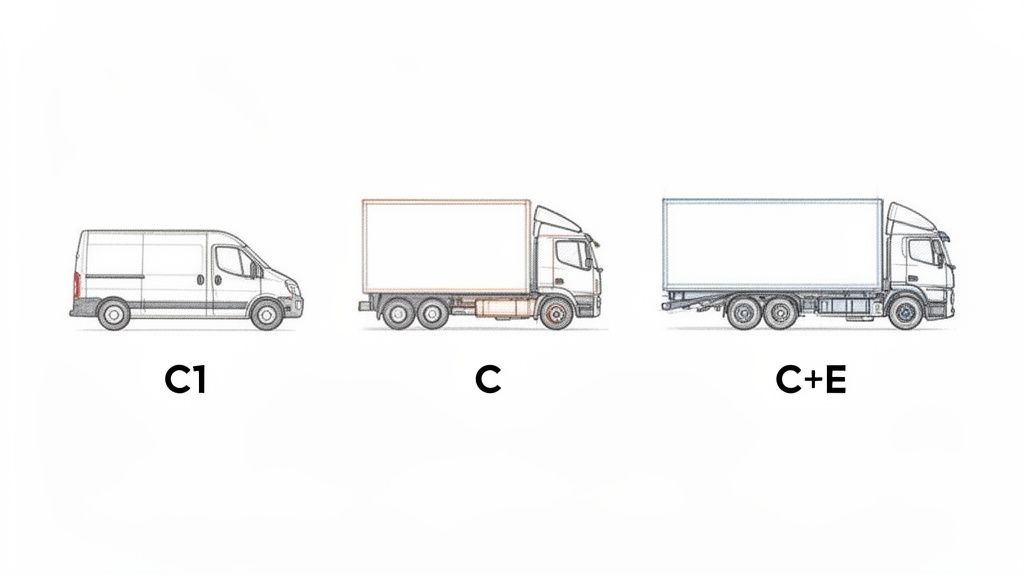
Category C1: The Versatile Starting Point
The Category C1 licence is your entry point into driving medium-sized goods vehicles. This licence permits you to drive vehicles with a gross vehicle weight (GVW) between 3.5 and 7.5 tonnes. You can also tow a small trailer up to 750kg.
Think of the larger delivery vans you see every day, like those used for supermarket home deliveries, or smaller horseboxes and ambulances. These are classic examples of C1 vehicles. This licence is often a requirement for paramedics and is a popular choice for local delivery drivers who do not need to handle the largest lorries.
It is an excellent option if your career ambitions are focused on lighter commercial work or if you need this specific licence for a role in the emergency services.
Category C: The Industry Standard
The Category C licence is often considered the true starting point for a career in haulage and logistics. It allows you to drive any rigid vehicle weighing over 3.5 tonnes, with no upper weight limit. This covers everything from bin lorries and tipper trucks to the large, fixed-body lorries that form the backbone of UK distribution.
If the C1 is a versatile tool, the Cat C is the workhorse of the industry. Passing this test means you can apply for a huge range of jobs in construction, waste management, and regional distribution. It is the most common HGV licence and provides a solid foundation for your driving career.
For many drivers, the Category C licence is the essential first step. It opens up the majority of rigid vehicle driving jobs and serves as the mandatory prerequisite before you can progress to the top tier: the C+E licence.
Category C+E: The Ultimate Qualification
The Category C+E licence is the highest qualification you can achieve in the HGV world. This allows you to drive an articulated lorry—a tractor unit pulling a trailer—with a combined weight of up to 44 tonnes. This is what most people picture when they think of a classic “artic” lorry thundering down the motorway.
Holding a C+E licence makes you one of the most in-demand professionals on the road. You will be qualified for long-haul trunking jobs, supermarket depot deliveries, and international haulage. These roles often come with the highest earning potential and the greatest responsibility.
Before you can start training for C+E, you must have already passed your Category C test. For more details on the nuances between licence types, you might be interested in our guide covering the different HGV licence types in greater depth.
To help you decide which route is right for you, we have put together a simple table comparing the three main categories.
HGV Licence Categories at a Glance
Licence Category
Vehicle Type
Maximum Weight (GVW)
Common Job Roles
Ideal For
Category C1
Medium Goods Vehicle
3.5 to 7.5 tonnes
Paramedic, Courier, Local Delivery Driver
Aspiring emergency service drivers and those focused on lighter commercial roles.
Category C
Rigid Lorry
Over 3.5 tonnes
Refuse Collector, Construction Driver, Regional Distribution
New drivers wanting the widest range of rigid vehicle job opportunities.
Category C+E
Articulated Lorry
Up to 44 tonnes
Long-Haul Driver, Supermarket Delivery, International Haulage
Experienced drivers seeking maximum earning potential and career progression.
Choosing the right path from the outset will save you time and money, ensuring your training directly supports the career you want.
Advancing Your Career with Specialist Training
Getting your Category C or C+E licence is a huge milestone, but it is really just the beginning. Think of your standard HGV licence as the key that starts the engine. To really go places, you need specialist training – this is what unlocks the more demanding roles, better pay, and long-term job security.
The world of logistics is always looking for experts, not just drivers. Adding specialist qualifications to your licence shows employers you are serious about your career. It proves you are committed to professional development and opens doors to niche sectors that are often much more rewarding. These courses take you from being a qualified driver to a specialist operator, making you a massive asset to any company.
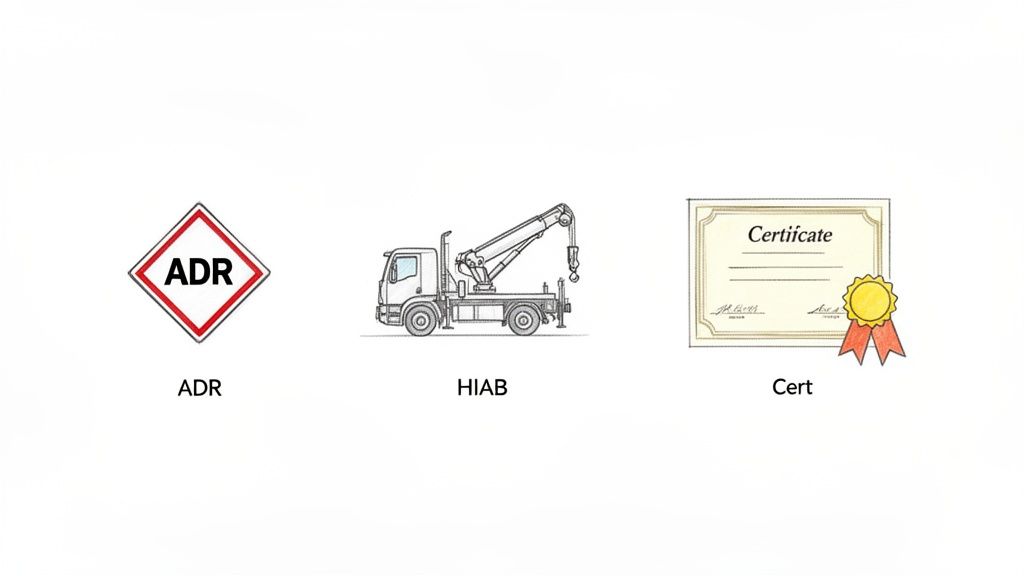
Transporting Hazardous Goods with ADR Training
One of the best qualifications you can add to your CV is the ADR certificate. This is a legal must-have for anyone transporting dangerous goods by road. We are talking about everything from fuel and corrosive chemicals to explosives and even radioactive materials.
An ADR course is much more than just a box-ticking exercise. It is an intensive programme that dives deep into the specific rules and safety protocols for handling hazardous cargo. You will learn to identify different classes of dangerous goods, understand the correct labelling, and master the emergency procedures.
Drivers with an ADR ticket are always in high demand in industries like fuel distribution, chemical manufacturing, and specialist waste management. Because the work carries more risk and responsibility, the salaries are typically much higher than in standard haulage. Completing this part of your hgv driver training makes you an essential link in the supply chain. For a full breakdown, have a read of our guide covering all you need to know about ADR training.
Holding an ADR qualification does more than just increase your earning potential. It signals to employers that you are a highly responsible, safety-conscious professional capable of handling complex and high-risk assignments.
Mastering Lorry-Mounted Cranes with HIAB Training
Another brilliant way to boost your career is with a HIAB certificate. A HIAB is a lorry-mounted crane, which means you can load and unload heavy items without needing a separate forklift or crane on-site. This equipment is vital in sectors like construction, forestry, and delivering heavy machinery.
HIAB training is all about hands-on, practical skills. The main focus is learning to operate the crane safely and efficiently, either with levers or a remote control. The course covers crucial skills you will use every day:
Pre-use safety checks: Making sure the crane is in perfect working order before you start.
Correct setup and stabilisation: Using the lorry’s outriggers to create a solid platform for lifting.
Load calculation and slinging: Knowing your weight limits and how to attach loads properly.
Precise operation: Moving the crane arm smoothly to place goods exactly where they need to be.
Drivers with a HIAB licence are incredibly versatile – you are not just a driver, you are a qualified crane operator, too. This makes you a two-in-one asset on any job site and highly sought after by builders’ merchants or companies delivering bulky items like hot tubs or portable cabins. Your ability to self-load and unload saves your employer time and money, and that extra responsibility is always reflected in your pay packet.
Understanding the Costs and Financing Your Training
Investing in HGV driver training is one of the best career decisions you can make, but it is completely normal to have questions about the initial cost. When you see how the fees are broken down, the whole process feels much more straightforward and highlights the fantastic return on investment waiting for you.
The total cost is not one big lump sum. It is actually a combination of several essential parts, with each one taking you a step closer to getting qualified. Think of it less as a single fee and more as a series of smaller, progressive investments in your career.
A Transparent Breakdown of Training Costs
To give you a clear picture, your investment in an HGV licence is made up of a few key elements. They are like building blocks, and each one gets you nearer to your goal.
Initial Fees: This covers the HGV medical exam and your provisional licence application – all the essential paperwork to get the ball rolling.
Theory Test Fees: You will need to cover the costs for the multiple-choice, hazard perception, and case studies tests (that is Modules 1 and 2).
Practical Training Hours: This is the core of your investment – the hands-on, in-cab time you spend with a qualified instructor learning the ropes.
Practical Test Fees: This pays for your final DVSA driving test (Module 3) and the practical demonstration test (Module 4).
While costs can shift a bit based on where you are and the exact licence you are going for, any good training provider will give you a clear, all-in quote right from the start. No surprises.
Making Your Training Affordable
One of the biggest myths about HGV training is that you need to have thousands of pounds sitting in the bank just to get started. That simply is not true anymore. There are accessible financing options designed to tear down that barrier, making a new career possible for anyone, no matter their current financial situation.
Flexible payment plans are an incredibly popular and practical way to manage the cost. Instead of finding the whole amount at once, these plans let you spread the cost of your training over a manageable period, usually between 10 to 12 months.
This approach turns a significant one-off expense into a series of small, manageable monthly payments. It means you can start earning in your new career long before you have finished paying for the training that got you there.
Suddenly, the investment feels less like a hurdle and more like a simple monthly bill, much like your phone contract or a gym membership. It puts you firmly in control of your budget and lets you focus on what really matters: learning the skills to pass your tests and hit the road. For a closer look at your options, you can learn more about how to finance your HGV training and find a plan that is right for you.
Ultimately, the key is to see your training as a direct investment in your future earning potential. With such high demand for qualified drivers across the UK, that initial outlay is quickly earned back through a stable, well-paid, and rewarding career in logistics.
How to Find Your First HGV Driving Job
Getting your HGV licence is a massive achievement, but let’s be honest—the real goal is landing that first professional driving job. The brilliant news is you are stepping into an industry that is crying out for new talent.
Right now, the UK is facing a major driver shortage. This is not just a small gap in the workforce; it is a critical skills shortage that impacts the entire country’s supply chain. The Road Haulage Association estimates that 60,000 new HGV drivers are needed every single year just to keep up. When you consider that around 80% of all goods in the UK travel by road, you start to see just how vital you are.
This puts newly qualified drivers like you in a fantastic position. With the right licence in hand and a professional attitude, you are exactly what employers are looking for.
Using Job Placement Support
The jump from passing your final test to starting your first paid role can feel daunting, but you do not have to navigate it alone. A good training provider does more than just teach you how to drive; they act as a vital bridge to employment through dedicated job placement support.
We have built strong relationships with a whole network of employers across logistics, construction, utilities, and more. This support system is designed to give our graduates a real head start, helping you get your foot in the door and begin your new career without delay.
Our guidance also includes practical advice on what employers really want to see in new drivers. It is about more than just your ability to handle the lorry.
Employers are looking for professionals who show a genuine commitment to safety, a solid grasp of compliance rules, and a reliable, positive attitude. These are the core principles we build into our training, helping you stand out from the crowd right from day one.
Standing Out to Employers
Once your HGV driver training is complete, your next mission is to package yourself effectively for potential employers. Your most important tool here is a well-crafted CV. It needs to clearly show off your new qualifications, your commitment to safety, and your eagerness to get to work.
Learning about crafting a powerful Europass CV for truck drivers is a great next step. It will show you how to present your skills in a way that haulage and logistics companies understand and appreciate.
Remember, the training you have just been through was not just about passing a test. It was designed to shape you into a competent, safe, and confident professional. Make sure you highlight this on your CV and in your interviews—it shows employers you are a valuable candidate who is ready to make a contribution from your very first shift.
Your HGV Training Questions Answered
If you are thinking about becoming a lorry driver, you probably have a lot of questions. That is completely normal. Let’s run through some of the most common queries we hear from aspiring drivers to clear things up and give you a better picture of the road ahead.
How Long Does HGV Training Take?
This is the big one, isn’t it? From start to finish, most people go from having their medical to passing their final test in around 8 to 10 weeks. Of course, this can depend on how flexible your schedule is and the availability of DVSA test slots, but a well-organised training plan will keep you moving forward without any unnecessary delays.
Do I Need Qualifications to Start?
Good news – you do not need a string of A-Levels or a degree to get started. The two main requirements are straightforward: you must be at least 18 years old and already hold a full UK car driving licence. If you have got those ticked off, all you need is the drive to learn a new skill.
Is There a Difference Between HGV and LGV?
Nope, not at all! You will see both terms used, but Heavy Goods Vehicle (HGV) and Large Goods Vehicle (LGV) mean exactly the same thing. They are completely interchangeable. LGV is the official term you will see on your driving licence, but most people in the industry just call it HGV.
The most important takeaway is that the path to becoming a professional driver is straightforward and accessible. With the right support, you can progress from a car driver to a fully qualified HGV professional in just a couple of months.
Each part of the process is a logical step forward, designed to give you all the skills you need for a long and successful career on the road.
Ready to start your journey? At HGV Learning, we provide end-to-end support to get you qualified and on the road. Find out more at https://hgvlearning.com.
Related Articles
01/07/2026
ADR Driver Salary UK: Your 2026 Earnings Guide
You're probably here because you typed something like “ADR driver salary UK” into Google and got a mess of answers. One page shows a fairly...