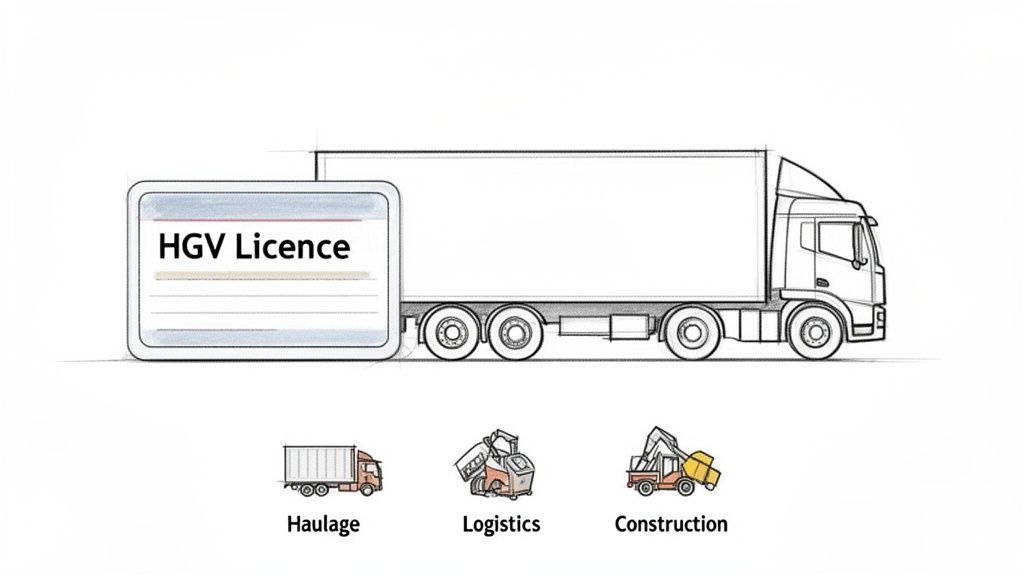
So, what exactly is an HGV licence? Think of it as your professional passport to drive any commercial vehicle weighing over 3.5 tonnes in the UK. It’s a separate, specialised qualification from your standard car licence.
If you’re aiming for a career in haulage, logistics, construction, or even some emergency services, this licence isn’t just a nice-to-have: it’s a legal necessity. It is less of a plastic card and more of a key that opens up a stable, in-demand career.
Understanding Your HGV Licence
Have you ever wondered about the driver behind the wheel of a massive supermarket lorry on the motorway, a tipper truck on a building site, or even a large horsebox? They all hold a Heavy Goods Vehicle (HGV) licence. This proves they have the advanced skills, deep knowledge, and medical fitness required to handle these powerful machines safely on public roads.
Your standard car licence (Category B) only gets you so far, legally limiting you to vehicles up to 3,500kg, or 3.5 tonnes. An HGV licence is your ticket to a different league of vehicle: the very ones that form the backbone of the UK’s economy.
Why Is an HGV Licence So Important?
Simply put, the demand for qualified drivers is always high. Right now, there is a well-known nationwide shortage of skilled HGV drivers, which puts anyone who gains their licence in a very strong position to find work. But this qualification is about more than just driving; it’s a mark of professionalism and responsibility.
An HGV licence is more than a permit to drive. It’s a professional qualification that shows a solid commitment to safety, compliance, and the skilled operation of large commercial vehicles. It’s the essential first step into the logistics and transport industry.
This professional status is exactly why the training and testing process is so rigorous. It is designed to ensure every single driver out there has met a high, consistent standard of competence.
The Main Licence Categories
It’s not a one-size-fits-all situation. The category of HGV licence you earn dictates the exact size and type of vehicle you are legally cleared to operate.
To get started, here’s a quick rundown of the main HGV licence categories and what they mean in the real world.
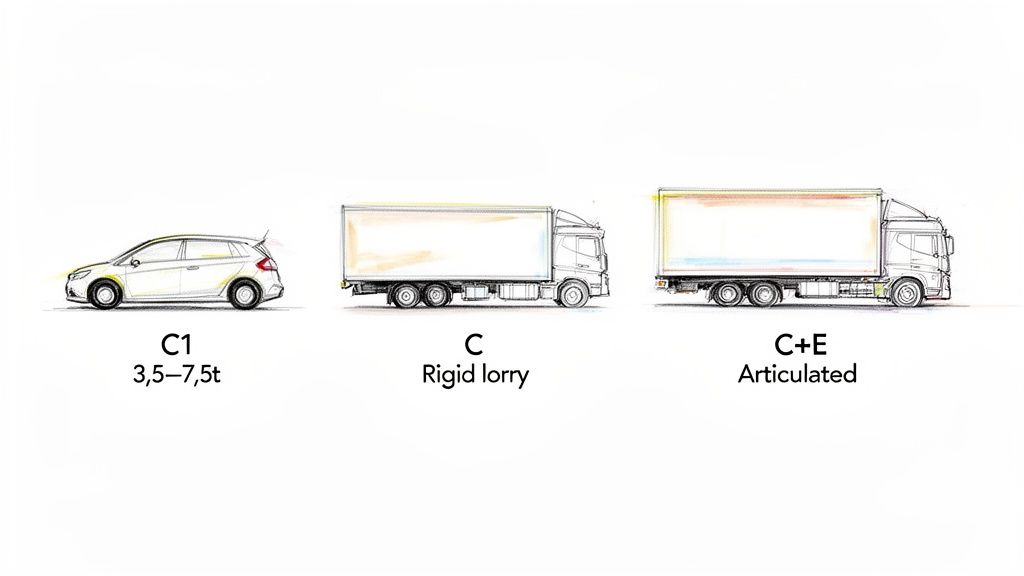
HGV Licence Categories at a Glance
Licence Category
Vehicle Type
Common Use
Category C1
Vehicles between 3.5 and 7.5 tonnes
Large delivery vans, ambulances, horseboxes
Category C (Class 2)
Rigid lorries over 7.5 tonnes
Local supermarket deliveries, construction tippers
Category C+E (Class 1)
Articulated lorries (tractor unit + trailer)
Long-distance haulage, motorway freight
As you can see, each category opens up a different career path. Whether you see yourself doing local multi-drop routes in a rigid lorry or crossing the country in a massive articulated truck, it all starts with choosing the right licence to aim for.
Breaking Down The HGV Licence Categories
Not all HGV licences are created equal. Think of them as different tiers of a qualification, with each one opening up the ability to drive progressively larger and more complex vehicles. Choosing the right category is the first major decision on your journey, and it directly shapes the types of jobs you can apply for.
Understanding these categories is crucial. After all, the licence needed to drive a paramedic’s ambulance is very different from the one required for a 44-tonne articulated lorry crossing the country. Let’s explore the three main types so you can see where your ambitions fit.
Category C1: The Versatile Starting Point
The Category C1 licence is your entry point into the world of professional driving. It gives you the authority to get behind the wheel of vehicles weighing between 3.5 and 7.5 tonnes. These are a definite step up from a standard van but are smaller than the huge lorries you see powering up and down motorways.
This licence is perfect for a range of specific careers. For example, it’s a non-negotiable requirement for many paramedic and ambulance driver roles. It’s also the go-to for drivers of:
Large delivery vans for major courier companies.
Horseboxes for the equestrian transport industry.
Smaller removal lorries used for local house moves.
Gaining a C1 is an excellent first step, opening doors to vital community roles and local logistics jobs. You can look more closely at the specific requirements for different HGV licence types in our detailed guide.
Category C: The Backbone of UK Logistics
Often referred to as Class 2, the Category C licence is a true workhorse qualification. It permits you to drive any rigid vehicle weighing over 3.5 tonnes, with the option of pulling a small trailer up to 750kg. These are the lorries you see every single day, keeping the country running.
A Category C licence is your ticket to driving the rigid lorries that handle everything from stocking supermarket shelves and delivering construction materials to managing waste collection. It’s one of the most in-demand licences in the industry.
This is a significant step up from the C1, giving you access to a huge variety of driving jobs, especially in local and regional distribution.
Category C+E: The Ultimate Qualification
Finally, we have the Category C+E licence, widely known as Class 1. This is the highest HGV qualification you can get. It allows you to drive the largest vehicles on UK roads: articulated lorries, or ‘artics’, where a powerful tractor unit pulls a huge trailer.
These vehicles can weigh up to 44 tonnes and are the undisputed giants of the motorway, responsible for long-haul and international freight. The current driver shortage, which still stands at around 30,000 to 45,000, is particularly felt in this category.
With an ageing workforce and relentless demand for drivers, gaining your C+E licence places you in a fantastic position for a secure and well-paid career. This makes the C+E a powerful asset for any serious HGV professional.
Checking Your Eligibility for an HGV Licence
Before you think about getting behind the wheel of a lorry for training, there are a few boxes you need to tick. The road to becoming a professional driver starts with meeting some clear, non-negotiable requirements. Think of this as laying the groundwork – without it, you simply cannot build your new career.
First things first, the rules are quite straightforward. You must be at least 18 years old to start the process. On top of that, you need to already have a full Category B driving licence, which is just the standard one you use for driving a car.
The Mandatory HGV Medical Exam
Once you’ve confirmed you meet the basic age and licence criteria, the very next step is a mandatory medical assessment. This isn’t just a bit of paperwork; it’s a critical check to ensure you’re medically fit to safely handle a large, heavy vehicle.
A GP, or a private doctor approved to carry out these exams, will look at several key areas of your health, including:
Eyesight: Your vision will be thoroughly tested to make sure it meets the strict standards required for HGV drivers.
Neurological Health: The assessment will check for any conditions that might affect your coordination, reaction times, or overall control.
General Health: This is a broader check for things like diabetes, heart problems, or any other issues that could impact your ability to drive safely for long periods.
The doctor fills out a specific form, known as the D4 form, which you’ll need to send to the DVLA. Passing this medical is an absolute must before you can get your provisional HGV licence.
Understanding the Driver CPC
Another vital piece of the puzzle is the Driver Certificate of Professional Competence (Driver CPC). This isn’t the licence itself, but a professional qualification you must hold to drive an HGV for a living. It’s the official proof that you have the skills and knowledge expected of a professional in the industry.
Your HGV licence gives you the legal permission to drive the vehicle. The Driver CPC is the professional qualification that allows you to be paid for it. You need both to start your career.
The good news is that you’ll gain your initial Driver CPC as part of your main HGV training and testing. It’s built right into the process, not a separate hurdle you have to jump over later. To keep this qualification valid throughout your career, you’ll need to complete 35 hours of periodic training every five years, keeping your skills sharp and up-to-date.
Your Step-by-Step Journey to Getting Licenced
Getting your HGV licence is not a single event, but a clear, structured path. The whole process is broken down into three manageable stages, designed to build your skills and knowledge from the ground up. It’s a journey that takes you from the initial paperwork right through to your final practical test.
First, you’ll need to handle the admin. This means filling out the right forms to get your provisional HGV licence and booking a medical examination. This essential first step confirms you’re eligible and fit to drive, officially kicking off your training.
To successfully navigate your step-by-step journey to getting licenced, enrolling in a specialised driving school is often a crucial prerequisite.
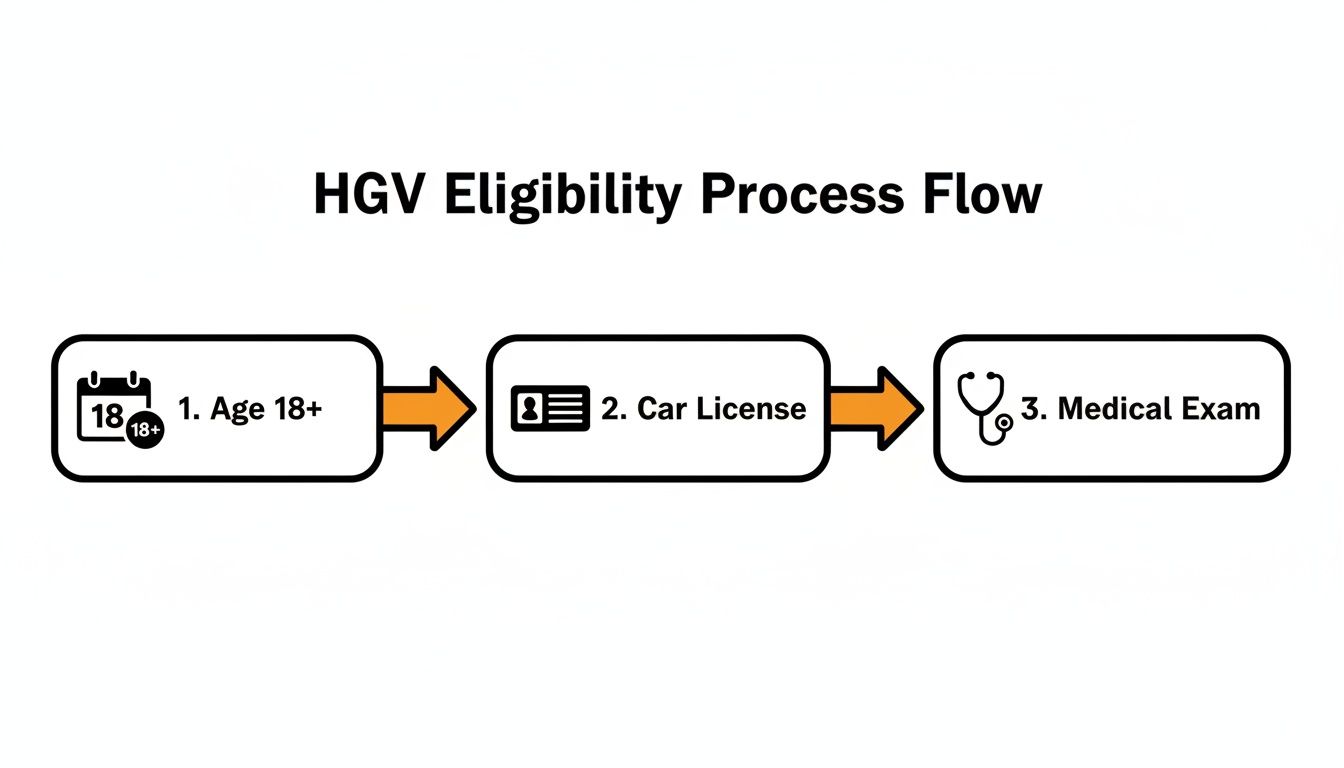
The flowchart below breaks down the initial eligibility requirements you’ll need to tick off before you can think about getting behind the wheel.
As you can see, these core requirements (being over 18, holding a car licence, and passing a medical) are the non-negotiable starting blocks for every aspiring HGV driver in the UK.
Stage 1: Paperwork and Medical
Your journey truly begins when you apply for the correct provisional entitlement to be added to your current car licence. If you’re aiming for a rigid lorry, you’ll need a provisional Category C. For an articulated lorry, it’s a provisional Category C+E.
At the same time, you’ll need to pass a medical assessment with a doctor. This is to prove you meet the DVLA’s strict health and eyesight standards for professional drivers. Once you’ve passed, you can send your application forms and the signed medical report to the DVLA. They will then post your updated licence back with the provisional entitlement, giving you the green light to book your theory tests.
Stage 2: Theory Tests and Preparation
With your provisional licence in hand, it’s time to hit the books. The next phase involves preparing for and passing two separate theory tests. This is much more than just re-reading the Highway Code; it’s a deep dive into the specific knowledge every professional driver needs.
The theory test is split into two parts:
Multiple-Choice Questions: This covers a huge range of topics, from vehicle safety and correct loading procedures to the complex rules around drivers’ hours.
Hazard Perception: A video-based test that assesses how quickly you can spot developing hazards on the road. It’s a critical skill for anyone driving a large vehicle.
Modern training platforms are a massive help here. They let you take mock tests, review your answers, and see where you need to improve. This means you can walk into the test centre feeling confident and fully prepared. If you want to dig deeper, our guide on how to get an HGV licence in the UK provides even more detail.
Stage 3: Practical Training and Final Test
Now for the exciting part: getting behind the wheel. The final stage is your practical training, which you’ll do with a qualified instructor in a full-sized HGV. You will learn everything from basic vehicle checks and controls to advanced driving skills needed for the UK’s roads.
This hands-on training is where theory meets reality. You’ll master complex manoeuvres like reversing perfectly into a loading bay and learn how to handle challenging situations, from tight city streets to busy motorways, all under expert guidance.
Your training builds towards the final practical driving test. This is made up of an off-road manoeuvring exercise and a lengthy on-road assessment with an examiner. Passing this is the final hurdle. Once you succeed, you will have officially earned your HGV licence and the professional Driver CPC qualification you need to start your new career.
Understanding the Costs, Timelines and Hurdles
Getting your HGV licence is a serious investment in your career, so it’s natural to want a clear picture of what’s involved, both in terms of money and time. The total price tag is not just one single payment; it’s built from several smaller costs that cover each stage of your journey.
It all starts with the initial fees for your medical exam and the provisional licence application. After that, you’ll need to cover the costs for the two-part theory test. The biggest chunk of the investment, as you might expect, goes towards your practical, hands-on training and the final driving test itself.
Breaking Down the Financial Investment
The final cost can vary, but it’s crucial to know what you’re budgeting for. Any good training provider will be completely upfront about these fees, so there are no nasty surprises waiting for you down the line.
Here are the main costs you can expect to see:
HGV Medical Exam: A mandatory check-up with a doctor to make sure you meet the DVSA’s health standards for driving professionally.
Provisional Licence: The official fee you pay to the DVLA to add the provisional HGV entitlement to your existing driving licence.
Theory Tests: There are separate fees for the multiple-choice questions and the hazard perception test.
Practical Training & Test: This is the big one. It covers all your in-cab tuition with an instructor and the fee for your final practical test.
To make things easier, many training providers offer payment plans. In-house financing, for example, can spread the cost over several months, which means you don’t need a huge lump sum to get started. You can get a much clearer idea by checking out our detailed guide on how much an HGV licence costs.
Setting Realistic Timelines
So, how long is this all going to take? While some steps are fairly quick, others depend on things outside your control. For example, getting your medical paperwork sorted and hearing back from the DVLA about your provisional licence can take a few weeks. Once that’s done, booking your theory tests is usually quite fast.
The biggest variable in your timeline is often the waiting list for practical tests. DVSA test availability can fluctuate, meaning your training provider may need to book your final test several weeks or even months in advance.
From the day you first apply to the day you pass your test, a realistic timeframe is usually somewhere between 8 to 12 weeks. A well-organised training partner will handle all this scheduling for you, booking everything in the right order to keep things moving along without any frustrating delays.
Navigating Common Hurdles
Even with the best plan in the world, you might hit a couple of speed bumps. Knowing what these are ahead of time helps you deal with them without losing your cool. Common issues include simple administrative delays with paperwork or, as happens to many, failing a test.
Failing a test isn’t the end of the world: far from it. It’s a normal part of the learning curve for many drivers. What matters is having the right support network. A quality training provider will sit down with you, figure out where you need to improve, offer extra tuition if you need it, and get you booked in for a retest as quickly as possible. That expert guidance is what makes all the difference in overcoming any challenges and getting you that HGV licence.
Advancing Your Career with Specialist Training
Getting your HGV licence is a massive achievement, but it’s really just the starting line. If you want to build a truly rewarding, long-term career, the next move is to add specialist skills to your professional toolkit. These extra qualifications do more than just make you versatile; they open the door to higher-paying roles and make you far more valuable to employers.
Think of your standard HGV licence as the solid foundation of a house. Specialist certifications are the extra rooms and features you build on top to skyrocket its value. By investing in more training, you can step beyond standard haulage into more niche, in-demand sectors.
Opening up New Opportunities
The world of professional driving is incredibly diverse, with many jobs that need very specific expertise. Adding certain tickets to your licence can give your earning potential and job security a serious boost.
Two of the most valuable certifications you can go for are:
ADR Training: This qualifies you to transport hazardous goods, from flammable liquids to corrosive chemicals. It’s a high-responsibility role that is always in demand and commands a much better salary.
HIAB Certification: This training teaches you how to operate a lorry-mounted crane, often known as a HIAB. It’s a crucial skill in industries like construction, forestry, and heavy equipment delivery.
These skills are your ticket to more complex and interesting work. As you look into advancing your HGV career, getting a handle on operational tools is also smart. Resources like this guide on understanding fuel cards can give you a broader perspective.
Why Specialist Skills Matter More Than Ever
The demand for HGV drivers has had a dramatic history. Back in 2018, the UK was already short of around 52,000 drivers. This gap widened significantly due to Brexit and COVID, peaking at over 100,000 in 2021. While things have settled slightly, the Road Haulage Association (RHA) says the UK still needs 40,000 new drivers every single year just to keep supply chains moving.
In a market like this, having specialist skills like ADR or HIAB makes you stand out from the crowd. It tells employers you’re a dedicated professional committed to growing your skills, which almost always leads to better job offers and faster career progression.
Good training providers know this. They do more than just help you pass a test; they offer real career support. They will often provide recruitment guidance and use their industry contacts to help match newly qualified drivers with great employers, making sure your new skills lead directly to a fantastic job.
Your Top HGV Licence Questions Answered
Starting out in the world of professional driving naturally brings up many questions. Let’s tackle some of the most common ones we hear from aspiring drivers to give you a clear picture of what’s involved.
How Long Does My HGV Licence Last?
Your HGV photocard licence is valid for five years at a time. To keep it active, you will need to renew it before it expires, which includes passing another medical exam to prove you’re still fit to drive a large vehicle.
Once you are 65 or older, this renewal process becomes an annual check-up. And don’t forget, your professional Driver CPC qualification needs its own upkeep: you’ll have to complete 35 hours of periodic training every five years to stay qualified.
Can I Go Straight for a Class 1 (C+E) Licence?
Absolutely. A recent and very welcome rule change means new drivers can now aim directly for their Category C+E (Class 1) licence without passing the Category C (Class 2) test first.
This “direct access” route is a real game-changer. It can save you a huge amount of time and money if your goal is to get behind the wheel of the biggest articulated lorries on the UK’s roads.
The HGV licence gives you the legal authority to drive the vehicle. In contrast, the Driver CPC is the professional qualification that allows you to get paid for driving it. To work in the industry, you absolutely need both.
It’s a crucial difference to understand. Your initial CPC is earned alongside your main HGV tests, making you a fully qualified professional right from the get-go.
Ready to stop wondering and start driving? Get in touch with HGV Learning today. We’ll help you find the perfect training course nearby and get you on the road to a brilliant new career. Find out more at https://hgvlearning.com.
Related Articles
23/10/2026
Driver CPC Card Renewal: How to Avoid a Lapsed DQC (2026 UK Guide)
If your Driver CPC card is sitting in your wallet with a date on it you haven't looked at properly in years, you're not alone....