Passing your HGV theory test first time isn’t about luck. It all comes down to a simple, effective approach: use HGV-specific revision materials, master the hazard perception technique, and stick to a structured study plan.
Relying on standard car theory apps is a common mistake and simply won’t cut it. They miss out on crucial, HGV-specific topics like drivers’ hours, tachographs, and safe vehicle loading, leaving huge gaps in your knowledge. This guide gives you a clear roadmap to make sure you get it right on your first attempt.
Your Blueprint for a First-Time Pass
Facing the HGV theory test can feel like a huge challenge, especially when you hear that national pass rates often dip below the 50% mark. It’s a serious hurdle, but with the right preparation, it’s one you can clear comfortably on the first go.
Think of this guide as your complete blueprint for success. We’re going to break down the entire process into practical, manageable steps, showing you exactly how to tackle both critical parts of the test and walk out with a pass certificate.
Understanding the Two Test Components
The HGV theory test is not one single exam; it’s two separate challenges that you’ll sit back-to-back on the same day. You have to pass both.
Here’s a quick overview of what to expect:
HGV Theory Test at a Glance
Test Component
What It Covers
Pass Mark
Key to Success
Multiple-Choice Questions
100 questions on HGV regulations, safety, vehicle loading, and technical knowledge.
85 / 100
Consistent revision using DVSA-approved materials.
Hazard Perception Test
19 interactive video clips assessing your ability to spot developing hazards early.
67 / 100
Practise identifying different types of hazards and clicking at the right time.
Failing either one of these parts means failing the entire test. You would have to re-book and pay all over again, which is why a balanced preparation plan is so important. Many people focus heavily on the multiple-choice questions, only to be caught out by the unique demands of the hazard perception clips.
A first-time pass is the fastest way to get you from the classroom into the driver’s cab. It saves you time, money, and the stress of a re-sit, keeping your career progression on track without unnecessary delays.
To build the most effective blueprint, it’s also worth looking at proven strategies for passing any exam and applying those principles to your HGV theory preparation.
In the following sections, we’ll walk you through building a personalised study timeline, mastering techniques for both parts of the test, and getting ready for the big day. By following this plan, you’ll swap anxiety for confidence, knowing you’ve done everything needed to secure that pass.
Building Your Personalised Study Plan
Passing your HGV theory test first time isn’t about luck: it’s about having a solid plan and preparing smartly. Let’s be honest, last-minute cramming just doesn’t work for this test. You need a realistic study schedule that fits into your life, one that lets you build a deep, lasting understanding of the material.
Forget trying to memorise the entire handbook overnight. The key is to break it all down into manageable, regular study sessions. This approach turns what seems like a mountain of information into bite-sized chunks, building your knowledge and confidence step-by-step.
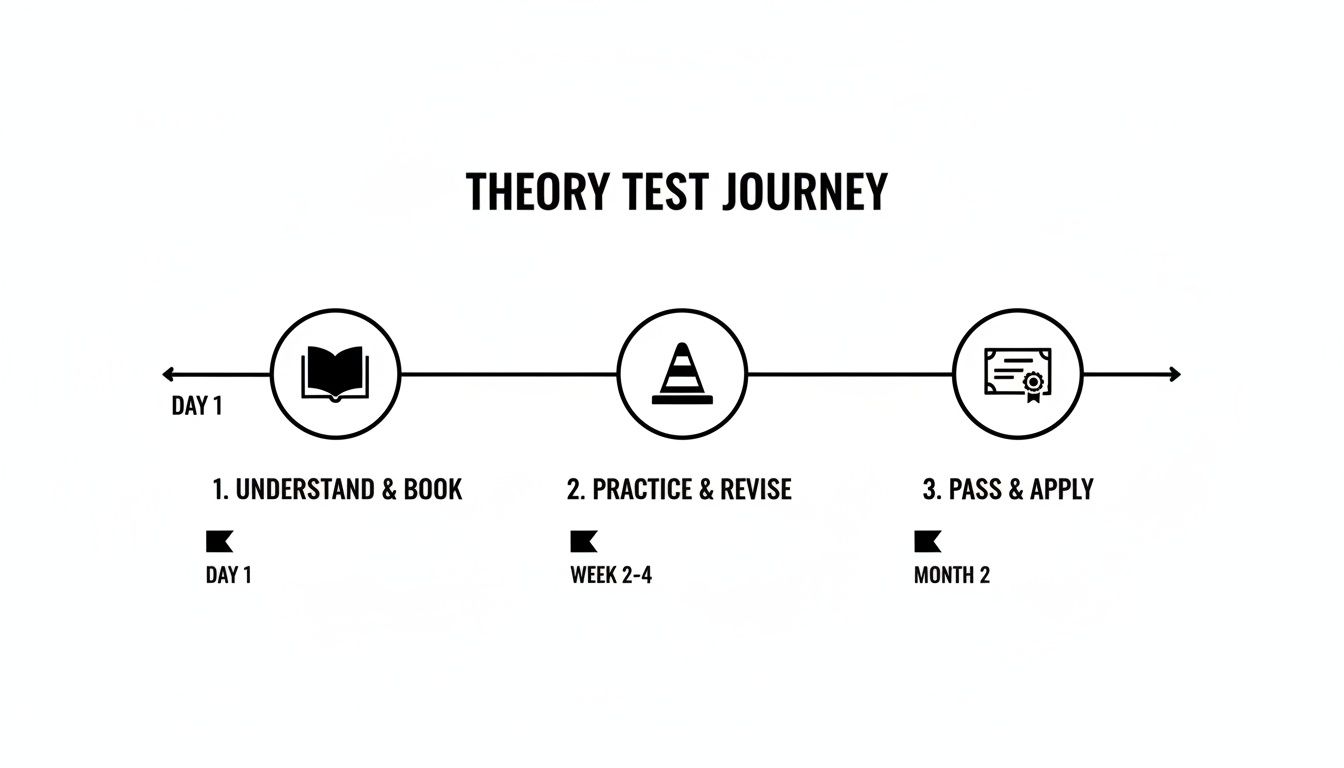
To give you an idea of what the journey looks like, here’s a simple timeline that shows the core stages, from getting to grips with the material to smashing the test.
This shows that success is a process, not a one-off event. It’s built on the foundations of learning, practising, and then proving what you know.
Pinpoint Your Weaker Areas Early On
Before you even think about revising, you need to figure out where your knowledge gaps are. There’s no point wasting hours on topics you already know inside out. The most effective way to start is by taking a full diagnostic mock test right at the beginning.
This first test isn’t about passing; think of it as a fact-finding mission. The results will give you a clear, honest picture of your current strengths and, more importantly, your weaknesses.
Once you have your results, you can use them to create a priority list. For example, if you struggled with questions on drivers’ hours but aced the road signs section, you know exactly where to focus your energy first.
Your diagnostic test results are your personal roadmap. They guide your revision, ensuring you spend your valuable study time on the topics that will make the biggest difference to your final score.
This targeted approach means every study session is productive. Instead of just revising in general, you’re actively turning your weakest areas into strengths. For more ideas on how to get organised, check out our tips for HGV theory test revision.
Prioritise HGV-Specific Topics
The HGV theory test covers a lot of ground that your standard car theory knowledge won’t even touch. The stakes are much higher, and the content is far more specialised.
This is exactly why generic driving theory apps often let aspiring HGV drivers down. You have to prioritise the topics that are unique to large goods vehicles.
Key HGV Topics to Master
Drivers’ Hours and Tachographs: Getting your head around the complex rules for driving limits, rest periods, and how to use a tacho correctly is non-negotiable.
Vehicle Loading and Stability: This covers everything from securing loads and distributing weight to understanding how these factors affect the vehicle’s handling.
Vehicle Weights and Dimensions: You’ll need to know the legal limits for different types of HGVs and the routes they can use.
Braking Systems and Safety Checks: HGV braking systems are complex, and knowing your daily walkaround checks is a legal requirement.
These topics are guaranteed to feature heavily in your test, and they’re often where people slip up and lose the most marks.
A Flexible Four-Week Study Timeline
Consistency beats cramming every time. A structured, four-week plan helps you cover all the essential material without getting overwhelmed. Here’s a flexible timeline you can adapt to your own schedule.
Week 1: Discovery and Planning
Day 1: Take your initial diagnostic mock test. No pressure, just see where you stand.
Day 2-3: Go through your results and make a list of your priority topics.
Day 4-7: Spend 45-60 minutes each day on your top-priority topics. Focus on really understanding the concepts, not just memorising answers.
Week 2: Deep Dive into Core Content
Focus: Keep working through your priority list, dedicating daily sessions to specific HGV modules.
Action: At the end of the week, take another mock test, but this time, just on the topics you’ve revised. Compare your score to the first test to see how much you’ve improved.
Week 3: Hazard Perception and Practice Tests
Focus: It’s time to bring in dedicated hazard perception practice. Split your study time between this and the multiple-choice questions.
Action: Start taking full mock tests under proper exam conditions: that means timed and with no distractions. This builds your stamina and gets you comfortable with the test format.
Week 4: Final Revision and Confidence Building
Focus: Go back over any remaining weak spots. Avoid learning brand-new information now; it’s all about consolidating what you already know.
Action: Take one last mock test a couple of days before the real thing. Aim for a score comfortably above the 85% pass mark. In the final 24 hours, just relax and do a light review of key facts.
Following a methodical plan like this ensures you walk into the test centre not just prepared, but genuinely confident and ready to secure that first-time pass.
Mastering the Multiple-Choice Questions
The multiple-choice section of the HGV theory test can feel like a huge hurdle. It’s made up of 100 questions, and you need to get at least 85 right to pass. This isn’t just about memorising facts; it’s designed to check if you can apply your knowledge in real-world situations.
You’ll face questions on everything from drivers’ hours and vehicle weights to the proper way to load a trailer. Success comes from understanding the why behind the rules. That way, you can think on your feet and answer confidently, even when you’re under pressure.
Go Beyond Rote Learning
Trying to memorise hundreds of questions and answers is a classic mistake and a sure-fire way to fail. The DVSA has a massive bank of questions, and the wording on your test will almost certainly be different from what you’ve seen in practice apps. If you’ve only memorised the answers, a slightly rephrased question will throw you completely off course.
Your goal should be to genuinely understand the principles. For example, when you know why a certain loading technique is critical for stability, you can answer any question on that topic, no matter how it’s phrased. This is the bedrock of passing the theory test first time.
A deep understanding of the Highway Code and HGV regulations is your greatest asset. It allows you to reason through unfamiliar questions and select the correct answer logically, rather than relying on a fragile memory.
Effective Techniques for Answering Questions
When you come across a tricky question, having a solid process helps you break it down and avoid falling into common traps. The first rule is: don’t rush. Read every question twice to make sure you know exactly what’s being asked before you even glance at the answers.
Once you’ve read it, try to think of the correct answer in your head before reading the options. It’s a simple trick, but it stops you from being swayed by cleverly worded distractors that are designed to confuse you.
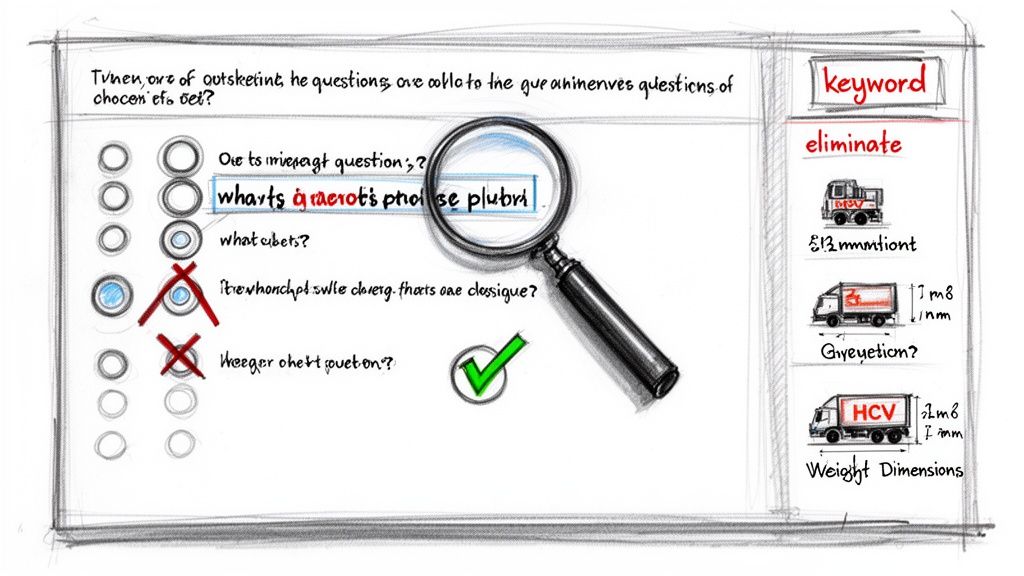
A Simple Process for Tough Questions
Identify Keywords: Keep an eye out for words like “not,” “always,” or “never.” These small words can completely change a question’s meaning. A question asking what you should not do requires a completely different approach.
Eliminate Obvious Wrong Answers: Most of the time, you can immediately rule out one or two options that are clearly wrong. This instantly improves your odds of picking the right one from what’s left.
Apply Logic to the Remaining Options: With only a couple of choices left, think about the real-world HGV scenario. Which answer makes the most sense from a safety and legal perspective? This practical application is what the test is really measuring.
Using a structured approach like this takes the guesswork out of it and builds your confidence, especially when you feel the clock ticking.
The Power of HGV-Specific Practice
Generic theory apps for car drivers just won’t cut it. The HGV test is a different beast entirely, and using the right tools is essential. You need an up-to-date, DVSA-aligned question bank that’s specific to HGVs to make sure you’re practising with relevant material that actually reflects the real exam. A great way to prepare is by using an AI Quiz Generator to build custom tests focusing on your weaker topics.
The data speaks for itself: consistent, specialist preparation sends pass rates through the roof. DVSA figures show car theory pass rates slumped to just 44.2% in 2022/23. In contrast, specialist providers often see first-time pass rates for the LGV theory test climb above 90%. This highlights just how valuable focused preparation is.
That huge difference isn’t down to luck. It’s the direct result of using high-quality, relevant resources and sticking to a proper study plan. By committing to HGV-specific practice, you’re not just studying – you’re investing in a first-time pass, saving yourself the cost and hassle of a re-test.
Conquering the Hazard Perception Test
For many new HGV drivers, the Hazard Perception Test feels like the most daunting part of the whole theory exam. It’s not about memorising rules; it’s a real-time test of your judgement and focus across 19 separate video clips. One click too early or a moment’s hesitation can mean losing valuable points.
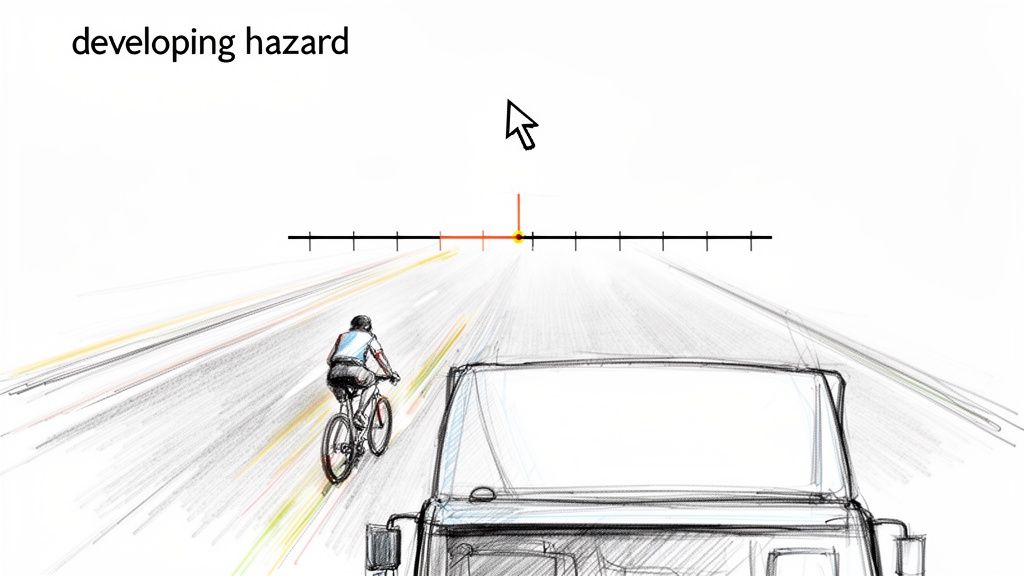
The goal is to spot a ‘developing hazard’ as soon as it appears. What’s that? It’s any situation that would make you, as the driver, take action – whether that’s braking, steering, or stopping completely. You’ll see at least one in every clip, and one tricky clip will even have two.
Success here comes down to one thing: knowing the crucial difference between a potential hazard and a developing one.
The Secret to Scoring High: Potential vs Developing Hazards
A potential hazard is something that could be a problem. Think of a pedestrian waiting patiently on the pavement or a legally parked car. You need to be aware of them, but they don’t demand an immediate reaction. Clicking for these gets you zero points.
A developing hazard is when that situation changes and becomes an active risk. The pedestrian steps into the road. The parked car’s indicator flashes and it starts moving. That’s your cue to click. The scoring window opens the second the hazard starts to develop, offering up to five points for the earliest click.
The real skill in the Hazard Perception Test isn’t just seeing things; it’s about anticipating what might happen next. Your job is to identify the exact moment a situation moves from being a simple observation to a genuine risk that requires a driver’s response.
To nail this, you need a method. I always tell trainees to scan the road ahead, note any potential hazards, and then play the “what if?” game. What if that cyclist wobbles? What if that van door opens? This simple mental exercise gets you ready to react the instant a “what if” becomes reality.
Common Mistakes and How to Avoid Them
It’s surprisingly easy to score zero on a clip, even if you see the hazard perfectly. The test software is designed to catch out anyone trying to game the system, and it’s a quick way to fail. Knowing the common traps is half the battle.
Here are the mistakes we see all the time:
Rhythmic Clicking: Clicking in a steady rhythm (click… click… click…) will get you a flat zero for that video. The system flags it as cheating, plain and simple.
Clicking Too Early: If you react to a potential hazard before it starts developing, your click is too early for the scoring window. You get nothing.
The Single-Click Panic: Some people get so worried about pattern clicking that they only click once. This is a gamble. If your timing is just slightly off, you’ve missed the window and all the points.
A much safer approach is the ‘click and confirm’ method. The moment you spot a developing hazard, click once. Then, as it evolves, give another one or two clicks. This creates a small buffer, ensuring you land within the scoring window without setting off any cheating alarms. For a more detailed look at this, check out our guide to perfecting your reaction with our HGV hazard perception tips.
Practice with HGV-Specific Scenarios
An HGV driver’s view of the world is completely different from a car driver’s. You’re sat much higher, your blind spots are huge, and your vehicle’s length and width are always on your mind. Using standard car-based practice tests just won’t cut it.
You need to find practice clips that put you in the virtual cab of a lorry. These will present you with scenarios that are directly relevant to the job.
HGV-Specific Hazards to Practise
Navigating Tight City Streets: Looking for pedestrians stepping out from between parked cars or cyclists creeping up your nearside.
Motorway Driving: Spotting sudden braking from cars up ahead or vehicles merging dangerously from a slip road.
Rural Roads: Dealing with blind bends, hidden farm entrances, and slow-moving tractors.
High Cab View: Learning to judge the speed and intentions of smaller vehicles that can easily disappear behind your cab’s A-pillars.
There’s no substitute for consistent practice with realistic, high-quality simulation software. It builds the muscle memory and instincts you need to spot hazards early and act with confidence. By drilling these HGV-specific clips, you’re training your brain to perform under pressure when it really counts on test day.
Your Final Week and Test Day Checklist
The final stretch before your HGV theory test isn’t about cramming in new information. It’s all about consolidating what you’ve learned, sharpening your test-taking skills, and getting mentally and logistically prepared for the day. Having a solid plan for this last week is the key to walking into that test centre feeling confident, not panicked.
Your mission now is to build up your mental stamina and get your pacing just right. The theory test is a marathon, not a sprint, and you need to be ready for the long haul.
Taking Mock Tests Under Exam Conditions
In this last week, your focus should shift from general revision to realistic simulation. The best way to do this is by taking at least two full mock tests under strict exam conditions. Find a quiet spot where you won’t be disturbed, set a timer for the official test duration, and power through both the multiple-choice and hazard perception sections in one go.
This isn’t just about testing your knowledge; it’s about building endurance. It gets you used to the rhythm of the test, helps you manage the clock effectively, and trains you to stay sharp even when you start to feel tired.
Think of your final mock tests as a dress rehearsal. They reveal how you perform under pressure and highlight any last-minute weaknesses in timing or concentration, giving you a chance to fix them before it counts.
By getting a feel for the real test environment, you strip away the fear of the unknown: a major source of test-day anxiety for many.
The Final 48 Hours: What to Do and What to Avoid
Those last two days are crucial for getting your mind and body in the right state. The goal is gentle consolidation, not last-minute cramming. Trying to force-feed your brain new information at this point will likely just lead to stress and confusion.
Instead, spend some time lightly reviewing your notes, paying extra attention to any topics you found tricky, like drivers’ hours or vehicle weights and dimensions. Just remind yourself of the core concepts without attempting any more full-length mock tests.
Your 48-Hour Pre-Test Plan
Review, Don’t Cram: Casually read through your notes on key HGV topics. No pressure.
Rest and Relax: Aim for two solid nights of sleep. A tired brain is prone to mistakes.
Prepare Your Documents: Get everything you need together the night before to avoid a frantic morning rush.
Eat Well: Have a decent, balanced meal the evening before and a good breakfast on test day.
Steer clear of anything that could increase your stress levels. That means no late nights, no panicked study sessions, and definitely don’t overdo it with caffeine on the morning of the test. You want to arrive feeling calm, alert, and ready to go. If you’re feeling unsure about the booking process or what happens at the test centre, our guide on how to book your HGV theory test will clear up any lingering questions.
To make sure nothing gets missed, here’s a simple checklist to run through.
Test Day Essential Checklist
This table breaks down everything you need to remember for the big day, from documents to mindset.
Category
Item/Action
Why It’s Important
Documentation
Your UK photocard driving licence
This is your primary form of ID. No licence, no test!
Logistics
Plan your route to the test centre
Know exactly how you’re getting there and allow extra time for traffic or public transport delays.
Preparation
Have a light, nutritious breakfast
Fuel your brain for optimal performance. Avoid heavy foods that can make you feel sluggish.
Arrival
Arrive at the test centre 15-20 minutes early
This gives you time to check in, use the facilities, and compose yourself without rushing.
Mindset
Stay calm and read each question carefully
Don’t rush. Misreading a question is a common and easily avoidable error.
During the Test
Use the ‘flag for review’ feature
If you’re stuck on a question, flag it and come back later. Don’t let it disrupt your flow.
Personal Items
Leave your phone and personal belongings in a locker
You are not allowed to take anything into the test room. Follow the centre’s rules precisely.
Having these essentials sorted beforehand means you can focus all your energy on what matters: passing the test.
What Happens After You Pass
Passing your HGV theory test is a huge milestone. It’s the official green light to start your practical training, and honestly, it’s where the real excitement begins. This certificate is your key to getting behind the wheel and moving on to the hands-on part of becoming a professional driver.
With this pass in your pocket, the bigger picture of your new career really starts to take shape. It’s more than just an exam result; it’s the first major step that gets you properly into the transport and logistics industry. Nailing it first time means no delays: you can get straight on the phone to coordinate your practical training and book your final driving test.
From Theory to Practical Training
Your theory pass certificate is valid for two years. This gives you a clear window to get your hands-on training done and pass the practical test.
The very next step is to schedule your in-cab lessons with your training provider. They’ll work with you to map out a plan, making sure you build the skills and confidence needed to handle a large goods vehicle safely and professionally.
This is where all that hard work studying really pays off. A first-time pass shows your instructor you’re committed and you know your stuff, setting a really positive tone right from the start of your practical sessions.
The Impact of a First-Time Pass
Passing your HGV theory test on the first attempt is a strong sign of future success. While DVSA data showed car theory pass rates dropped to just 44.2% in 2022/23, dedicated HGV candidates who prepare properly tend to do much better.
This preparation is the bedrock for everything that follows, including the practical test where national pass rates are around 59.7%. By knowing how to pass the theory test the first time, you’re already setting yourself apart. You can dig into more data on national driving test results to see the full picture.
Ultimately, this early success fast-tracks your entire journey towards landing a stable, well-paid job as a qualified HGV driver.
Frequently Asked Questions
Even with the best plan in place, it’s completely normal to have a few questions rattling around in your head before the big day. We get it. Below, we’ve tackled some of the most common queries we hear from trainees, giving you the clear, straight answers you need to walk into that test centre with total confidence.
How Long Is the HGV Theory Test Certificate Valid For?
Once you pass, your HGV theory test certificate is valid for two years from that date. This gives you a two-year window to complete your practical HGV driving test.
If you miss that deadline, your theory pass certificate becomes invalid. You’ll have to go back to square one, rebooking and resitting the entire theory test. This is exactly why a structured training plan is so important: it keeps you moving forward, ensuring you progress from theory to practical without the risk of your certificate expiring.
Can I Use a Car Theory App to Prepare?
In a word: no. While it might seem like a thrifty shortcut, using a standard car theory app is a huge mistake and is not sufficient to get you through the HGV theory test.
Why? Because they are missing hundreds of questions on topics that are specific to large goods vehicles. You’ll be tested on things like:
In-depth drivers’ hours and working time regulations
Proper use of digital and analogue tachographs
Rules on safe vehicle loading, securing, and weight distribution
HGV-specific braking systems and vehicle dimensions
Relying on a car app is setting yourself up to fail. You need an HGV-specific revision platform to ensure you’re covering the entire DVSA syllabus and are prepared for the questions you’ll face.
Trying to pass the HGV theory test with a car app is like using a road map of London to find your way around Glasgow. You might know the basics of driving, but you’ll be completely lost when it comes to the crucial local knowledge.
What Happens If I Fail One Part of the Test?
The HGV theory test has two separate parts: the multiple-choice questions and the hazard perception test. You absolutely must pass both parts in the same sitting to get an overall pass certificate.
If you pass the multiple-choice but fall short on the hazard perception (or vice-versa), it counts as a complete fail. You’ll have to book and pay for a whole new test and sit both sections all over again. This rule really highlights how vital it is to give both parts of the test equal attention in your revision.
How Many Clips Are in the Hazard Perception Test?
The HGV hazard perception test features 19 interactive video clips. Each one is shot from the driver’s seat and will contain at least one “developing hazard.” To keep you on your toes, one of the clips will contain two of them.
A developing hazard is anything that would cause a driver to take action, like changing speed or direction. You can score up to five points for each hazard, and the earlier you spot it, the more points you get. The pass mark for the HGV hazard perception section is 67 out of a possible 100 points.
Ready to stop worrying and start preparing? At HGV Learning, we provide the specialised theory test support and practical training you need to pass the first time and launch your new career with confidence. Explore our HGV training courses and get on the road to success today.
What Age Can You Start HGV Driver Training? A 2026 UK Guide to Licence Age Requirements
If you're asking what age you can start HGV driver training, the honest answer depends on which licence you're after. A C1 licence, covering vehicles...