Getting an HGV licence is a direct path to a stable, in-demand career. The whole process, from the first forms to your final test, usually takes around 8-12 weeks. Once you’re qualified, you’ll find job opportunities waiting for you in the UK’s vital logistics sector.
Your Roadmap to a Career on the Road
Deciding to become a professional driver is a big step, but it’s one of the most rewarding you can take. In today’s economy, an HGV licence is an incredibly smart move, putting you right at the heart of the industry that keeps Britain moving. HGV drivers are the backbone of our supply chain, making sure everything from supermarket shelves to construction sites are stocked and ready to go.
This guide is your complete roadmap. We’ll walk you through everything, starting with the initial paperwork and medicals, right up to the day you’re holding a new licence that opens up a world of career opportunities. Getting qualified is about more than just learning to drive a lorry; it’s about becoming a skilled professional in a field where you’ll always be needed.
Understanding the Licence Categories
To get started, it’s really important to know which licence category matches your career goals. Each one lets you drive different types of vehicles, which in turn leads to different kinds of jobs. For a deep dive into the whole process, you can check out our complete guide: your first HGV licence UK roadmap.
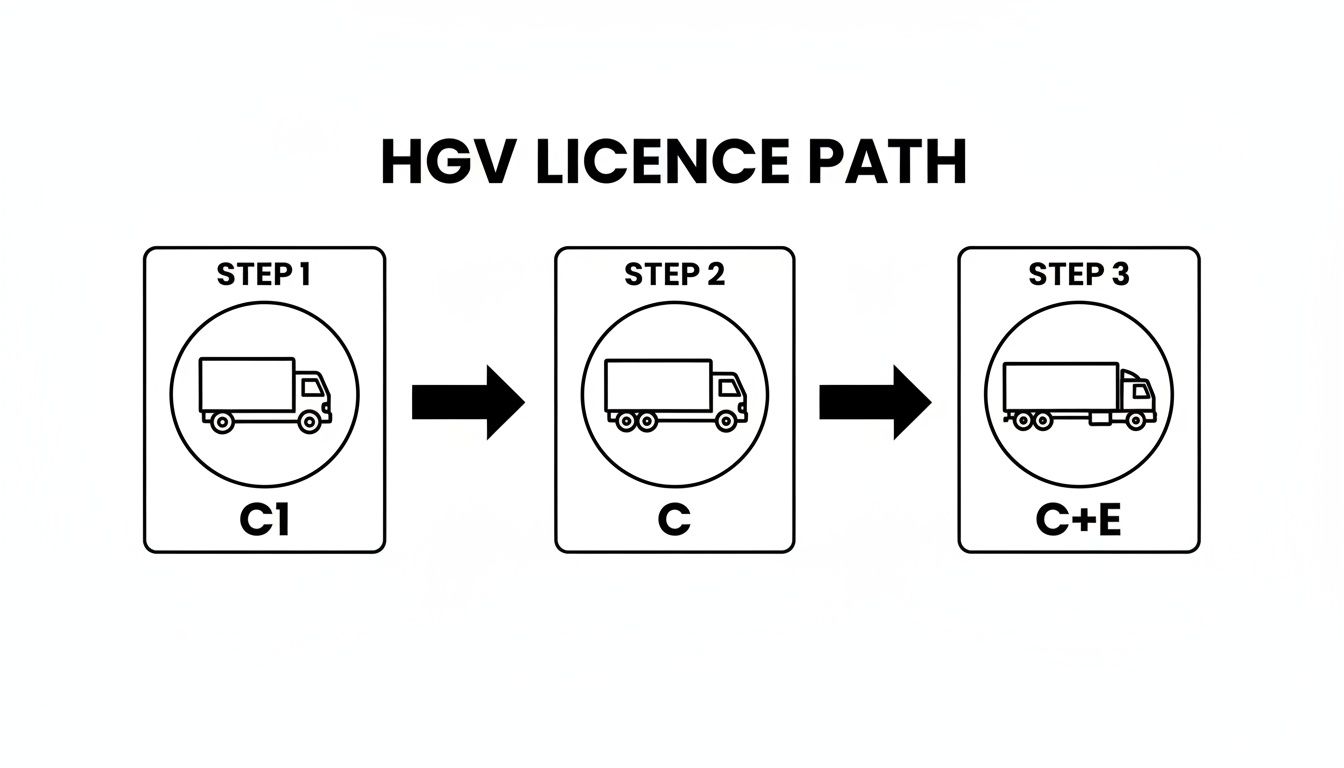
Category C1: This is the starting point for many. A C1 licence lets you drive vehicles between 3.5 and 7.5 tonnes, like larger delivery vans, horseboxes, or even ambulances.
Category C: Often called ‘Class 2’, this licence is for rigid vehicles over 3.5 tonnes. Think of the lorries you see every day making deliveries for big retailers or builders’ merchants.
Category C+E: This is the top tier, known as ‘Class 1’. It qualifies you to drive articulated lorries: the classic cab pulling a separate trailer. This licence offers the highest earning potential and the widest variety of jobs.
The diagram below shows you the typical journey a driver takes to get fully qualified.
As you can see, you can start with smaller rigid vehicles and work your way up to the largest artics, with each category building on the last.
A Secure and Valued Profession
The simple truth is, the country always needs qualified drivers, making this a very secure career choice. If you’re thinking about a new direction, it’s worth looking at the best jobs for career change, and you’ll often find HGV driving high on the list for its stability and good pay. The process might seem detailed at first, but with the right guidance, it’s a clear path to a solid new profession.
Choosing to become an HGV driver is an investment in a skill that is always in demand. Unlike many other jobs, the need for qualified drivers is constant, which provides a level of job security that’s hard to find anywhere else.
This guide will break down every single requirement, from the medicals to the final tests, making sure you have everything you need to get started with confidence.
Navigating the Initial Requirements and Paperwork
Before you can think about getting behind the wheel of a lorry, there’s some essential admin to sort out. This initial paperwork phase is the foundation of your HGV journey. It might look a bit intimidating at first glance, but it’s a straightforward process once you know what’s involved. Think of it as the pre-flight check before your new career really takes off.
The first thing to check is your eligibility. To apply for a provisional HGV licence, you must be at least 18 years old and already hold a full Category B (car) driving licence. Your car licence is proof that you have the basics of UK road rules and some practical driving experience, which is the starting point for any professional driver.
The Key Application Forms
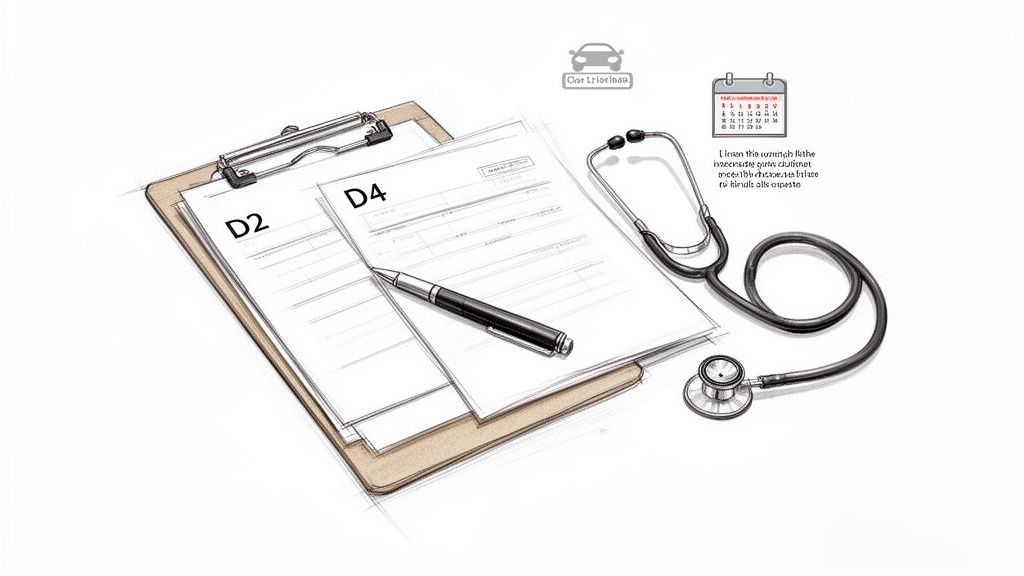
Once you’ve confirmed you meet the age and licence requirements, the next part of the puzzle involves two specific forms from the DVLA: the D2 and the D4.
D2 Form: This is your actual application for a provisional lorry or bus licence. It’s much like the application you filled out for your car licence, asking for personal details and specifying which licence category you’re aiming for.
D4 Form: This form is the medical report that a doctor has to complete. It’s there to confirm you meet the higher medical standards required to safely handle a large commercial vehicle.
These two forms go hand-in-hand. You’ll need to send both the completed D2 and D4 to the DVLA at the same time. Getting them right the first time is key to avoiding any frustrating delays, and this is where having some expert guidance can really help streamline the process.
The HGV Medical Examination
The D4 form leads us to one of the most crucial early steps: the medical exam. This isn’t just a box-ticking exercise; it’s a legal requirement designed to keep everyone on the road safe. You simply can’t get your provisional entitlement without passing this assessment.
The exam itself is a thorough health check carried out by a doctor. They’ll run through several key areas to make sure you’re medically fit to drive a heavy goods vehicle.
During the assessment, the doctor will check:
Your eyesight to ensure it meets the minimum standards.
Your blood pressure and discuss any history of heart issues.
Neurological health, including any history of conditions like epilepsy.
Any other conditions that could impact your driving, such as diabetes or sleep apnoea.
It’s vital to be honest on your medical forms, as failing to declare a condition could have serious consequences later on. For a deeper dive, you might find our guide on what to expect during your HGV medical useful.
Your HGV medical isn’t just about passing a test; it’s about establishing a baseline for a long and safe career. Think of it as your professional driver’s MOT: ensuring you’re in the best condition to handle the responsibilities of the road.
You need to arrange the medical yourself, but it doesn’t have to be a headache. You could go to your own GP, but this can sometimes be the more expensive option with a longer waiting list. A better choice is often a private doctor who specialises in driver medicals; they’re usually quicker and more affordable. A good training provider can normally point you in the right direction or even book the appointment for you, taking one more thing off your plate.
Once the doctor has completed and signed your D4 form, you’re ready to post it with your D2 application. After the DVLA has processed it, your provisional licence will arrive. This is the green light you need to start studying for your theory tests.
How to Pass Your Theory and CPC Tests
So, you’ve got your provisional licence sorted. Now for the theory tests. Don’t think of these as just another box to tick. This is where you build the professional knowledge you’ll use every day on the road, covering everything from road safety to the details of HGV regulations. Nailing these tests first time is your fastest route to getting behind the wheel for your practical training.
The theory side of things is broken down into a few different parts, making sure you have a solid foundation before you even start the engine. Forget dusty old textbooks – modern learning platforms and apps are the way to go. They let you work through mock tests, pinpoint where you’re going wrong, and build your confidence until you’re hitting those pass marks easily.
Mastering the Multiple-Choice and Hazard Perception
Your first theory hurdle will feel familiar if you remember your car test, but it’s been updated for the world of HGVs. You’ll tackle both sections in one sitting.
Multiple-Choice Questions: You’ll face 100 questions and need to get at least 85 right to pass. The topics are broad, covering vehicle weights and dimensions, drivers’ hours, safe loading, and a lot more.
Hazard Perception: This tests your real-world awareness. You’ll watch 19 video clips of normal road scenes and have to click as soon as you spot a developing hazard. One clip has a sneaky double hazard. You can score up to five points for each, and the pass mark is 67 out of 100.
The key here is practice. And that doesn’t just mean memorising answers. When you’re studying drivers’ hours, for example, put it into a real-world context. Imagine planning a run from London to Glasgow. Where would you legally have to take your breaks? Thinking like this makes the information stick.
Understanding the Driver CPC Module 2
Along with the standard theory, you have to get your initial Driver Certificate of Professional Competence (CPC). The first part is the CPC Module 2, which is a computer-based case studies test. This isn’t about rote learning; it’s designed to see how you’d apply your knowledge in realistic situations you’ll face on the job.
You’ll be given seven case studies, each one a short story about a scenario an HGV driver might encounter. After each story, you’ll get six to eight multiple-choice questions.
For example, a case study might put you in a situation where you arrive at a delivery point late, you’re tired, and the depot is pressuring you to squeeze in one last drop. The questions will test your knowledge of drivers’ hours, your legal duties, and your ability to make a safe, professional decision. You need to score 40 out of 50 to pass.
The Practical Demonstration of CPC Module 4
The last piece of the initial CPC puzzle is Module 4, a practical, hands-on test. This isn’t about your driving. It’s a ‘show me, tell me’ assessment where you prove you know your vehicle inside and out from a safety perspective. Passing this is essential for getting your HGV licence.
The examiner will ask you to demonstrate your knowledge in a few key areas:
Loading and Security: You’ll have to show how to secure a load properly with straps and explain the principles of good weight distribution.
Preventing Trafficking: You’ll need to walk the examiner through the checks you’d make on your vehicle to prevent illegal immigration.
Emergency Situations: You might be asked to identify different fire extinguishers and explain which one you’d use for an electrical fire versus a fuel fire.
The test takes about 30 minutes. To pass, you must score at least 80 out of 100 overall, with a minimum of 15 out of 20 in each of the five topic areas. This shows you’re ready for the responsibility of the job.
The CPC modules are what separate a professional driver from someone who can simply operate a large vehicle. They test your judgement, your knowledge of the law, and your commitment to safety in situations you will genuinely face on the road.
The UK is grappling with a serious HGV driver shortage, making this one of the smartest career moves you can make right now. Forecasts show we need to recruit and train 60,000 drivers every year for the next five years to keep the country running. You can read the full government report about road freight statistics here. Mastering these tests is your direct ticket into a secure and vital career. For more help, check out our detailed CPC theory test guide for extra tips.
Choosing the Right Practical HGV Training
Once you’ve got your theory and CPC tests squared away, it’s time for the best bit: the practical training. This is where theory becomes reality. You’ll get behind the wheel, learn to handle a large vehicle, and build the confidence you need to become a professional. It’s all about developing the muscle memory and road sense that will get you through your test and launch your career.
Picking the right training course is a huge decision. It directly affects how ready you’ll feel on test day. The good news is there are plenty of options out there to fit nearly any schedule or budget, so you won’t have to put your entire life on pause to get qualified.
Finding a Training Structure That Works for You
Not everyone can just take a week off work to train, and that’s completely fine. Good training providers understand this and offer different setups to suit all sorts of situations.
You’ll generally find two main options:
Intensive Courses: Often called ‘boot camps’, these pack everything into a solid week, usually Monday to Friday, with your practical test scheduled for the last day. It’s a fantastic choice if you can clear your diary and want to get your licence as quickly as possible.
Flexible Schedules: If you’re juggling a job or family commitments, spreading your training out might be a better fit. You can arrange lessons over a few weekends or on specific weekdays, letting you learn at your own pace without the pressure of a full-on intensive week.
No matter which path you choose, the aim is the same: getting you enough hours in the cab to master the skills and feel confident for your test.
What to Expect During On-Road Training
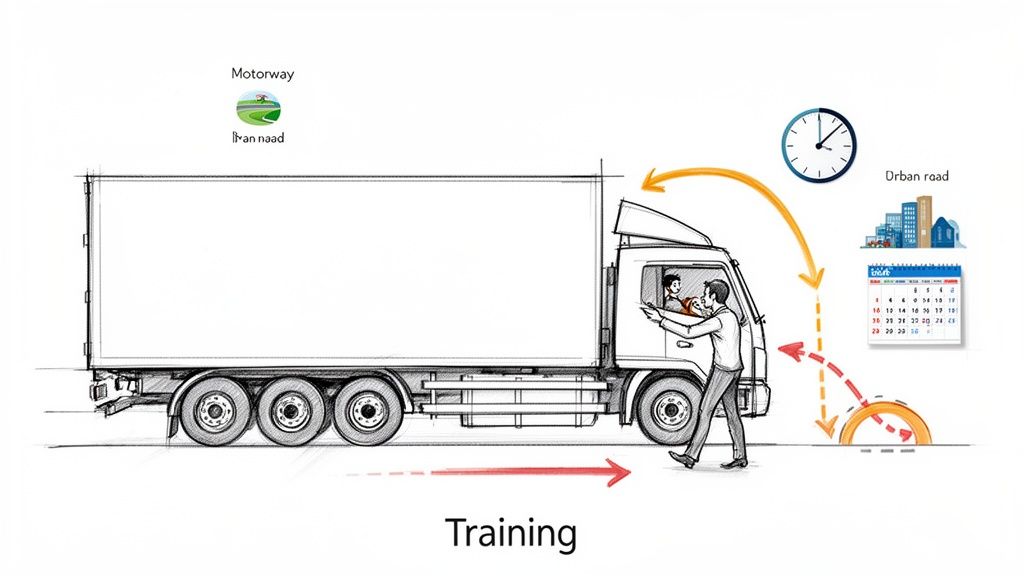
Your on-road sessions are where the real learning happens. Guided by an experienced, DVSA-approved instructor, you’ll start in quiet industrial areas and gradually move onto busy dual carriageways and complex junctions.
You’ll be concentrating on the key skills that define a safe, professional driver. Your instructor will walk you through everything, from mastering clutch control and navigating tight turns to judging your vehicle’s length when changing lanes on a motorway. The goal is to make you a smooth, safe, and considerate HGV driver.
Getting your HGV licence is more than just a personal achievement; it’s your ticket into an industry that desperately needs skilled drivers. A recent report from Logistics UK highlights that 14.5% of transport operators are facing severe recruitment problems for HGV drivers: a far bigger challenge than for van drivers or forklift operators. You can read more in the Logistics UK Q1 2025 Skills and Employment Update and see just how in-demand your new qualification will be.
Mastering the Module 3a Reversing Manoeuvre
Before you tackle the main on-road test, you have to pass the Module 3a off-road exercises. This part of the test is all about precise, low-speed vehicle control.
The reversing exercise is the main event here. You’ll be asked to reverse the vehicle in an ‘S’ shape and finish by parking it neatly in a marked bay, just like backing into a loading dock. It sounds daunting, but your instructor will break it down into simple, manageable steps until you can do it without thinking.
The secret to the reversing manoeuvre isn’t speed: it’s all about observation and control. Examiners want to see you constantly checking your mirrors and making small, deliberate adjustments. Once you get a feel for the vehicle’s pivot points, you’ll nail it.
A Look Inside the Module 3b Practical Driving Test
The final hurdle is the Module 3b on-road practical test, which lasts for about 60 minutes. A DVSA examiner will sit with you in the cab and assess your driving skills on a route that covers a mix of road types and traffic conditions.
Here’s what the examiner is looking for:
Vehicle Safety Checks: Right at the start, you’ll be asked a few ‘show me, tell me’ questions about the lorry’s safety and daily checks.
General Road Driving: You’ll spend about an hour driving on different roads, including town centres, roundabouts, and dual carriageways. The examiner will be assessing your overall safety, awareness, and control.
Independent Driving: For around 10 minutes of the test, you’ll be asked to follow directions from a sat nav or follow road signs to a specific place. This shows you can plan ahead and drive safely without step-by-step instructions.
Remember, the examiner isn’t there to trick you. They just want to confirm you can handle the vehicle safely and professionally while following the Highway Code. Listen to their instructions, try to stay calm, and trust the training you’ve had. With solid preparation, you’ll be in a great position to pass and kick-start your new career.
Landing Your First Driving Job and Managing the Costs
Passing your tests and getting that HGV licence in your hand is a fantastic feeling. But it’s just the beginning. Now it’s time to turn that qualification into a career and start earning. This last part of the journey is all about understanding the investment you’ve made and learning how to sell yourself to get that first crucial job.
Getting your HGV licence is a serious investment, but it’s one that pays off. The total cost includes everything you need: the initial medical, your provisional licence, all the theory and practical tests, and the hands-on training itself.
The upfront cost can seem daunting, but don’t let it put you off. Good training coordinators offer flexible payment options to make it far more manageable. Many will let you spread the cost over 10 to 12 months, breaking down that big figure into a simple monthly payment. Think of it as an investment in your future, not just a one-off expense.
Building a CV That Gets You Noticed
With your licence ready, your CV is now your most powerful tool. The goal is to present yourself as a safe, dependable professional, even if you’re brand new to the industry.
Make sure your new HGV licence details are right at the top. Clearly list the categories you hold (like Category C or C+E) and don’t forget to mention your Driver CPC qualification. These are the exact terms transport managers are looking for.
Next, think about your previous jobs. Were you always on time? Did you have to pay close attention to safety rules or handle paperwork accurately? These are called transferable skills, and they’re very valuable for a new driver. Highlighting them shows you have the right mindset. For those with no direct driving experience, learning how to get hired with no experience is all about showcasing these related abilities.
Your CV is your first impression. It should tell a clear story: you have the official qualification, a professional attitude, and a solid understanding of the responsibilities that come with driving a heavy goods vehicle.
Finally, a cover letter written specifically for the company you’re applying to can really set you apart. Do a bit of research. Mention why you want to work for them: maybe you admire their modern fleet, their reputation, or the types of work they do in logistics, retail, or construction. It shows you’ve made an effort.
Nailing Your First HGV Interview
An interview for a driving job goes beyond just checking your licence. The transport manager needs to know you have the right attitude for the job. You should be ready for questions about drivers’ hours, tachograph rules, and the daily vehicle checks you need to perform.
Get ready to talk about a few common topics:
Safety Scenarios: “What would you do if you found a tyre defect during your walk-around check?”
Legal Knowledge: “Can you quickly explain the rules for your weekly rest?”
On-the-Job Problems: “How would you handle a delay at a customer’s delivery point?”
They’re not trying to trip you up; they just want to see that you take the job and its legal responsibilities seriously. Turning up on time, looking professional, and showing real enthusiasm for the industry will go a long way.
Finding an Employer That’s Right for You
The good news is that qualified drivers are in huge demand, which puts you in a great position. The industry is facing a massive shortage, with an average driver age of 48 and over 50% of the workforce being over 50. As they retire, the need for new blood is getting critical, with shortages projected to hit 70,000-80,000 by 2025.
This demand means you can afford to be a bit choosy. Look for companies that are known for supporting new drivers. Do they offer extra mentoring or pair you up with an experienced driver for the first few weeks? A company with a strong safety record and a well-kept, modern fleet is also a huge plus.
You’re not just looking for any job: you’re kicking off a career. Find an employer who will help you get it started on the right foot.
Common Questions About Getting an HGV Licence
Starting out on the road to an HGV licence is an exciting prospect, but it’s completely normal to have a few questions. This is where we tackle some of the most common queries we hear from aspiring drivers day in, and day out.
We’ve put together some clear, straightforward answers to help you feel confident as you get the wheels rolling on your new career. Think of this as your quick-reference guide for those final details you’re curious about.
How Long Does It Actually Take to Get an HGV Licence?
This is probably the number one question we get asked. For most people, a realistic timeframe for getting fully qualified is somewhere between 8 to 12 weeks.
That window covers absolutely everything, from the initial paperwork right through to your final test:
Applying for your provisional licence and passing the medical.
Studying for and passing your theory tests.
Completing your practical, hands-on training behind the wheel.
Successfully passing all the final DVSA driving tests.
Of course, this can shift a bit depending on factors like DVSA test availability in your area or how quickly you can get your medical sorted. A good training coordinator is worth their weight in gold here – they’ll handle all the scheduling for you, booking everything in a logical order to keep things moving as smoothly as possible.
What Is the Driver CPC and Do I Really Need It?
Yes, you absolutely do. If you plan to drive an HGV for a living in the UK, you must have a Driver Certificate of Professional Competence (CPC). It’s not an optional extra; it’s a legal requirement for almost all commercial HGV work.
The good news is that the initial qualification is built right into your licensing journey. It’s made up of two distinct parts that you’ll do alongside your main tests:
Module 2: A theory test based on real-world case studies.
Module 4: A practical, hands-on demonstration test.
Once you’re qualified and out on the road, you’ll need to complete 35 hours of periodic training every five years to keep your Driver CPC card valid. Without it, you cannot legally drive for commercial purposes.
Can I Go Straight for My Class 1 Licence?
You certainly can. Thanks to recent rule changes, you no longer have to pass the Category C (Class 2) rigid lorry test before moving on to the larger vehicles.
This “direct access” route means you can train for and take your Category C+E test as long as you hold a full car driving licence. For anyone who knows their goal is to drive articulated lorries, this is a much more efficient and cost-effective path. It saves you the time, hassle, and expense of taking two separate practical tests.
Going straight to C+E is a fantastic option, but it’s always worth having a chat with your training provider about it. They can help you figure out if it’s the right move for your current driving skills and career goals, making sure you’re set up for success right from the start.
Are There Payment Plans Available for HGV Training?
Absolutely. Any reputable training coordinator knows that funding the process is a big consideration for most people. The initial cost can seem like a hurdle, but flexible payment options are widely available to make it much more manageable.
Many providers offer their own in-house payment plans, letting you spread the total cost over a set period, often for 10 to 12 months. This is a great way to invest in your future career without facing a huge upfront bill. When you’re looking at different schools, always ask them about their payment plans and get a clear understanding of the terms.
Ready to start your journey to a rewarding new career on the road? At HGV Learning, we manage the entire process for you, from medicals and paperwork to expert training and flexible payment plans. Find out how we can help you get your HGV licence by visiting https://hgvlearning.com.
Related Articles
23/10/2026
Driver CPC Card Renewal: How to Avoid a Lapsed DQC (2026 UK Guide)
If your Driver CPC card is sitting in your wallet with a date on it you haven't looked at properly in years, you're not alone....