Thinking about getting behind the wheel of a big rig? The journey to getting your HGV licence boils down to three key phases: passing a medical, nailing your theory tests, and finally, mastering the practical driving test. This is not just about finding a job: it’s about building a secure and rewarding career, and we are here to guide you every step of the way.
Your Journey into the Driver’s Seat
Deciding to become a truck driver in the UK is a big move, putting you on the path to a profession that is vital to the country. The process is clear and well-structured, designed to make sure every new driver on the road is safe, skilled, and professional. You will not just learn how to handle a massive vehicle; you will gain the qualifications that keep the UK’s economy moving.
Before you even climb into the cab, the journey starts with some basic checks and a good bit of book learning.
The Main Stages of Becoming a Driver
The whole process is laid out in a logical sequence, allowing you to build up your knowledge and skills one step at a time. Here is what the road ahead looks like:
Medical Examination: First things first, you will need a health check to confirm you meet the DVSA’s fitness standards for driving heavy goods vehicles.
Provisional Licence Application: Next, you will get the provisional entitlement added to your licence, which is your green light to start HGV lessons.
Theory and Hazard Perception Tests: This is where you prove you know your stuff: from road law and vehicle safety to spotting developing hazards on the road.
Practical Training and Test: Time for the hands-on part. You will get in-cab lessons with a qualified instructor, leading up to the official DVSA practical test.
Driver CPC Qualification: This is the final piece of the puzzle, the professional qualification that allows you to drive an HGV for a living.
This simple flowchart breaks down the journey into its three main parts.
As you can see, it is a straightforward progression: you start with your health and theoretical knowledge before building up your real-world driving skills.
To give you a clearer picture of the entire process, here is a quick summary of what to expect at each stage.
Overview of the UK Truck Driver Licensing Process
Stage
Key Action
Typical Duration
Medical & Provisional
Complete a driver medical and apply for provisional entitlement.
2-4 weeks
Theory Tests
Revise for and pass the multiple-choice and hazard perception tests.
2-6 weeks
Practical Training
Intensive in-cab training with a professional instructor.
1-2 weeks
Practical Test
Take the DVSA practical driving test.
1 day
Initial CPC
Complete Modules 2 & 4 to drive commercially.
1-2 weeks
This table maps out the typical timeline, but remember that your own journey might be faster or take a bit longer depending on your schedule and test availability.
The current HGV driver shortage in the UK has created a massive opportunity for new talent. The industry needs around 60,000 new drivers every single year for the next five years just to meet demand and replace those who are retiring. You can dig into the official government road freight statistics to see the full picture.
Navigating The Initial Paperwork
Your journey to becoming a professional truck driver does not start in a training yard; it begins with some essential paperwork. Getting these initial forms right is the foundation for everything that follows, so it is worth taking the time to get your head around the process.
The first two hurdles are getting your driver medical sorted and applying for your provisional HGV licence. Let’s break down what you need to do.
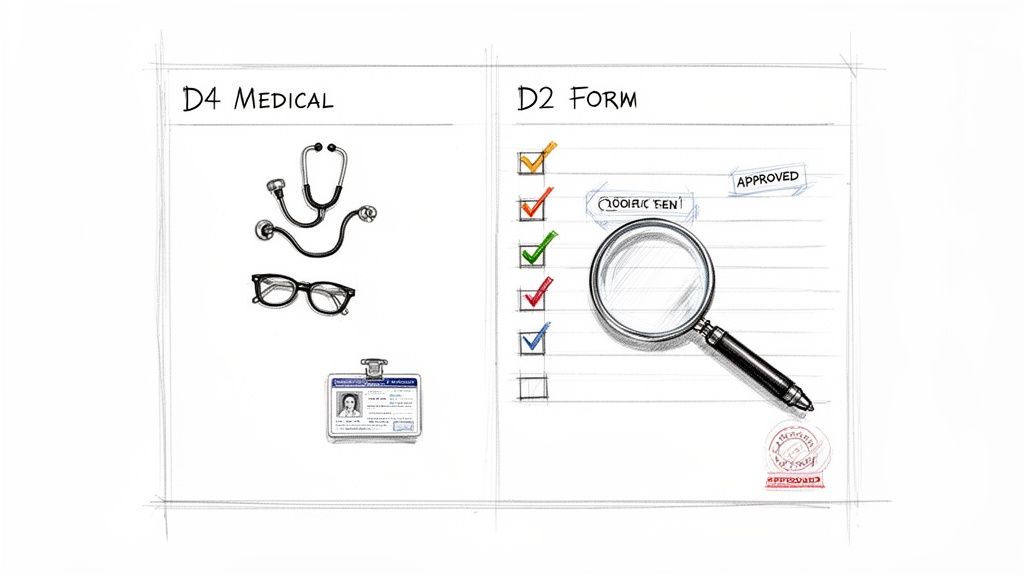
The D4 Medical Examination Explained
Think of the medical exam as a formal confirmation of your fitness to drive. The Driver and Vehicle Standards Agency (DVSA) needs to know you meet their health standards before they will even consider letting you train in a large vehicle. This is not just a box-ticking exercise; it is a critical safety measure.
The D4 medical is a fairly comprehensive health check-up performed by a doctor. Do not worry, it is a straightforward process, but knowing what to expect can ease any nerves.
The doctor will assess:
Eyesight: Your vision will be tested to ensure it meets the minimum DVSA requirements for HGV drivers, both with and without glasses or contact lenses.
General Health: This includes checks on your heart, blood pressure, and a review of your medical history. You will be asked about any conditions like epilepsy, diabetes, or sleep apnoea that could affect your driving.
Neurological Health: The assessment will look for any neurological issues that could impact your ability to drive safely.
Finding a doctor to complete your D4 form is simple. While your own GP can do it, they often charge a premium. Many private doctors and clinics specialise in driver medicals and offer the service for a much better price, often for around £50-£60. You can learn more about what is involved in our detailed guide to the HGV medical.
Applying For Your Provisional HGV Licence
Once the doctor has signed off your D4 medical form, you are ready for the next piece of the puzzle: applying for your provisional licence. This means filling out another form, the D2 application, and sending it off to the DVLA. This officially asks them to add provisional HGV entitlement to your existing driving licence.
The good news? There is no fee for this application. The bad news? Getting the details wrong can cause serious delays. Any errors or missing information can send your application to the back of the queue, holding up your training.
Before you send anything off, make a photocopy or take clear pictures of your completed D2 and D4 forms. Having a record can be a lifesaver if anything gets lost in the post or if you need to refer back to the information you provided.
As part of this early admin, you will also need to get your digital tachograph card application sorted. This is crucial for logging your driving hours once you qualify, and it is a good idea to apply for this early in the process so it’s ready when you are.
Common Mistakes To Avoid
Getting your provisional licence is a key milestone. A simple mistake on the forms can set you back weeks, which is incredibly frustrating when you are eager to get started.
Here are a few common pitfalls to watch out for:
Incorrect Licence Category: Double-check that you are applying for the correct provisional entitlement (e.g., Category C for rigid lorries).
Missing Information: Go through the forms one last time before sealing the envelope. Make sure every required section is filled in properly.
Out-of-Date Documents: Ensure your identification documents, like your passport, are valid and in date.
Once your application is approved, the DVLA will send your driving licence back with the new provisional entitlement added. This is your official green light to book your theory tests and start your practical driver training. With the paperwork done, the real excitement can begin.
Passing Your HGV Theory and Hazard Perception
Once your provisional licence is in the post, it is time to switch gears and focus on the next big hurdle: the theory tests. Do not underestimate this stage. It is not just about cramming the Highway Code; it is about building the core knowledge and split-second awareness that defines a professional driver. It is a two-part challenge designed to test what you know and how you react.
The whole thing is officially known as the Driver CPC Part 1. It is split into two distinct sections that you will usually tackle in one sitting: a multiple-choice theory paper and the hazard perception test. You have to pass both to get through, so you cannot afford to neglect one for the other.
Tackling The Multiple-Choice Questions
First up, you will face 100 multiple-choice questions with a time limit of 1 hour and 55 minutes. You need to score at least 85 out of 100 to pass, which does not leave much wiggle room. These questions are not just trivia; they cover the core principles of professional driving.
My best advice? Do not just memorise the answers. Try to actually understand the why behind the rules. This will serve you far better on the test day and, more importantly, when you are actually out on the road making real-time decisions.
You will be tested on a fairly broad range of topics, including:
Vehicle Weights and Dimensions: Getting your head around the legal limits for different HGV classes.
Drivers’ Hours and Tachographs: This is non-negotiable. You have to know the rules on driving time and rest periods inside-out.
Vehicle Loading and Restraint: All about securing your cargo properly so it does not become a danger on the move.
Road and Traffic Signs: Especially the ones that are specific to large goods vehicles.
Braking Systems and Safety Checks: You will need to know the basics of how your rig works and the walkaround checks you must perform.
Mastering The Hazard Perception Test
The second part is the hazard perception, and it is a completely different ball game. You will be shown 19 video clips of everyday driving scenarios. Your job is to click the mouse the moment you spot a developing hazard: that is anything that would make you, as the driver, need to take action like braking or steering.
Eighteen of the clips contain one developing hazard, but one of them has two to keep you on your toes. You can score a maximum of five points per hazard, with the points dropping the longer it takes you to react. The pass mark here is 67 out of 100.
A classic mistake people make is clicking frantically or in a set rhythm. The software is smart enough to spot this and will give you a big fat zero for that clip if it thinks you’re trying to game the system. Click once, and click deliberately.
So, what is a developing hazard? Imagine a car parked on the left. At first, it is just part of the scenery: a potential hazard. But the second its right indicator starts flashing or you see someone walking towards the driver’s door, it becomes a developing hazard. That is your cue to click. If you want to dive deeper, our guide on HGV hazard perception tips has some great practical advice to get you test-ready.
Your Study Strategy
Success here comes down to consistent effort. Trying to cram it all in the week before is a recipe for disaster. It is far better to chip away at it with regular, focused revision sessions.
Mix up your resources, too. The official DVSA materials are the gold standard, but there are some fantastic apps and online mock tests out there. Getting used to the question format and the pressure of the clock through practice tests is probably the single best thing you can do to build your confidence.
Once you have passed both parts, you will be handed your theory test certificate. This is valid for two years, and it is your green light to finally book that all-important practical driving test.
Alright, theory tests are done and dusted. Now for the exciting bit. This is where you trade in the books for the keys and get behind the wheel to learn the real-world skills you need to handle a heavy goods vehicle with confidence. It is a challenging phase, but it is also where you really start to feel like a trucker.
Getting your practical skills down is about so much more than just steering a big rig. You are developing a whole new level of spatial awareness, getting the hang of tight manoeuvres, and building the safety-first mindset that every professional driver lives by.
Choosing Your Licence Category
First things first, you need to decide which licence to go for. This choice dictates your training path and what kind of jobs you can look for straight after you pass. For most newcomers, it boils down to two main options.
Once you have got your theory sorted, you can start mastering the practical driving skills and decide on your vehicle category. A common goal, for instance, is to become a Class 2 Driver.
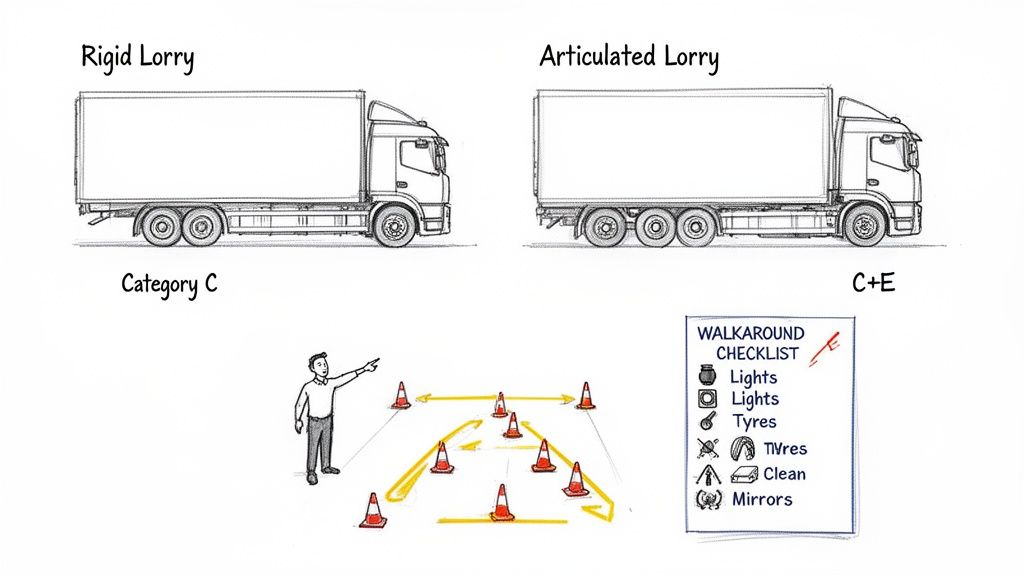
Category C (Class 2): This is your ticket to driving rigid lorries over 3,500kg. We are talking about the delivery trucks, bin lorries, and tippers you see every day. A Cat C licence is a brilliant place to start, opening the door to countless local and regional driving jobs.
Category C+E (Class 1): This is the big one. The C+E licence lets you drive the articulated lorries – the ‘artics’ – with a tractor unit pulling a trailer. To even attempt this, you must have your Category C licence first. A C+E is what you will need for most long-haul trunking work.
A popular route is to get the Category C licence, spend some time on the road getting experience, and then come back later to upgrade to C+E. It is a smart way to start earning sooner and build up your confidence in a slightly smaller HGV before taking on the artics.
What To Expect During Your Practical Lessons
Your practical training will be intensive and completely one-on-one with a qualified instructor. They will take you from the absolute basics of vehicle control right through to handling tricky road situations. Honestly, you will be amazed at how fast you get used to the size of the truck.
You will be laser-focused on a few key skills:
Vehicle Control: Getting the feel for the clutch, brakes, and accelerator, and learning to work the gearbox smoothly.
Spatial Awareness: Judging your width down narrow roads, your height under bridges, and your length when swinging around corners.
Road Positioning: Learning where to place the lorry in the lane is a massive part of it, especially when navigating roundabouts and tight bends.
Observation and Planning: Pro driving is all about looking miles ahead, anticipating what other drivers are going to do, and planning your next move well in advance.
Your instructor is not just teaching you to pass a test. They are teaching you how to be a safe professional for your entire career. Soak up every bit of advice, especially when it comes to managing blind spots and understanding braking distances.
The All-Important Manoeuvres
A huge chunk of your practical test is showing you can control the vehicle with precision in a tight spot. The main event here is the reversing exercise. You will have to reverse the lorry perfectly into a marked bay, just like backing onto a loading dock.
It is a true test of how well you can use your mirrors and control the truck at a snail’s pace. It takes a lot of practice, but your instructor will break it down into simple steps until you can do it in your sleep.
Another non-negotiable is the ‘walkaround’ vehicle check. Before you even start the engine on your test, the examiner will expect you to perform a thorough inspection of the vehicle. This is not just about pointing at things; you have to explain what you are checking and why it matters, covering everything from tyre pressures and fluid levels to lights and couplings.
The Driver CPC Module 4 Test
As well as your main driving test (known as Module 3), you have also got to pass the Driver CPC Module 4. This is a separate, practical demonstration test where you are not actually driving. Instead, it tests your knowledge of vehicle safety and security.
In this 30-minute test, you will need to show the examiner you can:
Load the vehicle correctly and make sure the load is secure
Show you know how to prevent trafficking of illegal immigrants
Assess what to do in emergency situations
Carry out a full vehicle safety check
The UK has around 684,000 HGV drivers keeping a fleet of over 625,800 heavy goods vehicles on the road. But here is the thing: over 60% of these drivers are aged 50 or over. As they head towards retirement, the industry is facing a massive skills gap, highlighting just how much new, well-trained drivers are needed to keep the country’s supply chain moving. You can see the full breakdown of these stats on the HGV driver workforce on ONS.gov.uk.
Getting through these practical tests is the final hurdle. With your new licence and CPC qualification, you will be ready to hit the road and kickstart your career as a professional driver.
Understanding the Costs and Funding Your Training
Investing in your future as a professional HGV driver is one of the smartest career moves you can make, but it is completely normal to wonder about the upfront costs. Getting a clear picture of the investment from the start helps you plan your journey and move forward with confidence.
The good news? The path to becoming a qualified HGV driver in the UK is probably more financially accessible than you think. The total cost is broken down into several smaller, manageable parts, so you will not be hit with one massive bill at the beginning. Instead, the expenses are spread across the different stages of the licensing process.
A Transparent Breakdown of the Costs
Let’s break down the typical expenses you can expect. Keep in mind that these are average figures, and prices can vary slightly depending on where you are in the country and which training provider you choose.
Here is a clear look at what you will need to budget for as you work towards your HGV licence.
Licensing Stage
Average Cost Range (£)
D4 Medical Exam
£50 – £80
Provisional Licence Application
£0 (Free)
Theory & Hazard Perception Tests
£37
Practical Training & Tests
£1,500 – £3,000
As you can see, the main expense is the hands-on training, which is where you build the real-world skills needed to pass your tests and handle a lorry safely and confidently.
Exploring Your Funding Options
The total cost might seem significant, but there are plenty of ways to fund your training that make it much more achievable. You do not have to find the full amount all at once.
Many training providers, including us here at HGV Learning, offer flexible payment plans. These allow you to spread the cost of your practical training over several months, which makes the payments much easier to manage. You can find more details in our complete guide to financing your HGV training.
Do not let the initial cost put you off. Think of it as a short-term investment for a long-term, high-earning career. Many newly qualified drivers recoup their training costs within the first few months on the job.
Another excellent route to explore is government-funded schemes. Keep an eye out for Skills Bootcamps in HGV driving, which often provide intensive, free training courses designed to get people qualified and into jobs quickly.
Getting Your Training Sponsored
It is also becoming more and more common for logistics companies to sponsor new drivers. An employer might offer to pay for your training in return for you committing to work for them for a set period, usually one or two years. This is a fantastic way to get your licence with zero upfront cost and a guaranteed job waiting for you at the end.
Finally, HGV driver apprenticeships are another great option. These programmes combine on-the-job training with classroom-based learning, allowing you to earn a wage while you work towards your full HGV licence.
The financial return on this career choice is impressive. Average HGV driver salaries in the UK have climbed steadily, with new Class 1 drivers earning between £38,000–£46,000 and experienced professionals reaching £45,000–£55,000+ per year. This shows just how quickly you can see a return on your initial training investment.
Launching Your HGV Driving Career
Passing your practical tests is a huge moment – all that hard work has finally paid off. With your brand new HGV licence and Driver CPC card in hand, you are officially qualified to drive for a living. It is an incredible feeling, but it is also where the real journey into the world of logistics begins.
The next challenge is turning that hard-earned qualification into your first paid driving job. This is all about crafting a CV that gets you noticed and preparing for interviews where you can show you are a professional with a safety-first mindset.
Finding Your First HGV Driving Job
As a newly qualified driver, your CV needs to be clean, professional, and put your new qualifications front and centre. Do not stress about a lack of professional driving experience; every single driver had a first day. Instead, shine a light on the skills you already have.
It is a good idea to highlight things like:
Your track record for punctuality and reliability in past jobs.
A solid grasp of drivers’ hours and safety rules.
Any experience you have dealing with customers.
Your clean driving record and commitment to doing things by the book.
When you get to the interview stage, be ready to explain why you wanted to become a truck driver. Employers are looking for people who are serious about the profession, not just someone after any old job. They want to see genuine enthusiasm and that you understand the responsibility that comes with getting behind the wheel.
A top tip for your first few months is to find a mentor. This could be a seasoned driver at your new company who you can ask for advice. Their real-world knowledge on tricky routes, specific delivery points, and how the company really works is absolutely invaluable.
Choosing The Right Type of Driving Work
It is a mistake to think all driving jobs are the same. The work can be chalk and cheese, so have a think about the kind of lifestyle and work-life balance you are really looking for. Figuring this out early will help you target the right companies from the get-go.
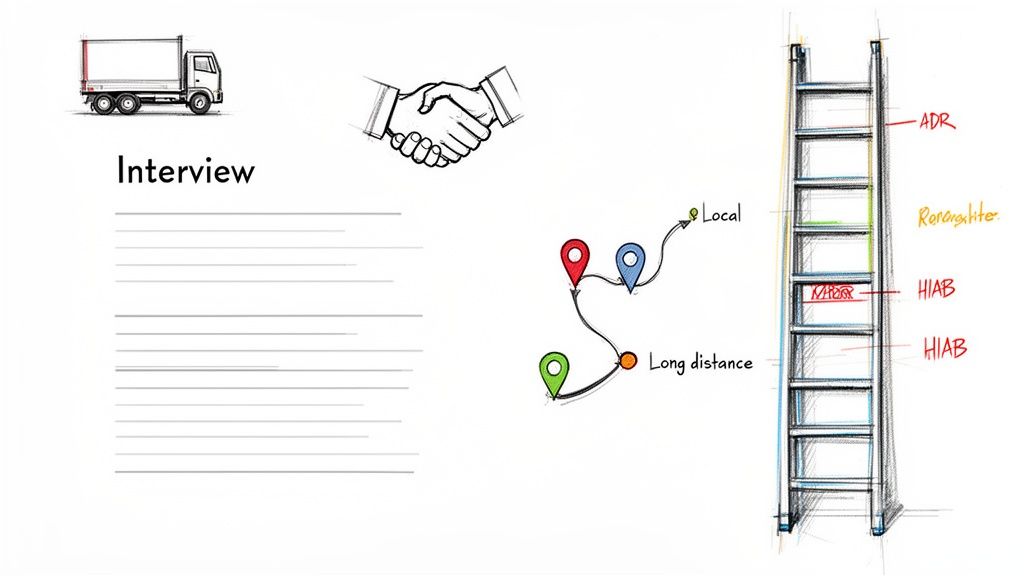
Local Multi-Drop: This is fast-paced work, involving dozens of deliveries in a specific local or regional area. It demands excellent time management and you will be the face of the company, so customer service skills are key.
Trunking (Long-Distance): This is the classic image of truck driving. You will typically be driving from one depot to another, mostly on motorways, with just a couple of stops. Be prepared, as this often involves nights away from home.
Planning Your Career Progression
Think of your first driving job as a launchpad. Once you get some experience under your belt, all sorts of new doors will open, allowing you to specialise and seriously boost your earning potential. After a year or two on the road, you can start looking at adding specialist tickets to your licence.
Consider certifications that are always in demand:
ADR: This qualifies you to transport hazardous goods. It is a skill that companies are always desperate for and it definitely comes with a better rate of pay.
HIAB: This involves training to operate a lorry-mounted crane (like a “grab arm”), which opens up a whole world of roles in construction, builders’ merchants, and other specialist sectors.
Thinking about these future steps shows you are not just looking for a job, but building a long and rewarding career on the road.
Your Questions Answered
Starting any new career path is a big deal, and it is only natural to have a few questions. We have pulled together some of the most common ones we hear from people just like you, to give you the clear, no-nonsense answers you need.
How Long Does It Take to Qualify as a Lorry Driver?
You might be surprised at how quickly you can get on the road. The whole journey, from your initial medical right through to passing that final practical test, can often be done in just eight to twelve weeks.
Of course, this can vary a bit depending on how available you are for training and how quickly the DVLA processes your paperwork. But even so, it is one of the fastest ways to get into a properly skilled and well-paid profession.
What’s the Minimum Age to Start?
In the UK, you need to be at least 18 years old to get your Category C or C+E licence. The other key requirement is that you must already hold a full car driving licence – you cannot even apply for your provisional HGV entitlement without it.
Do I Need My Own Lorry for the Training?
Not at all! Any reputable training provider will supply the vehicles you need for your lessons. These are not just any lorries either; they are kitted out with dual controls. This means your instructor has their own set of pedals, giving you a brilliant safety net while you are getting to grips with things.
Honestly, the only things you need to bring to your training are a can-do attitude and a genuine desire to learn. We handle the rest. The vehicle, the insurance, the expert instruction – it’s all sorted so you can focus 100% on honing your driving skills.
Ready to get behind the wheel and start your new career? HGV Learning offers complete, end-to-end support to get you qualified and into a job. Find out more at https://hgvlearning.com.