Becoming an ambulance driver is not just about getting behind the wheel; it is a commitment to being a calm, skilled professional in what can be incredibly high-pressure situations. To get started, you will first need to get the right C1 driving licence, sail through the essential medical and background checks, and then dive into the specialised training needed to handle an emergency vehicle safely and effectively. This guide will walk you through the entire journey, step by step.
Your Roadmap to a Career on the Front Line
Deciding to become an ambulance driver means you are looking to serve your community right on the front line of emergency care. It is a role that demands a unique blend of expert driving, cool-headed decision-making, and a real sense of responsibility. Unlike a standard driving job, this career puts you at the heart of critical incidents where every single second counts.
Think of this guide as your practical roadmap. We will break down every requirement, from the first bit of paperwork to the advanced skills you will need to drive under blue lights. Whether you are aiming for a role with an NHS Trust or a private service, these foundational steps are your starting point.
The Core Journey at a Glance
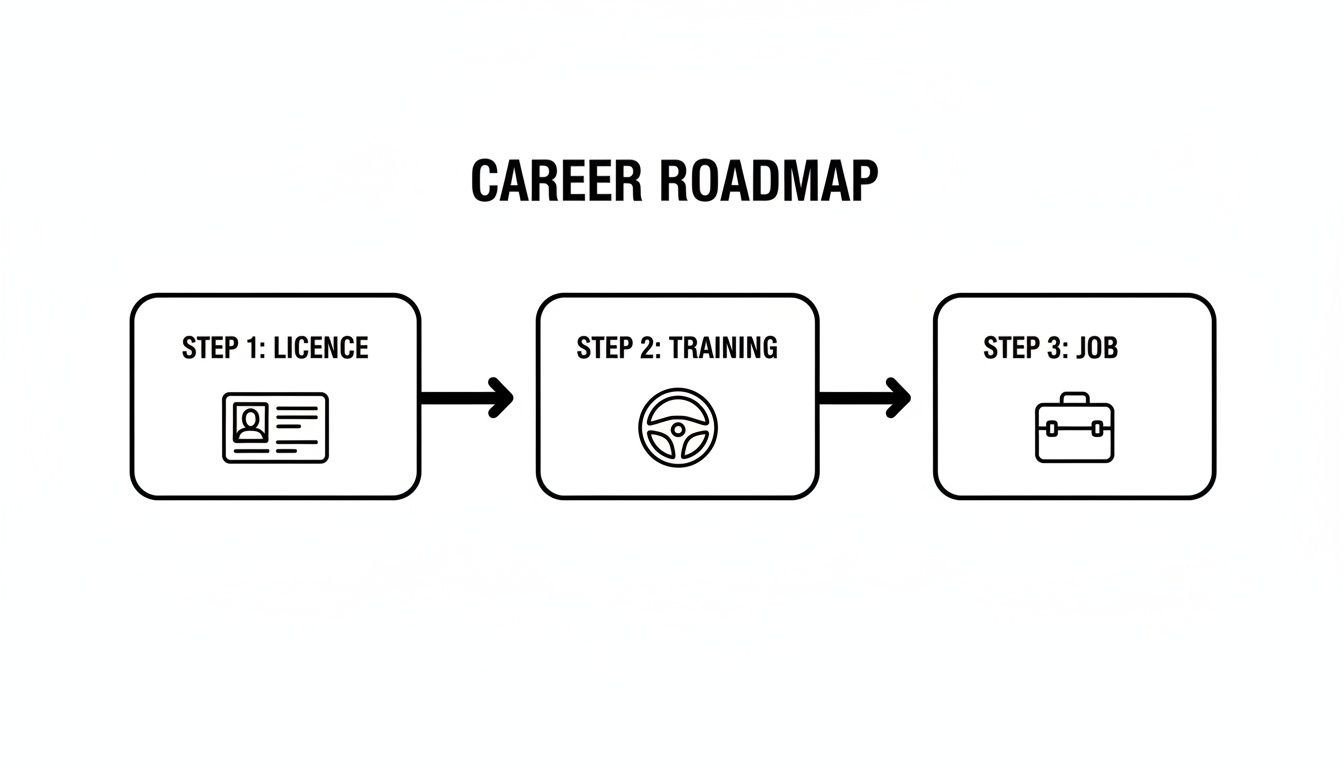
The path is best understood in three main phases: securing your qualifications, undergoing specialist training, and finally, entering the workforce. Each stage builds on the last, making sure you are fully prepared for the demands of the job. You will progress from being a qualified driver to a competent emergency response professional.
This career is not just about getting from A to B. It is about being the person who can safely and swiftly navigate challenging conditions to bring vital care to those in need. You are the critical link between the public and the hospital.
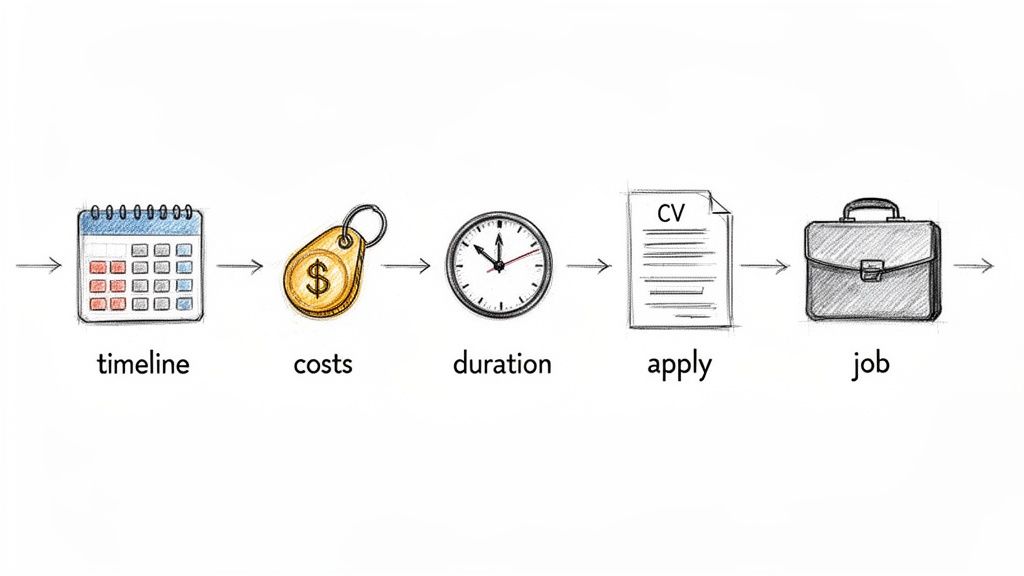
Understanding this pathway helps you plan your time, budget, and energy properly. This infographic simplifies the career roadmap, showing the key milestones you will need to hit.
As you can see, the journey kicks off with getting the right licence, moves through dedicated training, and finishes with you landing a professional role.
What to Expect From This Guide
We are going to cover everything you need to know, giving you total clarity on the specific steps involved. Here is a quick look at what we will explore:
Licensing and Medicals: How to get your provisional C1 licence, including getting your head around the DVLA forms and medical assessments.
Essential Checks: Understanding the theory tests, DBS checks, and occupational health screenings that all employers will ask for.
Practical Skills: From passing your C1 practical test to completing advanced emergency response driver training.
Timelines and Costs: A realistic look at the investment of time and money needed to qualify and find your first job.
By the end of this guide, you will have a clear, actionable plan on how to become an ambulance driver in the UK, giving you the confidence to turn your ambition into a rewarding career.
Securing Your Essential C1 Licence
Before you even start thinking about blue lights and sirens, your journey begins with something much more fundamental: your driving licence. A standard car licence (Category B) just will not cut it for the weight and size of most modern ambulances. This is where the Category C1 licence comes in, and it is the very first hurdle you need to clear.
A C1 licence is what legally allows you to drive vehicles with a gross vehicle weight (GVW) of between 3.5 and 7.5 tonnes. This weight bracket perfectly covers the vast majority of the UK’s frontline ambulance fleet. Put simply, without it, your application to most emergency services will be a non-starter.
This is not just about ticking a box. It is the foundational qualification that proves you are capable of safely handling a much larger, heavier, and more demanding vehicle on public roads. It is the key that opens up the door to the rest of your training.
Understanding the Key Licence Categories
Navigating DVLA licence categories can feel a bit like wading through alphabet soup, but for an aspiring ambulance driver, it is crucial to know the difference. Getting it right ensures you pursue the correct training and meet the exact standards set by NHS Trusts and private ambulance services.
To make things clearer, let us break down the main licence categories relevant to ambulance roles. This table shows you exactly where the C1 fits in and why it is so important.
UK Driving Licence Categories for Ambulance Roles
Licence Category
Vehicle Weight (Gross Vehicle Weight)
Common Vehicle Type
Relevance to Ambulance Roles
Category B
Up to 3.5 tonnes
Standard car, small van
Limited to some non-emergency Patient Transport Service (PTS) vehicles or smaller rapid response cars.
Category C1
Between 3.5 and 7.5 tonnes
Small lorry, most frontline ambulances
Essential for most emergency ambulance driver roles. This is the primary licence you will need to obtain.
Category C
Over 3.5 tonnes (no upper limit)
Rigid HGV, large delivery lorry
More than required for a standard ambulance but opens doors to driving larger support vehicles or incident response units.
As you can see, while a standard car licence has its uses, the C1 is the non-negotiable requirement for the job you are aiming for.
Starting the Process: Provisional Entitlement
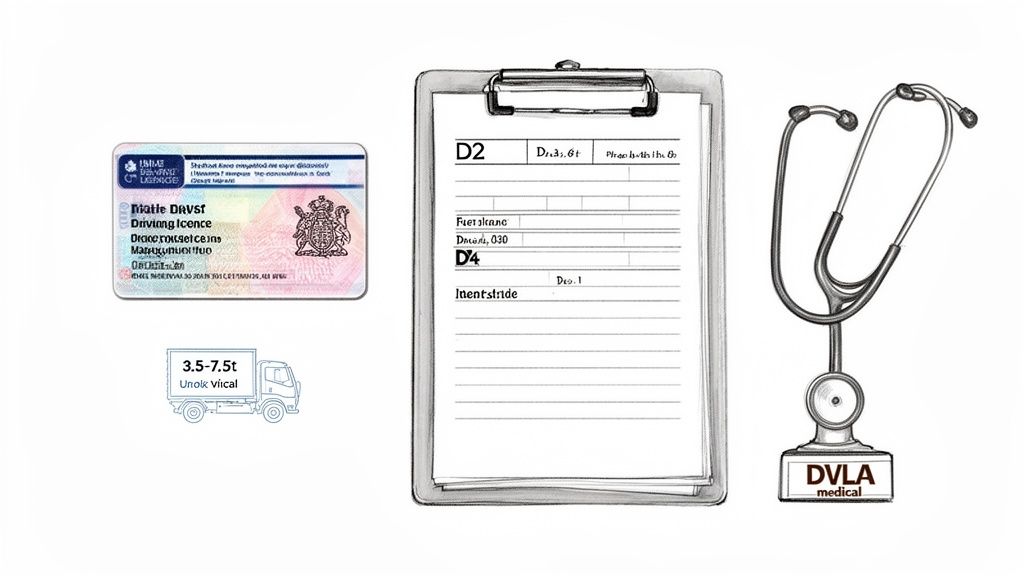
Your first practical step is to apply for a provisional C1 licence. This entitlement is not added automatically; you need to complete a couple of key forms to show the DVLA you meet the higher medical standards required for driving larger vehicles.
This involves two critical pieces of paper:
The D2 Form: This is the main application for your provisional lorry, bus, or minibus licence.
The D4 Form: This is a medical examination report that has to be filled out by a doctor.
You can order these forms straight from the GOV.UK website or often find them at larger Post Office branches. Filling them out accurately is the bedrock of your application, so take your time and double-check every detail. For a detailed walkthrough of this paperwork, check out our complete guide on how to get a C1 licence.
The Driver Medical: What to Expect
The DVLA medical is a crucial part of the process. It is there to confirm you are medically fit to be in control of a vehicle weighing several tonnes. Do not mistake this for a quick check-up; it is a thorough assessment of your overall health.
You can book this with your own GP, but be aware they can charge a hefty fee. A much more common and cost-effective route is to use a private doctor or a specialist driver medical provider. They often have better availability and more competitive prices.
The medical exam is designed to identify any health conditions that could impact your ability to drive safely. This includes your eyesight, neurological health, and cardiovascular condition. Honesty and accuracy are paramount during this assessment.
During the appointment, the doctor will go through your medical history and carry out a physical examination. This usually includes:
Vision Test: An eyesight check, including your field of vision, to ensure you meet the minimum standards for Group 2 licences.
Blood Pressure Check: A standard check to make sure your blood pressure is within a safe range for driving.
Medical History Review: The doctor will ask about any past or current conditions, like diabetes, epilepsy, or heart problems, that could affect your driving.
Once the doctor is satisfied, they will sign off your D4 form. You then send this, along with your D2 form and current driving licence, off to the DVLA. After a few weeks, your licence will arrive back with the provisional C1 entitlement added. You are now officially cleared to start your practical driver training.
Passing Your Theory Test and Background Checks
Once you have your provisional C1 entitlement in hand, the focus shifts from paperwork to proving your knowledge and suitability for the job. This next phase is all about passing your theory test and clearing the necessary background checks.
These steps are just as crucial as the practical driving test. They show that you have the required road safety knowledge and are a trustworthy person to put in an emergency service role. Every NHS Trust and private ambulance service has a massive duty of care to the public, so they need to be completely confident in the people they hire.
Navigating the C1 Theory Test
Do not mistake the C1 theory test for a simple box-ticking exercise. It is a proper assessment of what you know about driving larger vehicles and is split into two parts, which you will usually sit on the same day. You have to pass both to move on.
First up is the multiple-choice exam. This will test you on everything specific to C1 category vehicles – think road signs, vehicle safety, correct loading procedures, and the rules around drivers’ hours. It is a definite step up from the standard car theory test, so you will need to put the revision hours in. For a deeper dive into what to expect and how to prepare, our guide to the theory test for an HGV licence is packed with useful info.
The second part is the hazard perception test. Here, you will watch a series of computer-generated clips and your job is to spot developing hazards as quickly as possible. For an ambulance driver, this skill is second nature – spotting potential trouble early is what safe emergency response driving is all about.
A crucial tip for the hazard perception test: it is about reacting to developing hazards, not things that are already there. Clicking too soon, too late, or just randomly in a pattern can score you a zero for that clip. It is all about genuine observation and timing.
Essential Background and Health Screenings
It is not just about what you know; it is also about who you are. Employers need to be certain you are a suitable person for a role working with vulnerable people. This is where background and health checks come in, and they are non-negotiable for any aspiring ambulance driver.
These checks are not there to trip you up. They are a standard safeguarding measure to protect patients. Knowing what is coming will make the whole application process feel a lot less daunting.
The Enhanced DBS Check Explained
One of the most critical checks is the Enhanced Disclosure and Barring Service (DBS) check. This is the highest level of check available, and it is required because you will be in direct contact with children and vulnerable adults. It provides a detailed look at any convictions, cautions, reprimands, or warnings on police records.
What does it actually look for?
Spent and Unspent Convictions: It shows a complete criminal record.
Cautions, Warnings, and Reprimands: Any formal police warnings will be listed.
Barred Lists: It checks if you are on a list of people barred from working with children or vulnerable adults.
Relevant Police Information: This can also include other information held by local police that they believe is relevant to the role you are applying for.
Being completely honest on your application forms is absolutely vital. Hiding something that later shows up on a DBS check is one of the quickest ways to get your application rejected.
Occupational Health Screening
Finally, you will be asked to complete an occupational health screening. This is separate from the DVLA medical you did for your provisional licence. Your potential employer carries out this check to make sure you are physically and mentally up to the specific challenges of the job.
This screening typically assesses:
Your physical ability to lift and move patients and heavy equipment.
Your mental resilience for handling stressful and often traumatic situations.
Any existing health conditions that might impact your ability to do the job safely.
At its core, this check is to ensure the job will not put your own health at risk, and that your health will not compromise patient safety. Getting the all-clear on these checks is the final hurdle before you can get stuck into the most exciting part: the hands-on practical driver training.
Mastering Your Practical Driving Skills
This is where the rubber really hits the road. With your provisional licence sorted and theory test in the bag, it is time to shift your focus to the hands-on skills needed to handle a larger vehicle with genuine confidence. It all starts with passing your C1 practical driving test.
This test is much more than just a box-ticking exercise. It is a proper assessment of your ability to control a vehicle that is significantly bigger and heavier than a standard car. Getting through it successfully is the final hurdle to holding a full C1 licence, making it a major milestone on your path to become an ambulance driver.
The C1 Practical Driving Test Unpacked
The C1 practical test is built to evaluate your all-round driving ability, from basic safety checks right through to how you handle yourself in real-world traffic. It is a comprehensive exam that demands your full attention, requiring you to show you are in complete control at all times.
The test is usually broken down into a few key parts:
‘Show Me, Tell Me’ Questions: Before you even turn the key, the examiner will fire off a series of vehicle safety questions. You might be asked to explain how you would check the power-assisted steering is working correctly or show them where you would check the engine oil level.
Reversing Manoeuvre: You will be asked to complete a precise reversing exercise at the test centre, often an ‘S’ shaped reverse into a clearly marked bay. This is a pure test of your spatial awareness and ability to judge the vehicle’s dimensions.
On-Road Driving: The bulk of the test involves about an hour of driving on different types of roads. The examiner will be watching everything – your observation skills, mirror checks, signalling, and how you react to other road users.
The examiner is not looking for a racing driver. They are looking for someone who is safe, confident, and observant – a driver who can anticipate hazards and maintain total control of the vehicle. Smoothness and consistency will always beat speed.
What Examiners Are Really Looking For
Passing is not just about avoiding faults; it is about showing a professional driving mindset. Instructors will tell you that the biggest difference between a pass and a fail often comes down to attitude. A successful candidate demonstrates that they are constantly thinking, planning, and anticipating what could happen next on the road.
They want to see clear evidence of:
Excellent Observation: Constant use of mirrors and diligent blind spot checks.
Vehicle Control: Smooth acceleration, braking, and gear changes.
Road Positioning: Correctly placing the vehicle for turns and within lanes.
Awareness of Other Road Users: Showing real consideration for cyclists, pedestrians, and other drivers.
Nailing these areas comes down to quality training and plenty of practice. For a deeper dive, our guide on passing your C1 driving test is packed with practical tips and advice to get you test-ready.
Beyond the Test: Blue Light Training
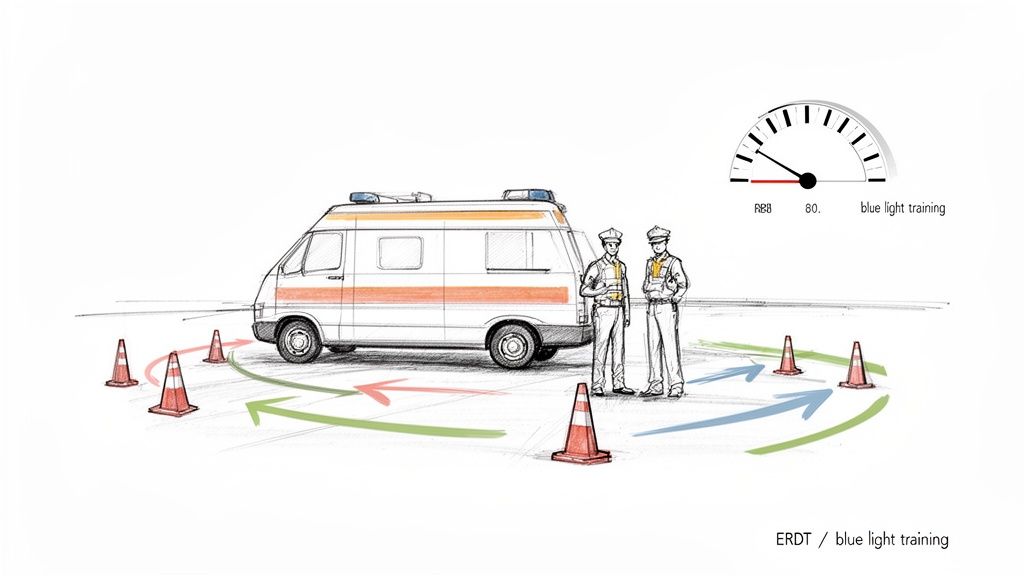
Once you have got that C1 licence in your wallet, the next level of training awaits: the specialist Emergency Response Driver Training (ERDT), better known as ‘blue light’ training. This is where you learn the very specific skills required to drive an ambulance under emergency conditions. This advanced training is almost always provided by your employer, whether that is an NHS Trust or a private service.
This is not your standard driving course. It is an intensive programme designed to give you the skills and mindset to respond to emergencies safely and effectively, balancing the need for speed with the absolute necessity of public safety.
The training demands for UK ambulance drivers are, quite rightly, focused on these critical response skills. For example, services like the East of England Ambulance Service Trust (EEAST) provide crucial programmes in resuscitation and safeguarding, on top of a professional development catalogue of 358 courses attended by 5,648 colleagues in 2023/24.
ERDT typically covers several core areas:
High-Speed Driving Techniques: Learning how to handle an ambulance at speed, including cornering, braking, and even skid control.
Legal Exemptions: Understanding which road traffic laws you can legally disregard when responding to an emergency and, crucially, knowing when it is safe to do so.
Continuous Risk Assessment: Developing the skill of constantly scanning for, identifying, and reacting to potential hazards while driving at speed.
Vehicle Sympathy: Learning to drive in a way that minimises wear and tear and ensures a smooth, stable ride for the patient and crew in the back.
Completing this advanced training is the final piece of the puzzle. It is what transforms you from a qualified C1 driver into a professional emergency response driver, fully prepared for the challenges of a career on the front line.
Costs, Timelines, and Landing Your First Job
Before you dive in, it is crucial to get a handle on the practical side of things. You need a clear picture of what this journey will ask of you, both in time and money. This section will break it all down, giving you a realistic game plan for becoming an ambulance driver.
From the first medical check to your final driving test, every step has a cost and a timeframe. Getting your head around these from the start will make the whole process feel much smoother, letting you focus on what really matters: the training.
Budgeting for Your New Career
Let us talk numbers. The total cost can shift a bit depending on your chosen training provider and where you are based, but we can map out a solid estimate. Being financially prepared from day one means you will not hit any unexpected roadblocks that could slow you down.
Here is a completely transparent look at the typical expenses you will run into on your way to getting your C1 licence.
Estimated Costs to Become an Ambulance Driver
Item / Stage
Estimated Cost Range (£)
DVLA Medical (D4 Form)
£50 – £120
Provisional Licence Application (D2 Form)
Free
C1 Theory & Hazard Perception Test
£37
C1 Practical Training Course (including test fee)
£800 – £1,500
Enhanced DBS Check
£38 – £55 (often covered by the employer)
Digital Tachograph Card (if required)
£32
Total Estimated Cost
£957 – £1,744
Think of this table as your financial roadmap. It is worth remembering that some employers, especially NHS Trusts, might fund some or all of this training through apprenticeships or trainee schemes. Keep an eye out for those opportunities – they are gold dust.
Mapping Out Your Timeline
So, how long does it all take? You might be surprised. If you are organised, you can get from a complete beginner to a qualified C1 licence holder pretty quickly. The main variable is always the DVLA processing times, which can sometimes throw a spanner in the works.
Having a realistic schedule helps manage your own expectations and plan your career switch without unnecessary stress.
The secret to a fast turnaround is being proactive. Book your medical the moment you decide this is for you, get stuck into theory revision early, and get your practical training booked as soon as that provisional licence lands on your doormat. Momentum is your best friend here.
Here is a typical breakdown of how long each stage might take:
Medical and Provisional Licence:4-8 weeks. This is often the longest wait, as you are in the hands of the DVLA.
Theory Test Preparation and Pass:2-4 weeks. This one is all on you: it depends entirely on how much study time you can put in.
Practical C1 Training and Test:1-2 weeks. Most courses are intensive, running over a few straight days right before your test.
All in, you could be fully qualified in as little as 7 weeks. A more common average, though, is around 12 to 14 weeks from start to finish.
Landing Your First Ambulance Driver Job
With your shiny new C1 licence in hand, it is time to find a job. The good news is that the UK has a steady demand for skilled drivers. You will find opportunities with NHS Ambulance Trusts, private ambulance services, and non-emergency Patient Transport Services (PTS).
To make your application stand out, your CV needs to be more than just a list of qualifications. You have to highlight the personal qualities that employers are really looking for: reliability, a cool head under pressure, brilliant communication skills, and a genuine dose of compassion.
When you get to the interview stage, be ready with real-world examples of when you have shown these traits. Think back to previous jobs or even personal experiences where you have handled a stressful situation or had to communicate with someone in distress. Proving you have the right character is every bit as important as having the right licence.
Got Questions About Becoming an Ambulance Driver?
Stepping into a new career always throws up a few questions. When that career is as full-on as driving an ambulance, you will want the full picture before you invest your time and money.
We get asked a lot of the same things by people just starting out. Getting straight answers now helps you map out your journey and avoid any nasty surprises down the road.
Do I Need Medical Qualifications to Be an Ambulance Driver?
This is a big one, and the answer really hinges on the exact role you are aiming for. For a pure driving job, like many in Patient Transport Services (PTS), you might not need any prior clinical skills. Your main job is to provide safe, smooth transport for non-emergency patients.
However, the game is changing. Most frontline emergency jobs, like an Emergency Care Assistant (ECA), now blend driving with clinical duties. For these roles, you will absolutely need clinical training. The good news? This is often baked into a trainee programme provided by your employer. Having your C1 licence sorted beforehand makes you a much stronger candidate for these sought-after trainee spots.
Can I Get a Job with Points on My Licence?
It is possible, but there is no simple yes or no. The final decision is always down to the hiring service, and they look at every case on its own merits. A couple of points for a minor speeding offence from a few years back probably will not be a deal-breaker.
Honesty is your best friend here. Be completely upfront about any points or endorsements on your licence when you apply. Trying to hide something that will definitely pop up during checks is the quickest way to get your application binned.
That said, any convictions for serious offences like drink, drug, or dangerous driving will almost certainly rule you out. These jobs demand the absolute highest standards of safety and public trust.
How Physically Demanding Is the Job?
Make no mistake, this role is physically tough and requires a decent level of fitness. You will have to pass a thorough occupational health assessment before you get a job offer. This is not just ticking a box; it is a vital check to keep you and your patients safe.
On any given day, you could be:
Lifting and moving patients, who might be unable to move themselves or are in distress.
Carrying heavy medical gear, sometimes up flights of stairs or over rough ground.
Working in tight, awkward spaces to give care.
Looking after your own physical health is non-negotiable. It means you can do your job properly without risking injury to yourself, your crewmate, or the very people you are there to help.
NHS vs. Private Ambulance Service: What’s the Difference?
Both the NHS and private sector offer great careers, but they are different beasts. Knowing how they differ can help you figure out where you will fit best.
Working for an NHS Ambulance Trust usually means responding to frontline 999 calls or handling structured, non-emergency patient transport. These jobs tend to have a clear career ladder, solid benefits, and the stability of being part of the public health system.
A private ambulance service can offer a bit more variety. Your work might involve providing medical cover at big events, doing inter-hospital transfers for private patients, or even backing up the NHS during busy periods. While the work can be incredibly varied, the pay and benefits can look quite different from what the NHS offers.
No matter which route you choose, the same high standards apply. Your C1 licence and advanced training are the keys that open up opportunities in both sectors.
Ready to get started on a seriously rewarding new career? HGV Learning offers complete, end-to-end support to get you that C1 licence, from booking your medical to sorting out your practical test. We keep the whole process clear and simple so you can focus on the driving. Take the first step with us today by checking out our C1 training packages.