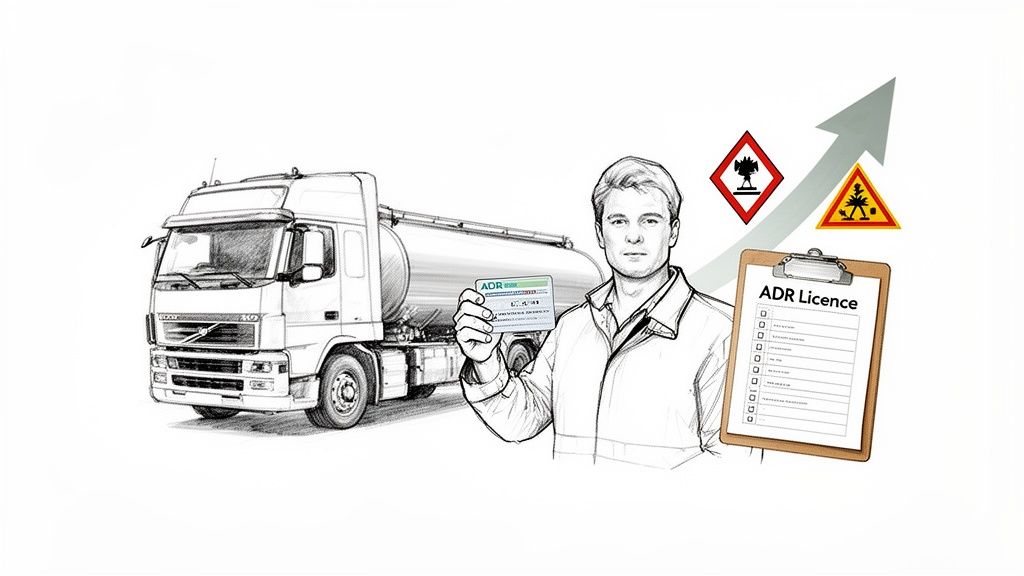
So, you’re thinking about getting your ADR licence. Good move. It’s a solid qualification that opens doors to more specialised, and often better-paid, HGV driving jobs across the UK. Essentially, it’s your ticket to legally transporting hazardous goods.
The process involves picking the right training modules for the types of goods you plan to carry, signing up for an approved course, and then passing a series of multiple-choice exams. See our ADR training course for the full breakdown of what’s involved.
Your Essential Guide to the ADR Licence
If you’re an HGV driver looking to take your career up a gear, securing an ADR licence is one of the smartest things you can do. It’s the qualification that allows you to legally transport dangerous goods by road, a skill that’s always in high demand and usually comes with a bigger pay packet.
Just so you know, the term “ADR” comes from the European Agreement concerning the International Carriage of Dangerous Goods by Road. It’s a set of rules that makes sure these materials are moved about safely.
This guide is your complete roadmap. We’ll walk you through every part of the process, breaking down what can feel like a complicated procedure into simple, clear steps. Getting your head around what an ADR licence is and why it’s so vital is the first hurdle, and we’ll cover everything you need to know.
What This Guide Covers
We’ll start with the basics. First, we’ll look at the initial requirements you need to meet before you even think about booking a course. Get the foundation right, and the rest is much easier. From there, we’ll get into the different training modules available, helping you choose the specific classes that match up with your career ambitions.
You’ll get a clear picture of:
The eligibility checks and paperwork you’ll need to sort out.
How to choose the right ADR modules for the job you want.
The costs, timescales, and what to expect from the exams.
How to renew your licence and steer clear of common mistakes.
Think of this qualification as more than just a licence. It’s a key that opens up access to specialised sectors within the logistics industry, like fuel distribution, chemical transport, and waste management.
Turning Qualification into Opportunity
At the end of the day, our goal isn’t just to tell you how to get an ADR licence, but to show you how to turn that piece of paper into a real career advantage. By the time you’re done with this guide, you’ll understand the ‘what’, the ‘how’, and the ‘why’ behind every requirement.
This knowledge will give you the confidence to breeze through the training and position yourself as a highly skilled, valuable professional driver in the UK’s competitive job market.
Checking Your Eligibility Before You Begin
Before you even think about booking a course or spending any money, the first thing you need to do is a quick eligibility check. Getting your ducks in a row now will save you a world of headaches later on. Trust us, it makes the whole process of getting your ADR licence much, much smoother.
A lot of drivers are surprised to learn you can technically start your ADR training with just a standard UK Category B (car) licence. But here’s the crucial bit: to actually use that qualification and drive a lorry carrying dangerous goods, you must hold the right vocational licence for the vehicle, like a Category C or C+E.
The Core Requirements for an ADR Licence
First off, you absolutely must have a valid, full UK driving licence. A provisional licence just won’t cut it when it comes to getting your ADR card issued. This is the non-negotiable starting block for anyone looking to add this specialism to their ticket.
Age is another key factor. You need to be at least 18 years old to even sit the training. That said, for certain jobs, especially those involving highly volatile substances or the biggest rigs, you’ll likely need to be 21 or over. This is usually down to insurance rules or specific company policies.
Finally, while it’s not strictly needed for the training course itself, you will need a valid Driver Certificate of Professional Competence (CPC) to drive for a living. The good news? Your ADR training hours can actually count towards your periodic 35 hours of CPC training. It’s a great way to kill two birds with one stone.
Medical Fitness and Documentation
If you already hold an HGV licence, you’ve been through the D4 medical assessment. This confirms you’re medically fit to be behind the wheel of a large vehicle, and it’s a vital piece of the puzzle for any professional driver. The standards are there for a reason: to keep everyone safe on the roads, a responsibility that’s even bigger when you’re hauling hazardous materials.
Let’s paint a picture. Say you’re a new Cat C driver with your sights set on a job with a fuel distribution firm. Your Cat C licence and the D4 medical you got for it are your proof of basic competence and fitness. The ADR qualification is simply the specialist layer you add on top.
Before you book anything, make sure you have these documents handy:
Your UK photocard driving licence (to prove who you are and what you can drive).
Your Driver CPC card (DQC) if you’re planning to drive professionally.
Having these ready to go will prevent any annoying delays when you sign up with a training provider.
Understanding the Legal Framework
Getting your ADR licence in the UK means getting to grips with its role in the safe transport of hazardous goods. The regulations are tight, and for good reason. Under the Carriage of Dangerous Goods (CDG) Regulations, which bring the European Agreement concerning the International Carriage of Dangerous Goods by Road (ADR) into UK law, most operators must appoint a Dangerous Goods Safety Adviser (DGSA). This really underlines how seriously the industry takes safety.
The government provides clear guidance on the entire journey of becoming a professional lorry driver.
This official resource lays out the step-by-step process, from medicals to theory and practical tests. This is the foundation of your career, long before you specialise with an ADR.
Ultimately, it all comes back to having the right driving licence in the first place.
Choosing the Right ADR Training Modules
Figuring out the ADR training structure can feel a bit like decoding a new language. It’s not a single, one-size-fits-all course. Instead, it’s a smart, modular system that lets you build a qualification perfectly matched to the hazardous goods you’ll actually be carrying. This flexibility is brilliant, as it means you only study and pay for what your job requires.
Every driver new to ADR has to start with the Core module. Think of it as the foundation for everything else. It covers all the essential principles of moving dangerous goods, from the crucial paperwork and regulations to what to do in an emergency.
Once you’ve got the Core module under your belt, it’s time to specialise. This is where you pick the specific classes of goods you’re likely to transport.
Decoding the ADR Hazard Classes
The ADR framework organises dangerous goods into nine distinct classes. The modules you choose will depend entirely on the industry you’re in or planning to join.
Here’s a quick rundown of some of the most common classes UK HGV drivers train for:
Class 2: This covers all types of gases, including flammable, non-flammable, and toxic ones. It’s a must-have for drivers shifting industrial gases or LPG.
Class 3: This is for flammable liquids. If you’re aiming to be a fuel tanker driver carrying petrol or diesel, this is your primary module.
Class 6: This class deals with toxic and infectious substances, making it essential for drivers in medical waste disposal or specialised chemical transport.
You can pick and choose as many classes as you need. A driver for a general haulage firm, for instance, might need several classes to handle occasional hazardous pallets, while a dedicated fuel driver might only need Class 3. You can dive deeper by exploring all you need to know about ADR training in our detailed guide.
Packages versus Tanks: The Critical Difference
After the Core and your chosen classes, you’ll face another key decision: Packages or Tanks. This choice is all about the type of container you’ll be qualified to transport.
The Packages module is for drivers handling dangerous goods in forms like drums, boxes, sacks, or cylinders. This is the most popular route for general haulage drivers and anyone delivering mixed chemical goods to different sites. It covers the safe loading, securing, and transport of individual items.
On the other hand, the Tanks module is specifically for drivers operating vehicles with fixed tanks, demountable tanks, or tank containers holding more than 1,000 litres. This is the specialism for fuel tanker drivers and those in the bulk chemical distribution industry.
A common point of confusion is the Intermediate Bulk Container (IBC). Although they look like small tanks, IBCs with a capacity of up to 3,000 litres are typically covered by the ‘Packages’ module, not ‘Tanks’. It’s always best to double-check this with your training provider.
This decision tree shows the basic licence requirements needed before you can even begin your ADR specialisation.
As you can see, holding the correct vocational HGV licence is a non-negotiable first step before you can use your ADR qualification professionally.
Matching Modules to Your Career Goals
To bring this all to life, let’s look at a couple of real-world examples.
Say you want to become a petrol tanker driver for one of the big supermarket chains. Your training path is nice and simple: Core + Tanks + Class 3.
Now, picture a driver working for a chemical supply company. They might be moving a huge variety of substances in drums and IBCs. Their training would look more comprehensive, something like: Core + Packages + Class 3 + Class 6 + Class 8 (Corrosives) + Class 9 (Miscellaneous).
Choosing the right modules from the get-go is vital. It saves you both time and money, making sure you’re qualified for the exact jobs you’re aiming for.
To help you visualise this, the table below maps out some common module combinations for different HGV driving roles.
Common ADR Module Combinations for UK HGV Drivers
This table matches typical HGV driving roles with the specific ADR training modules required, helping you choose the right course for your career goals.
Job Role
Required ADR Modules
Typical Industries
Petrol Tanker Driver
Core, Tanks, Class 3
Fuel Distribution, Forecourt Supply
Chemical Haulage Driver
Core, Packages, Various Classes
Chemical Manufacturing, Agriculture
Waste Management Driver
Core, Packages, Class 6.2, Class 9
Environmental Services, Healthcare
Gas Bottle Delivery Driver
Core, Packages, Class 2
Industrial Supply, Hospitality
By carefully considering your career path, you can build an ADR qualification that opens the right doors and makes you a valuable specialist in the logistics industry.
Understanding the Costs, Timelines, and Exams
Let’s get practical. Gaining any professional qualification is an investment of both time and money, so knowing exactly what to expect is key to planning your journey to get an ADR licence. A clear picture of the costs, timings, and exam process helps you budget properly and set realistic goals.
The UK’s ADR process is tightly regulated for a good reason: road safety. Demand for qualified drivers is high, thanks to sectors like e-commerce and specialised chemical transport. Getting fully certified usually takes several days and, according to industry data, costs on average around £1,500. Once you have it, the licence is valid for five years. For more background on the framework, you can find details on the ADR UK website. This just shows how important structured preparation is for keeping costs down and passing the first time.
A Breakdown of ADR Licence Costs
The total cost to get your ADR licence is made up of a few different parts. It’s not just a single fee, so it helps to see the full picture.
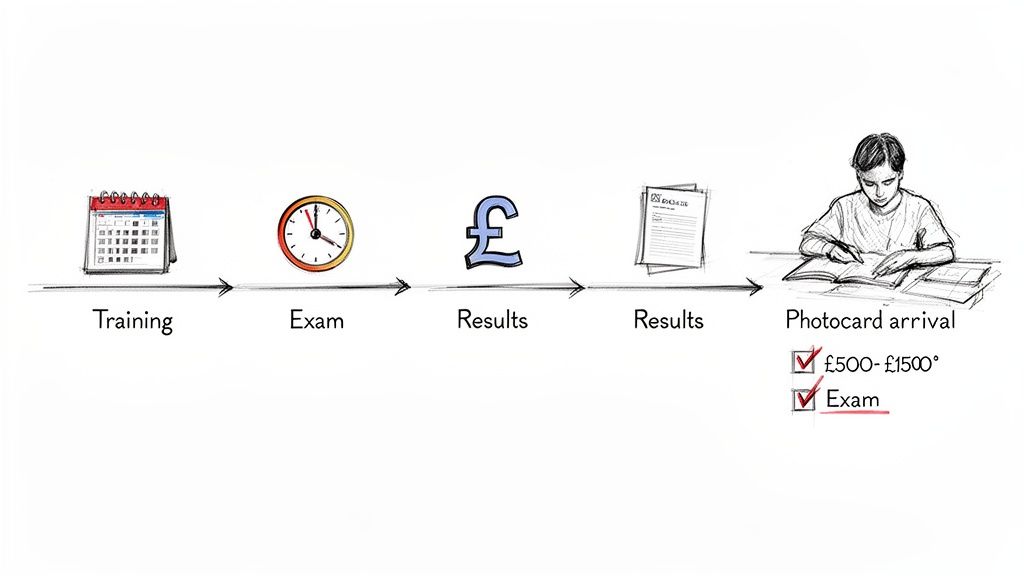
The main chunk of the cost is the training course fee. This can vary quite a bit, typically ranging from £500 to over £1,500. The final price really depends on which modules you choose. A basic “Core, Packages, and one class” course will be at the lower end, while a full “Core, Packages, Tanks, and all classes” course will be at the top end.
On top of the training, you’ll have:
Exam Fees: These are charged by the awarding body (like the SQA) for each module exam you sit.
ADR Photocard Fee: Once you’ve passed everything, there’s a fee to issue your physical ADR licence card.
A word of advice: the cheapest course isn’t always the best value. A provider with excellent pre-course materials and a high first-time pass rate can save you money in the long run by helping you avoid expensive resits.
What Is the Timeline for Getting Qualified?
From the first day of training to having the licence in your hand, the process is surprisingly quick. An initial ADR course is an intensive week, but it’s designed to get you qualified and on the road efficiently.
A full initial course covering Core, Packages, and several classes usually takes around five working days. If you decide to add the Tanks module, it might extend the course slightly. Refresher courses, for when you need to renew your licence, are much shorter, typically lasting two to three days.
After you’ve passed all your exams, there’s a short wait. Your results are sent by the awarding body to the DVLA for processing. You should expect to receive your shiny new ADR photocard licence in the post within three to four weeks.
Nailing the ADR Exams
The exams are the final hurdle. The good news is they are all multiple-choice, designed to test the practical knowledge you’ve picked up during the course. Each module you take (Core, Packages, Tanks, and each individual class) has its own separate exam paper.
To pass, you need to hit a minimum score on each paper, which is usually around 70%. This means you can’t rely on being strong in one area to make up for a weaker one; you have to pass every single module exam you sit.
Solid preparation is the key to a first-time pass. Here are a few tips from experience:
Get Involved in Class: Don’t just sit back and listen. Ask questions, join in the discussions, and make sure you understand the ‘why’ behind the rules, not just the ‘what’.
Use Mock Exams: Any decent training provider will offer practice questions or mock exams. Use them. They get you familiar with the format and highlight any areas you need to brush up on.
Focus on the Core Module: The Core exam is often the toughest because it covers the broadest range of information. Give this module some extra attention during your revision.
Passing first time isn’t just a confidence booster: it keeps your overall costs down. It means you can get on the road and start accessing those better-paying jobs without any frustrating delays.
Keeping Your ADR Licence and Growing Your Career
Getting that ADR photocard through the post is a great feeling, but it’s not the final whistle. Think of it as the start of a new chapter. Now, the real work begins: keeping that licence current and using it to build a better, more specialised career.
Holding an ADR licence immediately makes you stand out. It proves you’re a professional who can handle high-stakes, complex work safely and responsibly. This specialism is your ticket to better pay packets and greater job security.
Understanding Your Licence Validity and Renewal
Your ADR licence is valid for five years from the day it’s issued. This applies to every module and class you’ve qualified for. It’s absolutely vital to track that expiry date, because letting it lapse means you’re legally grounded from carrying dangerous goods, which could hit your wallet hard.
Thankfully, the renewal process isn’t as intense as the initial course, as long as you don’t leave it to the last second. You won’t have to do the full training all over again. Instead, you’ll take a shorter refresher course.
To renew, you need to complete this refresher training and pass the exams within the final 12 months of your licence’s validity. This year-long window gives you more than enough time to get a course booked without any last-minute stress.
A bit of advice from seasoned drivers: aim to book your refresher course with about 11 months to go. It gives you a comfortable buffer in case you need to resit an exam, so there’s no risk of your licence expiring while you wait for another test date.
Once you pass, your licence is extended for another five years from its original expiry date, so there’s no break in your qualification.
The Refresher Course and Exams
The refresher course is all about getting you up to speed with any changes in regulations, safety procedures, and best practices. The world of dangerous goods transport doesn’t stand still, and this training ensures your knowledge is sharp and current.
The course itself usually runs for two or three days, depending on how many modules you’re renewing. It’s a condensed version of what you did the first time around, zeroing in on the core principles and any recent updates.
Here’s a quick look at what to expect:
Focused Revision: The training will go back over the Core, Packages, and/or Tanks modules, plus any of the specific classes you hold.
Updated Regulations: You’ll cover any new amendments to ADR rules that have come into play over the last five years.
Renewal Exams: Just like your initial qualification, you’ll need to sit and pass a multiple-choice exam for every module you want to renew.
Passing these exams is the only way to get your renewal. That’s why it’s so important to pay attention during the course. It’s not just a formality; it’s your chance to make sure you’re ready for the tests and can continue to work safely and legally.
Turning Your ADR Licence into Career Growth
Now, let’s talk about the good stuff. Your ADR ticket is more than just a piece of plastic – it’s a powerful tool for advancing your career. It instantly separates you from the crowd of general haulage drivers and opens doors to specialist sectors that are often more stable and pay much better.
With an ADR licence in your pocket, you become a top candidate for jobs in several key industries.
High-Demand Sectors for ADR Drivers
Fuel Distribution: This is one of the most popular and profitable routes for ADR drivers. Petrol tanker work is consistent, always in demand, and offers very competitive pay.
Chemical Transport: The UK’s chemical industry is massive and depends on skilled drivers to move all sorts of substances safely between manufacturing sites and customers.
Waste Management: This specialist area involves transporting clinical and hazardous waste from hospitals, labs, and industrial sites. It’s a critical, highly regulated, and well-paid job.
Agriculture and Manufacturing: Many industries need drivers to transport specific hazardous goods, like fertilisers, industrial gases, or flammable liquids for production processes.
Having an ADR qualification can seriously boost your earnings. Specialist drivers often earn significantly more than their non-ADR colleagues because of the extra skill and responsibility involved. It also gives you better job security, as you have a skill set that the UK economy constantly needs. By keeping your licence up to date and looking for roles in these fields, you can build a stable and rewarding career that goes the distance.
Frequently Asked Questions About the ADR Licence
Even after going through a detailed guide, it’s completely normal to have a few questions rattling around. Getting your ADR licence is a big career move, and you want to be 100% sure about the details before you jump in.
To help with that, we’ve pulled together some of the most common queries we hear from drivers just like you. Think of it as a final check to clear up any last-minute uncertainties, so you can start your training with total confidence.
Can I Still Get an ADR Licence with Driving Convictions?
This is a big one, and we get asked it all the time. The short answer is yes, you can still get your ADR qualification even if you have points on your licence or certain past convictions. The awarding bodies, like the SQA, are focused on your ability to pass the course, not your driving history.
The real hurdle comes when you start applying for jobs. While an ADR ticket makes you a very attractive candidate, employers in the hazardous goods sector will definitely run thorough background checks. Insurers are also very strict, and a driver with a lot of points or serious convictions might be seen as too high a risk.
Our Advice: It’s absolutely possible to get qualified, but your job prospects will depend on what the convictions are and how long ago they were. Always be upfront and honest when you apply for roles.
How Long Does My ADR Card Take to Arrive?
A little bit of patience is needed here, but thankfully, the wait isn’t too long. Once you’ve passed all your exams, the results get verified and sent over to the DVLA. They’re the ones who process everything and issue your official ADR photocard.
On average, you can expect the card to drop through your letterbox within three to four weeks of passing your final module. It’s a good idea to factor this slight delay into your job search timeline.
What Happens If I Fail One of the ADR Exams?
First off, don’t panic. Failing an exam isn’t the end of the world, and it happens more often than you’d think, especially with the tricky Core paper. It’s just a small bump in the road.
If you don’t pass a module, you only have to resit that specific one. You don’t need to do the whole course again or retake the exams you’ve already passed. Any good training centre will have flexible options for booking a resit, giving you a chance to brush up and have another go. This is where choosing the right training partner really pays off: they’ll support you to get over the line.
Focus your revision: Concentrate only on the module you need to retake.
Talk to your instructor: Don’t be afraid to ask for help with the topics you struggled with.
Keep your head up: A resit is a minor setback, not a failure.
Is It Possible to Do My ADR Training Online?
Right now, the full ADR qualification has to be done in a classroom with a certified instructor. There’s a good reason for this: so much of the training is practical. You’ll be getting hands-on with safety gear and running through emergency drills, things that just can’t be taught properly through a screen.
That said, many training providers now offer fantastic online resources to back up the classroom work. You’ll often find theory prep materials, practice exam questions, and video tutorials to help you study at your own pace. This blended approach gives you the best of both worlds: flexible learning at home combined with the crucial hands-on training you need to be safe and competent on the job.
Ready to open up a more rewarding driving career? At HGV Learning, we’re here to guide you every step of the way. We handle the admin, provide top-tier theory prep, book your practical training, and even offer flexible payment plans to make it happen. Explore our ADR courses and see how we can help you get qualified.