Thinking about becoming a professional HGV driver? You’ve picked a great time. It’s a career that’s vital to the UK economy, putting you right at the heart of the supply chain that keeps the country running. This isn’t just another driving job; it’s a skilled profession with high demand and a solid future.
This guide is your roadmap. We’ll walk you through the entire process, step-by-step, from the first bits of paperwork right through to landing your first driving role. Forget the confusing jargon: we’re here to give you a practical, no-nonsense look at what it really takes to get behind the wheel.
Your Roadmap to an HGV Driving Career
Why HGV Drivers Are More Important Than Ever
Let’s be clear: the role of an HGV driver has gone from being just another trade to a national priority. There’s a well-known skills gap in the industry, which means huge opportunities for anyone new coming in.
At the start of 2025, the UK had an active HGV driver workforce of 293,714 drivers. To keep up with demand, experts estimate we need to train around 60,000 new drivers every single year for the next five years. A big part of this is the ageing workforce: the average driver is around 51 years old, and less than 1% are under 25. This has pushed the industry to create clear, accessible training pathways. You can dive deeper into the official workforce statistics to get the full picture.
Becoming an HGV driver today means walking into a sector that is actively looking for new talent. They aren’t just filling seats; they’re investing in the next generation of professionals who will be the backbone of UK logistics for decades.
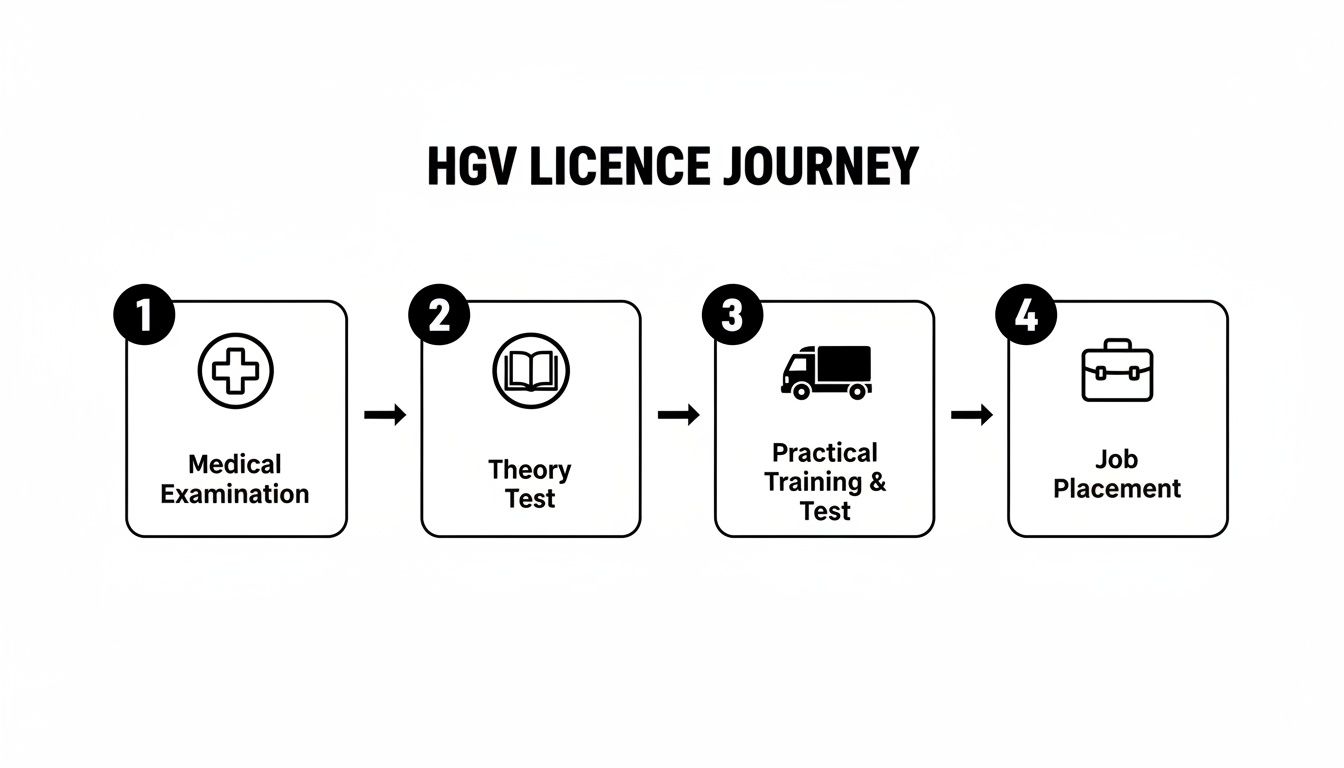
The Four Key Stages to Your HGV Licence
Getting your HGV licence is a journey broken down into four distinct stages. Each one builds on the last, taking you from a complete beginner to a fully qualified professional. This simple visual guide lays it all out for you.
To make it even clearer, here’s a breakdown of what each of those stages involves.
| The Four Key Stages to Your HGV Licence |
|:— |:— |:— |
| Stage | What’s Involved | Key Objective |
| 1. Medical & Provisional | Passing a medical exam and applying for your provisional HGV licence entitlement from the DVLA. | To prove you’re medically fit to drive and get the legal permission to start learning. |
| 2. Theory & Hazard | Studying for and passing the multiple-choice theory test and the hazard perception test. | To demonstrate you have the essential road safety and regulatory knowledge. |
| 3. Practical Training & Test | Getting hands-on driving instruction in a lorry and passing the practical driving test. | To prove you can safely operate a large goods vehicle in real-world conditions. |
| 4. CPC & Job Placement | Completing your initial Driver CPC qualification and starting your job search with your new licence. | To become a fully qualified professional driver and land your first HGV role. |
Think of it as a clear progression. Each stage is a checkpoint on your way to a new career, not a single overwhelming hurdle.
First Steps: Your Medical and Provisional Licence
Before you can even think about getting behind the wheel of a training lorry, there are a couple of essential bits of admin you need to sort out. First up is passing a medical exam, and second is applying for your provisional HGV licence. These aren’t just boxes to tick; they’re fundamental requirements to ensure everyone on the road is kept safe.
Getting these initial stages right from the start is absolutely key. A simple slip-up on a form or a delay in booking your medical can push your whole timeline back. Let’s walk through exactly what you need to do to get these done without any fuss.
The HGV Medical Exam: What’s Involved?
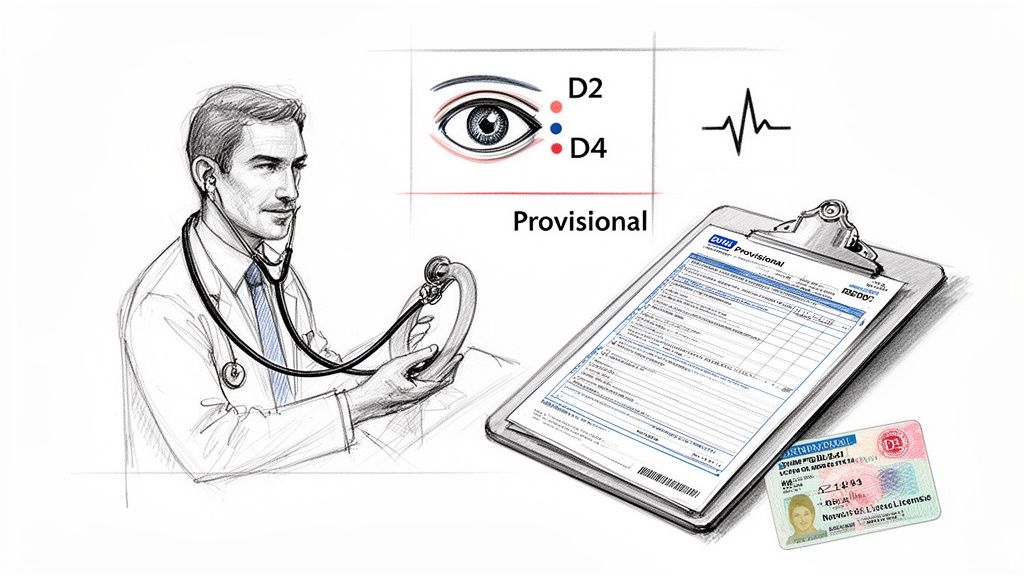
The very first step on your journey is proving you’re medically fit to drive a large vehicle. The DVLA’s standards are, for obvious reasons, much stricter than those for a regular car licence. You’ll need to book a specific HGV medical exam with a doctor.
It’s not as intimidating as it might sound. The doctor will run through several key checks to confirm you meet the Group 2 medical standards. This usually includes:
Your eyesight: A standard vision test is part of it, so don’t forget to bring your glasses or contact lenses if you wear them.
Your general health: The doctor will chat with you about your medical history, covering any neurological conditions, mental health, or substance dependencies.
Heart and blood pressure: A check for any cardiovascular issues is crucial to ensure you’re fit for potentially long hours of driving.
Other conditions: They’ll also discuss and assess any other health issues that might be relevant, like diabetes or sleep apnoea.
The doctor fills out a D4 medical form, which you’ll need to send to the DVLA with your licence application. You can often get this done with your own GP, but private clinics usually offer the service for a lower fee, typically somewhere between £50 and £100. To get a really clear picture of the process, it’s a good idea to read up on what to expect at your medical for an HGV licence so there are no surprises on the day.
Getting Your Paperwork in Order
With your completed D4 form ready, the next job is to tackle the DVLA paperwork. You need to fill out a D2 application form to apply for your provisional HGV licence. This is your official request to add a new lorry category to your current driving licence.
It’s so important to fill this form out perfectly. Any little mistake, like ticking the wrong box or leaving something out, will mean the DVLA sends it straight back to you, causing annoying and totally avoidable delays. Take your time with it and double-check everything before you put it in the post.
One of the most common slip-ups we see is people forgetting to send both the D2 and D4 forms together. The DVLA needs both your application and your medical report to issue your provisional entitlement. Always pop them in the same envelope.
Once you’ve sent your application off, the DVLA will process it and return your driving licence with the new provisional entitlement added. This usually takes about three weeks, but it can drag on a bit longer during their busy spells. Remember, you can’t book any theory tests until you have this updated licence back in your hands.
Choosing the Right Provisional Licence Category
On the D2 form, you’ll have to specify which provisional licence category you’re applying for. This is a big decision early on, as it dictates the type of vehicle you can start learning to drive.
The main options are:
Category C: This lets you drive a rigid lorry over 3,500kg with a small trailer up to 750kg. It’s what most people call a Class 2 licence, and it’s the most popular starting point for new drivers.
Category C+E: This is the full articulated lorry licence, for driving a vehicle over 3,500kg with a trailer over 750kg. Our Class 1 (C+E) driver training guide covers costs and what the training involves in full. You can actually apply for this provisional entitlement at the same time as your Cat C, which is often called a “fast-track” or “direct access” route.
Which one you choose really depends on your career goals. Most training providers nowadays will suggest applying for both provisional entitlements right away. It gives you the flexibility to move straight onto your Cat C+E training right after you pass your Cat C practical test, saving you time and the hassle of another DVLA application down the road.
Passing Your HGV Theory and CPC Tests
Got your provisional licence? Excellent. Now for what many people see as the biggest hurdle: the theory tests. Don’t be intimidated by them. Think of this stage less as a school exam and more as building the bedrock of knowledge you’ll rely on every single day out on the road.
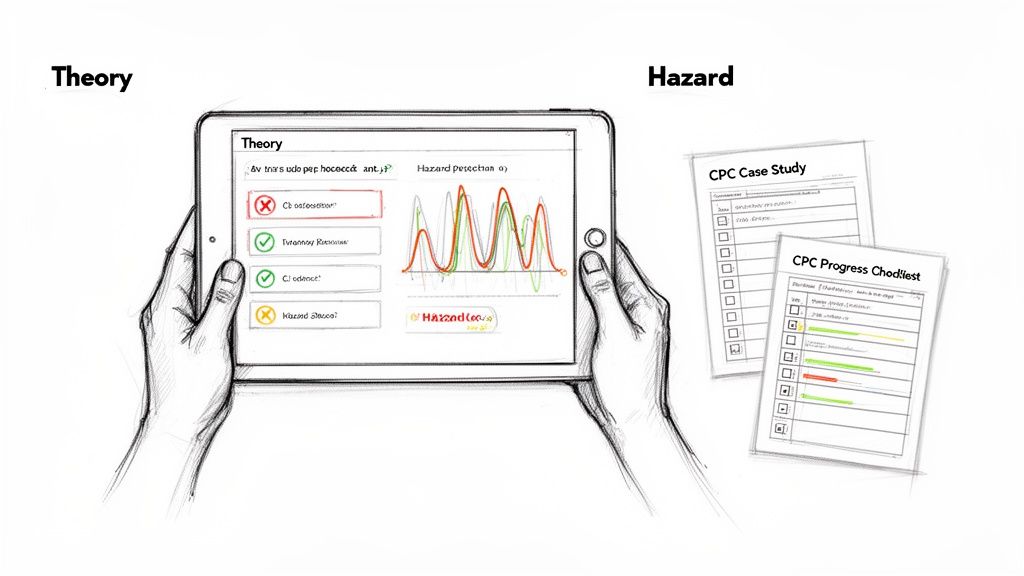
This isn’t just about memorising rules to pass a test. It’s about deeply understanding the principles of safe, professional driving. The theory stage is actually split into three distinct parts, and you’ll need a pass certificate for each one to move on to practical training. With the right approach, you can get through it without a problem.
Breaking Down the Theory Test Components
The first part of your theory is split into two sections, which you’ll usually sit back-to-back in the same appointment. You have to pass both to get that all-important pass certificate.
Part 1a Multiple-Choice Questions: You get 1 hour and 55 minutes to tackle 100 questions, and you need to get at least 85 right. These questions cover everything – from road signs and vehicle weights to drivers’ hours and daily walk-around checks.
Part 1b Hazard Perception: This test shows you 19 video clips of real driving scenarios. Your job is to click the mouse as soon as you spot a “developing hazard”: that’s anything that would make you brake, swerve, or change speed. The pass mark here is 67 out of 100.
Once you’ve cleared that hurdle, you can book the final theory element, the CPC Module 2.
Part 2 CPC Case Studies: This is a computer-based test where you’ll be given seven case studies based on real-life situations a driver might face. For each scenario, you’ll answer 6-8 multiple-choice questions. The pass mark is 40 out of 50.
A Smart Strategy for Studying
Forget trying to cram hundreds of questions and answers. That’s a sure-fire way to get overwhelmed. A much better way is to truly understand the why behind the rules. The DVSA offers a whole range of official study materials, including books and apps, which are worth their weight in gold.
The key to passing isn’t just knowing the answers; it’s understanding why they are the right answers. This approach will not only help you pass the test but will also make you a safer, more competent driver.
Most trainees I speak to find that using DVSA-approved apps is the best way to prepare. You can work through mock tests, see which topics you’re weakest on, and get a real feel for the format of both the questions and the hazard clips. It’s the perfect way to fit studying around your job, whether on your lunch break or for an hour in the evening.
Mastering the Hazard Perception Test
The hazard perception test can catch people out. It’s not just about spotting a potential danger; it’s about clicking at the precise moment it starts to develop. Click too early, or too late, and you score zero for that clip.
The secret is to look for clues that a situation is about to change. It could be a pedestrian glancing over their shoulder, a car’s wheels starting to turn at a junction, or a cyclist up ahead who looks a bit unsteady. Practice is everything here. The more mock tests you do, the more your brain becomes wired to spot these developing hazards almost instinctively. For a deeper dive into the specifics, our comprehensive guide to the theory test for an HGV licence breaks down each part in more detail.
Understanding the CPC Module 2 Case Studies
The final piece of the theory puzzle is your CPC Module 2. This test goes beyond road signs and speed limits: it checks if you can apply your knowledge to real-world, practical situations.
The case studies are designed to mirror the kind of challenges you’ll actually face on the job. Common topics include:
Drivers’ Hours and Tachographs: You might get a scenario asking you to work out legal driving times and rest periods for a complicated week.
Vehicle Loading and Safety: You could be tested on how to secure an awkward load or what your legal responsibility is if you think you’re overloaded.
Dealing with Emergencies: These questions might cover the correct procedure for a motorway breakdown, what to do after an accident, or how to handle driving in snow.
Again, the best preparation is simply to work through as many practice case studies as you can. It trains you to read the scenario, pull out the important information, and apply the correct rules to find the answer. Passing these three tests is a major milestone, and it’s the key that opens up the next, most exciting stage: getting behind the wheel for your practical training.
Mastering Your Practical Driving Skills
With the theory tests in your rear-view mirror, it’s time for the bit you’ve been waiting for: getting behind the wheel. This is where theory meets tarmac and all that knowledge turns into real, hands-on skill. Practical training is much more than just learning to steer a big vehicle; it’s about developing the awareness, precision, and confidence of a professional.
The practical side of things is broken down into two main tests: the driving ability test (what we call Module 3) and the practical demonstration test (Module 4). Let’s break down what’s involved in each, so you know exactly what to expect when you climb up into that cab.
What to Expect From Your On-Road Training
Your practical driving lessons are where you’ll spend most of your time. A typical training course usually lasts about five days, which gives you roughly 20 hours of intensive, one-on-one instruction. Your instructor’s mission is to transform you from someone who can operate a lorry into someone who can think like a lorry driver.
You’ll cover a huge amount of ground, literally and figuratively. Key areas you’ll focus on include:
Vehicle Control: Getting a proper feel for the gearbox, mastering the air brakes, and becoming comfortable with the sheer size and weight of your rig.
Road Positioning: Learning exactly where to place the lorry for tight turns, tricky roundabouts, and narrow country lanes, always keeping the swing of your trailer in mind.
Mirror Usage: This is critical. You’ll develop the habit of constantly scanning your mirrors to maintain a 360-degree awareness of everything happening around you.
Urban and Rural Driving: You’ll tackle everything from busy city streets packed with cyclists and pedestrians to high-speed dual carriageways.
It’s not just about ticking boxes and avoiding mistakes. The goal is to demonstrate proactive, safe driving habits at all times.
Nailing the Off-Road Manoeuvres (Module 3a)
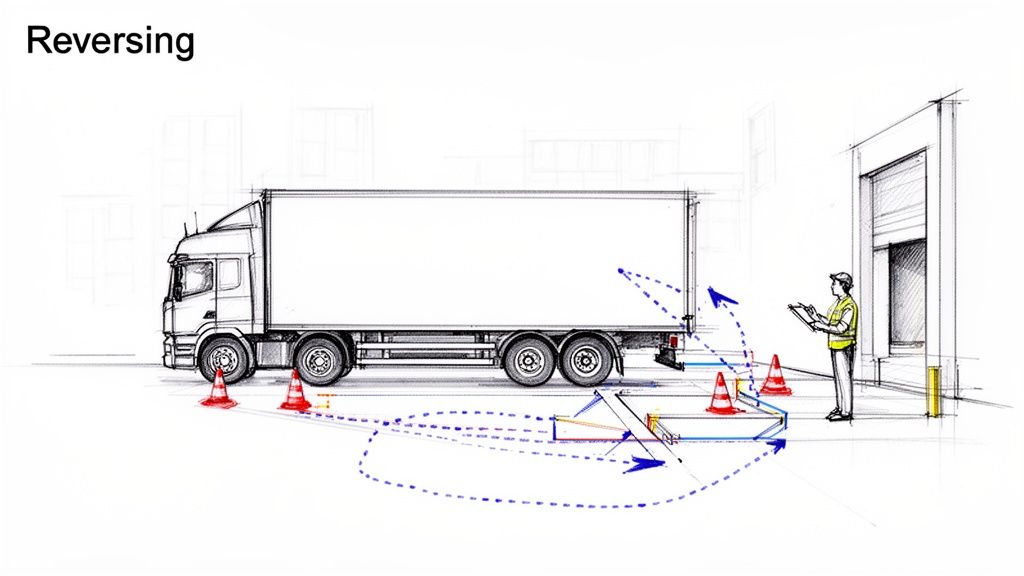
Before you can take your on-road test, you have to pass the Module 3a test. This is a simple, off-road assessment of your vehicle handling skills, usually done at a dedicated test centre or your training provider’s site. It sounds straightforward, but this is where precision is king.
The main event here is the reversing exercise. You’ll be asked to reverse the lorry accurately into a bay marked out with cones, simulating a loading dock. The examiner is looking for three things: control, accuracy, and observation. You have to prove you’re constantly checking your mirrors and blind spots, showing you’re aware of your surroundings even in a controlled area.
A top tip every instructor will give you is to take it slow. This isn’t a race. Make small, deliberate adjustments to the wheel and don’t be afraid to pull forward and straighten up if you need to. A calm, methodical approach is exactly what the examiner wants to see.
Once you’ve passed Module 3a, you get a pass certificate and can book the main on-road driving test.
The Final Driving Test (Module 3b)
The on-road test, Module 3b, is your moment to shine. It’s your chance to show the examiner you can apply everything you’ve learned in the real world. The test lasts about an hour and will cover a route designed to test you on a variety of road types and traffic conditions.
You’ll kick things off with a few “show me, tell me” vehicle safety questions. After that, you’re out on the road. The examiner will be assessing your overall safety, your road awareness, how you anticipate the actions of other drivers, and how smoothly you operate the vehicle’s controls.
A key part of the test is the ‘independent driving’ section. For about ten minutes, you’ll be asked to follow signs to a specific destination. This is designed to see how you handle making your own decisions in traffic without being given turn-by-turn directions.
The Practical Demonstration Test (Module 4)
Your final hurdle is the CPC Module 4 test. Think of this as a practical, hands-on theory test – there’s no driving involved at all. Instead, you’ll use the lorry as a prop to demonstrate to the examiner that you understand key safety and compliance rules.
The test takes about 30 minutes, and you need to score at least 80 out of 100 to pass. Crucially, you also need a minimum of 15 out of 20 marks in each of the five topic areas.
The Five Key Topics for CPC Module 4
Loading the vehicle safely: Demonstrating you know how to secure loads correctly and understand weight distribution.
Preventing criminality and trafficking: Explaining how you’d check your vehicle for stowaways or illegal immigrants.
Assessing emergency situations: Showing what your immediate actions would be in the event of an accident or a fire.
Performing a walk-around check: Talking the examiner through a full vehicle inspection, pointing out what you’re checking and why.
Reducing physical risks: Explaining safe ways to get in and out of the cab and correct manual handling techniques.
Passing this test completes your initial Driver CPC qualification. With this final pass slip in your hand, you are officially a qualified HGV driver, ready to get out there and find your first job.
Costs, Timelines and Landing Your First Driving Job
You’ve done it. The tests are passed and your new licence is in hand – that’s a massive achievement. Now for the practical side of things: what was the total investment, how long did it all take, and what’s the smartest way to land that first professional driving job?
Getting a handle on the financial and time commitments is crucial. This is where your investment really starts to pay dividends, so let’s break down the typical costs before shifting gears to focus on getting you hired.
A Realistic Look at the Investment
Becoming a fully qualified HGV driver isn’t cheap, but think of it as a solid investment in a stable and in-demand career. Costs can shift depending on where you are in the country and which training provider you choose, but having a ballpark figure helps.
All in, you’re typically looking at a total between £2,000 and £3,500. This figure should cover everything from your initial medical right through to your final CPC module. For a more detailed look, we have a whole guide on how much an HGV licence costs.
Here’s a quick look at the main expenses you’ll encounter:
Medical Exam: Usually between £50 and £100.
Provisional Licence: Applying for this is free.
Theory Tests (All parts): Around £115 in total.
Practical Training & Tests: This is the big one, covering vehicle hire, your instructor’s time, and the DVSA test fees.
It’s tempting to just go for the cheapest training package you can find, but always dig into what’s actually included. Does that price cover test resits if you need one? Are all the DVSA fees bundled in? A slightly more expensive course that includes better support or a retest can often be far better value in the long run.
Exploring Your Financing Options
That upfront cost can look intimidating, but there are some really accessible ways to fund your training. Many providers, including us here at HGV Learning, offer flexible payment plans that let you spread the cost over several months. This makes the whole thing much more manageable.
Better still, look into government-funded initiatives. HGV Skills Bootcamps are a fantastic option; they’re intensive courses designed to get new drivers qualified and into a job as quickly as possible. For eligible candidates, these programmes are often heavily subsidised or even completely free.
The impact of these schemes has been huge. To keep the industry moving, the UK needs to train around 60,000 new drivers every single year for the next five years. Government-backed bootcamps have already trained over 20,000 drivers with an impressive 72% job placement rate. That high success rate shows just how effective these structured pathways are.
How Long Does It Take to Qualify?
So, how long until you’re actually out on the road earning? From that very first medical appointment to holding your full Driver Qualification Card (DQC), the whole journey can be completed surprisingly quickly.
For most people, a realistic timeline is somewhere between 8 and 12 weeks.
This assumes you pass each stage first time and don’t hit any major administrative delays with the DVLA. Your personal pace of study for the theory tests and the availability of practical training slots in your area will also play a part.
To give you a clearer picture, here’s a breakdown of what to expect.
Estimated Costs and Timeline for HGV Training
This table provides a rough guide to the costs and time you should budget for each part of the process. Remember, these are just estimates and can vary.
Stage
Estimated Cost (£)
Estimated Time
Medical & Provisional Licence
£50 – £100
2 – 4 weeks
Theory & Hazard Perception Tests
£115 (all parts)
2 – 4 weeks (study time)
Practical Training & Test (Cat C)
£1,500 – £2,500
1 – 2 weeks
Initial CPC (Modules 2 & 4)
£300 – £500
1 – 2 weeks
Total Estimated
£2,000 – £3,500
8 – 12 weeks
As you can see, once you get started, things can move pretty fast. The key is to stay organised and book your next step as soon as you’ve completed the last one.
Landing Your First HGV Driving Job
With your licence and CPC sorted, it’s time to find work. The great news is that newly qualified drivers are in high demand right across the UK.
First things first, get your CV in shape. Don’t just list your old jobs; focus on the skills you’ve just gained. Put your new qualifications (Cat C or C+E Licence, Driver CPC) right at the very top. Even if you have zero professional driving experience, you can highlight your clean driving record, reliability, and a solid understanding of drivers’ hours rules.
Next, get ready for interviews. A potential employer wants to see that you’re reliable and have a professional, safety-first attitude. Be prepared for questions about:
Your knowledge of daily vehicle safety checks (the ‘walkaround’).
How you’d handle tricky situations on the road, like a breakdown or bad weather.
Your understanding of tachograph rules and regulations.
They aren’t trying to trick you; they just need to know you take safety and compliance seriously. Having confident answers ready will make a fantastic impression and set you on the road to a brilliant new career.
Boosting Your Career with Specialist Qualifications
Earning your HGV licence is a brilliant achievement, but it’s really just the starting line. Think of your Category C or C+E qualification as the key that opens up the door to a professional driving career. Specialist qualifications are what will set you apart from the crowd and seriously boost your earning potential.
Your standard HGV licence is the foundation. To build a taller, more impressive career, you need to add extra floors. Investing a little more time and money into extra training can open up higher-paying, in-demand roles that many standard drivers simply can’t apply for.
Opening up Higher Pay with ADR Training
If you’ve ever seen a tanker on the motorway with an orange diamond placard, you’ve seen an ADR driver at work. ADR is the certification you need to legally transport hazardous or dangerous goods by road, covering everything from petrol and chemicals to flammable gases and corrosive substances.
Because of the extra responsibility and risk involved, ADR-qualified drivers are highly sought after and command much better salaries. The training itself is broken down into handy modules:
Core Module: This is the essential starting point for all drivers.
Tankers Module: Specific training for driving tankers.
Packages Module: Covers the transport of hazardous goods in drums, boxes, and other packages.
Classes 1-9: These are individual modules for specific classes of dangerous goods (e.g., Class 2 for gases, Class 3 for flammable liquids).
The great thing is, you only need to take the modules relevant to the work you want to do. Gaining this qualification proves you have the specialist knowledge to handle these materials safely, making you a huge asset to any logistics firm in the fuel, chemical, or waste management sectors.
Gaining Versatility with a HIAB Licence
Another fantastic qualification to add to your toolkit is a HIAB certificate. A HIAB is a lorry-mounted crane, and being able to operate one makes you a self-sufficient, multi-skilled professional who is always in demand.
Drivers with a HIAB licence are essential in sectors like construction, engineering, and forestry. Instead of waiting for a separate crane and operator to arrive on-site, you can load and unload your own vehicle. This saves companies a huge amount of time and money, a value that’s always reflected in your pay packet.
Having a HIAB ticket instantly makes you more employable. It transforms you from just a driver into a complete delivery and logistics solution, capable of handling the entire job from depot to drop-off.
Getting qualified has never been more straightforward. Government-funded schemes are actively reshaping how people become HGV drivers. A national 16-week programme, extended to February 2026, offers fully subsidised Cat C and C+E training with a budget of £34 million and has already trained over 11,000 new drivers. These structured pathways, alongside huge government investment in better roadside facilities, create a supportive environment for new entrants to build a long-term career. You can learn more about how industry support is tackling the driver shortage.
Other Valuable Career Boosters
While ADR and HIAB are two of the most popular choices, there are other qualifications that can open up niche, well-paid roles. For example, a telehandler or forklift licence can be incredibly useful, particularly if you’re working in a depot, warehouse, or on a building site.
Each additional certificate you earn adds another string to your bow. It shows employers you’re committed to your own professional development and have the skills to take on more complex, responsible, and ultimately more rewarding work.
Ready to start your journey or add a specialist qualification to your licence? At HGV Learning, we provide end-to-end support to get you qualified and on the road to a rewarding new career. Find your perfect training course today at https://hgvlearning.com.