Thinking about a career as a professional HGV driver? It’s a brilliant move, offering solid job security and a crucial role in keeping the UK running. The journey to getting your licence might look a bit complicated at first glance, but it’s really just a series of straightforward, manageable steps.
Your Roadmap to an HGV Driving Career
The whole process is designed to build your skills and confidence one stage at a time, making sure you’re fully prepared for the responsibilities that come with being on the road.
Everything kicks off with the basics: getting your medical assessment done and applying for a provisional licence. Once that’s sorted, you’ll dive into the theory, which covers multiple-choice questions and a hazard perception test. Pass those, and you’re onto the exciting part – practical, on-the-road training and your final driving test.
Understanding the Key Milestones
The best way to tackle this is to see it as a clear progression, not one massive task. It all starts with choosing the right licence for the career you want, whether that’s a Category C for rigid lorries or a C+E for the big articulated trucks.
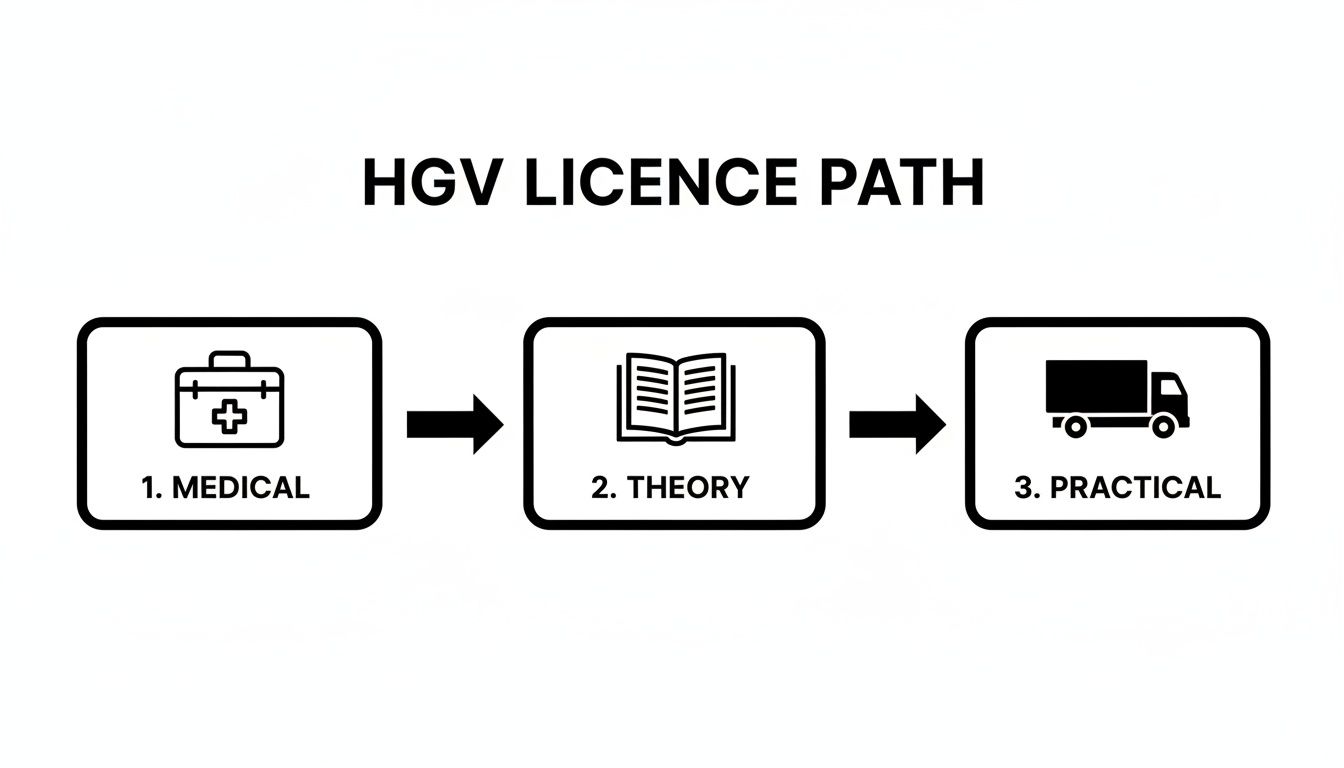
This flowchart gives you a quick visual breakdown of the main stages you’ll go through.
As you can see, it’s a logical sequence. You start with health and paperwork, move on to building your knowledge, and finish by proving your practical driving skills.
To help you get a clearer picture of what each licence allows you to drive, here’s a quick summary.
HGV Licence Categories at a Glance
This table breaks down the main HGV licence categories, the types of vehicles you can operate, and the kind of jobs they typically lead to. It’s a great starting point for figuring out which path is right for you.
Licence Category
Vehicle Type
Maximum Weight
Common Job Roles
Category C1
Small Rigid Lorries
Up to 7.5 tonnes
Light removals, horsebox driving, parcel delivery
Category C
Rigid Lorries
Over 3.5 tonnes (no upper limit)
Local/regional delivery, tipper/skip hire
Category C+E
Articulated Lorries
Over 7.5 tonnes with a trailer
Long-haul transport, supermarket distribution
Understanding these differences is key to planning your training and career. Each category opens up different doors in the logistics industry.
A Faster Process for New Drivers
In an effort to tackle the driver shortage, the government has made some big changes to streamline the licensing process. They’ve removed the old rule that required you to pass a separate test for rigid lorries before you could even think about articulated ones.
This change alone can cut the time it takes to get a full Category C+E licence by around 6-8 weeks. It’s a major shift that makes getting into the industry quicker and more direct than ever before.
A structured training plan is your best friend. It turns the whole process into small, achievable goals, which makes it feel far less overwhelming and keeps you on track from day one.
By breaking it down, you can focus on one thing at a time, building a solid foundation of knowledge and skill. For a more detailed look at each stage, check out our complete guide on your first HGV licence UK roadmap. Knowing the path ahead helps you plan your time and budget, setting you up for a flying start.
Navigating Your Medical and Provisional Licence
Before you can even think about theory tests or getting behind the wheel for practical training, there are two key steps you need to tick off first: the driver medical and applying for your provisional HGV licence.
Think of this as laying the groundwork for your new career. It might seem like a bit of form-filling, but it’s a straightforward process once you know what’s involved.
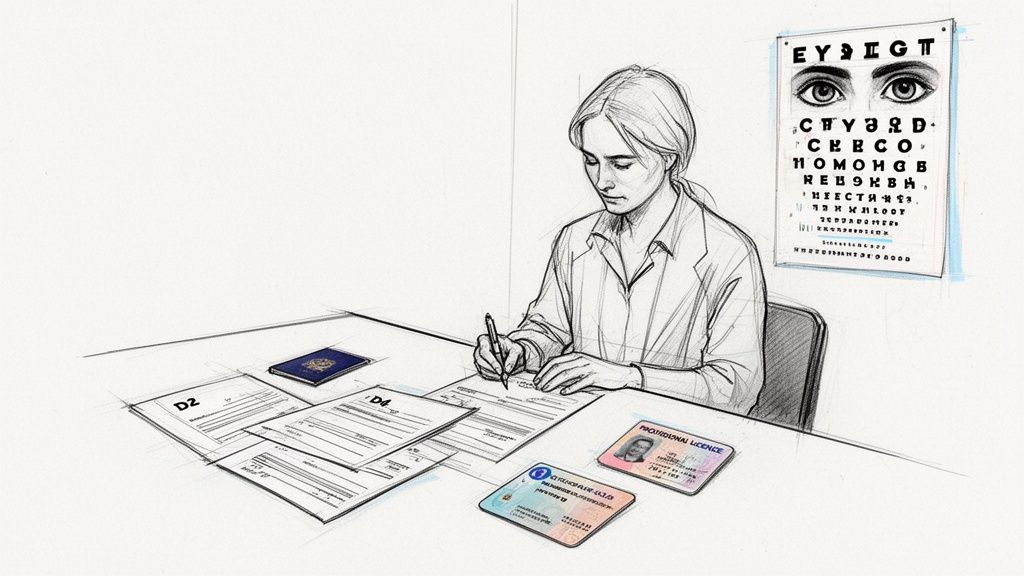
The very first thing you need to do is get the right forms from the DVLA. You’re looking for the D2 application form for your provisional licence and the D4 medical form, which has to be completed by a doctor. You can easily order these for free from the GOV.UK website.
Your HGV Medical Examination
The D4 medical is a compulsory health check to make sure you’re fit enough to safely handle a large vehicle. It isn’t designed to catch you out; it’s just a standard procedure to protect you and everyone else on the road. This isn’t usually something your local GP will handle, so you’ll probably need to book an appointment with a private doctor who specialises in driver medicals.
During the appointment, the doctor will go over a few key areas of your health.
Eyesight: Your vision will be tested to ensure it meets the minimum legal standard, both with and without glasses or lenses if you use them.
Neurological Health: The doctor will check for any conditions that might affect your coordination, reaction times, or awareness.
General Health: This part involves a review of your medical history, a blood pressure check, and a chat about any existing conditions like diabetes or heart issues.
It is absolutely vital that you’re completely honest on this form. For a more detailed look at the process, check out our guide on what to expect at your medical for an HGV licence. Once the doctor has filled out and signed the D4 form, you’re ready for the next part.
Top Tip: When you go for your medical, make sure to bring your driving glasses or contacts, a list of any prescription medicines you’re taking, and your driving licence for ID. Being prepared makes the whole thing much quicker and stress-free.
Applying for Your Provisional Entitlement
With your completed D4 medical form ready to go, you can now fill out the D2 application for your provisional HGV licence. This form just asks for your personal details and which licence category you’re applying for. For most new drivers, this will be Category C.
Double-check every part of the D2 form before you send it off. Simple mistakes, like forgetting to sign it or putting down the wrong details, can cause massive delays.
Once both the D2 and D4 forms are complete, pop them in an envelope with your current photocard driving licence and send them to the DVLA. They’ll process your application, add the provisional entitlement, and send your licence back to you. This normally takes about three weeks, but it can take longer during busy periods, so it’s a good idea to get it sorted as soon as you can.
Age and Licence Requirements
To get started, you must be at least 18 years old and already hold a full UK car driving licence (Category B). This is the absolute starting point for anyone looking to get an HGV licence in the UK – no exceptions.
There are no upper age limits for driving professionally, but you will have to renew your licence and pass a medical exam more often as you get older. This is just to ensure everyone stays fit and safe to drive on UK roads.
Passing Your HGV Theory and CPC Tests
Okay, so you’ve got your provisional licence in your pocket. What’s next? It’s time to hit the books and tackle the theory side of your HGV qualification. This isn’t just about passing a test; it’s about building the solid foundation of knowledge every professional driver needs before even thinking about climbing into the cab.
The theory test is broken down into two main parts, and you’ll need a pass on both to move on to practical training. You book them at the same time and usually take them back-to-back on the same day. Think of this as the first major gateway on your road to becoming a professional HGV driver.
This is also where the Driver Certificate of Professional Competence (CPC) comes into play, a standard requirement for almost every professional lorry driver across the UK.
Part 1a The Multiple-Choice Questions
First up is the multiple-choice exam. This covers a massive range of topics, from vehicle weights and road signs to drivers’ hours and daily safety checks. You’ll have 1 hour and 55 minutes to work through 100 questions, with a pass mark of 85 out of 100.
Don’t worry, these aren’t trick questions. They’re designed to make sure you have a deep understanding of the Highway Code and the specific rules that apply to heavy goods vehicles. Good, solid revision is your best friend here.
Vehicle Safety: Expect questions on everything from your daily walkaround checks to the technical details of your braking systems.
Load Security: You’ll need to prove you know how to secure different loads properly, preventing them from shifting or, worse, falling off.
Driver Regulations: This is a big one. It covers legal driving hours, mandatory rest periods, and the correct use of a tachograph.
The best way to prepare is by using the official DVSA revision materials and getting stuck into online practice tests. They’ll help you get a feel for the question format and quickly show you which areas you need to brush up on.
Part 1b The Hazard Perception Test
Right after the multiple-choice section, you’ll dive into the hazard perception test. This is all about spotting potential dangers on the road before they turn into actual problems. It’s an absolutely critical skill for any professional driver.
You’ll watch 19 video clips of everyday driving scenes. Each clip has at least one ‘developing hazard’, and one clip will have two. A developing hazard is simply anything that would make you, as the driver, take action – like slowing down, changing direction, or stopping.
The quicker you spot the hazard by clicking your mouse, the more points you’ll get, with a maximum of five points per hazard. To pass, you’ll need a score of at least 67 out of 100.
A common pitfall is clicking frantically. The system is designed to spot this pattern, assuming you’re just guessing, and will give you a zero for that clip. The trick is to click once when you see a hazard starting to develop (like a car pulling up to a junction) and maybe a second time as it becomes a definite hazard.
Part 2 The CPC Case Studies Test
Once you’ve cleared both parts of the theory test, you’ll move on to the Driver CPC Part 2 test, which is based on case studies. This exam isn’t about reciting rules; it’s about applying your knowledge to realistic situations you’ll face out on the road.
You’ll be presented with seven different case studies, each outlining a short scenario. From there, you’ll have 1 hour and 15 minutes to answer 50 questions related to them. The pass mark is 40 out of 50.
A typical case study might put you in a situation where your boss asks you to deliver a load that looks unsafe, or you have to navigate a route in treacherous weather. The questions are designed to test your judgement and your understanding of regulations, safety, and best practice. It’s all about getting you to think like a seasoned professional.
The industry is crying out for new talent. With the average HGV driver in the UK aged between 48 and 51 and less than 2% of all drivers being under 25, the need for well-trained, safety-conscious new drivers has never been more urgent.
Getting your theory and CPC tests passed is a huge step forward. For a much deeper look at what to expect and how to prepare, take a look at our complete CPC theory test guide for more insider tips and strategies.
Mastering Your Practical HGV Training and Test
Right, you’ve smashed the theory tests and now it’s time for the really exciting part – getting behind the wheel. Your practical training is where everything starts to feel real. You’ll swap the classroom for the cab and start building the hands-on skills that will define your career as a professional driver.
This isn’t just about ticking boxes to pass a test. It’s about developing the kind of deep-seated competence and road sense that will keep you safe and confident every single day you’re on the job. Most drivers find the training intense but incredibly rewarding, usually taking about a week to complete alongside a qualified instructor who’s seen it all before.
What to Expect During Your Practical Training
Climbing into the cab for the first time is a moment you won’t forget. That high seating position, the sheer number of mirrors, and the size of the vehicle can feel a bit much at first. But don’t worry, that initial feeling quickly turns into confidence as your instructor guides you through the basics.
A big part of your first few hours will be simply getting a feel for the lorry’s size and dimensions. You’ll spend a lot of time practising things like:
Vehicle positioning: Learning to keep the lorry perfectly centred in your lane is crucial, especially on those tight B-roads or when swinging around a bend.
Mirror usage: This is a non-negotiable skill. You’ll learn to constantly scan your multiple mirrors to stay aware of your surroundings and completely eliminate blind spots.
Braking and acceleration: An HGV doesn’t stop like a car. You’ll master how to brake smoothly and anticipate the much longer stopping distances required for a heavy vehicle.
Your training is specifically designed to cover every single element the DVSA examiner will be looking for on test day, so you’ll go in feeling fully prepared.
Mastering the Core Driving Skills
Beyond just moving the vehicle, professional HGV driving is all about mastering a specific set of skills that guarantee safety and efficiency. These are the foundations of every practical training session.
One of the very first procedures you’ll learn is the daily walkaround check. This isn’t just good practice; it’s a legal requirement before you start any shift. Your instructor will drum a systematic routine into you, checking everything from tyres and lights to fluid levels and air brakes to ensure the vehicle is 100% roadworthy.
Next up is the manoeuvre that new drivers often dread the most: reversing. Honestly, with a good instructor breaking it down, it becomes second nature pretty quickly. You’ll spend plenty of time practising reversing into a marked bay, just like you would at a loading dock, using only your mirrors to guide you.
Examiner’s Insight: When you’re doing the reversing manoeuvre on your test, the DVSA examiner is looking for three key things: control, accuracy, and observation. They want to see slow, deliberate movements and constant checks of all your mirrors. This proves you’re in full control and aware of everything around you.
For anyone going for the full Category C+E licence, you’ll also get hands-on training in how to safely couple and uncouple your trailer. This is a critical safety procedure that has to be done right every time, from connecting air lines and electrical cables in the correct sequence to making sure the fifth-wheel locking mechanism is properly engaged.
Preparing for Real-World Scenarios
Any decent HGV training provider will do more than just teach you to pass the test. They’ll prepare you for the reality of UK roads. This means your instructor will deliberately put you into challenging (but safe) situations to build your experience and decision-making skills.
Picture this: you’re approaching a busy multi-lane roundabout during rush hour. In a car, it’s simple. In a 44-tonne artic, you need to be thinking five steps ahead, positioning yourself early and using the vehicle’s length to your advantage without causing chaos for other drivers. Your training will give you the confidence to handle these moments calmly and professionally.
You’ll also be taught how to handle driving in poor weather. Driving an HGV in high winds or torrential rain requires a totally different approach to speed, braking, and even where you position yourself in the lane. These are the invaluable lessons that separate a true professional from someone who just scraped a pass.
Conquering the Practical Driving Test (Part 3)
The practical test, officially known as Part 3, is the final hurdle. It lasts around 90 minutes and is designed to be a comprehensive assessment of your driving ability. The examiner isn’t there to catch you out; they just need to see that you can drive safely, consistently, and according to the rules of the road.
On the day of your test, managing your nerves is half the battle. Just remember, your instructor wouldn’t have put you forward if they didn’t think you were ready. Trust your training, take a few deep breaths, and listen carefully to what the examiner asks you to do.
The test involves on-road driving where you’ll follow directions from the examiner and also a section of independent driving using a sat nav. You’ll perform various manoeuvres, including pulling over and moving off safely from different situations. Get a good night’s sleep, stay calm, and go in there ready to show them what you’ve learned. You’ve done the hard work – this is your time to shine.
Advancing Your Career with Specialist Qualifications
Passing your Category C or C+E test is a massive milestone, but think of it as the foundation, not the finish line. With that licence in your pocket, you’ve opened up the door to a whole world of specialised, better-paying driving jobs. Adding extra qualifications is how you step through it, moving into niche industries, taking on more complex work, and seriously boosting your payslip.
These aren’t just bits of paper to pad out your CV. They make you a far more flexible and valuable driver. Companies in sectors like construction, fuel distribution, and heavy haulage are always on the hunt for drivers with these specific skills, and they’ll pay a premium to get them.
Transporting Hazardous Goods with an ADR Licence
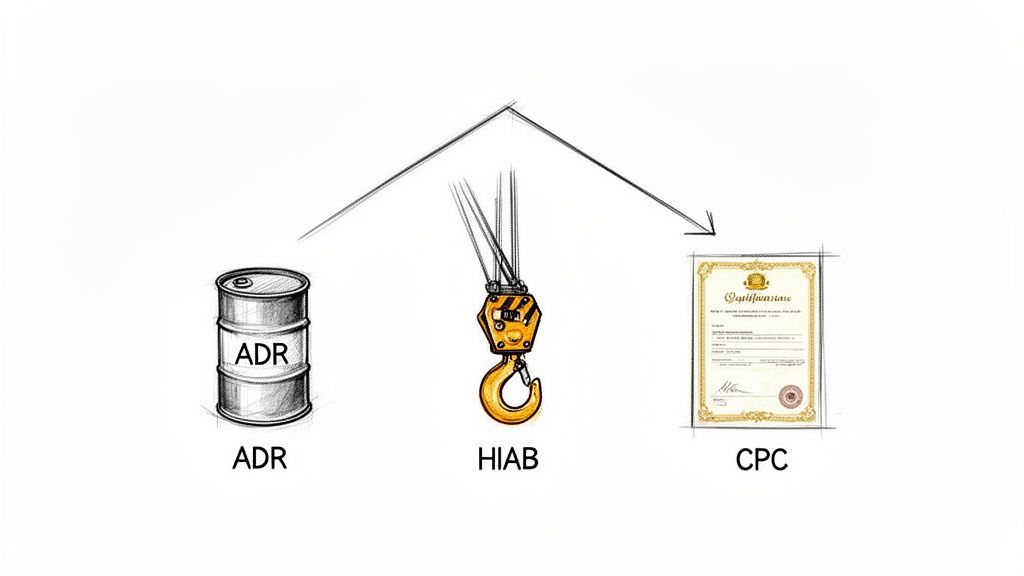
If you want a qualification that really makes you stand out from the crowd, an ADR licence is one of the best investments you can make. This is the legal certification you need to transport dangerous goods by road. Every single petrol tanker, chemical transporter, or vehicle carrying clinical waste you see on the motorway is driven by someone holding an ADR licence.
The training is all about safety and covers the critical knowledge you need to handle these loads responsibly:
Core Module: This gets you up to speed on the fundamental rules of carrying dangerous goods.
Classes: You’ll learn the specifics of the nine different hazard classes, from flammable liquids to corrosive substances.
Packages and Tanks: The course is split to cover carrying goods in packages (like drums or boxes) and in road tankers.
Getting your ADR opens doors to highly regulated sectors like fuel and chemical logistics, where the jobs often come with better pay packets and more structured, predictable work.
Operating Lorry-Mounted Cranes with HIAB Training
Ever watched a builders’ merchant lorry arrive on site and effortlessly lift pallets of bricks right where they’re needed? That’s a driver with a HIAB qualification at work. HIAB is actually a brand name, but it’s become the go-to term for any lorry-mounted crane.
The training is almost entirely hands-on, focusing on operating the crane safely and efficiently. You’ll learn the whole process, from setting up the lorry with stabilisers to using the remote controls with pinpoint accuracy. This skill is in huge demand, particularly in construction and logistics, where being able to self-load and unload saves a massive amount of time, money, and manpower. A HIAB ticket can make you the most valuable member of a delivery crew.
Getting specialist skills is about future-proofing your career. While a standard HGV licence gets you a job, qualifications like ADR and HIAB get you a better job with more responsibility and higher pay. They turn you from a driver into a multi-skilled operator.
Maintaining Your Professional Status with Driver CPC
It’s crucial to remember that being a professional driver means committing to lifelong learning. To keep your Driver Qualification Card (DQC) valid, you have to complete 35 hours of periodic Driver CPC training every five years. This isn’t a pass-or-fail exam; it’s about keeping your knowledge sharp and staying current with industry rules, safety standards, and best practices.
You can break the training down into manageable seven-hour modules covering a whole range of useful topics, such as:
Drivers’ hours and tachograph rules
Vehicle safety checks and defect reporting
Fuel-efficient driving techniques
Health, safety, and emergency procedures
This system ensures that every pro driver in the UK maintains a high standard of skill and knowledge. A top tip is to plan your CPC hours well ahead of your deadline. That way, you can choose courses that genuinely interest you and add real value to your day-to-day work.
Recognising the need for skilled drivers, there’s been a significant push to create accessible training pathways. Government-funded HGV Skills Bootcamp programmes have been incredibly effective at expanding the driver workforce. Since launching in 2022, these programmes have trained over 20,000 drivers with an impressive 72% job placement rate, attracting many people looking for a career change. This momentum continues, with 127 construction firms signing up to train over 366 new drivers in 2025 alone, showing just how much confidence the industry has in these schemes. You can discover more insights about HGV recruitment on logistics.org.uk.
Common Questions About Getting Your HGV Licence
Starting out in any new career brings a whole host of questions. We get it. To help clear up some of the usual uncertainties, we’ve pulled together some straightforward answers to the questions we hear the most from people just like you, who are thinking about getting their HGV licence.
Getting to grips with the practical details from the get-go helps you plan your journey and make the right choices for your future. Here’s what you need to know.
How Long Does It Take to Get an HGV Licence?
Everyone’s journey is slightly different, but a realistic timeframe from the moment you decide to go for it until you have your licence in hand is typically between 8 to 10 weeks.
A big chunk of that is simply waiting for the DVLA to process your application and send back your provisional licence, which usually takes about two or three weeks. Once that’s back, you’ll need time to revise for and pass your theory tests. The final piece of the puzzle is the practical driver training itself, which is often structured as an intensive one-week course. A good training provider will help manage this whole timeline, getting everything booked in efficiently to keep things moving.
What Is the Difference Between an HGV and an LGV Licence?
This is probably one of the most common points of confusion we see, but the answer couldn’t be simpler: there is no difference at all.
In the UK, the terms HGV (Heavy Goods Vehicle) and LGV (Large Goods Vehicle) are used completely interchangeably. They refer to the exact same driving licences. The term LGV was brought in years ago to align with European classifications, but in practice, you’ll see both used. So, don’t let it throw you when you’re looking at training courses or job ads – they mean the same thing.
Don’t worry if you fail a test on your first attempt: it happens. The important thing is to view it as a learning opportunity. Your training provider should offer targeted support to help you focus on the areas that need improvement, building your confidence for the next go.
Are There Ways to Spread the Cost of HGV Training?
Absolutely. We know the upfront cost is a real concern for many people, but you don’t have to find the full amount in one go. Most reputable training companies understand this and offer flexible payment plans to make the investment more manageable.
These finance options allow you to spread the total cost over several months, taking the immediate financial pressure off. It’s always worth asking about payment plans before you commit to any training package.
What Happens if I Fail One of My HGV Tests?
Failing a test is disappointing, there’s no doubt about it, but it is definitely not the end of the road. You can simply rebook it, and your training provider will be right there to support you. They should offer some extra coaching or a few hours of refresher training, focusing specifically on the areas you found tricky.
Their goal is to see you succeed, and a good school will help you build the skills and confidence you need to nail it the next time. Remember, plenty of successful, experienced professional drivers didn’t pass every single test on their first try. It’s all part of the learning curve.
Ready to start your journey to a rewarding new career on the road? HGV Learning provides complete, end-to-end support to get you qualified and into your first HGV driving job. Find out more and get started at hgvlearning.com.